TL;DR
- A diversity and inclusion survey asks two kinds of question: how included people feel, and, optionally, who they are, so that you can see whether some groups have a worse experience than others.
- This article gives you 35 inclusion statements in seven themes, eight open questions and guidance on optional demographic questions. Keep the survey short, voluntary and anonymous.
- Demographic answers are sensitive personal data. Explain why you are asking, make every question optional, never report small groups and decide before you launch how you will act on the results.
Most organisations can tell you how diverse their workforce is, at least roughly. Far fewer know how it feels to work there for different groups of people. Headcount tells you who is in the building. An inclusion survey tells you whether they feel that they belong in it.
This article gives you 50 inclusion survey questions: 35 statements in seven themes, eight open questions and seven optional demographic questions. It also explains how to run the survey fairly, how to protect people's data and how to turn the results into action.
Inclusion is built in everyday conversations, more than in surveys. See how New Dynamics continuous feedback helps every employee to be heard regularly.
This is general information, not legal advice. Data protection and equality law differ between countries.
Diversity and inclusion: the difference
Acas gives plain definitions in its guidance on equality, diversity and inclusion.
- “Diversity is the range of people in your workforce. For example, this might mean people with different ages, religions, ethnicities, people with disabilities, and both men and women. It also means valuing those differences.”
- “An inclusive workplace means everyone feels valued at work.” It lets all employees feel safe to come up with different ideas, to raise issues and suggestions with managers, and to try doing things differently.
Acas adds that an inclusive workplace “can help lower the risk of bullying, harassment and discrimination”.
So a complete survey has two parts. Inclusion questions ask about experience. Demographic questions let you compare experience between groups. The second part is optional, and it carries legal duties, which we cover below.

How to design an inclusion survey
- Decide what you will do with the results before you ask. A survey that leads to nothing does more harm than no survey.
- Keep it short. Twenty to twenty-five statements, plus two or three open questions, is enough. Aim for about ten minutes.
- Use a consistent scale. For example, five points from strongly disagree to strongly agree, with a “prefer not to say” option.
- Ask about experience, in plain words. “I can be myself at work” is better than “The organisation fosters an inclusive culture”.
- One idea per statement. “My manager is fair and supportive” is two questions.
- Make it anonymous, and say how. Use a trusted tool, state the minimum group size for reporting and keep to it.
- Make everything voluntary.
- Test it with a small, varied group, including people from under-represented groups. Ask what is missing, and what feels intrusive.
Our workplace engagement survey questions follow the same principles, and you can run the two together.
35 inclusion survey questions by theme
Ask people to rate each statement from strongly disagree to strongly agree. Choose three or four from each theme.
Belonging
- I feel that I belong here.
- I can be myself at work.
- I feel part of my team.
- People here take an interest in me as a person.
- I would recommend this organisation as a place to work for people like me.
Respect and fair treatment
- I am treated with respect by the people I work with.
- People from all backgrounds are treated fairly here.
- I have not experienced or witnessed exclusion or disrespect here in the past twelve months.
- Jokes or comments that put people down are not tolerated in my team.
- My manager treats everyone in the team fairly.
Voice and psychological safety
- I feel safe to speak up with a different point of view.
- My ideas are taken seriously, whoever I am.
- A mistake made in good faith is treated here as something to learn from.
- I can raise a concern without fear of negative consequences.
- Meetings in my team make room for everyone to contribute.
Opportunity and growth
- I have the same opportunities to develop as my colleagues.
- Promotion decisions here are fair.
- Interesting work is shared fairly in my team.
- I can see people like me in senior roles.
- I have someone at work who supports my development.
Managers and leaders
- My manager makes an effort to include everyone.
- My manager deals with inappropriate behaviour promptly.
- Senior leaders show by their actions that inclusion matters.
- Leaders here are open about progress on diversity and inclusion, including where we fall short.
- I trust this organisation to act on the results of this survey.
Policies, pay and practical support
- I know how to report bullying, harassment or discrimination.
- I am confident that a report would be handled fairly.
- I believe that people here are paid fairly, whatever their background.
- Flexible working is available to me in a way that meets my needs.
- I have the adjustments or support that I need to do my job well.
Everyday inclusion
- Social events in my team are welcoming to everyone.
- Information reaches me at the same time as my colleagues, wherever I work.
- My working pattern does not limit my chances here.
- Our tools, buildings and documents are accessible to me.
- My team welcomes new people well.

Eight open-ended inclusion survey questions
Numbers show where a problem is. Words show what it is.
- What is one thing that would make this a more inclusive place to work?
- When have you felt most included here? What made the difference?
- When have you felt left out, or unable to be yourself? What happened?
- Is there anything that makes it harder for you to do your best work, and that we could change?
- What should leaders start doing, stop doing or continue doing on inclusion?
- How well do our policies, such as flexible working and leave, work for you in practice?
- Is there anything about our recruitment or promotion processes that seems unfair?
- Is there anything else that you would like us to know?
Warn people not to name individuals in open answers, and tell them how to report a specific incident through the proper route.
Optional demographic questions
Demographic questions let you see whether, for example, disabled employees or part-time staff report a worse experience than others. They are the most sensitive part of the survey.
- Which age band are you in?
- What is your gender? Include a self-describe option.
- What is your ethnic group? Use the categories from your national census, so that you can compare with official data.
- Do you consider yourself to have a disability or a long-term health condition?
- What is your sexual orientation?
- What is your religion or belief, if any?
- Do you have caring responsibilities for children or adults?
You might also ask about working pattern, location, length of service and level, which are less sensitive and often very revealing.
Every demographic question needs a “prefer not to say” option. Nobody should be pressed to answer.
Handle demographic data with great care
In the UK and the EU, much of this information has special legal protection. The Information Commissioner's Office explains that the UK GDPR singles out some types of personal data “as likely to be more sensitive, and gives them extra protection”. The list includes personal data revealing racial or ethnic origin and religious or philosophical beliefs, data concerning health, and data concerning a person's sexual orientation.
In practice:
- Explain why you are asking, what you will do with the data and who will see it.
- Keep it voluntary, and separate from the personnel file.
- Set a minimum group size for any reported result, for example ten people, so that nobody can be identified. Do not report combinations that shrink groups below it.
- Limit access to the raw data to a very small number of named people, or use an external provider.
- Set a retention period, and delete the data when it ends.
- Involve your data protection lead before launch, and take legal advice on the rules in each country where you operate. In some countries, collecting certain categories is restricted.
Our employee data protection guide covers the wider duties.
How to analyse and act on the results
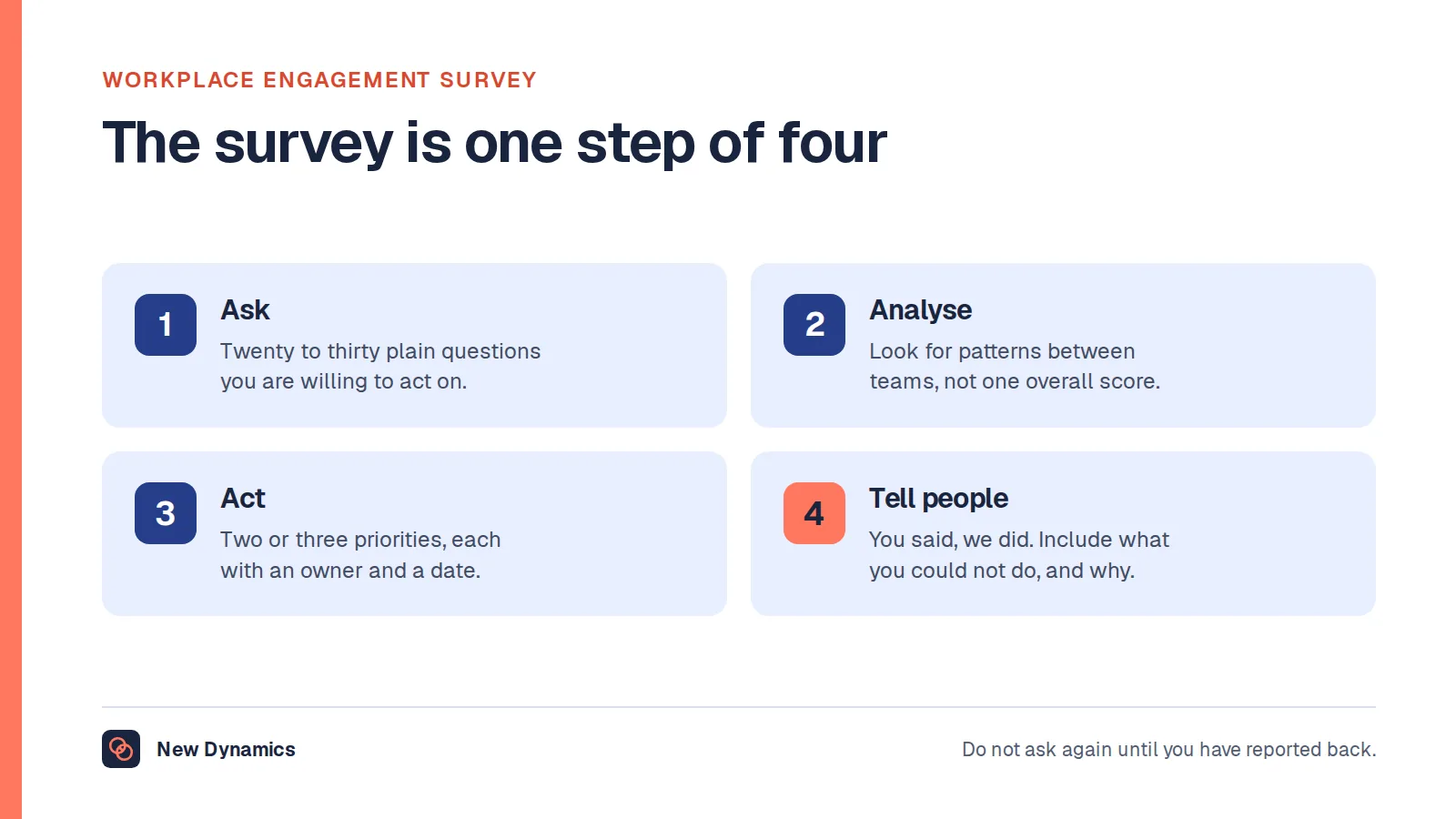
- Look at gaps between groups, as well as overall scores. An overall score of 80% can hide a group at 50%.
- Look at themes. Low scores on voice and on fair promotion call for different actions.
- Read the comments for causes and examples.
- Share the results openly, including the uncomfortable ones, within a few weeks.
- Involve employees in choosing actions. Staff networks and listening groups can help to interpret the findings.
- Choose two or three priorities, each with an owner, a measure and a date. Our performance goals examples show how to word them.
- Hold leaders to account for the actions.
- Report back, and repeat the survey after a year to see what has changed.
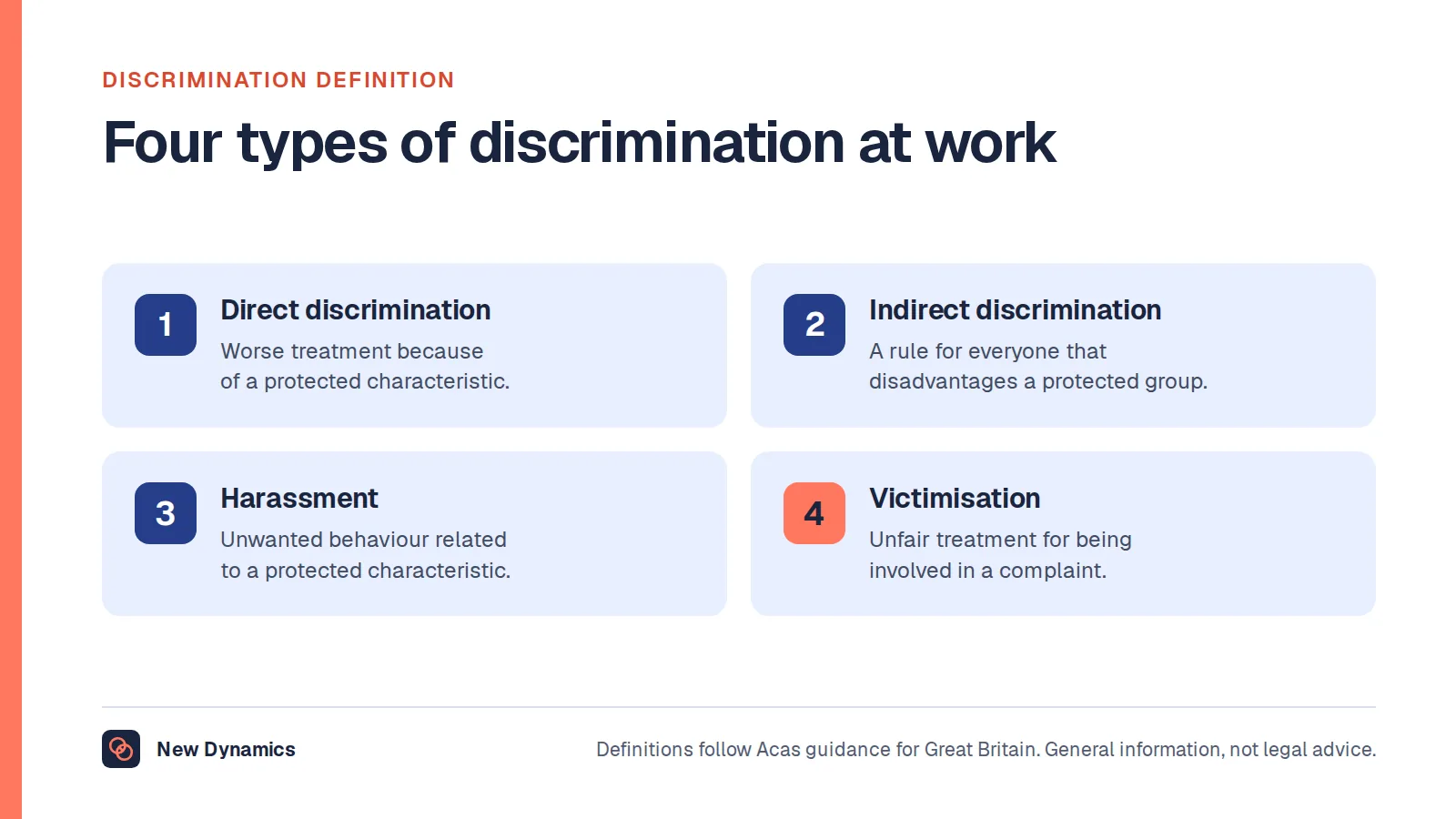
If the survey reveals possible bullying, harassment or discrimination, act through your formal procedures. Our plain guide to the definition of discrimination at work explains the terms.
Common mistakes
Asking and not acting. It teaches people that speaking up is pointless.
A long survey. Forty statements and ten demographic questions will lose people halfway.
Reporting small groups. If a team has one disabled employee, a “disability” result identifies them.
Compulsory demographic questions. They reduce trust, and may breach the law.
Treating the survey as the programme. Measurement is the start.
Only looking at averages. Inclusion problems live in the gaps.
Asking only about feelings. Check the facts as well: who is hired, promoted, paid more and leaves.

Frequently asked questions
What are good inclusion survey questions?
Good questions ask about everyday experience in plain words, such as: I feel that I belong here. I can be myself at work. I feel safe to speak up with a different point of view. Promotion decisions here are fair. My manager makes an effort to include everyone.
What questions should a diversity and inclusion survey include?
Include statements on belonging, respect and fair treatment, voice and safety, opportunity, managers and leaders, and practical support. Add two or three open questions. Optional demographic questions let you compare the experience of different groups.
What is the difference between a diversity survey and an inclusion survey?
A diversity survey asks who works in the organisation, using demographic questions. An inclusion survey asks how people experience working there. Used together, they show whether some groups have a worse experience than others.
Should a diversity survey be anonymous?
Yes. Anonymity encourages honest answers and protects sensitive data. Use a trusted tool, state the minimum group size for any reported result and never report groups small enough for individuals to be identified.
Is it legal to ask employees about ethnicity, disability or sexual orientation?
It depends on the country. In the UK, this is special category data with extra legal protection, so participation must be handled with great care: voluntary, with a clear purpose, secure and limited in access. Take legal advice for each country.
How often should you run an inclusion survey?
Once a year is common for a full survey, with a few inclusion questions in shorter pulse surveys between. Only repeat the survey when you have acted on the last one and told people what changed.
Your next step: plan the response first
- Decide who will own the results, and how you will share them.
- Choose 20 to 25 statements from this list, and two open questions.
- Agree with your data protection lead whether, and how, to ask demographic questions.
- Test the draft with a small, varied group before you launch.
For a wider approach to building an inclusive workplace, read and download our diversity and inclusion guide. The guide is free to read, and the PDF uses our short download form.
Want every employee to be heard regularly, and not only once a year? Book a New Dynamics demo and bring your current listening approach. You can also email contact@new-dynamics.com.