TL;DR
- Employee retention is an organisation's ability to keep its employees over time, and the share of them it keeps over a period. It is the mirror image of turnover: retention counts who stayed, turnover counts who left.
- Other words for it include staff retention, workforce retention, employee stability and, on the other side of the coin, low turnover or low attrition. None of them is a policy; retention is an outcome of pay, management, development, flexibility and fair treatment.
- The retention rate is the number of employees at the start of a period who are still employed at the end, divided by the number at the start. Measure it by team, tenure and reason for leaving to find out what to fix.
“Employee retention” appears in board packs, HR strategies and job adverts for HR directors, usually as something to improve and rarely as something defined. Ask three managers what it means and one will say “keeping good people”, one will quote a percentage and one will describe a bonus scheme. All three are talking about the same thing from different ends.
This article gives the meaning of employee retention, lists the other words and related terms people use, explains how the retention rate is measured and how it differs from turnover and attrition, summarises why people stay or leave, and sets out the practices that improve retention.
Retention is decided in one-to-ones long before it shows in the numbers. See how New Dynamics continuous feedback supports check-ins between managers and their teams.
What does employee retention mean?
The Cambridge Dictionary defines retention as “the continued use, existence, or possession of something or someone”, and the verb retain as “to keep or continue to have something”. Employee retention is the workplace application: an organisation's continued possession of its employees, its ability to keep the people it has hired.
The phrase is used in three ways, and the context usually tells you which.
- An outcome. How many of the people employed at the start of a period are still employed at the end.
- A goal. “Improving employee retention” means reducing the number of people who leave, usually the number who leave by choice.
- A set of practices. “Our retention strategy” means the pay, development, flexibility and management practices intended to keep people.
The CIPD's factsheet on employee turnover and retention connects the three: “By understanding why staff leave an organisation, employers can devise initiatives that reduce turnover and increase employee retention.” The outcome is measured, the reasons are found, and the practices follow.
Other words for employee retention
Searches for “another word for employee retention” usually want either a synonym for the outcome or the name of the opposite measure.
| Term | What it means |
|---|---|
| Staff retention, workforce retention | The same thing; staff is the usual UK word, employee the usual US one |
| Employee stability | Retention seen as a property of the workforce rather than an HR measure |
| Keeping people, holding on to talent | Plain-English versions used in conversation |
| Low turnover | The same outcome, counted from the other side |
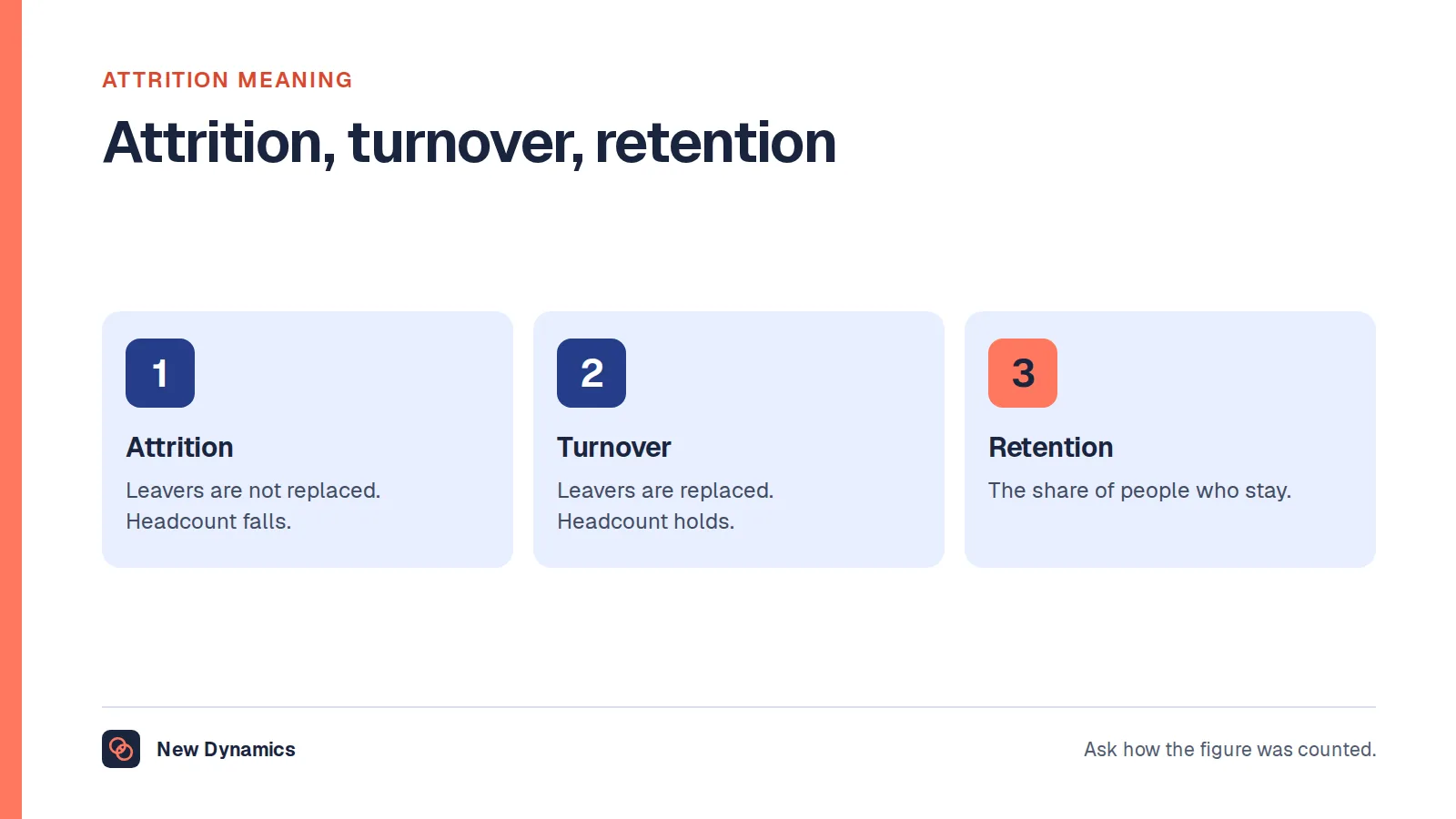
| Low attrition | Turnover where leavers are not replaced; see our guide to the meaning of attrition |
| Tenure | How long individuals stay; high average tenure usually means high retention |
None of these is a policy. A retention strategy is a set of actions; retention itself is what those actions produce.

How employee retention is measured
Retention rate. The share of employees at the start of a period who are still employed at the end of it. Divide the number of those starting employees who remain by the number who started, and multiply by 100. New joiners during the period are excluded from both numbers, which is what distinguishes retention from turnover.
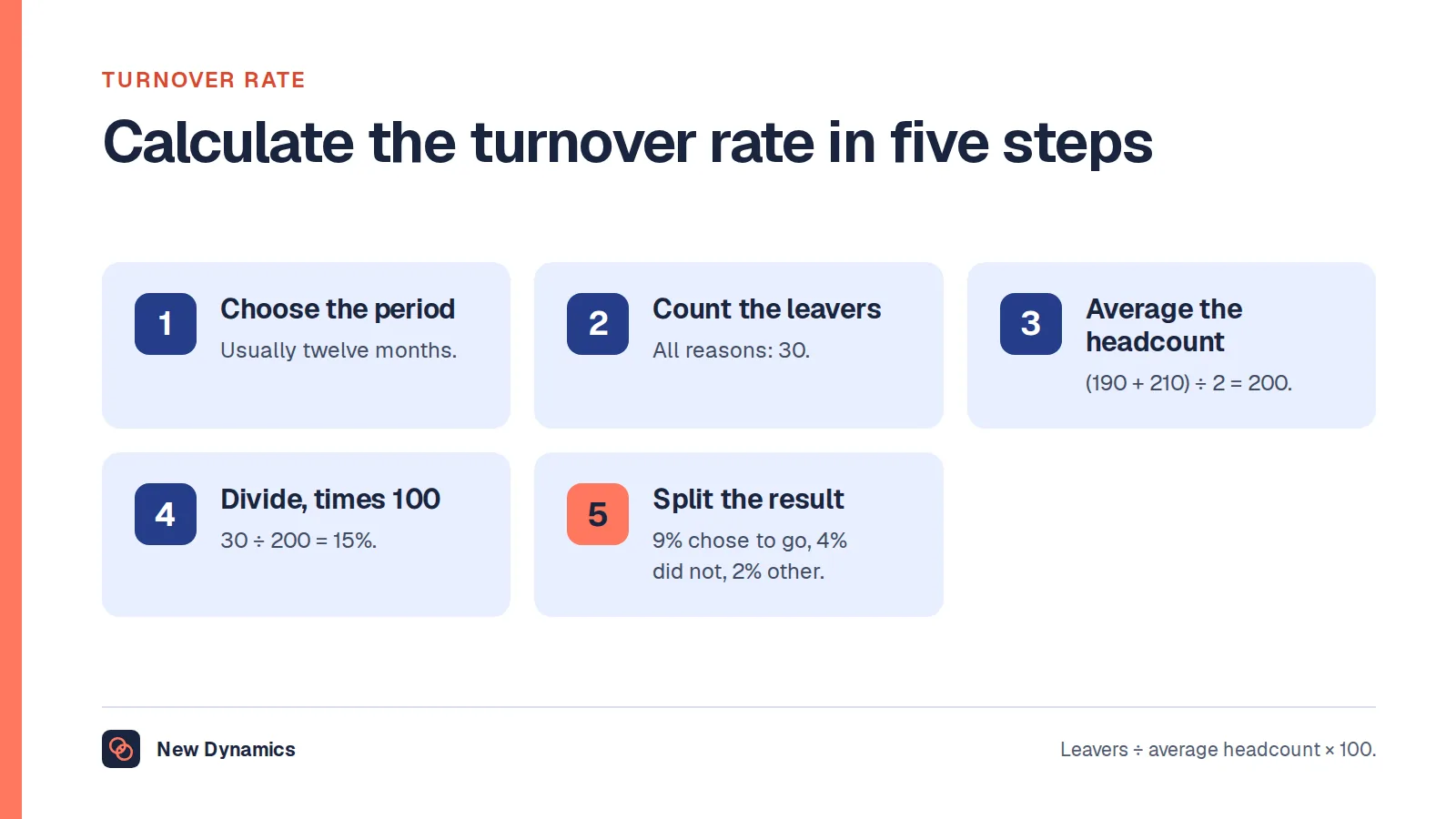
Turnover rate. The number of leavers in a period divided by the average headcount, multiplied by 100. Our guide to the turnover rate explains the calculation and the benchmarks.
The two rates are not simple opposites, because turnover includes people who joined and left within the period while retention ignores them. An organisation can have a high retention rate among its established staff and a high turnover rate driven by new starters leaving in their first year, which is a specific problem with a specific fix.
Three splits make the number useful.
- By team and manager. Retention varies more between managers than between organisations.
- By tenure. First-year retention says something about hiring and onboarding; five-year retention says something about careers.
- By reason for leaving. Voluntary against involuntary, and within voluntary, what people said at their exit interview. Regretted leavers matter more than the total.
Why people stay, and why they leave
The CIPD's factsheet says it “covers why people leave organisations and recommends practices to improve staff retention such as flexibility, fair treatment and employee wellbeing”. The reasons cluster into six.
- Pay and reward, relative to the market and to colleagues.
- The manager. Support, feedback, fairness and whether the person feels seen.
- Development. A visible next step, and learning on the way to it.
- Flexibility and workload. Hours, location and demands that fit a life.
- Fair treatment. Respect, inclusion and how complaints are handled.
- Meaning and fit. Believing the work matters and the organisation's values are real.
Most people leave for a combination, and most of the combination is within the employer's control. Our guide to the meaning of hiring makes the related point that retention starts with whom you hire and what you promise them.

What improves employee retention
- Hire honestly. Adverts that describe the job as it is produce fewer first-year leavers.
- Onboard properly. A clear first ninety days with a named manager and early goals. Our employee onboarding guide sets it out.
- Manage well. Regular one-to-ones, specific feedback and fair reviews. Retention is the manager's job before it is HR's.
- Show the path. Career conversations, development plans and internal moves before people look outside.
- Pay fairly and explain it. A transparent structure retains more than a surprise counter-offer.
- Offer flexibility where the work allows, and say clearly where it does not.
- Act on what people tell you. Engagement surveys, stay conversations and exit interviews that lead to visible change.
Our employee retention guide covers each in depth.
Common mistakes
Treating retention as the goal. Keeping everyone is not the aim; keeping the people you would rehire is.
One number for the whole organisation. The average hides the team that is losing everyone.
Counter-offers as a strategy. They retain the person for a year and teach everyone else how to get a rise.
Perks instead of management. Nobody stays for the fruit bowl if their manager is unfair.
Measuring without asking. The rate tells you that people left; only the conversation tells you why.

Frequently asked questions
What is employee retention?
Employee retention is an organisation's ability to keep its employees over time, measured as the share of people employed at the start of a period who are still employed at the end. It is also used to mean the goal of reducing voluntary leaving and the practices intended to achieve it.
What is another word for employee retention?
Staff retention and workforce retention mean the same thing. Employee stability, keeping people and holding on to talent are plain-English versions. Low turnover and low attrition describe the same outcome counted from the other side.
How do you calculate the employee retention rate?
Take the number of employees at the start of the period who are still employed at the end, divide by the number employed at the start, and multiply by 100. Exclude people who joined during the period. Split the result by team, tenure and reason for leaving.
What is the difference between employee retention and turnover?
Retention counts who stayed among those employed at the start; turnover counts who left as a share of average headcount, including people who joined and left within the period. High turnover with high retention usually means new starters are leaving early.
Why is employee retention important?
Because leaving is expensive and disruptive: recruitment, onboarding, lost knowledge and the effect on the people who remain. The CIPD notes that understanding why staff leave lets employers devise initiatives that reduce turnover and increase retention.
What improves employee retention?
Honest hiring, proper onboarding, good management with regular one-to-ones, visible career paths, fair and transparent pay, flexibility where the work allows and acting on what employees say in surveys, stay conversations and exit interviews.
Your next step
- Calculate your retention rate for the last year, by team and by first-year tenure.
- List the regretted leavers and what they said on the way out.
- Pick the team with the lowest retention and talk to its manager first.
- Choose one of the seven practices to improve this quarter.
For the full method, read and download our employee retention guide. The guide is free to read, and the PDF uses our short download form.
Want one-to-ones, development plans and reviews in one place, so that retention is managed rather than measured? Book a New Dynamics demo and bring your current numbers. You can also email contact@new-dynamics.com.