TL;DR
- An EMT interview is not a clinical exam. The job is prehospital care delivered in someone's kitchen or on a roadside, so the interview has to find out how a person behaves under pressure, inside their scope of practice, with one colleague and no audience.
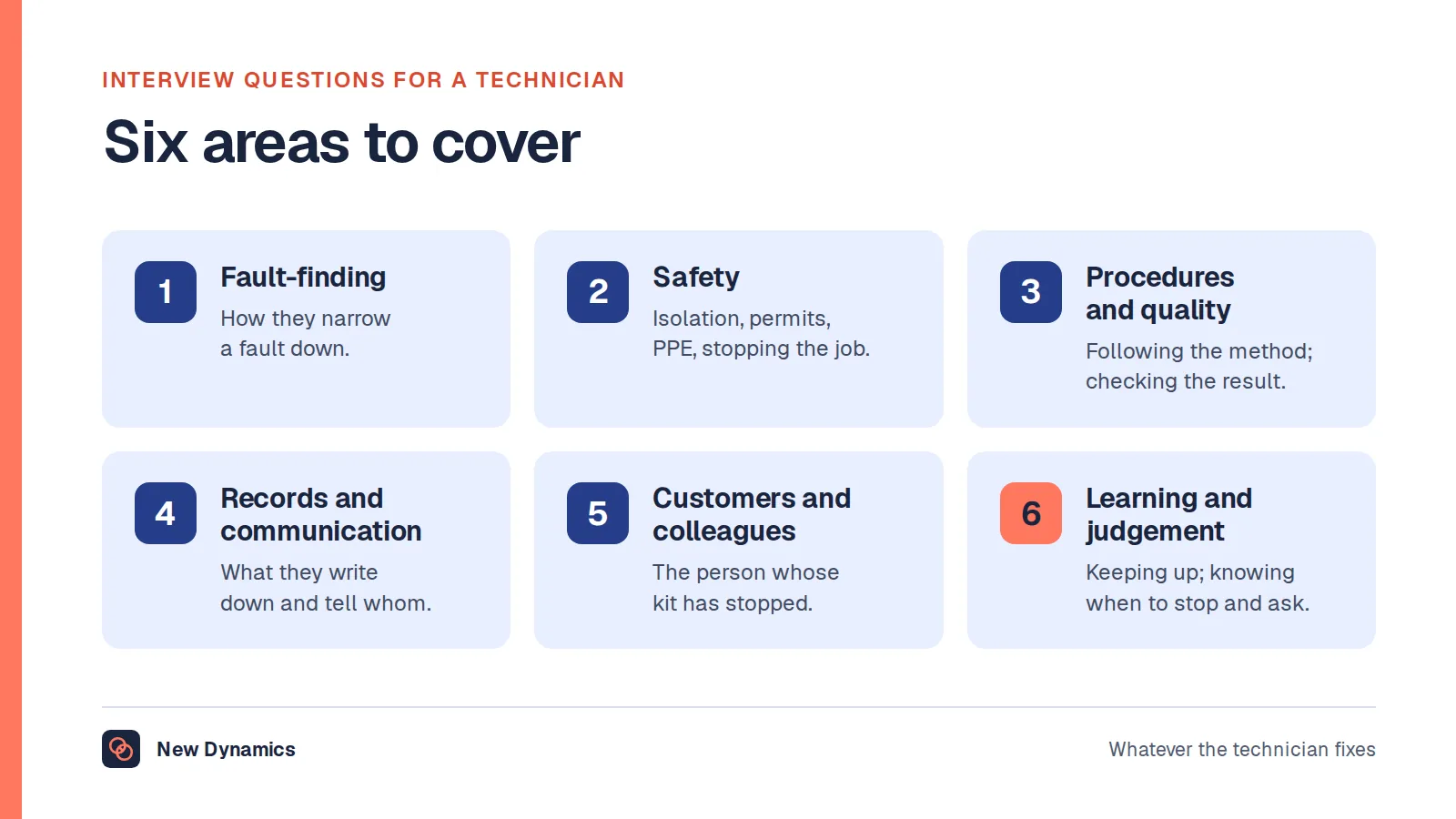
- These twenty-five questions cover six groups: the work itself, judgement within scope, driving and the vehicle, the crew and the handover, the public on a bad day, and what happens after a difficult job. Each comes with what a good answer sounds like.
- Score them consistently, and consider values as well as skills. NHS Employers describes values-based recruitment as an approach “which will help you find people whose personal values match with your organisation”, delivered through pre-screening, values-based interviewing techniques such as role play and scenarios, and assessment centres.
Most EMT interviews spend too long on what a candidate knows and not long enough on how they behave when a job goes wrong at four in the morning with one crew mate and no supervisor.
This article gives twenty-five EMT interview questions in six groups, what a good answer sounds like for each, two scenario exercises, the questions to leave out, and a way to score the answers. It is written for interviewers and candidates rather than as clinical guidance, and it contains no protocol or treatment advice.
A new technician's first weeks decide whether they stay. See how New Dynamics onboarding brings tasks, early goals and manager conversations into one clear path.
EMT, ambulance technician or emergency care assistant?
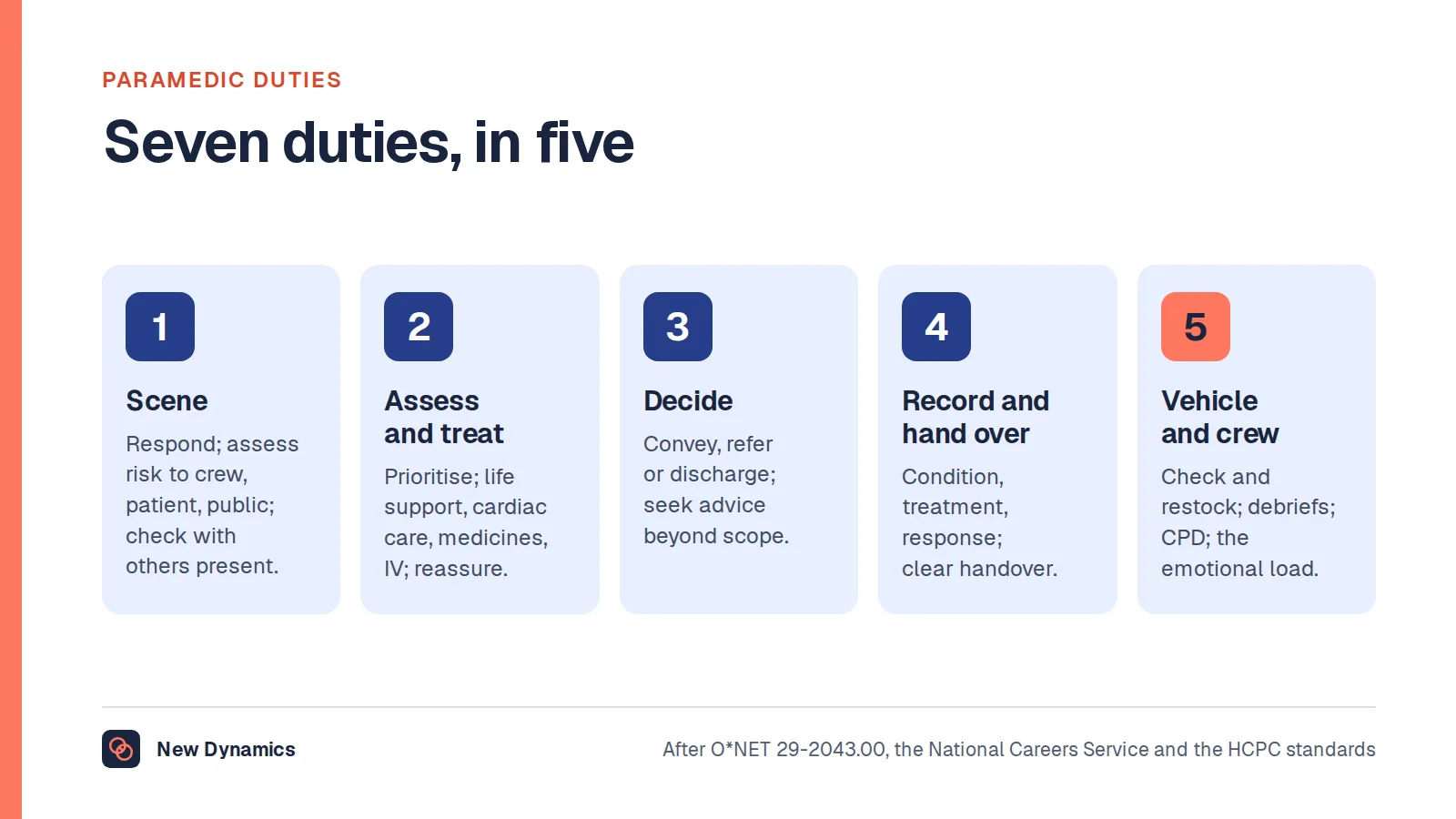
The titles differ by country and by service, and it is worth being precise in the advert. EMT is the US title, defined occupationally by O*NET's Emergency Medical Technicians, who administer "first aid treatment or life support care to sick or injured persons in prehospital settings". In the UK the nearest entry roles are ambulance technician and emergency care assistant: the National Careers Service profile for emergency care assistant lists day-to-day tasks as driving ambulance vehicles, responding "to medical emergencies and accidents", supporting "paramedics to carry out essential emergency care", monitoring "patient health during ambulance journeys", maintaining "radio contact with the control room", completing "a patient handover report at the hospital" and maintaining "stocks of medical supplies and equipment".
The scope of practice differs between those roles and between services, and the interview should be written against your service's scope rather than a generic one. Our paramedic job description covers the registered role above them.
What the interview has to find out

Four things, in this order:
- Behaviour under pressure, because the clinical content can be taught and this largely cannot.
- Judgement inside their scope, including the discipline to escalate rather than improvise.
- How they treat a patient who is frightened, drunk, aggressive, confused or embarrassed.
- Whether they are reliable in a crew, the vehicle checked, the stock replaced, the handover accurate, the paperwork done.
The work itself: four questions
- "Describe a shift from your last role, start to finish." Vague answers are common here from people who have not done the job. Listen for vehicle checks, stock, the radio, handovers and the admin at the end.
- "What did you do before a job started, at the start of a shift and on the way to a call?" O*NET's task list includes maintaining "vehicles and medical and communication equipment, and replenish first aid equipment and supplies", and it is the part candidates forget to mention.
- "What is the least glamorous part of the job, and how do you deal with it?" Cleaning, waiting, queueing at hospital, repeating a handover. Honest answers here predict retention better than enthusiasm does.
- "Why this service, and why this role rather than paramedic training now?" A good answer has a plan in it, not an apology.
Judgement within scope: five questions

- "Tell me about a time you were unsure. What did you do?" Looking for the escalation, the call to control, or the second opinion, not a heroic decision.
- "When did you last call for help earlier than you strictly had to?" A strong candidate treats this as good practice rather than a confession.
- "How do you prioritise when two patients need you?" O*NET's tasks include assessing "nature and extent of illness or injury to establish and prioritize medical procedures". Listen for a method, and for asking for resources.
- "What would you do if a patient refuses to go to hospital?" One of the most revealing questions in the whole interview: capacity, explanation, documentation, advice about what to do if things change, and who they would tell. No clinical detail is needed to hear whether they have thought about it.
- "When have you disagreed with a colleague about a patient?" How they raised it matters more than who was right.
Driving and the vehicle: four questions
- "Tell me about your driving, honestly." Endorsements, blue-light training if any, the vehicles they have driven, and their view of speed. The National Careers Service lists a full driving licence among the requirements for the UK role, with a Category C1 licence possibly needed depending on when the original test was passed.
- "You are running late to a call and the traffic is bad. What do you do?" Listen for lawful, calm and in contact with control.
- "Tell me about a vehicle defect you found. What happened next?" Reporting a defect that takes a vehicle off the road is a test of character, not mechanics.
- "How do you look after the back of the vehicle across a twelve-hour shift?" Stock, cleanliness and decontamination. O*NET lists decontaminating the "ambulance interior following treatment of patient with infectious disease" as a task in its own right.
The crew and the handover: four questions
- "What makes a good crew mate?" Then: "what do you do when you get one who is not?"
- "Talk me through a handover you gave." Structure, brevity, what they lead with, and whether they check it was received. The profile lists completing "a patient handover report at the hospital" as a core task.
- "How do you work with the fire service or police at a scene?" O*NET's tasks include coordinating "work with other emergency medical team members or police or fire department personnel".
- "What do you write down, and when?" Records made at the time rather than remembered at the end of a shift.
The public on a bad day: four questions
- "How do you calm someone who is frightened?" Comforting and reassuring patients is a listed task, and the best answers are specific and unshowy.
- "Tell me about an aggressive patient or bystander." Looking for de-escalation, distance, and calling for help without embarrassment.
- "How do you talk to a family while you are working?" One person to talk to, plain words, no promises.
- "When did you last treat someone whose choices you disagreed with?" The answer should be boring. If it is not, ask more.
After the job: four questions
- "Tell me about a job that stayed with you." Not for the detail, for whether they have a way of processing it.
- "Who do you talk to after a bad shift?" A candidate with nobody is a risk to themselves.
- "How do you take criticism?" The National Careers Service lists "the ability to accept criticism and work well under pressure" among the skills needed, which is unusually direct for a careers profile.
- "What are you doing to keep your skills current?" O*NET lists attending "training classes to maintain certification licensure" as a task. Look for a habit rather than an intention.
Two exercises worth adding
- A scenario, described aloud. Give a short prehospital situation with an awkward, non-clinical complication: a narrow staircase, a hostile relative, a patient who does not want the neighbours to see. Ask what they would do first, second and third, and who they would call. You are marking the sequence and the communication, not the clinical answer.
- A handover role-play. Give a scripted set of facts for two minutes, then ask them to hand over to you in thirty seconds. It is the closest an interview gets to the real job, and it separates candidates immediately.
Both are ours to use. Tell candidates in advance that a scenario and a role-play are coming, and mark every candidate against the same criteria.
The questions to leave out
- Health, disability and fitness questions. A good level of fitness is a genuine requirement for the role, but assess it through the stated requirement and any conditional health check that applies, not by asking about health at interview. Offer adjustments for the interview itself.
- Background checks as interview questions. Enhanced background checks are part of the process for UK ambulance roles; they are a check, not a conversation topic.
- "What would you do if you saw a colleague doing something wrong?" asked as a loyalty test. Ask instead about a time they raised a concern and what happened.
- Clinical trivia outside the scope you are hiring for. It measures recency of revision, not competence.
Scoring: skills and values, marked the same way

NHS Employers describes values-based recruitment as "an approach to recruitment which will help you find people whose personal values match with your organisation", delivered through "pre-screening assessments", "values based interviewing techniques (role play, written responses to scenarios)" and "assessment centre approaches", with a national programme designed to help employers "assess the values and behaviours of candidates, to align with the NHS constitution".
For an ambulance service interview, that means:
- Pick eight questions across the six groups, weighted to the role's scope.
- Agree what a weak, adequate and strong answer sounds like for each, before the first candidate.
- Include one scenario and one handover role-play, marked on the same scale.
- Score independently, then compare, so that the panel's clinician does not decide the non-clinical questions by default.
Our recruitment and selection guide covers building the scoring sheet and keeping essential criteria genuinely essential.
What a good candidate will ask you
Treat these as a positive sign: the crewing model and who they would be paired with, the shift pattern and how overruns are handled, what happens after a serious incident, what the mentoring arrangement is in the first months, and what the route to paramedic training looks like from here. The National Careers Service profile notes that with experience, an emergency care assistant could apply to train as a paramedic, and candidates who ask about it are usually thinking in years rather than months.
Frequently asked questions
What questions are asked in an EMT interview?
Expect questions about a typical shift, vehicle and equipment checks, prioritising between patients, when you escalated or asked for help, a patient refusing hospital, driving and any defect you reported, giving a handover, dealing with an aggressive or frightened person, working with police or fire colleagues, how you cope after a difficult job, and how you keep your skills current.
How do I prepare for an ambulance technician interview?
Prepare three or four real examples you can tell in two minutes each: a job that went wrong, a time you escalated, a difficult handover and a conflict with a colleague. Learn the service's own scope of practice and shift pattern, be honest about your driving, and expect a scenario or a handover role-play.
What is the best EMT interview question?
"What would you do if a patient refuses to go to hospital?" It reaches judgement, communication, documentation and the willingness to involve someone else, without requiring any clinical detail in the answer.
Should an EMT interview include a scenario?
Yes. A short scenario with a non-clinical complication, plus a two-minute handover role-play, tells you far more than another hypothetical question. Tell candidates in advance and mark every one against the same criteria.
Can you ask about fitness or health in an EMT interview?
Treat fitness as a stated requirement of the role and assess health through whatever conditional check applies rather than through interview questions, and offer adjustments for the interview itself. This is general information rather than legal advice; take your own advice on the checks that apply to your service.
What is the difference between an EMT and an emergency care assistant?
Mostly geography and scope. EMT is a US title for prehospital care staff; in the UK the nearest entry roles are ambulance technician and emergency care assistant, who drive ambulance vehicles, respond to emergencies, support paramedics with essential care and monitor patients in transit. What each may do clinically is set by the service and the registration behind it.
Your next step: write the sheet before the first candidate
- Write the questions against your own scope of practice, not a generic list.
- Pick eight, plus one scenario and one handover role-play.
- Agree the rating standards in advance and score independently.
- Keep fitness and health out of the interview and into the right part of the process.
For the scoring sheet, the essential criteria and a defensible process end to end, read and download our recruitment and selection guide. The guide is free to read, and the PDF uses our short download form.
Want a first year that keeps new technicians, objectives, check-ins and mentoring in one place? Book a New Dynamics demo and bring your current induction plan. You can also email contact@new-dynamics.com.