TL;DR
- A registered nurse is a regulated professional who assesses, plans, provides, leads and evaluates nursing care. In the UK, the Nursing and Midwifery Council sets the standards and keeps the register.
- The NMC groups what every registered nurse must know and do under seven platforms. This article turns them into six duties for a job description, and adds the five details that every nursing post should state.
- A good job description names the field of practice, the setting, the patient group, the band and the support for development, including revalidation every three years.
Most job descriptions describe what an employer wants. A registered nurse's job description also has to fit what a regulator requires, because a nurse answers to a professional code as well as to a manager. A description that ignores this asks people to choose between the two, and good nurses will not apply.
This article gives a registered nurse job description: what the title means, the four fields of practice, the standards that define the role in the UK, six duties, five details that every nursing post should state and a template. It is written for the UK, with a note on the American RN.
Newly registered nurses need structure in their first months. See how New Dynamics onboarding brings tasks, early goals and manager conversations into a clear path for a new starter.
What is a registered nurse?
A registered nurse is a nurse whose name is on a statutory register, which means that they have completed approved education and met the regulator's standards. The Cambridge Dictionary defines a registered nurse, abbreviated R.N., as, in the US and Canada, “a nurse who has formally trained and passed an exam and is officially qualified to perform all nursing duties”.
In the UK, the regulator is the Nursing and Midwifery Council (NMC). Skills England's registered nurse degree standard explains: “Registered nurses are a statutorily regulated profession and the standards for proficiency are set by the Nursing and Midwifery Council (NMC)”.
The same standard sums up the purpose of the occupation. It is “to play a vital role in providing, leading, coordinating and evaluating care that is compassionate, evidence based, and person centred”. It adds that registered nurses “are accountable for their own actions and those who they delegate to and must be able to work autonomously, or as an equal partner with a range of other professionals”.
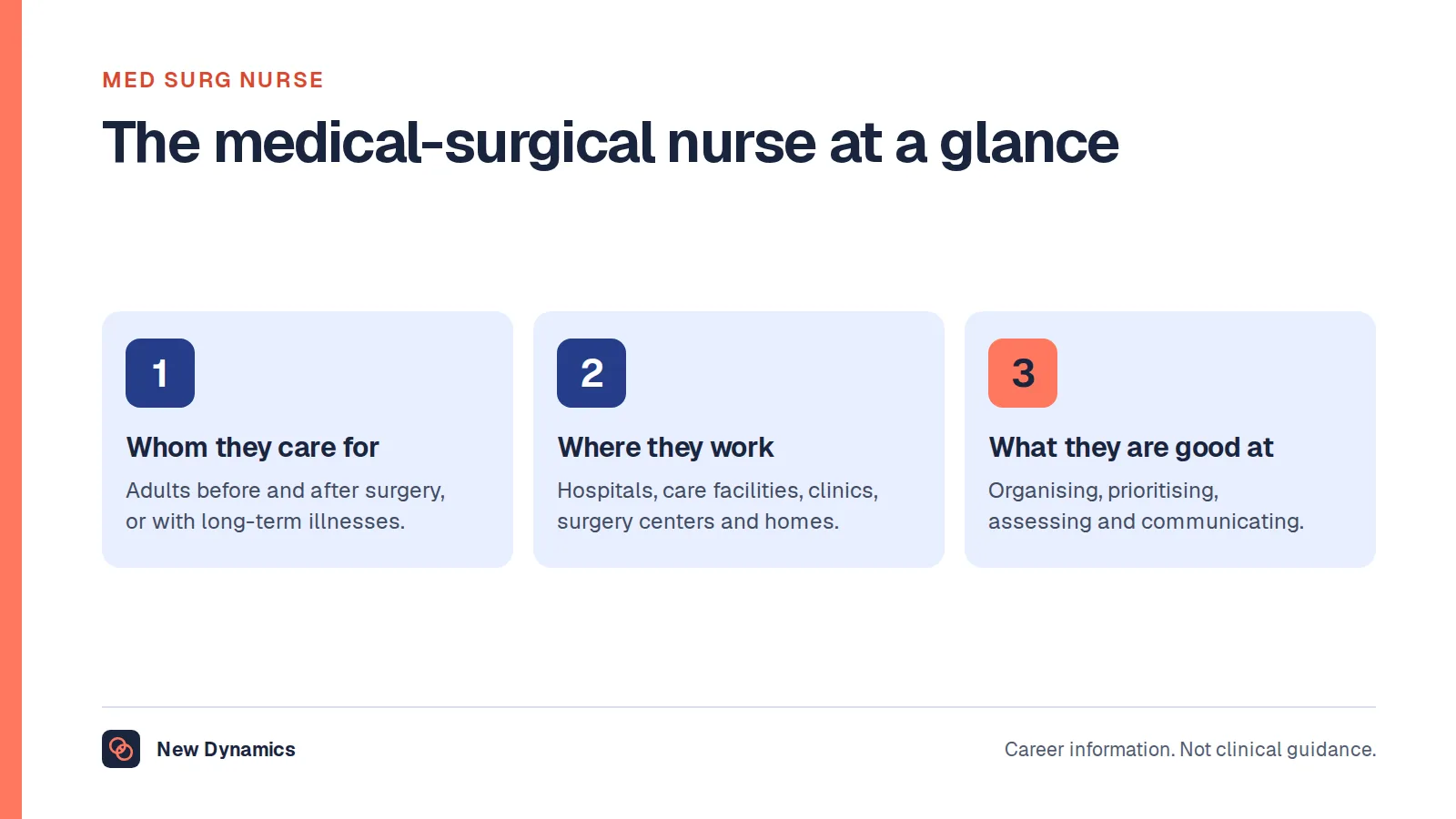
In the United States, RNs are licensed by state boards of nursing. The duties described below apply broadly, but the rules on licensing and scope of practice differ, so check the state's requirements. For one American hospital specialty, see our guide to the med surg nurse.
Four fields of practice
In the UK, a nurse registers in one or more of four fields. Skills England lists them as typical job titles.
- Adult nursing.
- Children's nursing.
- Learning disability nursing.
- Mental health nursing.
A job description should say which field the post requires. Settings vary just as widely. Skills England notes that a registered nurse “might be working in a hospital, someone's home, the community, social care or public health”, often on shift patterns that provide care 24 hours a day.

The NMC's seven platforms
The NMC's standards of proficiency for registered nurses set out, in its words, “the skills, knowledge and attributes all nurses must demonstrate”. They are grouped under seven platforms:
- Being an accountable professional
- Promoting health and preventing ill health
- Assessing needs and planning care
- Providing and evaluating care
- Leading and managing nursing care and working in teams
- Improving safety and quality of care
- Coordinating care
The NMC says that the platforms “reflect what the public can expect nurses to know and be able to do in order to deliver safe, compassionate and effective nursing care”.
Beside the standards sits the Code, which the NMC describes as “the professional standards that nurses, midwives and nursing associates must uphold in order to be registered to practise in the UK”. It is structured around four themes: “prioritise people, practise effectively, preserve safety and promote professionalism and trust”.
An employer does not need to copy these documents into a job description. It does need to write nothing that conflicts with them.
Registered nurse duties: six for a job description
These six follow the seven platforms, with the two that concern leadership and coordination combined.
- Practise accountably. Work within the Code, keep accurate records, protect confidentiality, raise concerns and recognise the limits of your own competence.
- Promote health. Support people to understand and manage their own health, and contribute to the prevention of ill health.
- Assess and plan care. Assess nursing needs, identify priorities and plan person-centred, evidence-based care with the patient and the family.
- Provide and evaluate care. Deliver safe and compassionate nursing care, including the safe administration of medicines, monitor its effect and adjust the plan.
- Lead and coordinate. Manage the care of a group of patients, delegate to and supervise healthcare assistants, nursing associates and students, and coordinate with doctors, therapists, social care and other agencies.
- Improve safety and quality. Assess and manage risks, report incidents, take part in audit and contribute to improvement.
On delegation, Skills England's wording is worth keeping in mind: registered nurses “may have responsibility for delegating work to other members of the nursing team and take accountability for the delegated activity”.

Five details that every nursing job description should state
- Field and registration. The part of the NMC register that the post requires, and any further qualification, such as prescribing.
- Setting and pattern. Ward, clinic, community or care home, and the shift pattern, including nights, weekends and on-call.
- Patient group and caseload. Who the nurse will care for, and the typical number of patients or the size of the caseload.
- Band and accountability. The pay band or grade, the line manager, and whom the post holder supervises.
- Support and development. Preceptorship for newly registered nurses, clinical supervision, study leave and support for revalidation.
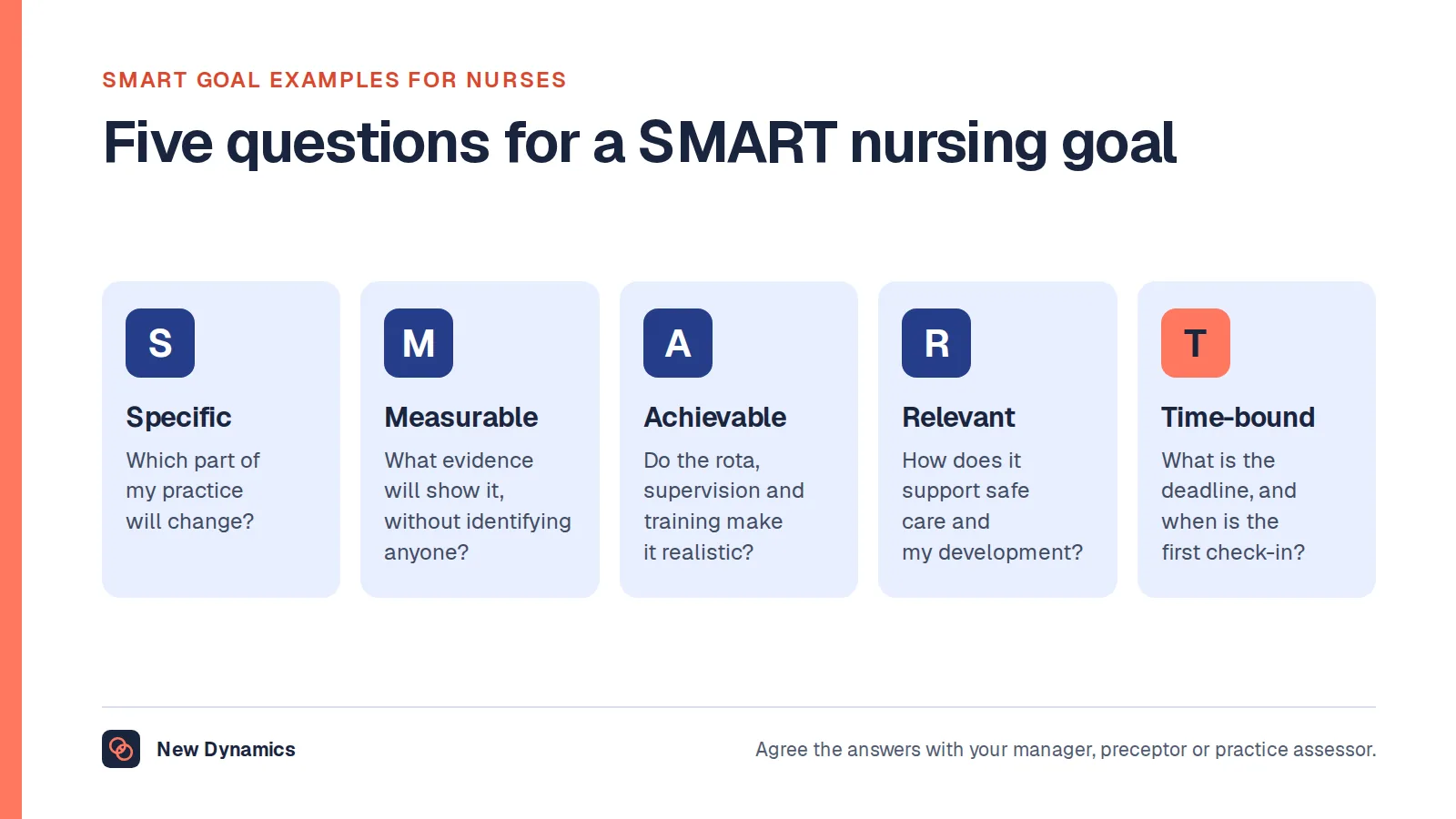
Revalidation deserves its own line. The NMC's guide to what revalidation is explains that it is the process that nurses “need to follow to maintain their registration with the NMC”, and that “we ask you to revalidate every three years”. It requires evidence of practice hours, professional development, feedback and reflection. An employer that gives time and a confirmer for this will keep its nurses. For goals that support it, see our SMART goal examples for nurses.

Registered nurse job description template
Adapt the wording to your service. Replace the text in square brackets.
Job title: Registered nurse ([adult, child, learning disability or mental health])
Band or grade: [Band]
Reports to: [Ward manager, team leader or clinical lead]
Location and hours: [Unit or base]. [Hours per week]. Shifts include [days, nights, weekends, bank holidays].
Purpose of the job: To assess, plan, deliver and evaluate safe, compassionate, evidence-based nursing care for [patient group], as an accountable member of the multi-disciplinary team.
Main duties
- Practise in line with the NMC Code and the organisation's policies, and keep accurate and timely records.
- Assess patients' needs, and plan and review care with patients, families and carers.
- Deliver nursing care and treatment, including the safe administration of medicines.
- Monitor patients' condition, recognise deterioration and escalate promptly.
- Take charge of a group of patients or a shift when required, and delegate to and supervise support staff and students.
- Work with medical, therapy, social care and other colleagues to coordinate care, discharge and referral.
- Promote health, and give patients and carers the information that they need to manage their care.
- Report incidents and concerns, follow infection control and safeguarding procedures, and take part in audit and improvement.
Essential requirements
- Current registration with the NMC in the [field] part of the register.
- [Experience required, or “newly registered nurses are welcome, with preceptorship”.]
- Clear, compassionate communication with patients, families and colleagues.
- The ability to prioritise and to stay calm under pressure.
- A commitment to continuing professional development and revalidation.
Desirable
- Experience in [specialty].
- A mentorship, assessor or prescribing qualification.
Conditions: [Pay], [holiday], [pension], [preceptorship, supervision and study leave].
For the general format, see our sample job description.
Common mistakes
A generic description for every ward. A community mental health post and a surgical ward post share a register and little else.
Duties that conflict with the Code. Nothing in the document should press a nurse to work beyond their competence or to stay silent about a concern.
Vague accountability. Say who the nurse reports to, and whom they supervise.
Hiding the shift pattern. Nights and weekends belong in the first paragraph.
Forgetting development. Preceptorship, supervision and time for revalidation are reasons to choose one employer over another.
Shutting out newly registered nurses by habit. If the post can be supported, say that they are welcome.
Frequently asked questions
What is the job description of a registered nurse?
A registered nurse assesses patients' needs, plans and delivers nursing care, administers medicines, monitors and evaluates care, leads and supervises support staff, coordinates with other professionals and works to improve safety and quality, all within the regulator's professional standards.
What are the main duties of a registered nurse?
The six main duties are to practise accountably, promote health, assess and plan care, provide and evaluate care, lead and coordinate the care team, and improve safety and quality. They follow the seven platforms in the NMC's standards of proficiency.
What is the difference between a registered nurse and a nursing associate?
Both are regulated by the NMC in the UK. A registered nurse is accountable for assessing, planning and evaluating care, and leads and delegates. A nursing associate, a role in England, supports registered nurses in delivering care.
What are the four fields of nursing?
In the UK they are adult nursing, children's nursing, learning disability nursing and mental health nursing. A nurse registers with the NMC in one or more of these fields, and a job description should say which one the post requires.
How often must a registered nurse revalidate?
The NMC asks nurses to revalidate every three years to maintain their registration. The process requires evidence of practice hours, continuing professional development, feedback and reflection on the Code.
Is an RN in the United States the same as a registered nurse in the UK?
The role is similar, but regulation differs. In the US, registered nurses are licensed by state boards of nursing. In the UK, they are registered with the NMC. Qualifications do not transfer automatically between the two.
Your next step
If you are hiring, copy the template, state the five details and ask a nurse in the team to check the duties against a real week. If you are applying, compare the description with the Code before you accept.
For the whole hiring process, from the job description to the offer, read and download our recruitment and selection guide. The guide is free to read, and the PDF uses our short download form.
Want preceptorship, goals and regular feedback in one place for every new nurse? Book a New Dynamics demo and bring your current approach. You can also email contact@new-dynamics.com.