TL;DR
- A paramedic is a registered healthcare professional who responds to emergency and urgent calls, assesses the patient, gives treatment at the scene and on the way to hospital, and decides whether the patient needs to go at all. O*NET's tasks for paramedics include assessing the nature and extent of illness or injury to prioritise procedures, performing emergency cardiac care, administering drugs and intravenous procedures, coordinating with other emergency services, and observing, recording and reporting the patient's condition and treatment.
- The duties fall into seven groups: response and scene assessment, clinical assessment and treatment, decisions about conveyance and referral, working with other services, records and handover, equipment and vehicle, and self-care and the crew. In the UK the paramedic is distinguished from the emergency medical technician, who supports the paramedic and works to a narrower scope, and from the emergency care practitioner or specialist paramedic, who has trained further; the National Careers Service gives those as the progression routes after two years' experience.
- In the UK a paramedic must hold a degree approved by the Health and Care Professions Council, or complete the level 6 degree apprenticeship, and register with the HCPC, whose standards of proficiency include practising within scope, managing the emotional burden of a pressured environment and working safely in unpredictable settings. The advert should list the registration, the driving licence, the enhanced checks and the medical in the person specification, and say how the service supports debriefs, continuing professional development and wellbeing.
A paramedic's shift is a series of decisions made quickly with incomplete information, in someone's kitchen, at a roadside or in the back of a moving vehicle. The job description of a paramedic has to describe that: the clinical skill, the judgement about whether a patient needs hospital, the coordination with police and fire crews, the records, the vehicle and the toll the work takes. Most adverts copy the service's standard wording and leave out the parts that decide whether a paramedic applies and stays.
This article sets out the duties of a paramedic using three primary sources, the US O*NET occupational database, the UK National Careers Service and the Health and Care Professions Council's standards of proficiency, groups the work into seven duties, separates the paramedic from the emergency medical technician and the emergency care practitioner, lists the registration, licence and checks that belong in the person specification, and gives a job description template with objectives for the appraisal. It is general information about the role, not clinical guidance; the clinical scope is set by the regulator and the employing service.
Paramedics are appraised on work that nobody in the office sees. See how New Dynamics continuous feedback supports the debriefs and check-ins between a paramedic and their team leader that a once-a-year appraisal cannot.
Hiring below the registered role? Our EMT interview questions cover twenty-five questions for ambulance technician and emergency care assistant interviews, and how to score them.
What does a paramedic do?
A paramedic responds to emergency and urgent calls, assesses the patient, treats at the scene and in transit, decides whether the patient needs hospital or can be treated, referred or discharged, and hands over with an accurate record. In the UK the title is protected: only someone registered with the HCPC may use it.
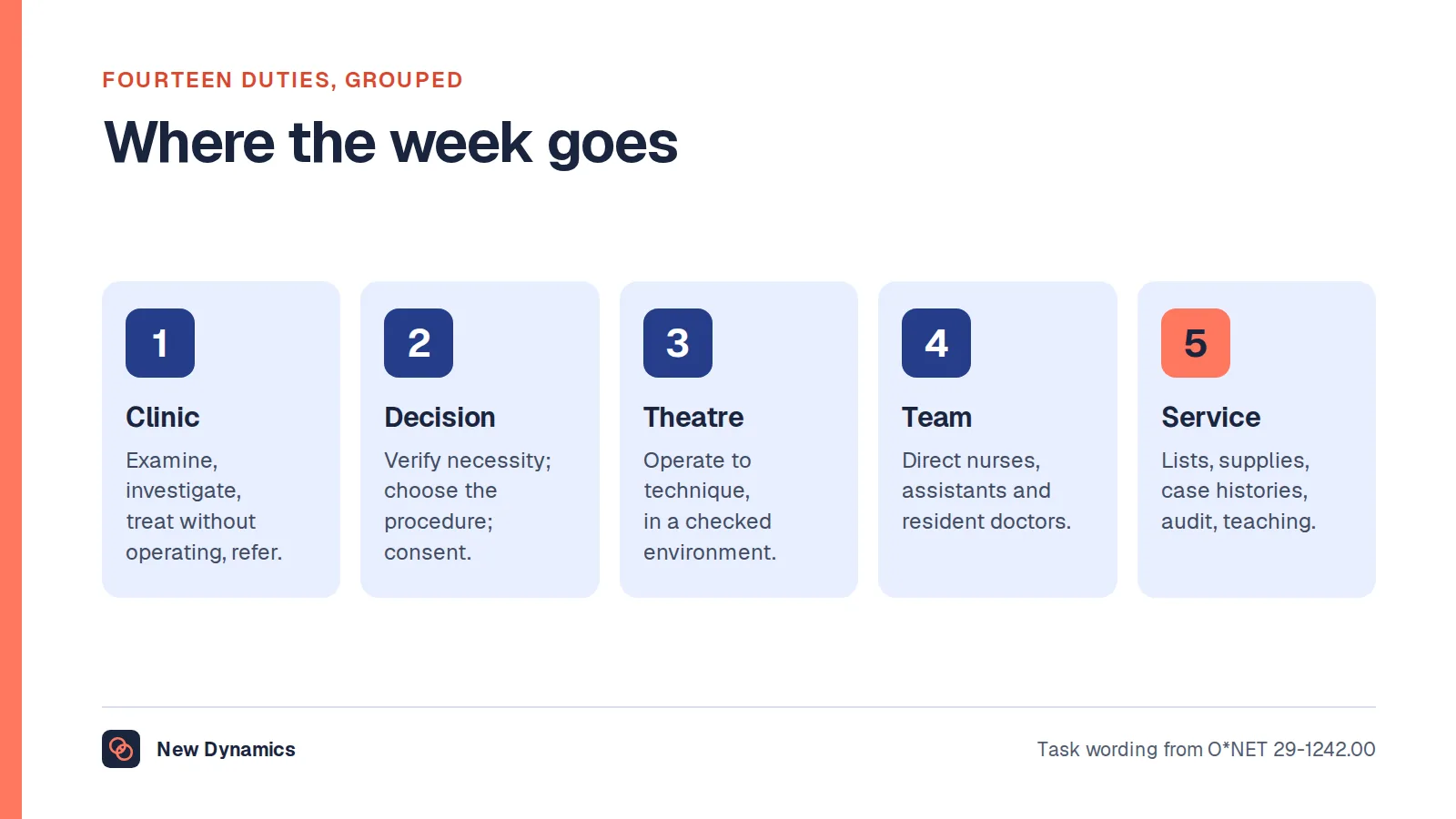
O*NET lists fourteen tasks for paramedics, including “assess nature and extent of illness or injury to establish and prioritize medical procedures”, “administer first aid treatment or life support care to sick or injured persons in prehospital settings”, “perform emergency cardiac care, such as cardioversion and manual defibrillation”, “administer drugs, orally or by injection, or perform intravenous procedures”, “coordinate work with other emergency medical team members or police or fire department personnel”, “observe, record, and report to physician the patient's condition or injury, the treatment provided, and reactions to drugs or treatment”, “comfort and reassure patients”, and “lift and move patients using assistive devices, such as stretchers and stairchairs”.
The National Careers Service describes the ambulance paramedic's day: respond to emergency calls; assess situations on arrival and check details with others at the scene, like the police; work calmly and quickly to stabilise patients; use a defibrillator; give medicines and injections; help to deliver babies; attend non-emergency calls and decide whether patients need to go to hospital; check equipment regularly and keep accurate records; and reassure family and members of the public at the scene.
Paramedic duties: seven responsibilities
Grouped from the O*NET tasks, the National Careers Service profile and the HCPC standards of proficiency, the work has seven parts.
- Response and scene assessment. Respond to emergency and urgent calls; on arrival, assess the scene for risk to the crew, the patient and the public; check details with those present, including other services; the HCPC standard is to “work safely in challenging and unpredictable environments, including taking appropriate action to assess and manage risks”.
- Clinical assessment and treatment. Assess the nature and extent of illness or injury; prioritise; give first aid, life support and advanced interventions within scope, from defibrillation and cardiac care to drugs, injections and intravenous procedures; comfort and reassure the patient.
- Conveyance and referral decisions. Decide whether the patient needs hospital, which hospital, and how urgently; or treat at the scene and refer to a GP, community service or urgent care; or discharge with advice. The National Careers Service lists deciding whether patients need to go to hospital as a day-to-day task; the HCPC standard is to “identify the limits of their practice and when to seek advice or refer to another professional or service”.
- Working with other services. Coordinate with the crew, control room, other ambulance staff, police, fire and hospital teams; on major incidents, work within the command structure.
- Records and handover. Observe, record and report the patient's condition, the treatment given and the response; hand over clearly at the hospital or to the next service; complete the patient record accurately and on time.
- Equipment and vehicle. Check and restock the vehicle and equipment at the start of the shift and after each call; report faults; drive to the standard the service requires.
- Self-care and the crew. Manage the physical and emotional load; take part in debriefs; support colleagues; keep skills and knowledge up to date through continuing professional development. The HCPC standard is to “recognise the need to manage their own workload and resources safely and effectively, including managing the emotional burden that comes with working in a pressured environment”.

Paramedic vs emergency medical technician vs emergency care practitioner
| Role | Scope | In the UK |
|---|---|---|
| Emergency medical technician | Supports the paramedic; treats within a narrower scope | Not a protected title; trained by the service or a college |
| Paramedic | Independent clinical assessment, treatment and decisions | Protected title; HCPC-approved degree and HCPC registration |
| Emergency care practitioner or specialist paramedic | Extended assessment and treatment, often in the community | The National Careers Service's progression route after two years' experience and extra training |
The National Careers Service gives the progression routes as team leader, specialist paramedic or emergency care practitioner, then operations management, education and training, or another area of healthcare such as nursing. Say in the advert which role is being recruited and which route the service supports. Titles and scope differ by country; in the United States O*NET places paramedics in Job Zone three, medium preparation, while UK registration requires a degree.

Skills, environment and demands
The National Careers Service lists knowledge of healthcare and medicine, sensitivity and understanding, customer service skills, patience and the ability to remain calm in stressful situations, excellent verbal communication, knowledge of public safety and security, flexibility, the ability to work well with others, and competence with computers. The HCPC standards add the ability to “use a range of integrated skills and self-awareness to manage clinical challenges independently and effectively in unfamiliar and unpredictable circumstances”.
For the advert, add:
- Judgement under pressure, especially the decision not to convey.
- Communication with frightened people: patients, families and bystanders, in plain words.
- Physical capability. Lifting and moving patients, working outdoors, long shifts.
- Resilience with support. The HCPC standard names the emotional burden; the service should name the support.
Environment. The National Careers Service describes work on an ambulance, at a patient's home or in the community, physically and emotionally demanding, outdoors some of the time, in protective clothing and uniform. Shifts cover nights, weekends and public holidays. State the rota.
Registration, qualifications and checks
Qualifications and registration in the UK. A paramedic science degree approved by the HCPC, usually three years full time, or the paramedic level 6 degree apprenticeship, also three years, followed by registration with the HCPC. The HCPC standards of proficiency are “the threshold standards we consider necessary to protect members of the public”; professionals must meet all of them to register and the ones relevant to their scope of practice to stay registered.
Checks. The National Careers Service lists enhanced background checks, because paramedics may work with children and vulnerable adults, and a medical check. Many ambulance services expect a full driving licence by the end of training and preferably a C1 licence for medium-sized vehicles.
Continuing professional development. O*NET's tasks include attending training to maintain licensure and keep abreast of developments; the HCPC standard is to keep skills and knowledge up to date throughout the career. State what the service provides.
Paramedic job description template
Job title: Paramedic (state Newly Qualified Paramedic, Specialist Paramedic or Emergency Care Practitioner where that is the post)
Reports to: Team Leader or Clinical Team Leader; professionally accountable to the HCPC
Scope: State the station or area, the vehicle types, the rota pattern, and whether the post is emergency, urgent care or a mix.
Purpose: Provide safe, effective assessment, treatment and decisions for patients in emergency and urgent situations, within your scope of practice and the service's clinical guidance, and hand over with an accurate record.
Responsibilities:
- Respond to emergency and urgent calls; assess and manage risk at the scene; work with other services present.
- Assess the patient's condition; provide treatment within scope, including life support, cardiac care, medicines and intravenous procedures.
- Decide on conveyance, referral or discharge; seek advice or refer where the situation is beyond your scope.
- Communicate clearly with patients, families and the public; comfort and reassure.
- Record observations, treatment and response accurately; hand over to hospital or community teams.
- Check, restock and report faults on the vehicle and equipment; drive to the service's standard.
- Take part in debriefs, clinical supervision and continuing professional development; support colleagues; maintain registration.
Person specification:
- HCPC registration as a paramedic, or eligibility on completion of an approved degree or apprenticeship.
- Full driving licence; C1 category, or willingness to obtain it, where the service requires.
- Enhanced background check and a satisfactory medical.
- Calm, clear communication under pressure; sound clinical judgement; physical fitness for the role.
- Commitment to continuing professional development and to the HCPC standards of conduct, performance and ethics.
Working pattern: State the shift pattern, nights, weekends and public holidays, and the rest arrangements.
Support and progression: State the preceptorship or induction for newly qualified paramedics, the clinical supervision, the wellbeing and debrief arrangements, and the routes to team leader, specialist paramedic and emergency care practitioner.
Objectives for the appraisal
Response times are the service's measure, not the paramedic's. Set objectives the individual can influence:
- Clinical practice. Cases reviewed in supervision; feedback from audits of records and handovers acted on.
- Registration and development. CPD recorded and registration maintained; one agreed development area each year.
- Team. Contribution to debriefs, mentoring of students and new starters, and the crew's safety.
- Wellbeing. Rest, support used when needed, and a conversation about the load, recorded as an objective rather than left to chance.

Frequently asked questions
What does a paramedic do?
Responds to emergency and urgent calls, assesses the scene and the patient, gives treatment within scope from first aid to advanced life support and medicines, decides whether the patient needs hospital or can be treated, referred or discharged, works with other emergency services, and records and hands over the patient's condition and treatment. The US occupational database lists assessing illness or injury to prioritise procedures, performing emergency cardiac care and administering drugs among the tasks.
What is the difference between a paramedic and an EMT?
In the UK the paramedic is a registered professional with a protected title, an approved degree and an independent scope of clinical practice; the emergency medical technician supports the paramedic and works to a narrower scope, trained by the service or a college. Titles and scope differ by country.
What qualifications do you need to be a paramedic in the UK?
A paramedic science degree approved by the Health and Care Professions Council, or the paramedic level 6 degree apprenticeship, then registration with the HCPC. The National Careers Service adds enhanced background checks, a medical check and, for most ambulance services, a full driving licence with C1 category.
What skills does a paramedic need?
Knowledge of healthcare and medicine, calm under pressure, excellent verbal communication, sensitivity, flexibility and teamwork, in the National Careers Service's list, plus the judgement to decide when not to convey and when to refer, the physical capability for lifting and long shifts, and the self-awareness to manage the emotional load, which the HCPC standards name.
How is a paramedic's performance appraised?
Through clinical supervision and record audits, evidence of continuing professional development and maintained registration, contribution to the team and to students, and an honest conversation about wellbeing. Response times belong to the service; the appraisal should measure what the individual can influence.
Your next step: put the support in the advert
- State the post, the station, the vehicles and the rota.
- List registration, licence, checks and medical in the person specification.
- Describe the preceptorship, supervision, debrief and wellbeing arrangements.
- Set objectives for practice, development, team and wellbeing, and review them in regular check-ins.
For a way to give feedback on competencies that nobody in the office sees, read and download our competency feedback guide. The guide is free to read, and the PDF uses our short download form.
Want check-ins, CPD records and appraisals for clinical staff in one place, without chasing forms at the end of the year? Book a New Dynamics demo and bring your current appraisal form. You can also email contact@new-dynamics.com.