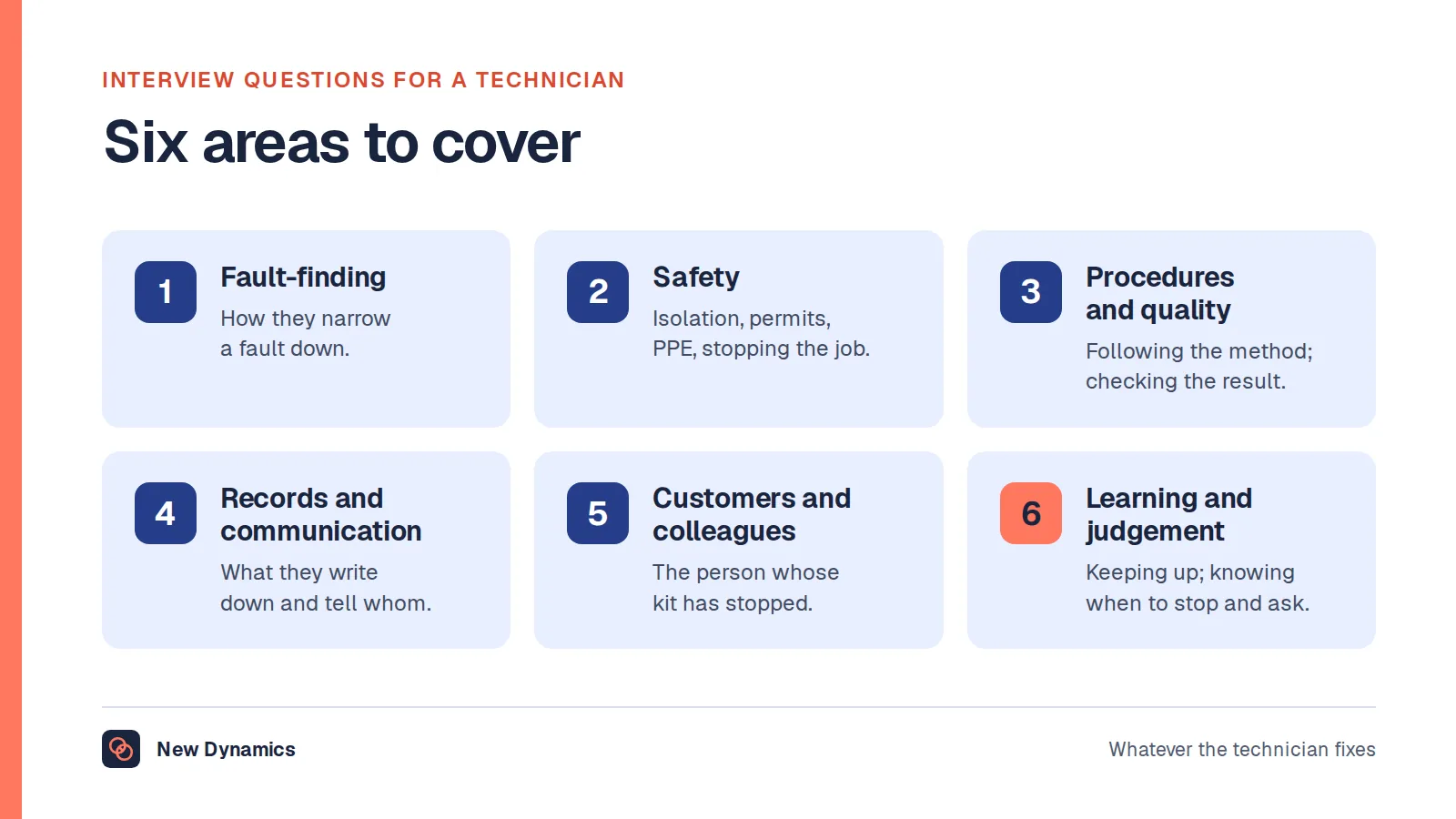
TL;DR
- An engineering technician applies established engineering techniques and procedures to practical problems, usually under the direction of engineering staff. The Engineering Council's definition of the UK registered title is exactly that: technicians “apply proven techniques and procedures to the solution of practical engineering problems”.
- Every discipline has one. O*NET describes mechanical technicians as applying theory and principles of mechanical engineering “to modify, develop, test, or adjust machinery and equipment under direction of engineering staff”, and electrical and electronic technicians as working “usually under the direction of engineering staff” to design, build, repair, adjust and modify components, circuitry, controls and machinery.
- The phrase that defines the role also causes most of the confusion. Direction settles who holds design responsibility. It does not mean the work is simple, closely supervised, or done without judgement, and in the UK the EngTech title exists precisely to recognise that.
Ask three people in an engineering business what separates a technician from an engineer and you will get three answers: the qualification, the pay grade, and whose name goes on the drawing. Only the third one is about the work.
This article explains what an engineering technician is: the phrase that defines the role, eight duties, how the neighbouring titles differ, the UK's EngTech registered title, the routes in and a job description template.
Technicians build the evidence for their own progression a job at a time, and it is usually lost by the time anyone needs it. See how New Dynamics performance reviews keep that record in one place.
The short answer
An engineering technician applies established engineering techniques and procedures to practical problems, normally within a framework set by engineers. The Engineering Council, which holds the UK register, defines the title plainly: Engineering Technicians (EngTech) "apply proven techniques and procedures to the solution of practical engineering problems".
Two words in that sentence do the work. Proven means the method already exists; devising a new one is engineering. Practical means the problem is real and in front of you, not modelled.
The phrase that defines the job
Occupational descriptions of technicians nearly all contain the same clause. O*NET's Mechanical Engineering Technologists and Technicians apply theory and principles of mechanical engineering "to modify, develop, test, or adjust machinery and equipment under direction of engineering staff or physical scientists". Its Electrical and Electronic Engineering Technologists and Technicians apply electrical and electronic theory "usually under the direction of engineering staff, to design, build, repair, adjust, and modify electrical components, circuitry, controls, and machinery for subsequent evaluation and use by engineering staff in making engineering design decisions".
"Under the direction of engineering staff" is widely misread. What it settles:
- Who carries design responsibility for the outcome, and whose approval a change needs.
- Who sets the specification the work is measured against.
What it does not mean:
- That the work is simple. Calibrating an instrument, finding an intermittent fault or getting a test rig to behave is not junior work.
- That somebody is watching. Most technicians work alone for most of the day.
- That no judgement is involved. Deciding a reading is wrong before anyone else notices is the whole value of the role.
Technician, technologist, engineer, craftsperson

- Craftsperson. Makes or installs to a specification with a high level of manual skill, welding, machining, fitting, wiring. The overlap with technician work is real and the boundary is local.
- Engineering technician. Applies proven techniques and procedures to practical problems: testing, fault-finding, commissioning, maintaining, measuring, recording. Holds technical responsibility for the work, within a framework set by others.
- Engineering technologist. Works closer to the design and development end, applying engineering theory to development and implementation. O*NET groups technologists and technicians together in one occupation, which tells you how blurred this line is in practice.
- Engineer. Holds responsibility for the design itself: the analysis behind it, the assumptions in it and the decision to approve it.
A blunt test that survives contact with a real organisation: ask who signs the change. The person who may approve a departure from the specification is the engineer, whatever anyone's job title says.
Eight things engineering technicians do

- Read the drawing. Interpret "engineering sketches, specifications, or drawings", and read "blueprints, wiring diagrams, schematic drawings, or engineering instructions". Everything else depends on this.
- Build and strip. Assemble or disassemble "complex mechanical systems", and assemble, test or maintain "circuitry or electronic components, according to engineering instructions, technical manuals, or knowledge of electronics".
- Test. Test "machines, components, materials, or products to determine characteristics such as performance, strength, or response to stress", after reviewing "project instructions and blueprints to ascertain test specifications, procedures, and objectives".
- Measure and calculate. Calculate "required capacities for equipment of proposed system to obtain specified performance", then "submit data to engineering personnel for approval", the technician produces the numbers, the engineer owns the decision.
- Fault-find and repair. Modify, maintain or repair equipment or systems "to ensure proper functioning", which in practice means diagnosing before replacing.
- Check compliance. Review engineering plans "to ensure adherence to design specifications and compliance with applicable electrical codes and standards", which is why technicians are often the first to spot a problem on paper.
- Draw. Produce a "detail drawing or sketch for drafting room completion or to request parts fabrication by machine, sheet or wood shops".
- Record. Maintain "system logs or manuals to document testing or operation of equipment", and compile records documenting "engineering schematics, installed equipment, installation or operational problems, resources used, repairs, or corrective action performed".
Duty eight is the one that gets cut when a job runs late and the one everybody wants six months later. A technician's records are the organisation's evidence about its own equipment.
Every discipline has one
The title travels across the whole profession: mechanical, electrical and electronic, civil, aerospace, manufacturing, process, building services, automotive, marine, rail. Reported job titles for the mechanical occupation alone include engineering laboratory technician, manufacturing engineering technician, process technician, mechanical designer and research and development technician.
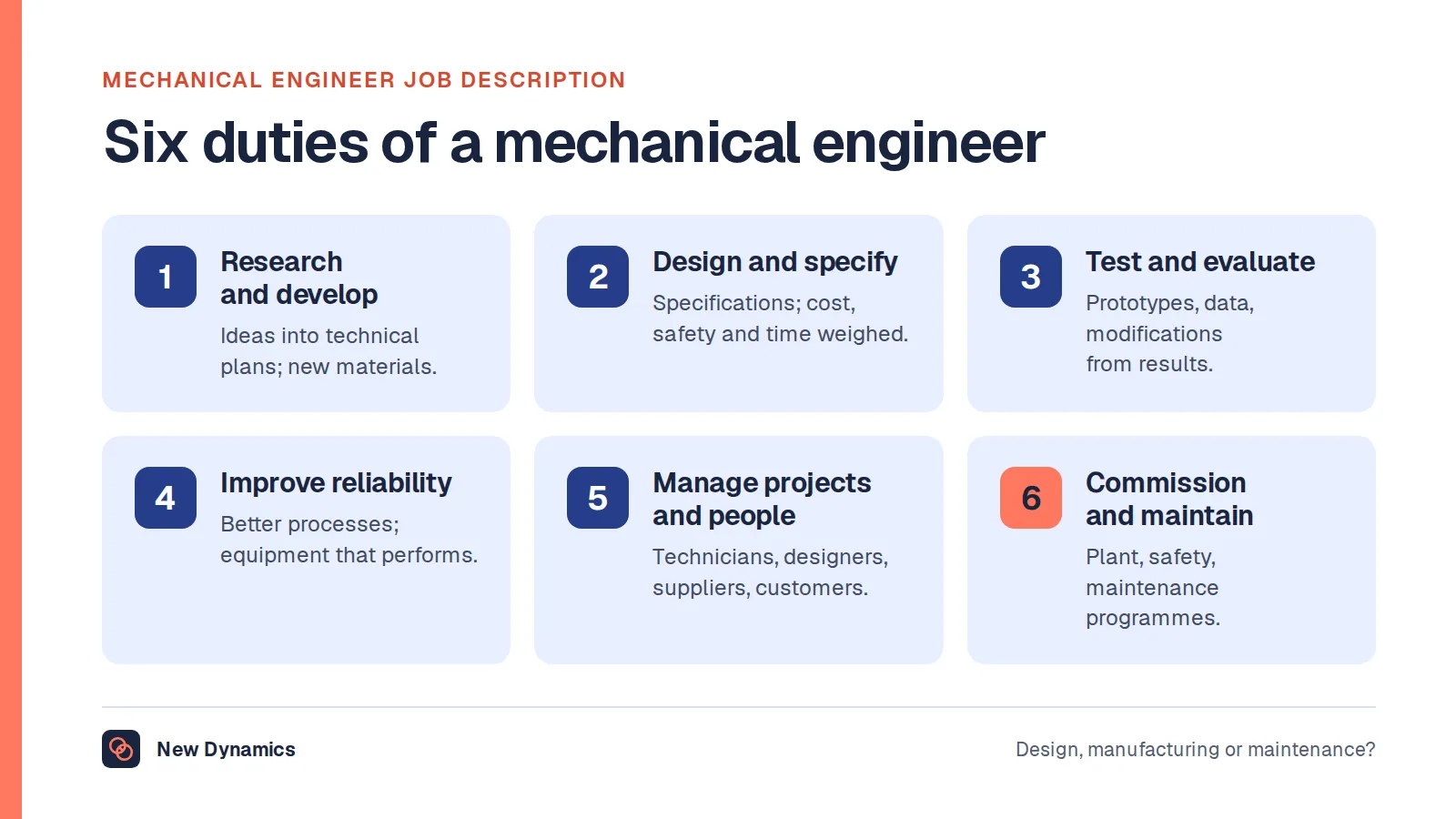
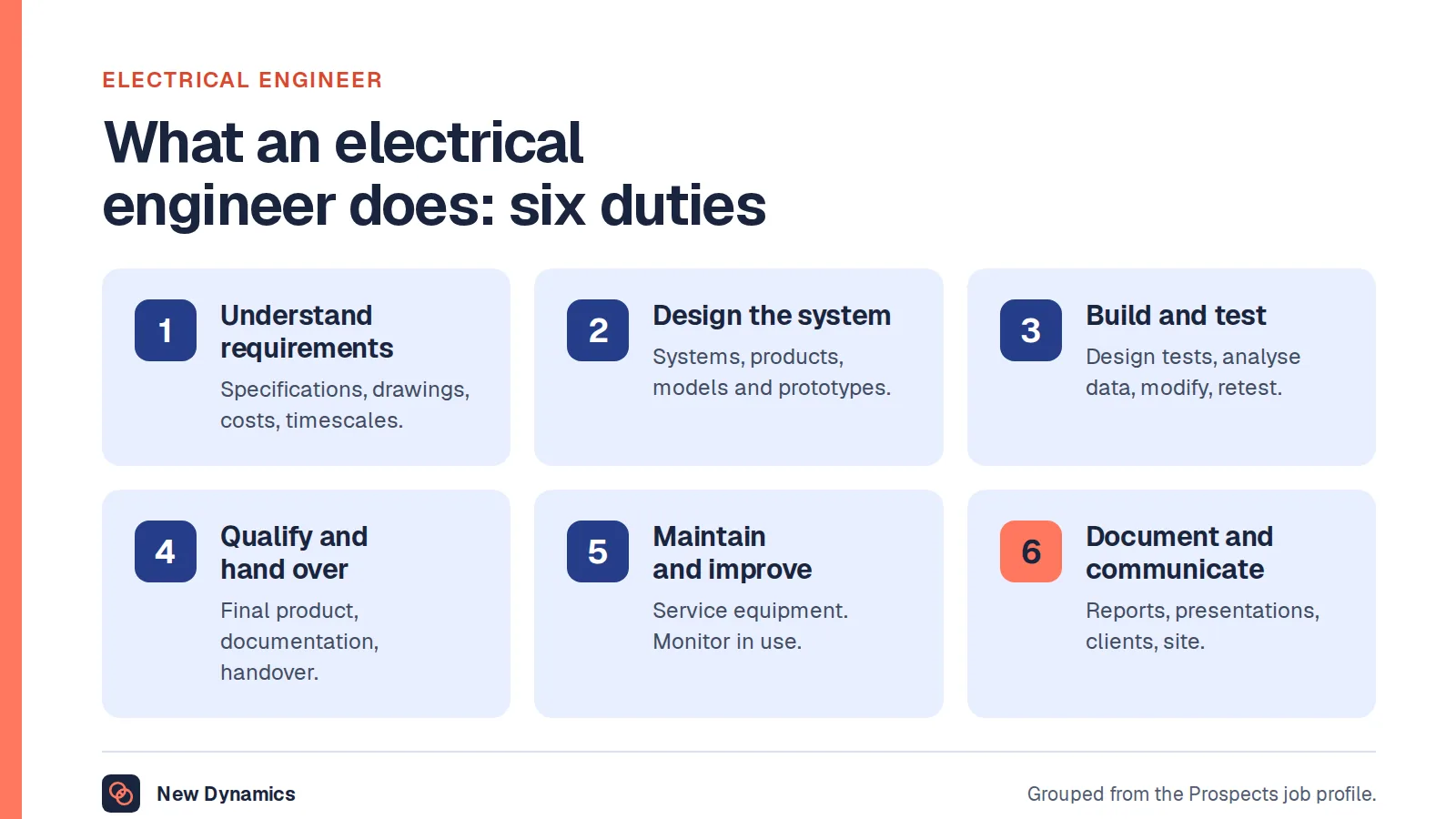
That breadth is why "engineering technician" on its own is a poor advert. The discipline, the equipment and the sector decide whether the person is calibrating instruments, commissioning a building's plant or stripping a gearbox. Our mechanical engineer job description and electrical engineer job description cover the engineer side of the same teams.
EngTech: the UK registered title

In the UK, Engineering Technician is a registered professional title awarded by the Engineering Council through a licensed professional engineering institution. Registrants are "required to apply safe systems of work" and must demonstrate four things:
- Contribution to real engineering work, evidence of their contribution "to either the design, development, manufacture, commissioning, decommissioning, operation or maintenance of products, equipment, processes or services".
- Supervisory or technical responsibility.
- Effective interpersonal skills in communicating technical matters.
- Commitment to professional engineering values.
Note what is absent from that list: a degree. The Engineering Council states that registration "is open to anyone who can demonstrate the required professional competences and commitment". Typically applicants will have completed "an Advanced/Modern Apprenticeship or other work-based learning programme approved by their Licensed PEI", or hold an approved engineering or construction qualification "set at level 3 (or above)" in the English, Northern Irish or Welsh frameworks, or "level 6 (or above) in the Scottish Credit and Qualifications Framework". And, explicitly: "individuals without formal qualifications may also apply for EngTech registration by demonstrating they have acquired the necessary competence through substantial working experience."
For an employer that is a cheap and underused retention tool. Supporting a technician's application costs a subscription and some evidence-gathering, and it gives a person without a degree a recognised professional title. Our career development guide covers building that into a progression route rather than leaving it to individuals.
What a technician job description must state
A generic technician advert produces generic applications. State the four things that actually differ between employers:
- The discipline and the equipment. Not "engineering", but hydraulics, PLCs, rotating plant, HVAC, avionics, test rigs.
- Who directs the work, and who approves a departure from specification. This is the single most useful line in the document.
- What the technician may decide alone, which tests to run, when to stop a machine, what to order, what to record.
- The conditions. Shifts, call-out, sites, permits, travel, and whether the work is on live plant.
Add whether the employer supports professional registration, and say so in the advert rather than at the offer stage.
How the role is measured
- First-time quality of the work, the job done right rather than done again.
- Diagnosis rather than replacement, which is the difference between an expensive parts bill and a technician who understands the system.
- Records completed on the day, because the log is the asset.
- Standards and safe systems of work followed, including permits and isolation.
- Judgement escalated at the right moment. A technician who stops and calls is doing the job; one who improvises on a design decision is not.
Avoid counting jobs closed on its own. It rewards the fastest swap-out and punishes the person who found the actual cause.
An engineering technician job description template
Job title: Engineering technician [discipline]
Reports to: [engineering manager / lead engineer]
Works under the direction of: [named engineering role] for design and specification decisions
Equipment and systems: [list]
Purpose: Apply proven engineering techniques and procedures to build, test, maintain and record the performance of [equipment], to specification and within safe systems of work.
Responsibilities
- Interpret drawings, schematics, specifications and engineering instructions.
- Assemble, install, commission, maintain and repair [equipment].
- Carry out tests to defined procedures and report results accurately.
- Take measurements and produce calculations for engineering approval.
- Diagnose faults and determine the cause before replacing components.
- Check work against specifications, codes and applicable standards.
- Produce detail sketches and drawings to support fabrication or repair.
- Maintain equipment logs, test records and asset documentation.
- Apply safe systems of work, permits and isolation procedures.
Decides alone: [tests to run, stopping a machine, parts within £x]
Refers to an engineer: any change to a specification, design or approved method.
Professional registration: we support applications for EngTech registration through [institution].
Frequently asked questions
What is an engineering technician?
Someone who applies established engineering techniques and procedures to practical engineering problems, normally within a framework set by engineers. The work covers reading drawings, building and stripping equipment, testing, measuring, fault-finding, checking compliance with standards, producing sketches and keeping the records that document all of it.
What is the difference between an engineering technician and an engineer?
Design responsibility. An engineer owns the design, the analysis behind it and the decision to approve a change. A technician applies proven techniques within that framework and holds technical responsibility for the work itself. The practical test is who may sign off a departure from the specification.
Do you need a degree to be an engineering technician?
No. The usual route is an apprenticeship or a work-based learning programme, or a level 3 qualification in engineering or construction. The Engineering Council also states that people without formal qualifications may apply for EngTech registration by demonstrating competence gained through substantial working experience.
What is EngTech?
Engineering Technician is a professional title registered by the Engineering Council in the UK and awarded through a licensed professional engineering institution. Applicants demonstrate their contribution to engineering work, supervisory or technical responsibility, effective interpersonal skills in communicating technical matters, and commitment to professional engineering values.
What is the difference between a technician and a technologist?
Technologists work closer to design and development, applying engineering theory to developing and implementing solutions, while technicians apply proven procedures to practical problems. The line is blurred enough that O*NET groups technologists and technicians in the same occupations, so what matters locally is the responsibility each role carries.
What should an engineering technician job description include?
The discipline and the specific equipment, who directs the work and who approves a departure from specification, what the technician may decide alone, and the conditions of the job: shifts, call-out, sites, permits, travel and whether the work is on live plant. Say whether professional registration is supported.
Your next step: write the direction line
- Name the discipline and the equipment rather than advertising for an "engineering technician".
- Write down who directs the work and who approves a change to specification.
- List what the technician decides alone, including spend and stopping authority.
- Decide whether you support EngTech registration, and put the answer in the advert.
For turning that into a progression route rather than a one-off conversation, read and download our career development guide. The guide is free to read, and the PDF uses our short download form.
Want the evidence for a technician's registration and their next grade in one place instead of scattered across job cards? Book a New Dynamics demo and bring your current competence framework. You can also email contact@new-dynamics.com.