TL;DR
- Lateness and missed deadlines look like the same problem and usually are not. Separate four causes first: something outside work, a health or disability question, a workload or system problem, and a genuine choice. Only the last one is a straightforward conduct conversation.
- Acas uses lateness as its own example of something that looks like conduct and may be capability, saying that if regular lateness is caused by a condition that is a disability, an employer will need to consider a reasonable adjustment before taking any disciplinary action.
- Describe the pattern with dates, ask an open question, then agree one specific change. If nothing moves after real support, Acas sets out what a performance improvement plan should contain, and says dismissal should be a last resort.
Someone on your team is late most mornings, or their work is good and always arrives two days after it was due. You have mentioned it twice in passing. Nothing has changed, and you are now somewhere between irritated and worried about whether this is a formal matter.
This article covers the four causes worth separating before you open your mouth, why lateness is not always what it looks like, wording for each case, how to coach time management without saying "manage your time better", and what happens if nothing changes. It describes the position in Great Britain and is general information, not legal advice.
Patterns are easier to see, and to raise early, when one-to-one notes live in one place. See how New Dynamics continuous feedback keeps the record of small conversations.
Four causes, and why the order matters

Something outside work. Childcare, a carer's responsibility, a commute that broke when a bus route changed. Usually fixable with a start time, a shift change or a conversation about flexible working, and usually never mentioned because nobody asked.
A health or disability question. Acas is explicit about this one, and it uses lateness as the example: "sometimes, a situation might seem like a conduct issue but could actually be capability. For example, if someone is regularly late to work, this could be because of an impairment or condition". If that condition is a disability, it says an employer "will need to consider if a reasonable adjustment is needed", and "they should do this before taking any disciplinary action". Its examples of adjustments include "giving someone more time to do written tasks, adjusting shift patterns or providing specialist equipment".
A workload or system problem. The deadline was never achievable, the inputs arrive late, three people set competing priorities, or the work needs four hours of uninterrupted time in a calendar that has none. HSE lists Demands, covering "workload, work patterns and the work environment", among the six areas of work design that reduce productivity when they are managed badly. If this is the cause, feedback to the individual fixes nothing.
A genuine choice. Some people are late because being late has never cost anything. Acas lists "regularly being late for work" among conduct issues, and when the first three causes are ruled out this is the conversation you are in.
The order matters because the cheapest mistake is treating cause four as the explanation when it is actually cause one or two.
The lateness conversation

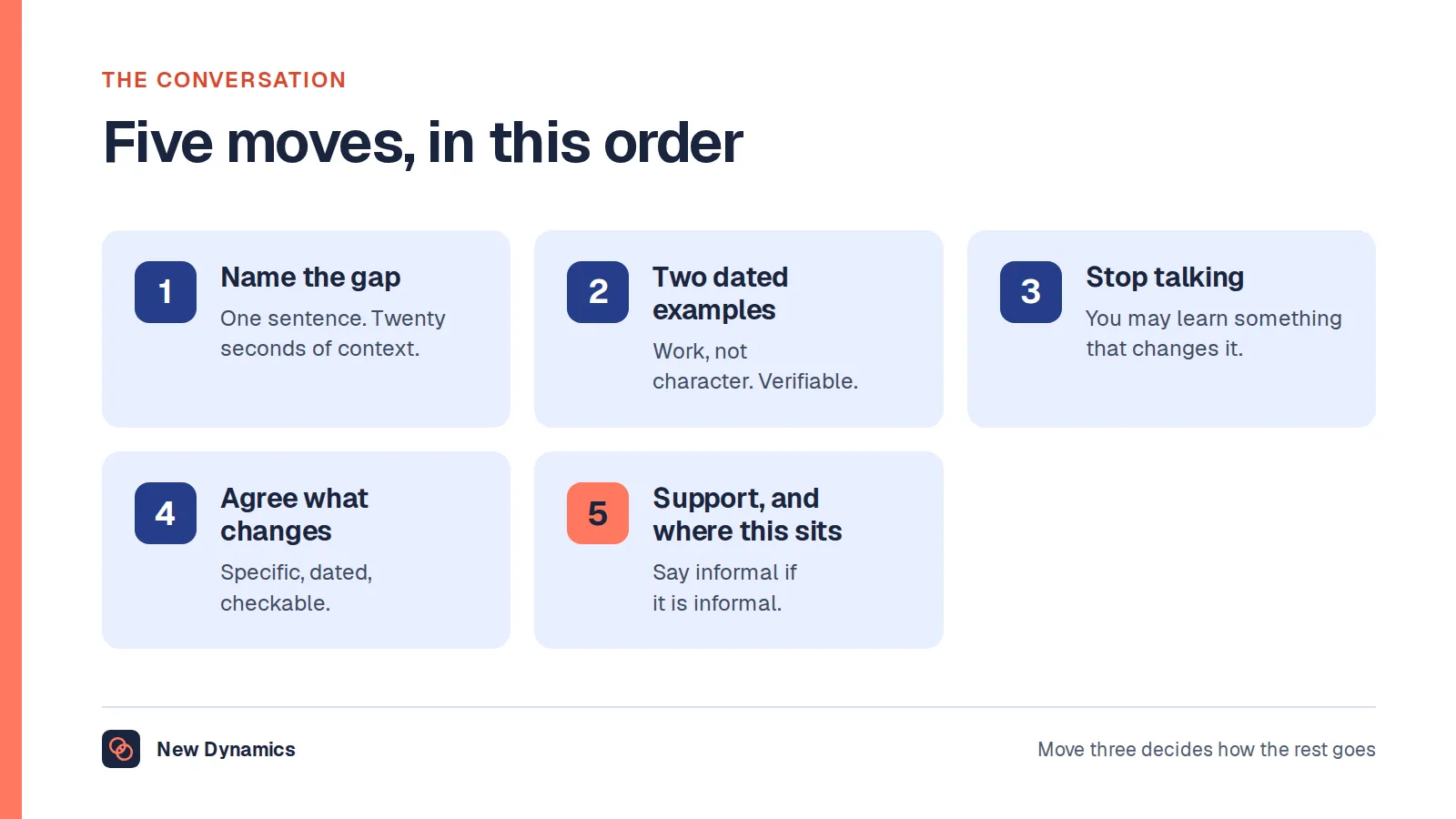
Describe the pattern, say the effect, ask one open question, and stop.
"You have arrived after half past nine on eight of the last ten days. The handover slips and the morning calls start without you, which means the team repeats itself. Is something making mornings difficult?"
Then listen properly, because this is where the cause appears. Three ways the answer tends to go:
- A practical obstacle. Fix it where you can. A different start time, a swapped shift, a changed handover slot. If it involves a formal change to hours, that is a flexible working conversation with its own process.
- Health, or something they are reluctant to name. Do not probe for a diagnosis. "You do not have to tell me anything medical. If something is affecting work, we can look at what would help, and I can get HR involved if that is easier." Then follow the adjustment route rather than the disciplinary one.
- Nothing in particular. Then be plain. "I need you here by nine because the handover depends on it. Can you commit to that from Monday?" Agree it, write it down, and check in two weeks later.
What not to do: make it a joke in front of others, mention it only in the annual review, or let it run for a year and then escalate suddenly. Our post on the underperformance conversation covers the structure in full.
The missed deadline conversation
Deadlines need a different first question, because the usual cause is not the person.
"The last three monthly packs arrived on the fourth, the fifth and the fourth, against a second working day deadline. Finance rework their timetable each time. Walk me through what happens in those first four days."
Listen for which of these you have:
- Too much work. Then the conversation is about priorities and what drops, and it is your conversation to have, not theirs.
- Late inputs. The deadline is being missed upstream and landing on the last person in the chain. Fix the chain.
- No early warning. This is the most common, and it is a specific and fixable behaviour: "I can work with a delay I know about on Tuesday. I cannot work with one I find out about on Thursday. If something will slip, tell me as soon as you know."
- Estimating. The person genuinely believes three days of work fits in one. Coach the estimate rather than the attitude: ask for a plan with dates before the next piece starts, and compare it to what happened afterwards.
Coaching time management without saying "manage your time better"
Telling someone to manage their time better is advice they have heard before and cannot act on. Four things that can be acted on:
- Plan the week in writing, with the two things that must happen, and show it to you on Monday for a month.
- Estimate before, compare after. The gap between the estimate and the actual is the whole lesson, and it closes faster than any course.
- Protect the block. If the work needs uninterrupted hours, put them in the calendar as real appointments and defend them yourself.
- Give early warning a format. A one-line message with the new date and the reason, sent as soon as the slip is known. Make it normal rather than an admission of failure.
For more wording across other situations, our negative feedback examples post has fifty lines grouped by topic.
If nothing changes

Acas puts informal resolution first: before starting a disciplinary procedure, the employer should "first see whether the problem can be resolved in an informal way", by talking privately, listening to the person's point of view, agreeing improvements and setting up a training or development plan where it is a performance issue. It also says employers "should take steps to try and help someone to improve, before starting a formal disciplinary procedure", and that "it's important for employers to keep a record of any conversations they have with employees about performance".
If informal steps do not work, Acas says an employer could consider a performance improvement plan, which should set out "specific objectives for the employee", "a reasonable timeline to meet them" and "any further support or training they need", shared in writing and explained so the person understands it. It adds that the employer should make clear what happens if the improvement does not come, that dismissal requires a fair procedure, and that it "should be a last resort".
Before any of that, check your own half honestly: was the adjustment made, was the workload fixed, did the late inputs stop? An improvement plan that asks someone to solve a problem they do not control fails twice, once for them and once for you.
Writing it up in the review
Keep it factual and keep the cause in it. "Eight late starts in ten days in March; start time changed to 9.30 by agreement in April and no further issue" is a complete and fair record. "Punctuality concerns" is not, and it will be read by people with no context at all, for the reasons our post on performance review record keeping sets out.
If an adjustment is in place, record the adjustment and not the medical detail behind it.
Frequently asked questions
How do you give feedback to an employee who is always late?
Describe the pattern with dates, say what it costs the team, then ask one open question such as whether something is making mornings difficult, and listen. The answer tells you whether this is a practical obstacle, a health question or a choice. Agree one specific change, write it down and check in two weeks later.
Is lateness a conduct or a capability issue?
It can be either. Acas lists regularly being late among conduct issues, but also uses lateness as its example of something that may actually be capability, saying that if it is caused by an impairment or condition that is a disability, the employer will need to consider a reasonable adjustment before taking any disciplinary action. Ask before you decide. This is general information, not legal advice.
What do you say to an employee who keeps missing deadlines?
Give the dates, say what it costs downstream, and ask them to walk you through what happens in the days before the deadline. Usually you will find too much work, late inputs or no early warning rather than carelessness. Fix what you control, and make early warning a normal one-line message rather than a confession.
How do you give feedback on time management?
Replace the instruction with something actionable: a written plan for the week, an estimate before each piece of work compared with the actual afterwards, protected blocks for work that needs uninterrupted time, and a simple format for flagging a slip early. "Manage your time better" is advice nobody can act on.
When does lateness become a disciplinary matter?
After the cause has been established and informal steps have genuinely been tried. Acas says employers should first see whether the problem can be resolved informally and should take steps to help someone improve before starting a formal procedure, and that any disability question should be considered before disciplinary action. Keep a record of each conversation.
What should a performance improvement plan contain?
Acas says a plan should set out specific objectives, a reasonable timeline to meet them, and any further support or training needed. It should be explained to the employee and shared in writing, and the employer should make clear what happens if the improvement does not come. Dismissal should be a last resort and requires a fair procedure.
Your next step: establish the cause this week
- Write down the pattern with dates. If you cannot, you are not ready to raise it.
- Check your own half: the workload, the inputs, the calendar, any adjustment already requested.
- Have the conversation with one open question in it, and plan to say nothing for the first thirty seconds afterwards.
- Agree one change with a date, and put the follow-up in the diary before you leave the room.
For the stage after informal conversations, read and download our performance improvement guide. The guide is free to read, and the PDF uses our short download form.
Want the small conversations recorded so the pattern is visible early? Book a New Dynamics demo and bring the case you are stuck on. You can also email contact@new-dynamics.com.