TL;DR
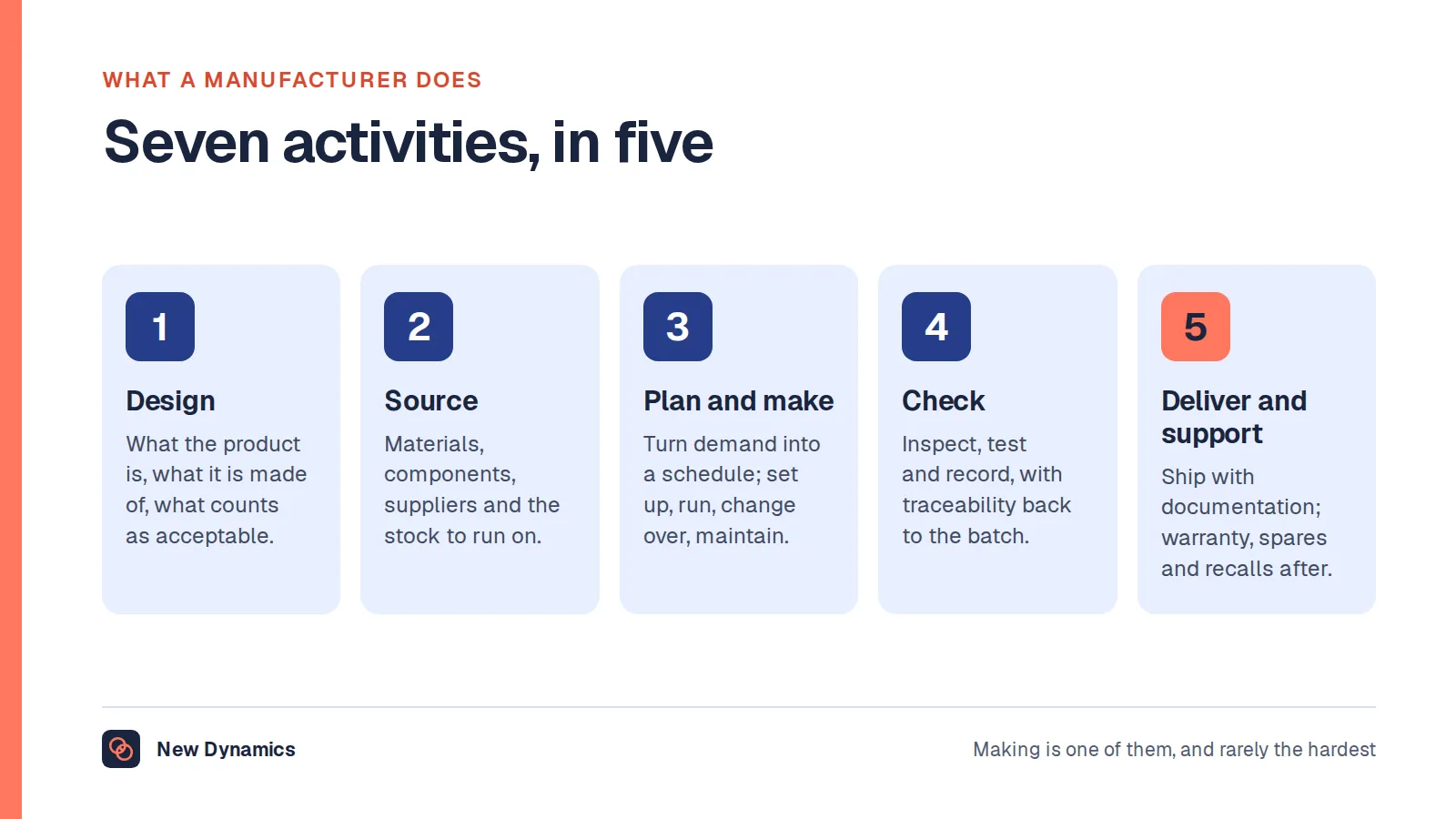
- An industrial engineer designs the system that makes the product. O*NET's occupation covers people who “design, develop, test, and evaluate integrated systems for managing industrial production processes”, planning the sequence of operations, drafting layouts and developing manufacturing methods and standards.
- The work runs from estimating production costs and the effect of design changes, through layout, sequence and method, to standards for quality and for how long a job should take. The National Careers Service describes the UK equivalent as testing systems and analysing data “to improve production methods”.
- Two things belong in the job description and usually are not: who owns the labour standards the role sets, and the duty that arrives with any redesign of physical work. HSE requires employers to avoid hazardous manual handling “so far as reasonably practicable”, then assess and reduce what remains.
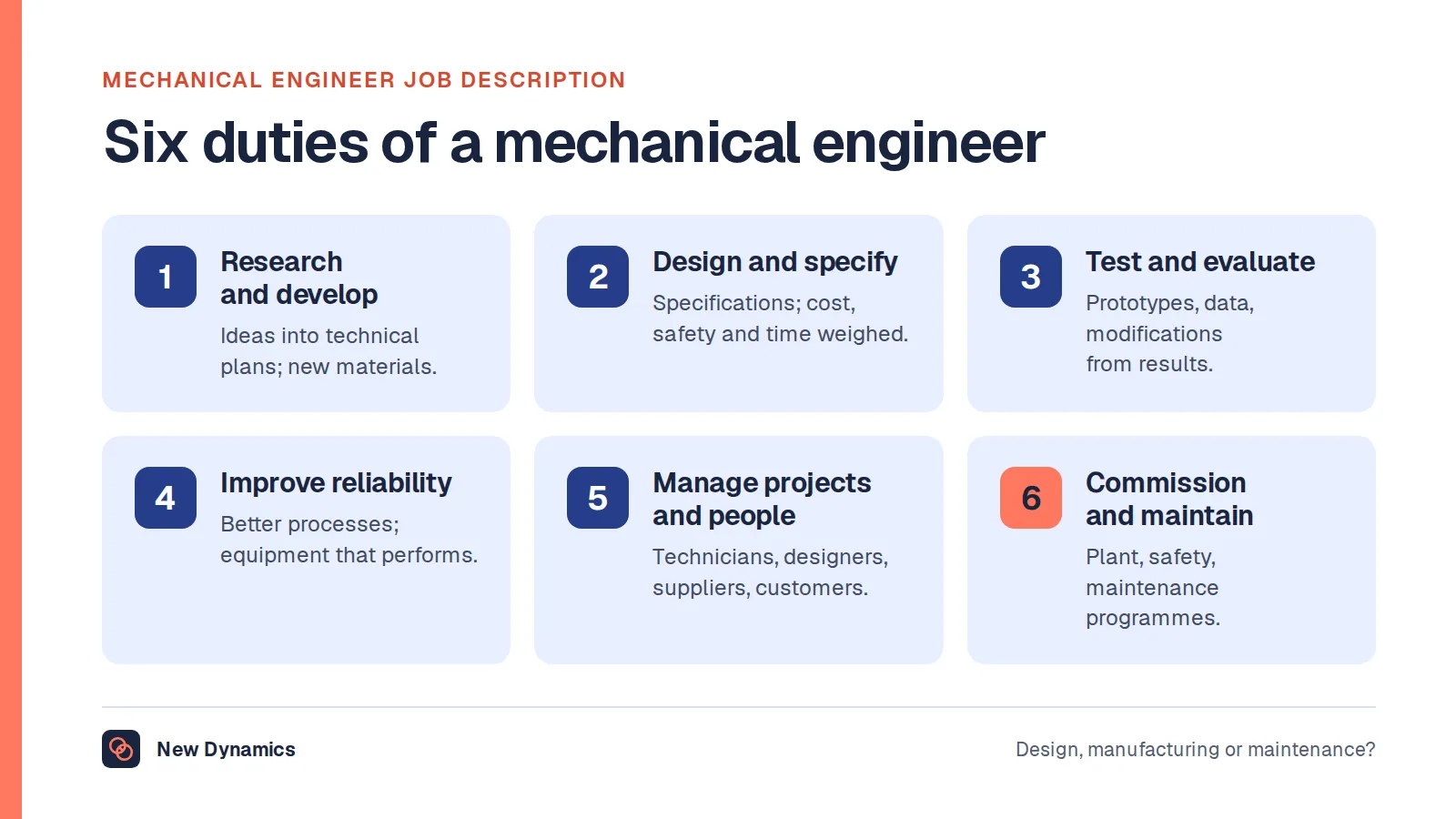
A mechanical engineer is asked whether the part will hold. An industrial engineer is asked why it takes eleven days to make something that needs four hours of work.
This article sets out an industrial engineer job description: what the discipline covers, eleven responsibilities in four groups, the standards question, layout and flow, the safety duty that comes with redesigning work, how the role is measured and a template.
Improvement projects need targets and dates that survive contact with the shop floor. See how New Dynamics Goals & OKRs keep those in one place rather than in a project file.
Product or system?
O*NET's Industrial Engineers "design, develop, test, and evaluate integrated systems for managing industrial production processes". The distinction that matters:
- Product engineering asks whether the thing works.
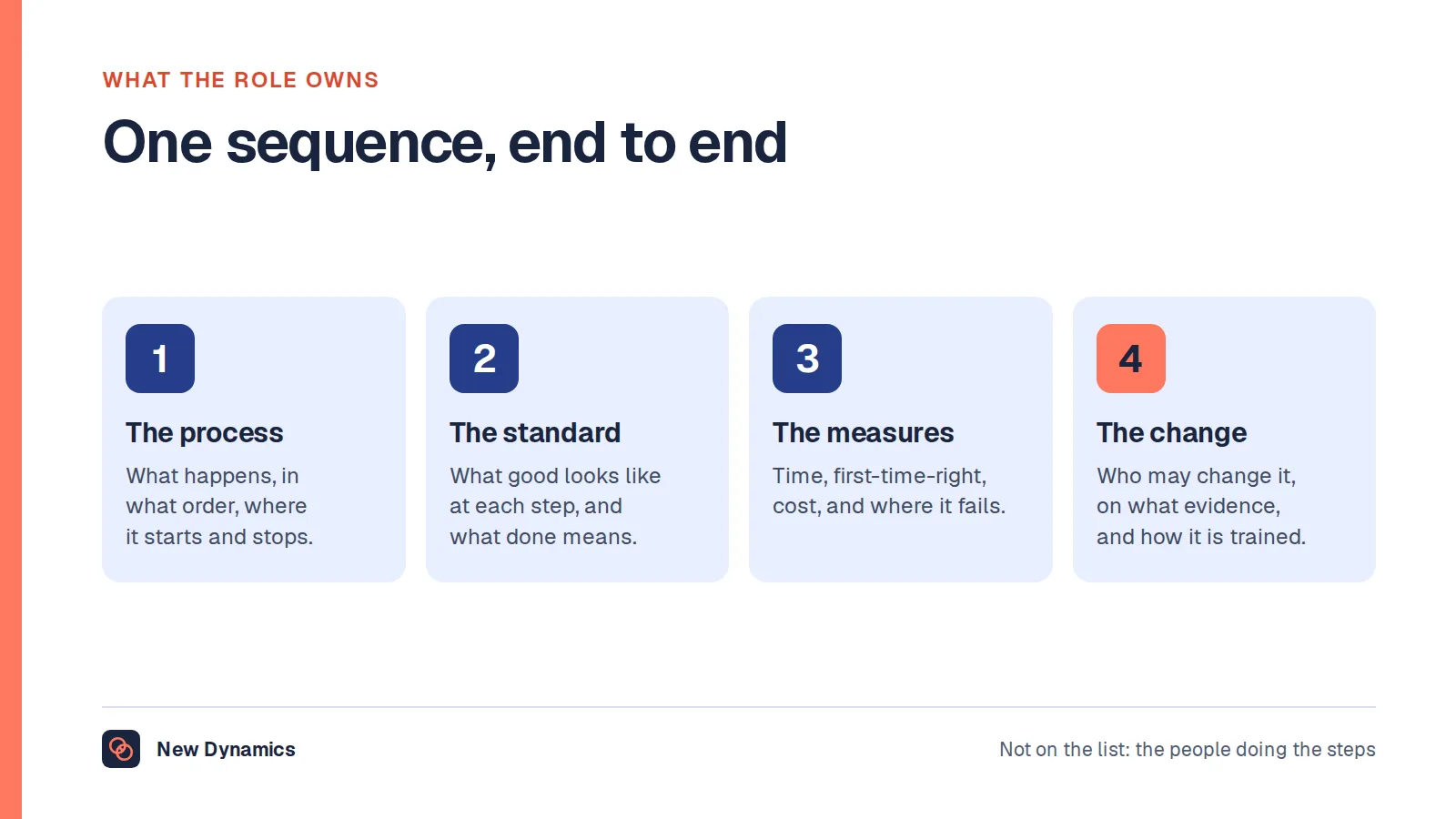
- Industrial engineering asks whether the way we make, move and control it works, sequence, layout, method, standards, cost and quality together.
In the UK the nearest job title is often manufacturing systems engineer. The National Careers Service describes that role as producing "design and engineering plans for new installations and equipment", building models "using computer aided design (CAD) and manufacturing (CAM) software", testing "systems and analyse data to improve production methods", and managing "projects, budgets and a team of engineers and technicians". Its profile notes the role exists across vehicles, food and drink, pharmaceuticals, electronics and aerospace.
Eleven responsibilities

Cost and method
- Estimate production cost, including "cost saving methods, and the effects of product design changes on expenditures for management review, action, and control".
- Develop manufacturing methods, together with "labor utilization standards, and cost analysis systems to promote efficient staff and facility utilization".
- Recommend improvements to "utilization of personnel, material, and utilities", the sentence that covers most of what the job is actually asked for.
Layout and flow
- Plan the sequence of operations to fabricate and assemble parts or products "and to promote efficient utilization".
- Design the layout of "equipment, materials, and workspace to illustrate maximum efficiency", using drafting tools and software.
- Install and prove the change, which in the UK profile appears as producing design and engineering plans for new installations and equipment, then testing the system.
Standards and quality
- Set quality and reliability objectives by analysing "statistical data and product specifications to determine standards".
- Develop production and design standards with management and the people who do the work.
- Check the equipment. Evaluate "precision and accuracy of production and testing equipment and engineering drawings to formulate corrective action plan".
People and records
- Direct measurement and inspection work for quality control and reliability, and confer with clients, vendors, staff and management "regarding purchases, product and production specifications, manufacturing capabilities, or project status".
- Keep the documentation current, recording or overseeing recording of information "to ensure currency of engineering drawings and documentation of production problems".
Responsibility eleven is the one that decays first and costs the most later: an out-of-date drawing or method sheet is how an improvement quietly disappears.
The standards question

Industrial engineers often set how long a job should take. That number then appears in capacity plans, costings, pay schemes and sometimes in performance conversations, which makes it the most politically loaded output of the role.
Four questions to settle in the job description rather than in an argument:
- Who owns the standard once it is set, engineering, operations or finance?
- How is it derived, and is the method visible to the people it applies to?
- What allowances are included for setup, fatigue, breaks, cleaning and rework?
- How is it challenged, and by whom, when the work has changed?
A standard nobody can question is a standard everybody works around. Our process manager post covers the ownership question for processes that cross departments.
Layout, flow and the constraint
Most improvement requests arrive as "we need more people" or "we need a faster machine". The industrial engineer's job is to check whether either is true. That means measuring where work waits rather than where it moves, finding the constraint, and deciding whether the answer is layout, sequence, batch size, information or equipment.
Two honest points for the job description: the cheapest fix is usually information arriving earlier, and a change that optimises one station while starving the next is not an improvement.
The duty that arrives with the redesign
Redesigning work changes what people's bodies do all day. HSE's guidance on manual handling at work is direct: "as an employer, you must protect your workers from the risk of injury from hazardous manual handling in the workplace." Manual handling "means transporting or supporting a load by hand or bodily force", including "lifting, putting down, pushing, pulling, carrying or moving loads", and the law requires employers to:
- "Avoid hazardous manual handling, so far as reasonably practicable."
- "Assess the risk of injury from any hazardous manual handling operations that cannot be avoided."
- "Reduce the risk of injury from hazardous manual handling to as low as reasonably practicable."
HSE also notes that "the weight of a load is important, though the law does not set specific weight limits", which rules out the common shortcut of quoting a number from memory. Write into the job description that layout and method changes include a manual handling assessment, and say who signs it off. This is general information rather than legal advice, and the duty is the employer's.
Beyond the factory
The discipline travels: hospitals, distribution centres, airports, laboratories, call centres, food production, public services. The vocabulary changes and the questions do not, where does work wait, what is the constraint, what does it cost to do it this way, and what would have to be true for the alternative to work?
If you are hiring outside manufacturing, say so in the first line, because most applicants will assume a factory.
What the job description must state
- The environment: what is made or done, volumes, and the process type.
- The scope: one site, several, or a product line.
- Whether the role sets labour standards, and who owns them afterwards.
- The software: CAD, CAM, simulation, ERP and data tools, named.
- Project authority: what the engineer may change, what needs operations' agreement, and who arbitrates.
- The safety responsibilities attached to redesign, including manual handling assessments.
How the role is measured

- Throughput and lead time for the line or process changed, measured before and after with the same definition.
- Changes that stuck, reviewed six months later. The honest measure of the whole role.
- Standards accuracy: how closely the standard predicts the actual time when the method is followed.
- Quality and rework after a change, since speed bought with defects is not a gain.
- Safety: manual handling risk reduced rather than moved along the line.
Avoid measuring savings claimed at project sign-off. It rewards the business case rather than the result, and the result arrives after the project closes. Our change management guide covers making a change survive the first busy week.
An industrial engineer job description template
Job title: Industrial engineer [site or product line]
Reports to: [engineering manager / operations director]
Environment: [what is made], [volumes], [process type]
Systems: [CAD / CAM / simulation / ERP]
Purpose: Design and improve the system by which work is done here (sequence, layout, method, standards and cost) and prove the change worked.
Responsibilities
- Analyse current processes, measure performance and identify constraints.
- Design layouts, sequences and methods, and model alternatives.
- Estimate costs, including the effect of design changes on production cost.
- Set and maintain production, quality and labour standards with operations.
- Specify equipment and support installation and commissioning.
- Evaluate accuracy of production and testing equipment, and act on findings.
- Maintain drawings, method sheets and documentation of production problems.
- Complete manual handling and ergonomic assessments for changes to work.
- Train and brief the people whose work changes, before it changes.
- Report results against agreed measures, before and after.
May change alone: [layout within a cell, method sheets, standard work]
Needs agreement from: [operations manager] for [staffing, sequence, shift patterns].
Frequently asked questions
What does an industrial engineer do?
Designs and improves the systems that produce goods or services: planning the sequence of operations, designing layouts of equipment, materials and workspace, developing manufacturing methods and labour standards, estimating production costs, setting quality and reliability objectives, evaluating equipment accuracy, and keeping drawings and documentation current.
What are an industrial engineer's main responsibilities?
Cost and method work, layout and flow, standards and quality, and the people and records side: briefing those whose work changes, directing measurement and inspection, and documenting production problems. In the UK the equivalent role also covers CAD and CAM modelling, testing systems and reporting progress to senior managers.
What is the difference between an industrial engineer and a mechanical engineer?
A mechanical engineer designs the product or the machine. An industrial engineer designs the system that makes it: the sequence, layout, methods, standards and cost of production. They overlap where equipment is specified, and disagree productively about whether a problem is a machine problem or a flow problem.
Do industrial engineers only work in manufacturing?
No. The same methods apply in hospitals, distribution centres, airports, laboratories and services. If the role is outside manufacturing, say so in the first line of the advert, because applicants will otherwise assume a factory.
Who owns the time standards an industrial engineer sets?
That should be decided before the role starts. Settle who owns a standard after it is set, how it is derived, what allowances it includes for setup, fatigue, breaks and rework, and how it can be challenged when the work changes. A standard nobody can question gets worked around instead.
What safety duties come with redesigning work?
Changing layout or method changes what people lift, push and carry. Employers must avoid hazardous manual handling so far as reasonably practicable, assess the risk where it cannot be avoided, and reduce that risk as low as reasonably practicable. The law does not set specific weight limits, so assessments matter more than remembered numbers.
Your next step: write the standards line
- Name the environment, the scope and the volumes.
- Say whether the role sets labour standards, and who owns them afterwards.
- Write what the engineer may change alone and what needs operations to agree.
- Include manual handling and ergonomic assessment in the responsibilities.
For changes that survive the first busy week, read and download our change management guide. The guide is free to read, and the PDF uses our short download form.
Want improvement targets, owners and evidence of what actually changed in one place? Book a New Dynamics demo and bring your current project list. You can also email contact@new-dynamics.com.