TL;DR
- A process manager owns a repeatable process from end to end (order to cash, hire to start, request to resolution) across the departments that each do part of it. That is the whole definition, and it is what separates the role from every manager around it.
- The work looks like O*NET's Management Analysts, who “conduct organizational studies and evaluations, design systems and procedures, conduct work simplification and measurement studies, and prepare operations and procedures manuals to assist management in operating more efficiently and effectively”, with tasks from interviewing staff and observing work on site to documenting findings and training people in new procedures.
- The difficulty is structural. A process crosses teams the process manager does not manage, so the role runs on evidence, convening and agreed measures rather than on authority. Appoint one without deciding what they can decide, and you have created a reporting job with a manager's title.
Most managers own a box on the org chart. A process manager owns a line that runs across several of them, and usually does not manage anyone in any of them.
This article sets out what a process manager is: what the role owns, eight duties, how it differs from operations, project and functional management, the authority problem at the centre of it, what to measure and a template. It covers the business role; "process manager" also means something entirely different in computing.
A process that lives in people's heads cannot be owned by anyone. See how New Dynamics workflows let you define your own stages, forms and approvals, with a completion view instead of a spreadsheet.
Where the process is physical, the neighbouring role is the engineer who redesigns it: our industrial engineer job description covers layout, method and the standards question.
What the role owns

One repeatable sequence, end to end:
- The process itself: what happens, in what order, with what inputs and outputs, and where it starts and stops.
- The standard: what good looks like at each step, and what "done" means.
- The measures: how long it takes, how often it works first time, what it costs, and where it fails.
- Changes to it: who may change the process, on what evidence, and how a change is communicated and trained.
Typical processes with a named owner: order to cash, procure to pay, hire to start, request to resolution, complaint to closure, quote to install.
Note what is not on the list: the people doing the steps. They report to their own managers, which is the defining feature of the job.
Process manager, operations manager, project manager
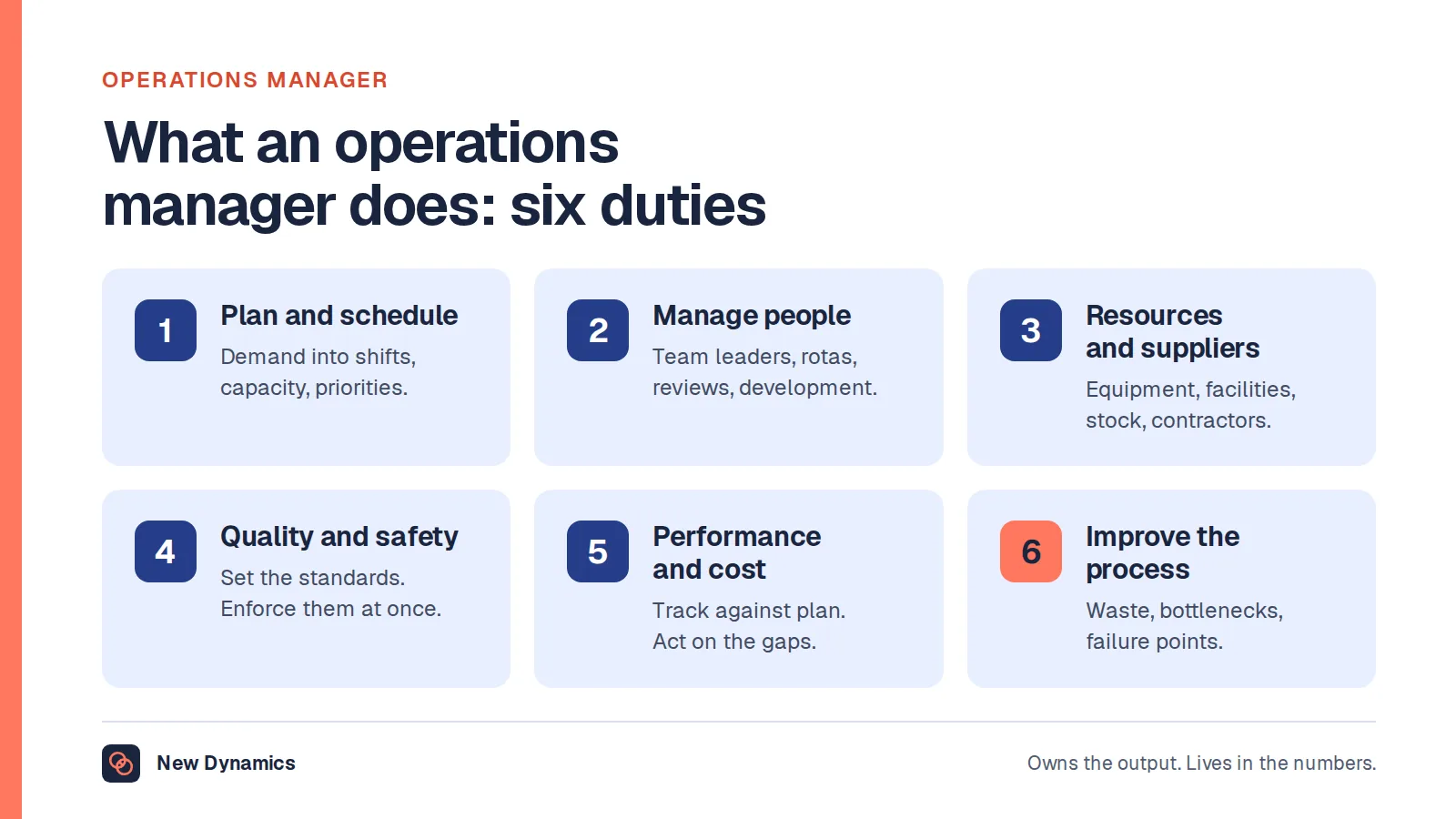
- Operations manager. Owns a function and its output, managing "through subordinate supervisors", with duties O*NET's General and Operations Managers occupation describes as "too diverse and general in nature to be classified in any one functional area". Our operations manager job description covers it. They own the box; the process manager owns a line that passes through it.
- Project manager. Owns something temporary. The Association for Project Management notes that project management "has final deliverables that are constrained to a finite timescale and budget", and that the distinguishing factor is "this final deliverable and a finite timespan, unlike management which is an ongoing process". A process has no end date.
- Functional or department manager. Owns the people and the part of the process their team performs, and is the process manager's most important relationship.
A short test: if the work stops when the thing is delivered, it is a project. If it stops when the department is disbanded, it is a function. If it runs indefinitely and crosses departments, it is a process.
Eight duties

- Map what actually happens. Not the flowchart from three years ago. O*NET's Management Analysts "interview personnel and conduct on-site observation to ascertain unit functions, work performed, and methods, equipment, and personnel used", and "gather and organize information on problems or procedures".
- Measure it. Establish the baseline (time, volume, failure points, rework) because everything after this is argument without it.
- Find the constraint. "Analyze data gathered and develop solutions or alternative methods of proceeding", and plan studies of work problems "such as organizational change, communications, information flow, integrated production methods, inventory control, or cost analysis".
- Design the change. "Document findings of study and prepare recommendations for implementation of new systems, procedures, or organizational changes", and where the process is physical, apply what O*NET's Industrial Engineers do in planning "sequence of operations… to promote efficient utilization".
- Get agreement. The step with no shortcut, covered below.
- Implement and embed. "Confer with personnel concerned to ensure successful functioning of newly implemented systems or procedures", and "prepare manuals and train workers in use of new forms, reports, procedures or equipment".
- Maintain the standard. Keep documentation current, review forms and reports with "management and users about format, distribution, and purpose, identifying problems and improvements", and stop the process drifting back.
- Report. On the measures, on the changes made, and on what is still costing the organisation time or money.
The authority problem

A process manager is accountable for something delivered by people who report elsewhere. That is not a flaw in the job; it is the job. But it only works if four things are settled at the outset.
- What the role can decide alone. Usually: the documented standard, the measures, and the design of the process. Rarely: how any department staffs or sequences its own work.
- What needs agreement, and with whom. Name the department managers whose sign-off is required for a change, and the forum where it happens.
- Who arbitrates. When the process manager and a department manager disagree, someone decides. If that person is not named, the process manager loses by default.
- What the role is measured on. End-to-end measures, not departmental ones, or the job reduces to negotiating with each team about its own numbers.
Without these, the appointment produces a person who writes documents nobody follows, which is the most common failure mode of the role and the reason it has a mixed reputation.
Measuring a process rather than a team
- End to end, not step by step. The time from trigger to outcome, including the waiting. Most delay sits between steps, not inside them.
- First-time-right rate. How often the process completes without rework or a return to an earlier step.
- Cost per instance, where it can be estimated honestly.
- Variation, not just the average. A process with a good mean and a terrible tail feels broken to the people it fails.
- Where it fails, counted by step, so improvement is aimed rather than general.
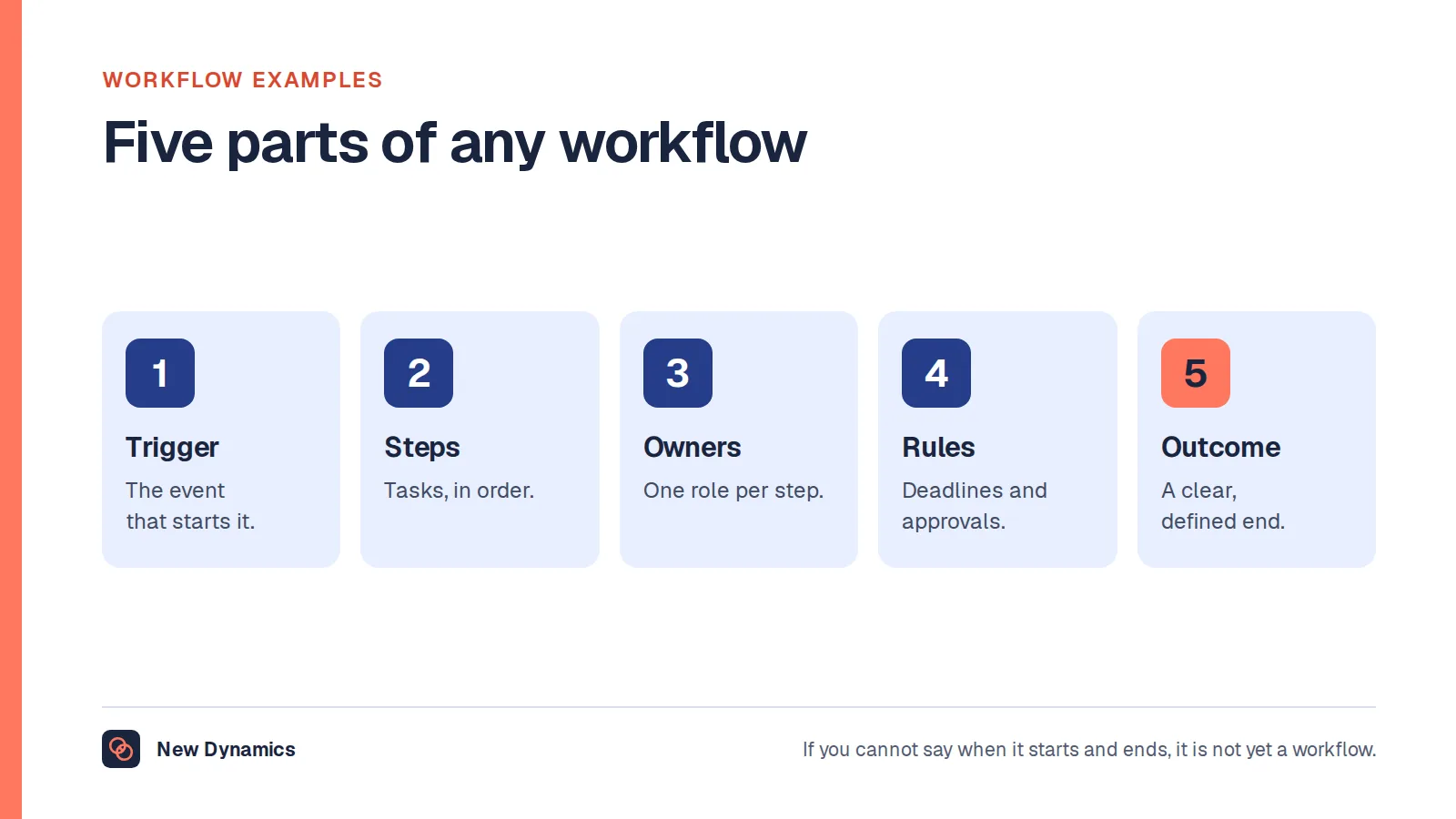
Our post on workflow examples covers the people processes most organisations run and the five parts every workflow needs.
The trap: improving a process nobody follows
Before redesigning anything, check whether the current process is actually being used. If it is not, the problem is adoption rather than design, and a better process will be ignored in exactly the same way.
Three questions that settle it:
- Can the people doing the work describe the process? If descriptions differ, there is no process to improve yet.
- What do they do when the process would slow them down? The workaround is the real process.
- Who notices when it is skipped? If nobody does, no design will survive.
Process change is change, which means it needs the same communication and consultation as any other. Our change management guide covers the sequence.
A process manager job description template
Job title: Process manager [named process]
Reports to: [operations director / head of business improvement]
Process owned: [start trigger] to [end outcome], across [departments involved]
Purpose: Own the end-to-end process: how it runs, how well it runs, and how it changes.
Responsibilities
- Maintain an accurate map of the process as it is actually performed.
- Define and report the end-to-end measures for the process.
- Identify constraints, failure points and rework, and quantify them.
- Design process changes and build the case for them with evidence.
- Secure agreement from the departments affected, through [named forum].
- Implement changes, update documentation, and train the people who use it.
- Monitor for drift and keep the standard current.
- Report performance and improvement activity to [audience].
Decision rights: decides [the standard, the measures, the design]; requires agreement from [roles] for [changes]; arbitration by [role].
You will need: the ability to map and measure work; plain writing; and the patience to convene people who do not report to you.
Frequently asked questions
What does a process manager do?
Owns a repeatable process from end to end across the departments that perform it: mapping what actually happens, measuring it, finding the constraints, designing changes, getting agreement from the teams affected, implementing and training, keeping the documentation current, and reporting on performance and improvement.
What is the difference between a process manager and an operations manager?
An operations manager owns a function and the people in it, managing through supervisors and accountable for its output. A process manager owns a sequence that crosses several functions and usually manages none of the people performing it. One owns a box on the chart; the other owns a line through several.
Is a process manager the same as a project manager?
No. A project has final deliverables constrained to a finite timescale and budget, as the Association for Project Management puts it, and ends when they are delivered. A process runs indefinitely. A process manager may run projects to change the process, but the ownership continues afterwards.
What is a process owner?
Usually the same role under a different name, common in quality and service management. Whichever term is used, the important question is identical: what may this person decide alone, what needs agreement, and who arbitrates when there is disagreement.
How do you measure a process?
End to end rather than step by step: the time from trigger to outcome including waiting, the proportion completed first time without rework, the cost per instance where it can be estimated honestly, the variation rather than only the average, and where failures occur by step.
Why do process manager roles often fail?
Because the appointment is made without settling authority. If nobody has decided what the role can change alone, whose agreement is needed, who arbitrates and what the role is measured on, the process manager produces documents that departments ignore. Settle those four before advertising.
Your next step: settle the four questions
- Name the process, its start trigger and its end outcome, and list the departments it crosses.
- Write down what the role decides alone and what needs agreement.
- Name the arbitrator for disagreements, before the first one.
- Set end-to-end measures rather than departmental ones.
For running process change with the consultation any change needs, read and download our change management guide. The guide is free to read, and the PDF uses our short download form.
Want a process defined as stages, forms and approvals rather than a document nobody opens? Book a New Dynamics demo and bring your current process map. You can also email contact@new-dynamics.com.