TL;DR
- A manufacturer turns materials and parts into finished products and takes responsibility for what leaves the door. The making is one of seven activities: design and specify, source, plan, make, check, deliver, and support what has been sold.
- Two sets of duties come with it. On the product, GOV.UK's guidance is that “if you make, import, distribute or sell products in the UK, you need to understand the basics of product safety law”, complying with regulations for specific product types or, where none apply, the general product safety regulations. On the floor, HSE's PUWER rules require work equipment to be suitable, safe, maintained, inspected, and “used only by people who have received adequate information, instruction and training”.
- Inside a manufacturer the work splits between the floor and the office. O*NET describes production supervisors as directly supervising “inspectors, precision workers, machine setters and operators, assemblers, fabricators, and plant and system operators”, and industrial engineers as designing and evaluating “integrated systems for managing industrial production processes, including human work factors, quality control, inventory control, logistics and material flow, cost analysis, and production coordination”.
Ask what a manufacturer does and the obvious answer is "makes things". True, and it leaves out most of the business. Making is one activity among seven, and it is rarely the one that decides whether the company works.
This article sets out what a manufacturer does: the seven activities, the words that get confused with it, the duties that attach to putting a product into the world, and the jobs the work is divided into. It is general information, not legal advice.
Manufacturers employ people across shifts, sites and a factory floor where nobody has a desk, which is exactly where a review cycle tends to stop. See how New Dynamics performance reviews let you run the review cycle on your own form, with completion visible instead of chased.
What a manufacturer is
A manufacturer turns materials and components into finished products, at scale, to a specification, and carries responsibility for what it puts on the market. That last part matters: the difference between a manufacturer and a middleman is not the machinery, it is who stands behind the product.
The seven things a manufacturer does

- Design and specify. Decide what the product is, what it must do, what it is made of, and what counts as acceptable. Everything downstream is judged against this.
- Source. Buy materials, components and services, qualify suppliers and hold enough stock without holding too much. For most manufacturers this is the single largest cost.
- Plan. Turn demand into a schedule: what gets made, in what order, on which line, with which people. O*NET's industrial engineers "plan and establish sequence of operations to fabricate and assemble parts or products and to promote efficient utilization".
- Make. Set up, run, change over and maintain. This is the part everyone pictures, and in a well-run plant it is the most routine.
- Check. Inspect, test and record. Quality is a system rather than a department: O*NET's production supervisors "inspect materials, products, or equipment to detect defects or malfunctions" and "observe work and monitor gauges, dials, and other indicators to ensure that operators conform to production or processing standards".
- Deliver. Pack, label, document and ship, with traceability back to the batch.
- Support what has been sold. Warranty, spares, technical support, recalls. A manufacturer's obligations do not end at the loading bay.
Words that get confused

- Supplier is a role, not a type of business. A manufacturer is a supplier to its customers and a customer to its own suppliers.
- Distributor buys finished goods and sells them on without making them.
- OEM (original equipment manufacturer) makes products or components that another company sells under its own name, though the term is used loosely in both directions.
- Contract manufacturer makes to someone else's design and specification. The design authority (and much of the legal responsibility) may sit with the brand.
- Fabricator usually means making to order from standard materials, often bespoke, rather than producing a catalogue product in volume.
If a contract or a job advert uses one of these, check which activities the business actually performs. "Manufacturer" on a website sometimes means "we design it and someone else makes it".
What the law asks of a manufacturer
Putting a product on the market brings duties that a distributor does not carry in the same way.
GOV.UK's guidance from the Office for Product Safety and Standards on product safety for businesses states the basic position plainly: "if you make, import, distribute or sell products in the UK, you need to understand the basics of product safety law." It adds that "you must comply with the regulations for specific product types. If none apply, you must comply with the general product safety regulations", and notes that provisions are applied differently in Great Britain and Northern Ireland, with separate guidance for each.
Practically, that means a manufacturer needs to know which regulations apply to its product type, to be able to show how it meets them, and to keep the records that demonstrate it. Specific requirements vary enormously by product, which is why the guidance is organised as an A to Z rather than a single rule.
The duty on the factory floor
The other set of duties is about the equipment people use to make the product.
HSE's overview of the Provision and Use of Work Equipment Regulations, usually shortened to PUWER, explains that the regulations "place duties on people and companies who own, operate or have control over work equipment", and "also place responsibilities on businesses and organisations whose employees use work equipment, whether owned by them or not".
PUWER requires that equipment provided for use at work is:
- "suitable for the intended use";
- "safe for use, maintained in a safe condition and inspected to ensure it is correctly installed and does not subsequently deteriorate";
- "used only by people who have received adequate information, instruction and training";
- "accompanied by suitable health and safety measures, such as protective devices and controls", which "will normally include guarding, emergency stop devices, adequate means of isolation from sources of energy, clearly visible markings and warning devices";
- "used in accordance with specific requirements, for mobile work equipment and power presses".
Note the scope. HSE defines work equipment as "any machinery, appliance, apparatus, tool or installation for use at work (whether exclusively or not)", including equipment employees provide themselves, and says the scope "is therefore extremely wide". On a factory floor that is almost everything, and the training requirement applies to all of it, which is why manufacturers run competency matrices rather than training lists. Our skills gap analysis guide covers building one that stays current.
The jobs inside a manufacturer

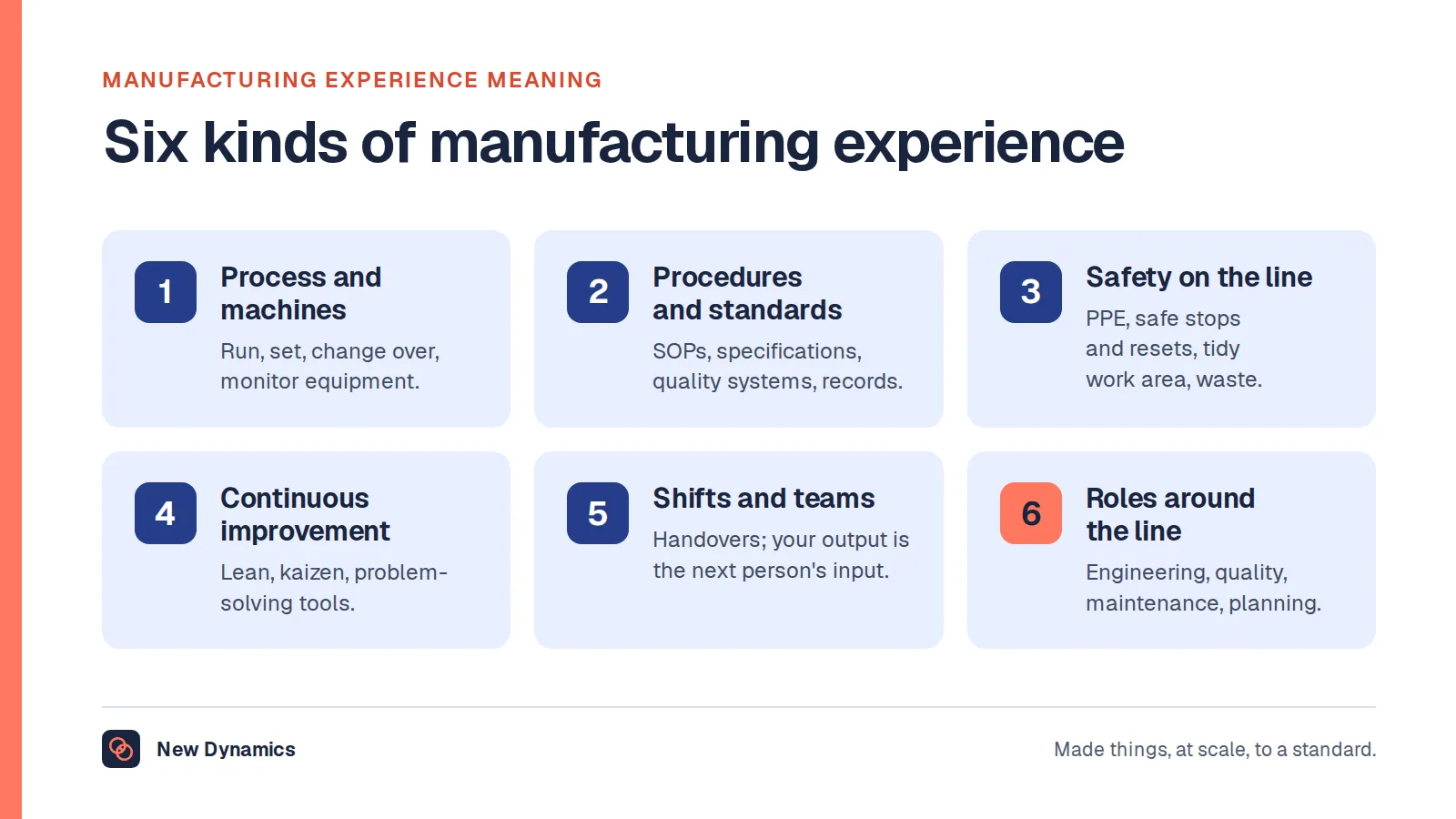
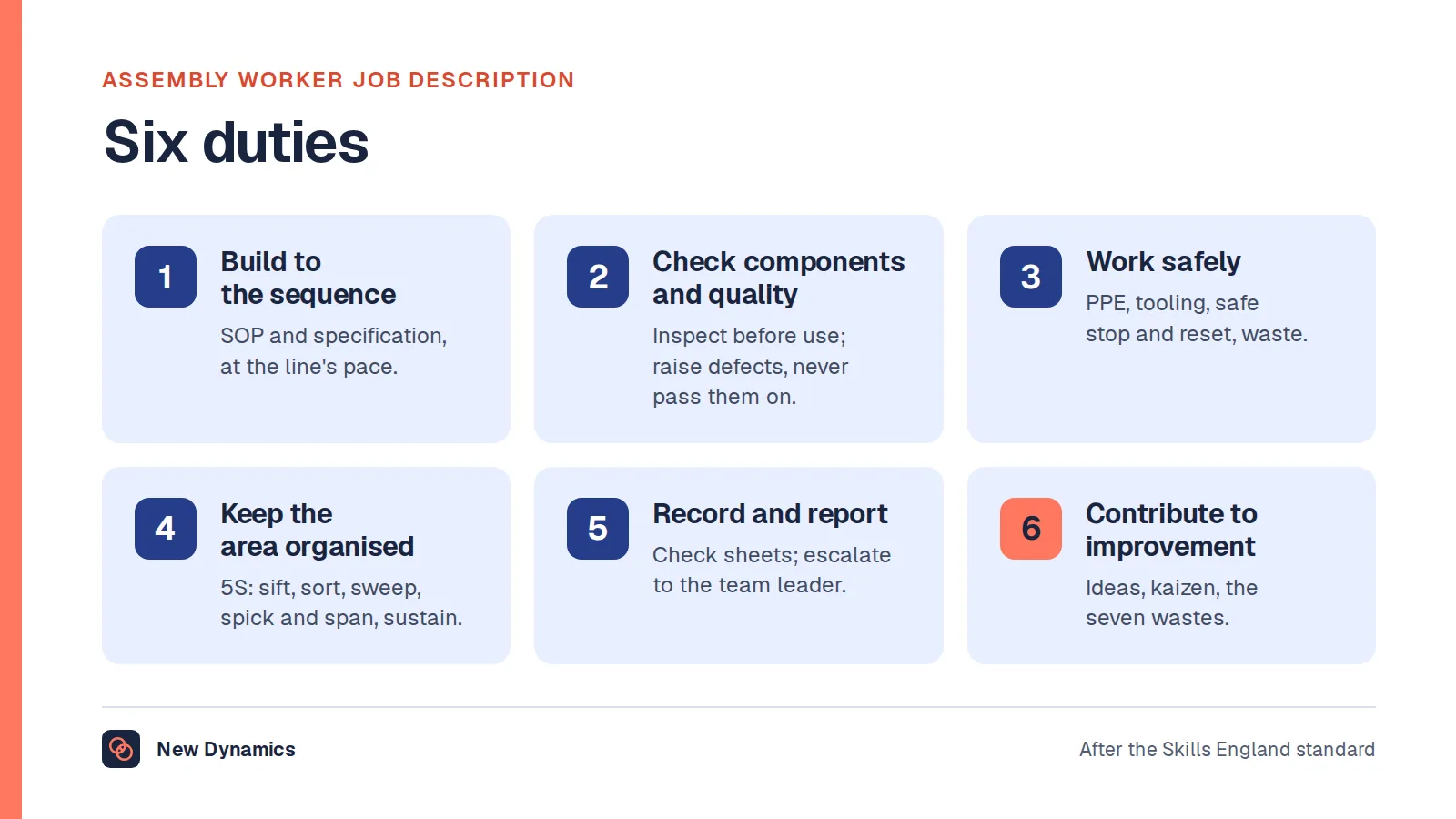
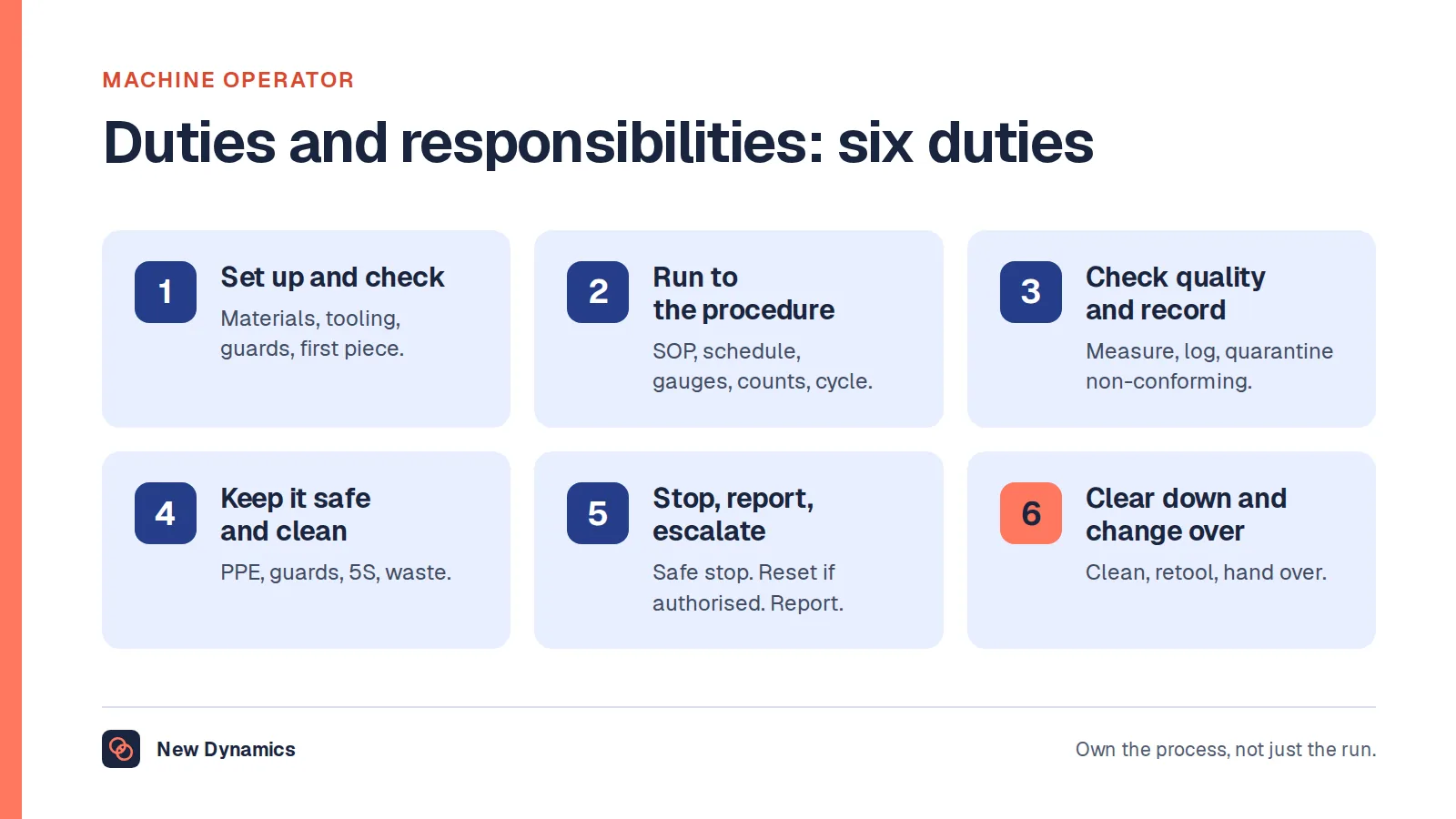
On the floor. Machine setters and operators, assemblers, fabricators, inspectors, materials handlers, maintenance technicians. Our posts on the machine operator and the assembly worker describe two of them.
Leading the floor. O*NET's First-Line Supervisors of Production and Operating Workers "directly supervise and coordinate the activities of production and operating workers, such as inspectors, precision workers, machine setters and operators, assemblers, fabricators, and plant and system operators". Their tasks include planning and establishing "work schedules, assignments, and production sequences to meet production goals", interpreting "specifications, blueprints, job orders, and company policies and procedures for workers", enforcing safety and sanitation regulations, and conducting employee training in equipment operations and safety procedures.
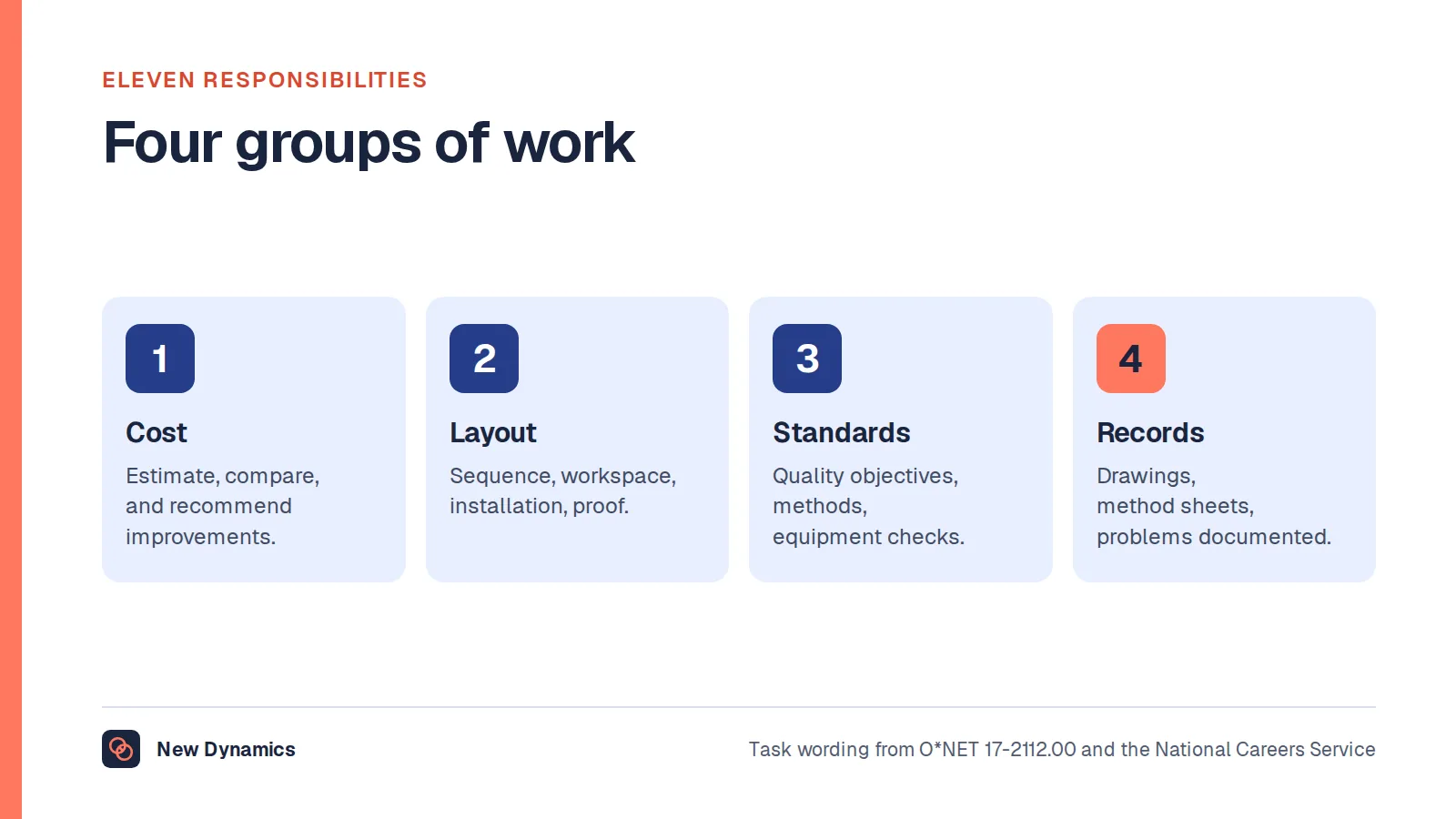
Engineering and improvement. O*NET's Industrial Engineers "design, develop, test, and evaluate integrated systems for managing industrial production processes, including human work factors, quality control, inventory control, logistics and material flow, cost analysis, and production coordination", estimating production costs and cost-saving methods and recommending "methods for improving utilization of personnel, material, and utilities".
The rest of the business. Procurement, planning, quality, health and safety, maintenance, logistics, finance, sales and HR. A manufacturer is an office and a factory sharing a car park, and most of its people problems live at the join.
How the work is measured
Four families, and the tension between them is the management job:
- Output: units, throughput, schedule adherence, overall equipment effectiveness.
- Quality: first-pass yield, scrap and rework, customer complaints, warranty claims.
- Cost: material and labour cost per unit, overtime, stock held.
- Safety: incidents, near-misses, equipment inspections completed, training current.
Push output alone and quality, cost and safety all pay for it, usually in that order.
What changes when you work for one
- The clock matters. Shifts, changeovers and start times are real constraints, not conventions.
- Standard work is the point. Doing it the agreed way is the job, and improvements go through a process rather than being invented at the machine.
- Records are part of the product. The batch, the check and the signature travel with what you made.
- Nobody has a desk. Communication, training and appraisal all have to reach people who are on a line, which is why so many manufacturers have good production systems and poor people systems.
Frequently asked questions
What does a manufacturer do?
Turns materials and components into finished products and takes responsibility for them. The work covers seven activities: designing and specifying the product, sourcing materials and components, planning production, making, checking and testing, delivering with the right documentation, and supporting the product afterwards through warranty, spares and any recall.
What is the difference between a manufacturer and a supplier?
Supplier describes a relationship, not a type of business: whoever provides goods or services to you is your supplier. A manufacturer makes the goods. A manufacturer is a supplier to its customers, and has suppliers of its own for materials and components. A distributor, by contrast, buys finished goods and resells them without making them.
What responsibilities does a manufacturer have?
Two broad sets. On the product, GOV.UK states that anyone who makes, imports, distributes or sells products in the UK needs to understand product safety law, complying with the regulations for specific product types or, where none apply, the general product safety regulations. On the workplace, duties include those under PUWER for the equipment people use. This is general information, not legal advice.
What is PUWER and why does it matter in manufacturing?
The Provision and Use of Work Equipment Regulations. HSE says they place duties on those who own, operate or have control over work equipment, and require equipment to be suitable for its intended use, safe and maintained, inspected, accompanied by protective measures such as guarding and emergency stops, and used only by people who have received adequate information, instruction and training. Work equipment is defined very widely, covering any machinery, appliance, apparatus, tool or installation used at work.
What jobs are there in a manufacturer?
On the floor: machine setters and operators, assemblers, fabricators, inspectors, materials handlers and maintenance technicians, led by production supervisors. In engineering: industrial, process and quality engineers working on methods, cost and reliability. Elsewhere: procurement, planning, quality, health and safety, logistics, finance, sales and HR.
Is an OEM the same as a manufacturer?
Not quite. An original equipment manufacturer makes products or components that another business sells under its own name. The term is used loosely, sometimes for the maker and sometimes for the brand, so it is worth asking which activities each party actually performs and who holds the design authority.
Your next step: check which activities the business actually does
- For any company calling itself a manufacturer, ask which of the seven activities it performs in-house.
- Ask who holds the design authority, because that usually follows the legal responsibility.
- Check that the training record covers every piece of work equipment in use, not just the obvious machines.
- Set objectives across output, quality, cost and safety together rather than one at a time.
For keeping a competency and training matrix that stays current across shifts, read and download our skills gap analysis guide. The guide is free to read, and the PDF uses our short download form.
Want reviews, objectives and check-ins that reach people who are on a line rather than at a desk? Book a New Dynamics demo and bring your current shift structure. You can also email contact@new-dynamics.com.