TL;DR
- A manager is assessed on three layers: what the team delivered, how it was managed, and whatever direct contribution is still yours. Most people write only the first or only the third, and both read badly.
- Management evidence hides in the six areas HSE names as the work design managers control: demands, control, support, relationships, role and change. Used as prompts, they recover a year of work that left no artefact.
- The phrasing rule is simple. The team delivered the result; you name your contribution to it. Claiming the team's work reads as theft, and hiding behind the team reads as absence.
An individual contributor's self assessment is a list of things they made. A manager's is harder, because the things were made by other people, and the work that was genuinely yours is mostly invisible: the person you persuaded to stay, the project you stopped in month two, the week you spent rewriting someone's objectives until they made sense.
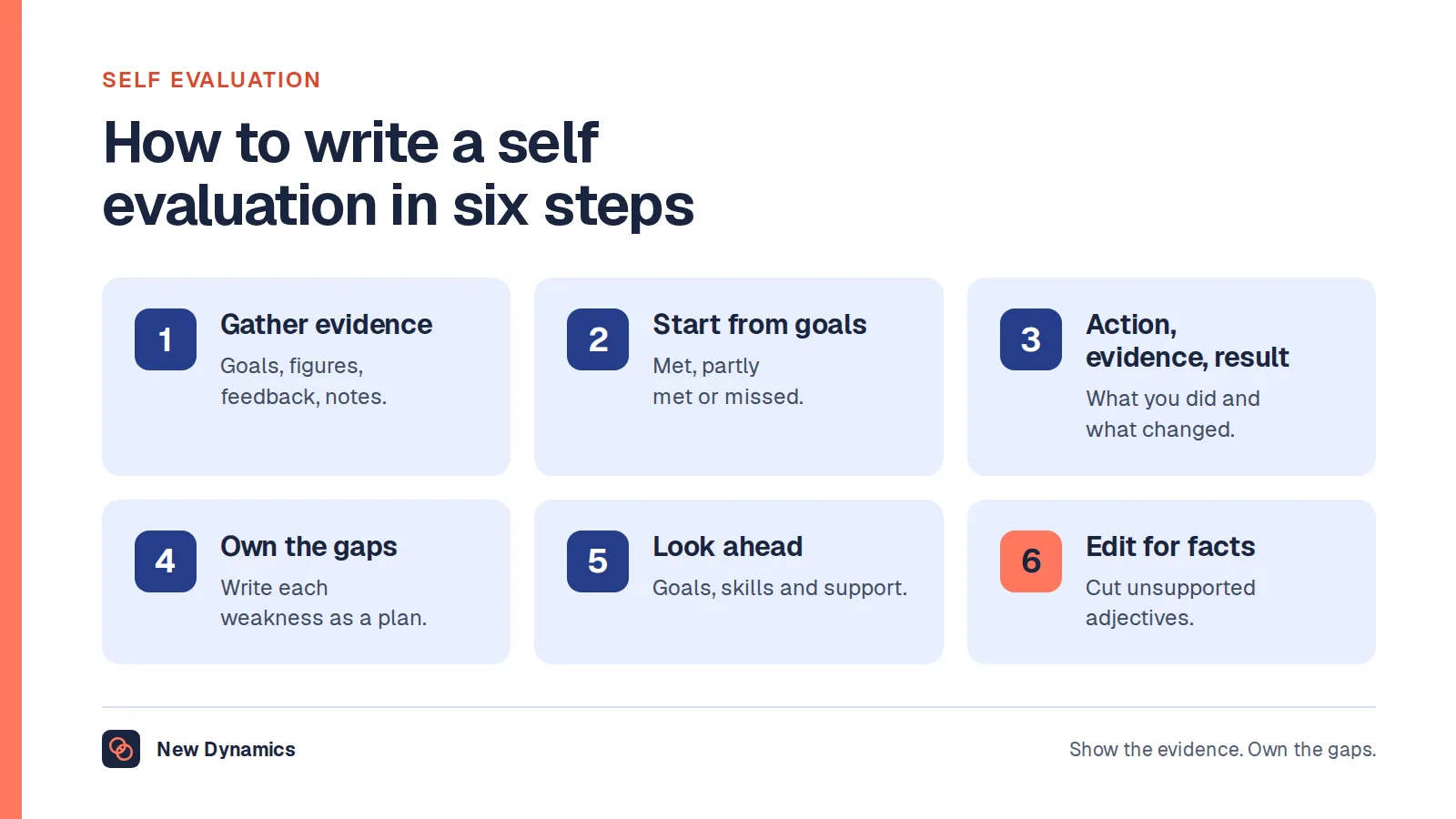
This article covers what you are actually assessed on, where to find evidence for work that left no artefact, a structure for the document, wording that claims your contribution honestly, and what to leave out.
A manager's evidence is easier to assemble when the team's objectives and progress are recorded as they happen. See how New Dynamics goals and OKRs keep the team's outcomes visible through the year.
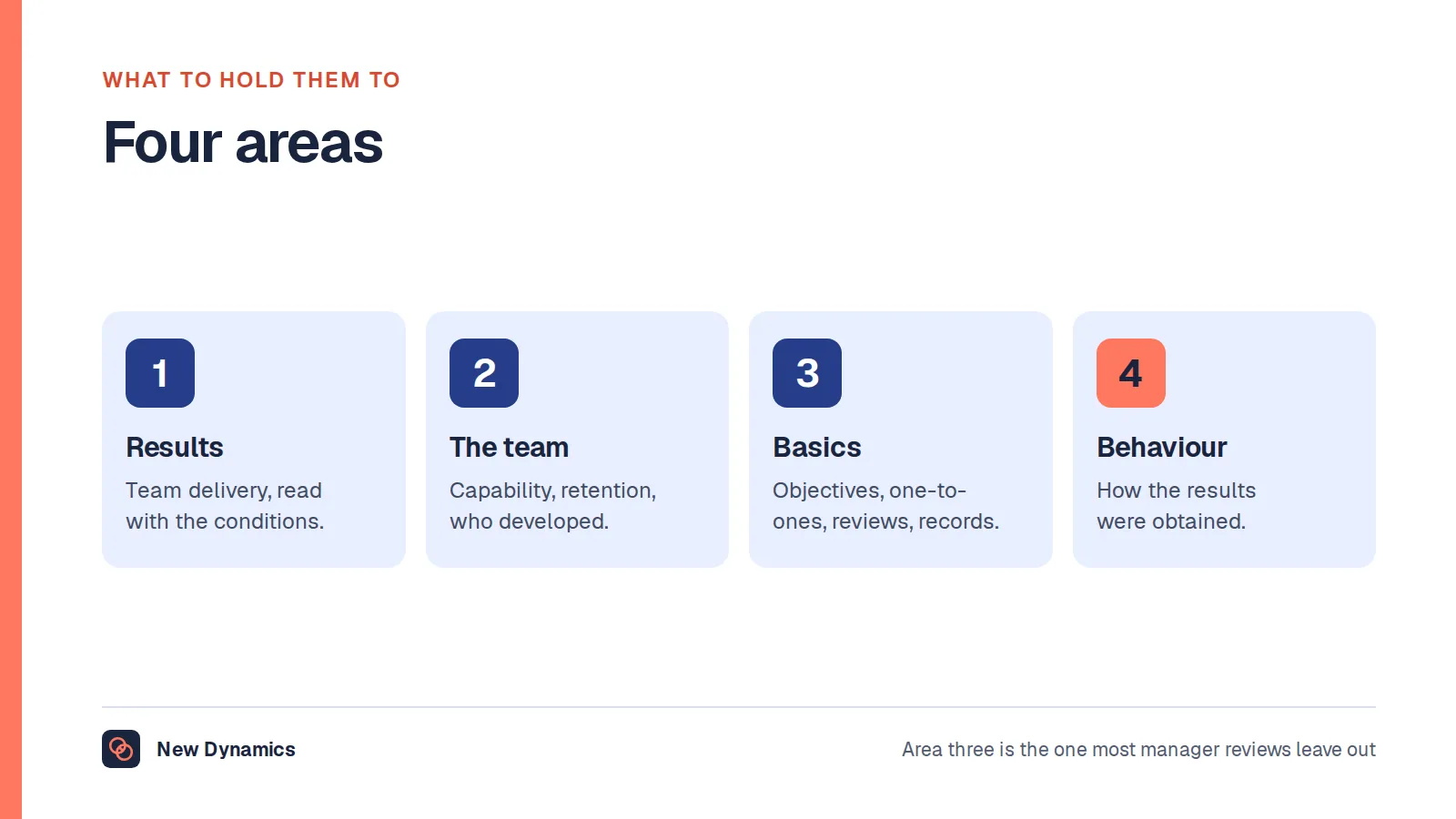
Three layers, not one

What the team delivered. The outcomes, against the objectives that were set. This is the layer most senior readers care about, and it belongs at the top.
How it was managed. The practice: objectives set and kept current, one-to-ones held, feedback given when it was awkward, problems addressed early, people developed. Acas treats this as ordinary management work, describing regular feedback, coaching and "regular check-ins, sometimes known as one-to-ones" as what happens alongside the formal cycle.
Your own direct contribution. Shrinking every year, and that is correct rather than a problem. Name it briefly and move on.
Two failure modes. Writing only the first layer reads as if you were a spectator with good luck. Writing only the third reads as if you are still doing the job you were promoted out of.
Six places management evidence hides

HSE's Management Standards name six areas of work design that managers control, and they work unreasonably well as prompts for a self assessment. HSE describes them as areas that, "if not properly managed, are associated with poor health, lower productivity and increased accident and sickness absence rates".
Demands, which HSE defines as "workload, work patterns and the work environment". What did you rebalance, refuse, or resequence? The work you took off the team is evidence, and it is never in a delivery report.
Control, "how much say the person has in the way they do their work". Where did you hand over a decision you used to make? Name the decision and who holds it now.
Support, "the encouragement, sponsorship and resources provided by the organisation, line management and colleagues". Training you funded, a case you made for headcount, someone you put forward for work that stretched them. Acas puts a floor under this: employers "must provide 'adequate resources' to enable an employee to do their job", including training.
Relationships, "promoting positive working to avoid conflict and dealing with unacceptable behaviour". The conflict you handled in week one rather than month six. This is the single most under-claimed category in manager self assessments, because a problem you prevented leaves no trace.
Role, "whether people understand their role within the organisation and whether the organisation ensures that they do not have conflicting roles". Job descriptions you rewrote, overlaps you resolved, the handover that stopped two people doing the same work.
Change, "how organisational change (large or small) is managed and communicated". What did you explain, and how did you find out whether it had landed?
A six-part structure
- The team's results, against the objectives that were set, with the misses included and explained.
- People. Who joined, who left and why, who was promoted, who developed into something new, and the retention conversation that worked.
- Management practice. The cadence you actually kept: one-to-ones held, reviews completed on time, feedback given early. Acas treats the written record as part of the job, saying "it's important to keep a written record of what is discussed".
- Problems handled. Performance concerns raised early, a difficult case managed properly, a risk escalated before it became an incident.
- What went wrong, and what you changed. One real example, with the change you made. A manager with no section five is either very new or not reading the evidence.
- What you need next. Headcount, budget, a decision, air cover, or a conversation about your own development. This is the part most managers delete, and it is the part your own manager can act on.
Phrasing that claims your contribution honestly

The rule: the team delivered the result, and you name your contribution to it. Wording to adapt:
- Instead of "I delivered the migration", write "the team delivered the migration; I resequenced it in March when the second workstream slipped, and took two reporting commitments off them to protect the deadline."
- Instead of "the team missed the target", write "we missed the target by a quarter. I set it before the supplier change and did not revise it when the scope moved, which I would now do at the first review point."
- Instead of "I supported the team", write "I funded two people through the certification, and moved one into the architecture work they had asked for twice."
- Instead of "I improved communication", write "I rewrote the three job descriptions that overlapped, which ended the duplicate reporting both teams were doing."
- Instead of "I managed a difficult situation", write "I dealt with a conflict between two reports in the week it surfaced, agreed how they would work together, and checked back twice."
Specific beats generous. Every line above can be verified by someone else, which is what makes it usable in a calibration conversation you will not be in.
What to leave out
- Your reports' personal details. Your self assessment is not the place for anyone else's health, family circumstances or performance rating. Keep it to your actions, for the reasons our post on performance review record keeping sets out.
- The list of meetings you attended. Attendance is not management.
- Adjectives about yourself. "Strategic", "collaborative" and "driven" survive no scrutiny at all. Replace each with the thing you did.
- The team's work with your name on it. Someone will read both documents.
Upward feedback, read properly
If your organisation collects feedback from your team, read it before the meeting rather than during it, and read it for patterns. One sharp comment is a person having a bad week; the same theme from four people is your year. If you have never asked for it, ask informally: three questions, in confidence, to people who will answer honestly.
Our post on manager performance covers what is reasonable to be measured on, which is worth agreeing with your own manager before the cycle rather than after it.
If you manage managers
The layers move up. Your evidence is what your managers' teams achieved, how your managers developed, and whether the practice is consistent across them: are ratings comparable, are one-to-ones actually happening, did anyone get promoted from inside. Add one line on the manager you grew into a bigger role and one on the manager you had to move, because both are the job.
Frequently asked questions
What should a manager write in a self assessment?
Three layers: what the team delivered against its objectives, how you managed it, and whatever direct contribution was still yours. Then people decisions, management practice, problems you handled, one thing that went wrong with what you changed, and what you need next from your own manager.
How do you write about your team's achievements without taking credit?
Separate the result from your contribution in the same sentence. The team delivered the thing; you resequenced it, protected the deadline, or funded the training that made it possible. Specific contributions read as honest, while unqualified claims read as theft and vague ones read as absence.
How do you evidence management work that left no artefact?
Use HSE's six Management Standards areas as prompts: demands, control, support, relationships, role and change. What did you rebalance, hand over, fund, resolve, clarify or explain? Problems prevented leave no trace in a delivery report, so they have to be written down deliberately.
How long should a manager self assessment be?
Two pages is usually right: one on results and people, one on practice, problems and what you need. Length is not evidence. If a section cannot be made specific, it is better deleted than padded.
Should a manager include failures in their self assessment?
Yes, one real one, with what you changed as a result. A self assessment with no misses invites the reader to find them for you, and the change you made is the part that demonstrates judgement.
What is different about a self assessment for a manager of managers?
The evidence moves a level up: what your managers' teams achieved, how your managers developed, and whether practice is consistent across them. Include both the manager you grew into a larger role and the one you had to move, because handling the second well is as much the job as the first.
Your next step: find the invisible year
- Open your calendar for the last twelve months and mark every conversation that changed something. That is your evidence list.
- Walk the six HSE areas and write one line under each. Blank ones are either a gap or something you forgot.
- Write the results section last, so that the management work is not squeezed into whatever space is left.
- Ask three people for one thing you should do differently, before you write section six.
For the conversations most of this evidence comes from, read and download our manager one-to-one guide. The guide is free to read, and the PDF uses our short download form.
Want your team's objectives and feedback in one place when you sit down to write? Book a New Dynamics demo and bring last year's assessment. You can also email contact@new-dynamics.com.