TL;DR
- Mentoring is a relationship in which, as CIPD puts it, “a more experienced colleague shares their greater knowledge to support the development of an inexperienced individual”, and it runs longer than coaching.
- The distinction most programmes blur is mentor against sponsor. A mentor advises you; a sponsor advocates for you in rooms you are not in.
- CIPD is clear that mentoring works best when it moves “beyond the directive approach of a senior colleague 'telling it how it is'”, with learning for both participants.
Somebody asks for a mentor. What they usually want is for a senior person to say their name in a meeting they are not invited to. Those are different things, and a programme that confuses them disappoints everyone politely.
This article explains what mentoring programs are, how mentoring differs from coaching, the mentor and sponsor distinction, and what mentors actually need in order to be any good.
Mentoring works on top of ordinary feedback, not instead of it. See how New Dynamics feedback keeps that record continuous.
Mentoring, and how it differs from coaching

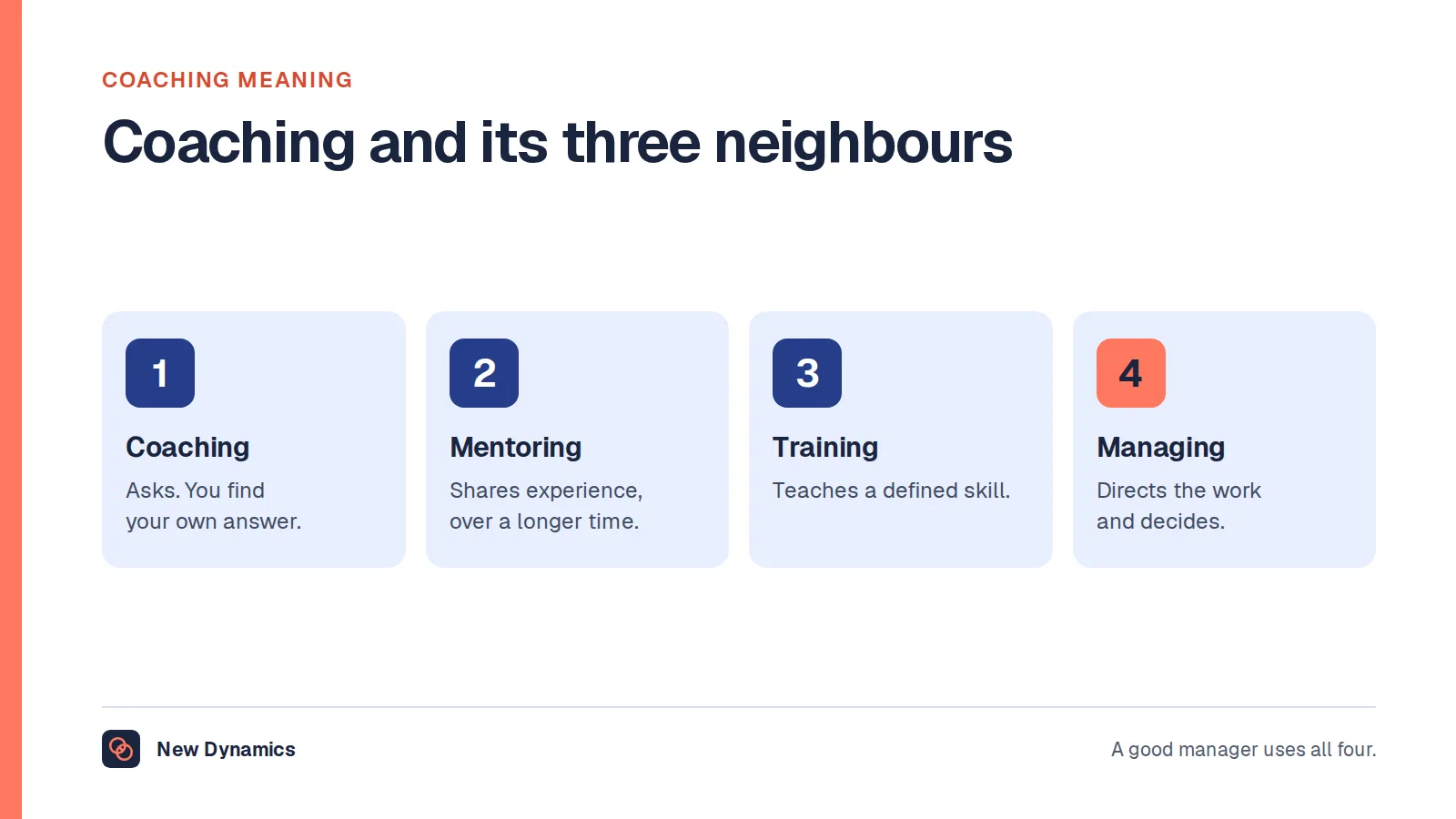
CIPD's factsheet on coaching and mentoring treats them as siblings: both are "development approaches based on the use of one-to-one conversations to enhance an individual's skills, knowledge or work performance", and "it's possible to draw distinctions between coaching and mentoring although the two terms are often used interchangeably".
Mentoring "describes a relationship in which a more experienced colleague shares their greater knowledge to support the development of an inexperienced individual". It "calls on the skills of questioning, listening, clarifying and reframing that are associated with coaching", and "one key distinction is that mentoring relationships tend to be longer term than coaching arrangements".
Coaching "aims to produce optimal performance and improvement at work", "focuses on specific skills and goals", and "typically lasts for a defined period of time". It is "essentially a non-directive form of development" and "a skilled activity, which should be delivered by those trained in coaching skills".
So: coaching is shorter, narrower and non-directive; mentoring is longer, wider and may legitimately include advice. Our coaching meaning post covers the coaching side in detail.
Mentor versus sponsor

This is the distinction worth building a programme around.
- A mentor talks to you. They share experience, answer questions, and help you think. The relationship is developmental and mostly private.
- A sponsor talks about you. They put your name forward, argue for you in decisions about promotion and opportunity, and spend some of their own credibility doing it.
- A coach asks you questions. They do not need to know your job, and they are not advocating for you anywhere.
Most people asking for a mentor want a sponsor. Most programmes supply mentors, because mentoring can be volunteered and sponsorship cannot be assigned, it requires the senior person to take a risk on someone.
Being honest about which one a programme offers is the single most useful thing you can do for it. If access to sponsorship is unevenly distributed in your organisation, a mentoring scheme will not fix that, and pretending otherwise wastes everybody's goodwill.
What a programme consists of

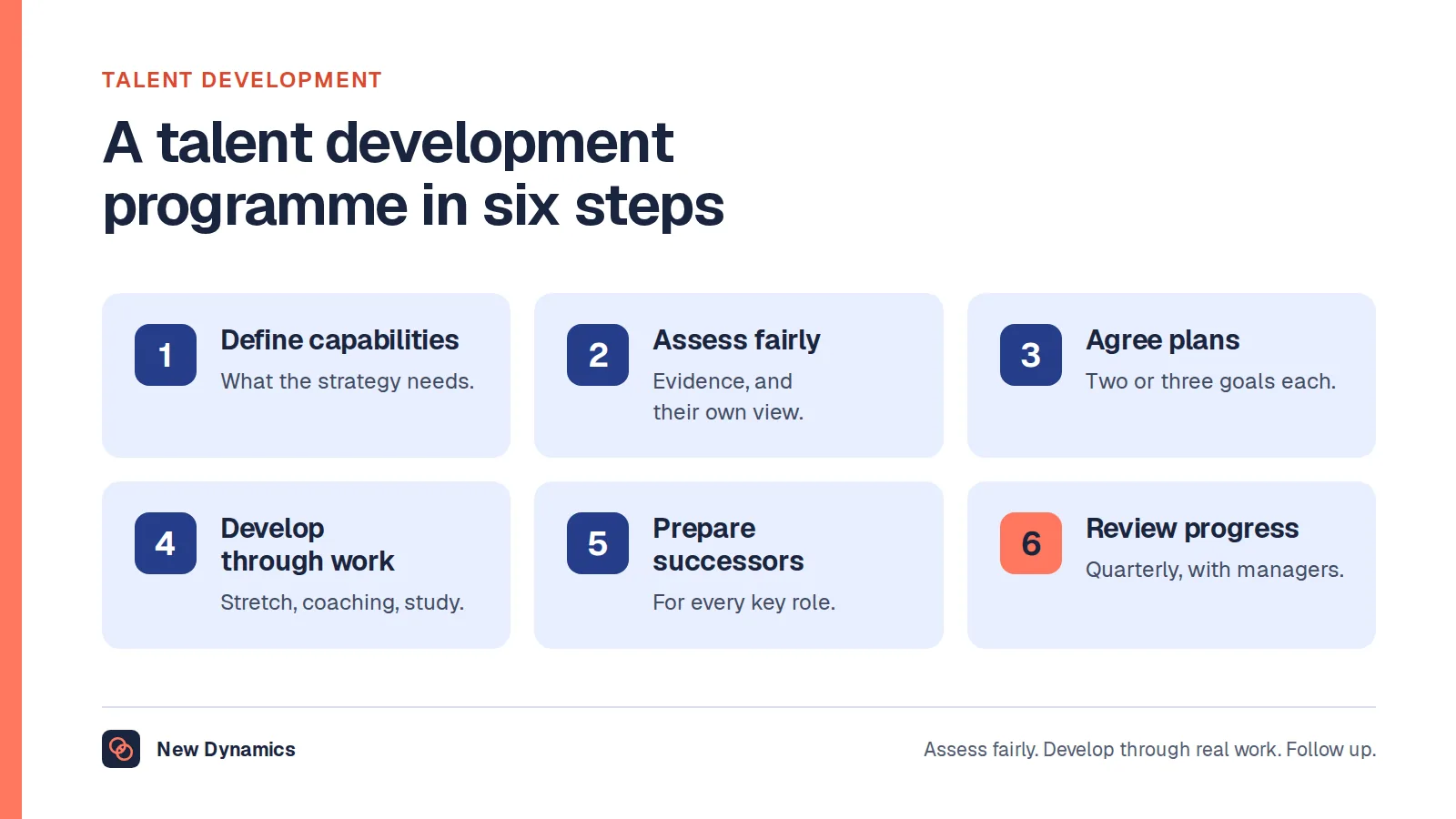
CIPD lists the objectives organisations have for coaching and mentoring programmes: "assisting performance management", "preparing and supporting people through change", "supporting self-directed learning and development", and "sharing curated resources".
Four decisions turn those objectives into something that runs:
- Purpose. Which of the objectives above yours serves. A programme that serves all four serves none.
- Matching. Who pairs people, on what basis, and whether either side can decline without awkwardness.
- Duration and cadence. A stated length with an agreed end, and a frequency people can actually hold.
- Review. A scheduled point at which both people say whether it is working, with a graceful way to stop.
CIPD also notes that although such programmes "are widespread within organisations, there needs to be clarity on: how best to support the stakeholders, when coaching is (or isn't) an appropriate intervention for poor performance, how to work effectively with an external coach". The middle one matters: mentoring is not a performance remedy, and routing a performance problem into a mentoring scheme delays the conversation somebody needs to have.
What mentors actually need
Less training than people expect, and more support than they are usually offered.
The skills CIPD associates with these relationships ("questioning, listening, clarifying and reframing") can be introduced in a short session. What is harder is the disposition: CIPD says mentoring relationships "work best when they move beyond the directive approach of a senior colleague 'telling it how it is'", and that "an effective mentoring relationship is where there are learning opportunities for both participants". A mentor who treats the meeting as an opportunity to broadcast will not be told they are doing it.
CIPD also points to the value of supervision: people involved "need structured opportunities to reflect on their practice", which acts as "an important quality assurance for organisations and a source of organisational learning". A termly conversation among mentors about what is hard is worth more than a longer induction.
One practical note on cost: CIPD observes that "external mentors can be expensive". Internal mentoring is usually the realistic option, which makes the selection and support of internal mentors the whole game.
The conditions it depends on
A mentoring programme is a support mechanism, and HSE's Support standard describes what has to be true for any of them to work: systems in place "to enable and encourage employees to support their colleagues", employees who "know what support is available and how and when to access it", and employees who "receive regular and constructive feedback".
If people do not know the programme exists, or cannot get ordinary feedback from their own manager, mentoring becomes a substitute for management rather than an addition to it.
Fairness
CIPD notes it is "important to consider the link with coaching and mentoring and the wider organisation's EDI policy". The practical risk is that informal mentoring already exists and already favours the people who are most visible. A formal programme either corrects that or formalises it, depending on how matching is done and who is invited.
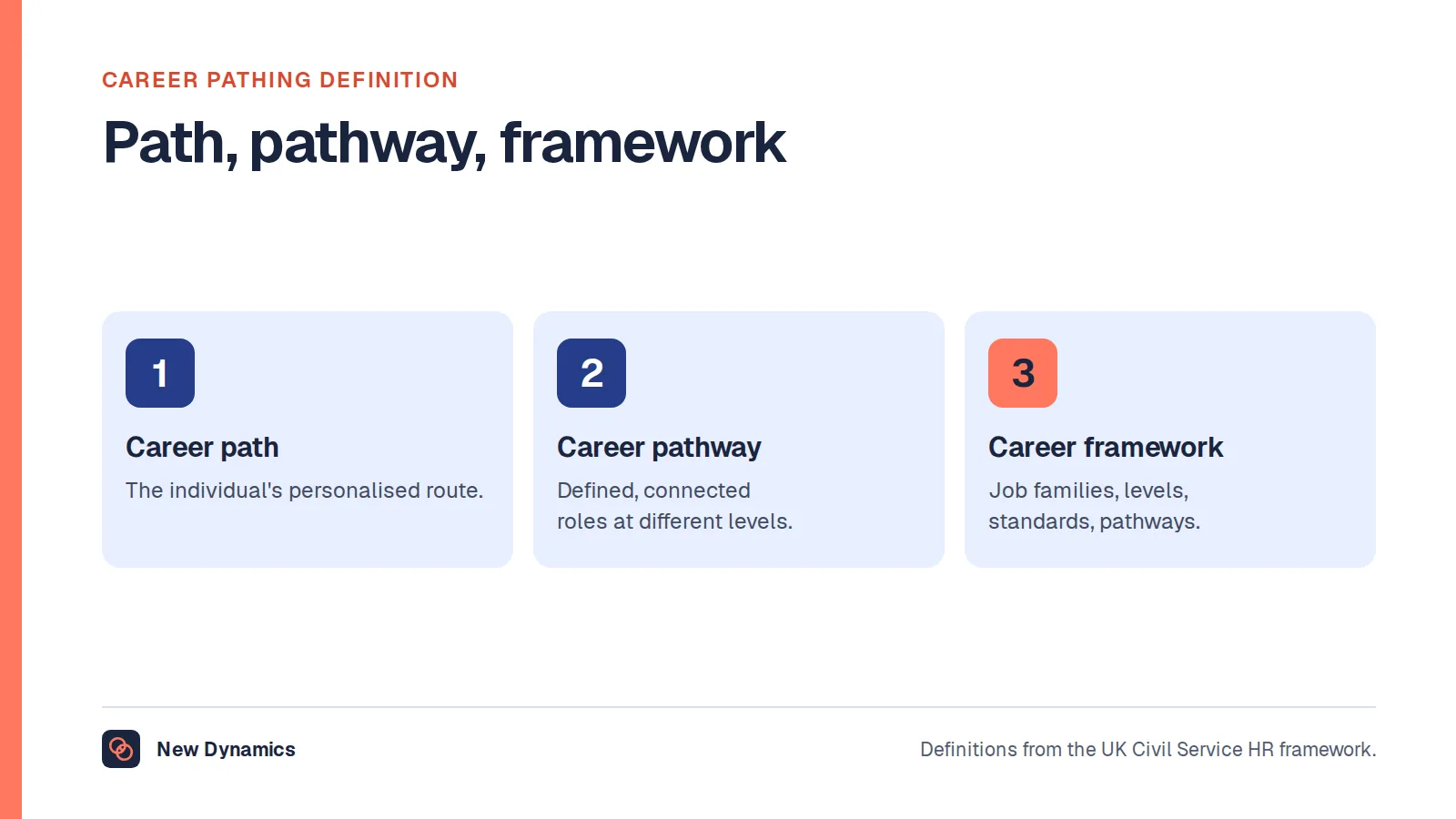
Publish who the programme is open to, how to join, and how pairs are made. Our career pathing post covers giving people somewhere to progress towards.
Measuring it
Avoid satisfaction scores as the headline. More useful:
- Whether pairs met at the agreed frequency, and how many stopped early.
- What mentees did differently, in their own words, at the review point.
- Who took part, by function and level, compared with the population.
- Whether mentors would do it again, which is the best predictor of whether the programme survives.
Frequently asked questions
What are mentoring programs?
Organised schemes pairing a more experienced colleague with someone less experienced, for a stated period and purpose. CIPD describes mentoring as a relationship in which a more experienced colleague shares their greater knowledge to support another person's development.
What is the difference between mentoring and coaching?
Coaching focuses on specific skills and goals, is non-directive and usually runs for a defined period. Mentoring is broader, tends to be longer term, and may include advice drawn from the mentor's own experience.
What is the difference between a mentor and a sponsor?
A mentor advises you directly. A sponsor advocates for you in decisions you are not present for, spending some of their own credibility to do it. Programmes can assign mentors; sponsorship has to be earned and offered.
What training do mentors need?
A short introduction to questioning, listening, clarifying and reframing, plus a clear brief on what the programme is for. More valuable is ongoing supervision, structured chances to reflect on practice, which CIPD treats as quality assurance for the organisation.
Can mentoring fix poor performance?
No, and treating it as the remedy delays the conversation that is needed. CIPD explicitly flags the need for clarity about when coaching is or is not an appropriate intervention for poor performance; the same caution applies to mentoring.
How long should a mentoring relationship last?
Longer than a coaching arrangement, with a stated end and a review point. Setting an end date makes it easier for either side to stop without it being a judgement on the other person.
How do you measure a mentoring programme?
Track whether pairs met as agreed, how many stopped early, what mentees describe doing differently, who took part compared with the wider population, and whether mentors would volunteer again.
Your next step: decide which thing you are offering
- Write down whether your programme offers mentoring, coaching or sponsorship.
- Pick one objective from the four, and drop the others.
- Decide how pairs are matched and publish it.
- Book the mentors' reflection session before the programme launches.
For giving people something to aim at that the mentoring can serve, read and download our career development guide. The guide is free to read, and the PDF uses our short download form.
Want development conversations recorded as they happen rather than recalled at review time? Book a New Dynamics demo and bring your current scheme. You can also email contact@new-dynamics.com.