TL;DR
- Coaching is a way of developing someone through conversation. The coach mostly asks and listens, so that the person finds their own way to improve their performance and reach a goal.
- To be coached means to be helped to think, not told what to do. It differs from mentoring, which shares experience, from training, which teaches a skill, and from managing, which directs the work.
- A coaching conversation has five steps: agree the topic, explore what is happening, generate options, choose a step and follow up. Any manager can learn to do it.
Your manager says, “I would like to coach you on this.” It could mean several things. It could mean help. It could mean that you are in trouble. It could mean an hour of being asked “and how does that make you feel?” The word has travelled a long way from the touchline, and it has picked up some confusion on the way.
This article gives the meaning of coaching at work, explains what it means to be coached, separates coaching from mentoring, training and managing, and sets out a simple coaching conversation with 20 questions to use in it.
Coaching happens in ordinary conversations. See how New Dynamics continuous feedback helps managers to coach, recognise and listen as part of everyday work.
What does coaching mean?
The everyday meaning comes from sport and study. The Cambridge Dictionary defines the verb coach as “to give special classes in sports or a school subject, especially privately, to one person or a small group”. Its business entry is wider: “to provide training or help prepare someone for something”. Its example is “He offered to coach me for my interview.”
In organisations the word has taken on a more particular sense. The CIPD's factsheet on coaching and mentoring describes both as “development approaches based on the use of one-to-one conversations to enhance an individual's skills, knowledge or work performance”. Of coaching it says: “Coaching aims to produce optimal performance and improvement at work. It focuses on specific skills and goals”.
The CIPD lists some generally agreed principles of coaching in organisations.
- It is “essentially a non-directive form of development”.
- Personal factors may be included, but the emphasis is on performance at work.
- Coaching has both organisational and individual goals.
- It is a skilled activity, which should be delivered by those trained in coaching skills.
“Non-directive” is the word that matters. A sports coach may shout instructions from the side of the pitch. A workplace coach mostly asks questions. The thinking is done by the person being coached.
What does it mean to be coached?
To be coached at work means that someone helps you to think through a goal or a problem, so that you reach your own conclusions and act on them. You do most of the talking.
Good coaching has five signs.
- They listen more than they speak.
- They ask open questions, and wait for the answer.
- The goal is yours. You say what you want to achieve, within what the job needs.
- The decision is yours. You choose what to do next.
- They follow up. They ask later how it went.
Being coached is not a sign that you are failing. The CIPD notes that coaching can form “the basis of an on-going management style”. Coaching is often offered to capable people, because someone wants them to go further.

Coaching, mentoring, training and managing
- Coaching. Asks. It helps you to find your own answer to a particular goal or problem. The CIPD says that it typically lasts for a defined period of time.
- Mentoring. Shares. The CIPD describes it as a relationship in which “a more experienced colleague shares their greater knowledge to support the development of an inexperienced individual”, and notes that mentoring relationships “tend to be longer term than coaching arrangements”.
- Training. Teaches. A defined skill or piece of knowledge is passed on, often to a group.
- Managing. Directs. The manager sets priorities, makes decisions and is accountable for the results.
The CIPD points out that the two terms coaching and mentoring “are often used interchangeably”, and that mentoring calls on the same skills of questioning, listening, clarifying and reframing. A good manager moves between all four in a single week, and sometimes in a single conversation.
One neighbour is outside the workplace altogether. Coaching is not counselling or therapy. A coach who finds that a conversation is turning to serious distress or to mental health should help the person towards proper support, such as an employee assistance programme or a doctor.

Who does the coaching?
- Line managers, in one-to-ones and in the moment. This is where much coaching happens, or fails to happen.
- Internal coaches: trained colleagues, usually from outside your reporting line.
- External coaches: professionals, often engaged for senior leaders or for a particular transition.
- Peers, in pairs or small groups.
The CIPD's factsheet covers who delivers coaching inside and outside the organisation, how to develop a coaching culture, and the increasing use of AI as an option. For that last topic, see our guide to AI-assisted manager coaching.
A coaching conversation in five steps
You do not need a qualification to hold a useful coaching conversation. You need fifteen minutes, some patience and these five steps.
- Agree the topic. What does the person want to work on, and what would a good result look like?
- Explore what is happening. What is going on now? What have they tried? Resist the urge to diagnose.
- Generate options. What could they do? Ask for several. Offer an idea of your own only after theirs, and as one option among others.
- Choose a step. What will they do, by when? What might get in the way?
- Follow up. Agree when you will ask how it went. Then ask.

Twenty coaching questions
To agree the topic
- What would you like to get from this conversation?
- What does success look like?
- Why does this matter to you now?
- How will you know that you have got there?
To explore
- What is happening at the moment?
- What have you tried so far, and what happened?
- What is getting in the way?
- What part of this is within your control?
To generate options
- What could you do?
- What else?
- What would you do if you had more time, or more confidence?
- What would you advise a colleague to do in your position?
To choose a step
- Which option appeals to you most, and why?
- What exactly will you do, and by when?
- What could stop you, and how will you deal with that?
- What support do you need, from me or from anyone else?
To follow up
- What did you do?
- What happened?
- What did you learn?
- What is the next step?
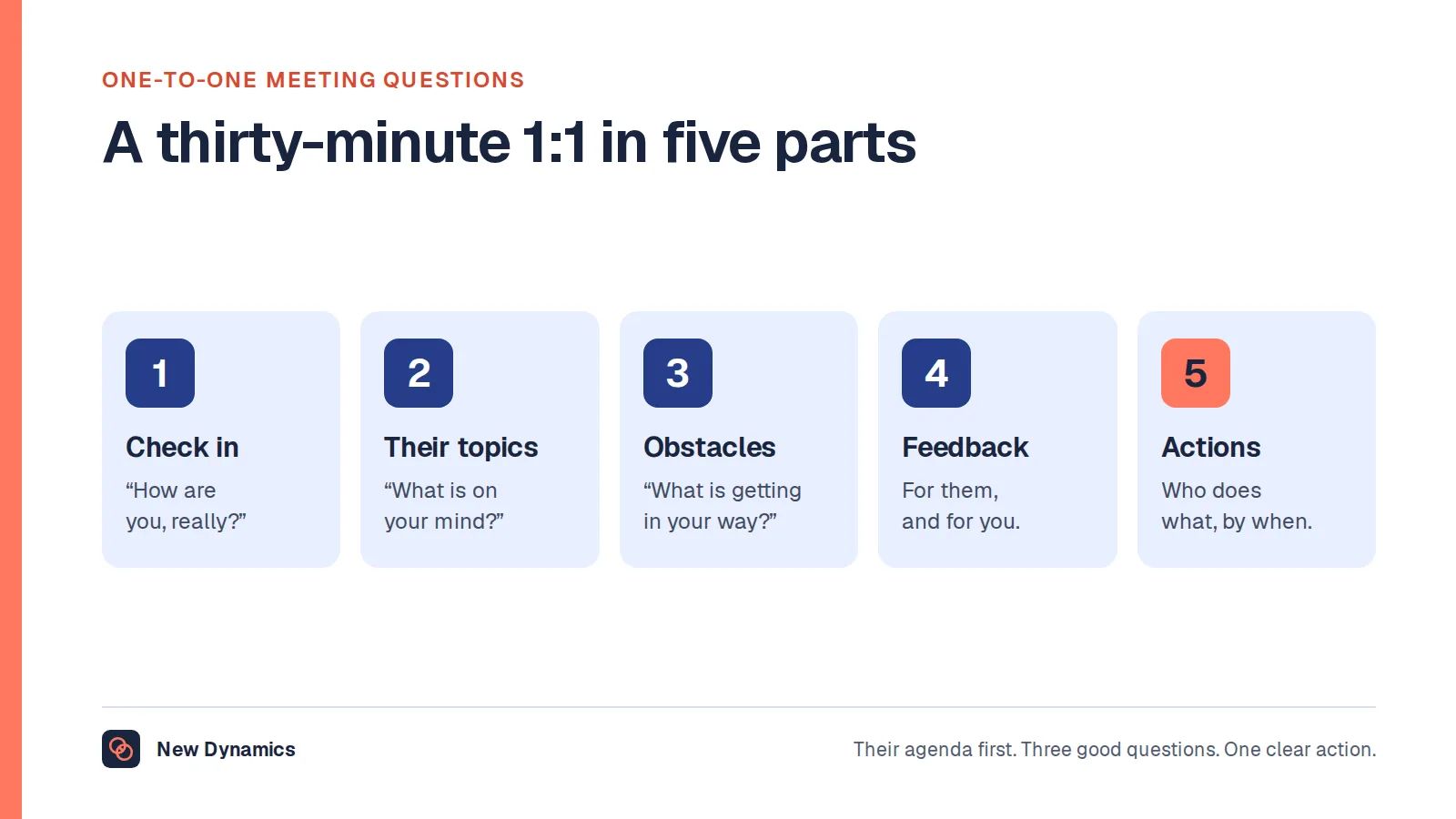
“What else?” is worth more than the other nineteen. The first answer is rarely the best one. For questions to use in regular meetings, see our one-to-one meeting questions.
When coaching works, and when it does not
Coaching suits
- a capable person who faces a new or difficult situation;
- someone stepping up to a bigger role;
- a problem with more than one reasonable answer;
- building confidence and judgement over time.
Coaching does not suit
- an emergency. If the building is on fire, give instructions;
- a gap in basic knowledge. Someone who has never been shown the system needs training, and questions will only frustrate them;
- a breach of the rules, which calls for a clear conversation about standards;
- someone who does not want to be coached. It cannot be done to a person.
Common mistakes
Advice dressed as a question. “Have you thought about doing it my way?” is not coaching.
Coaching only poor performers. It teaches everyone that coaching is a punishment.
Asking, and then answering. Silence is part of the method. Count to five.
No follow-up. Without it, a coaching conversation is a pleasant chat.
Playing therapist. Know where coaching stops.
Calling a telling-off “coaching”. People notice, and the word is spoiled for everyone.
Frequently asked questions
What is the meaning of coaching?
At work, coaching is a way of developing someone through one-to-one conversation. The coach mainly asks questions and listens, so that the person finds their own way to improve performance and reach specific goals. The CIPD calls it an essentially non-directive form of development.
What does it mean to be coached?
To be coached means that someone helps you to think through a goal or a problem, so that you reach your own conclusions and act on them. You set the goal, do most of the talking and decide the next step. It is not a sign of failure.
What is the difference between coaching and mentoring?
A mentor is a more experienced colleague who shares knowledge and experience, usually over a longer period. A coach need not be an expert in your field, and works mainly by asking questions about a specific goal, usually for a defined period.
Is coaching the same as training?
No. Training teaches a defined skill or piece of knowledge, often to a group. Coaching helps one person to apply what they know, solve their own problems and build judgement. People often need both.
Can a manager be a coach?
Yes. The CIPD notes that coaching can be the basis of an ongoing management style. A manager cannot coach all the time, because managers must also direct work and make decisions. The skill lies in knowing which the moment needs.
What are good coaching questions?
Open questions that make the person think: “What would success look like?”, “What have you tried?”, “What else could you do?”, “What will you do, and by when?” and, afterwards, “What did you learn?”
Your next step: ask before you tell
- In your next one-to-one, when someone brings you a problem, ask “What have you tried?” before you offer a view.
- Ask “What else?” at least once.
- End with “What will you do, and by when?”
- Put a note in your diary to ask how it went.
For a structure for regular coaching conversations, read and download our one-to-one meeting guide. The guide is free to read, and the PDF uses our short download form.
Want coaching to be part of everyday work, with notes and follow-ups in one place? Book a New Dynamics demo and bring your current one-to-one format. You can also email contact@new-dynamics.com.