TL;DR
- A motivation theory is an explanation of why people put effort into some things and not others. Content theories describe what people need. Process theories describe how people decide whether effort is worthwhile.
- Six theories cover most of what managers need: Maslow's hierarchy of needs, Herzberg's two factors, Vroom's expectancy theory, Adams's equity theory, goal-setting theory from Locke and Latham, and self-determination theory from Deci and Ryan.
- Together they give five practical questions: are the basics fair, is the work interesting, are goals clear, is reward fair and linked to effort, and do people have autonomy and belonging?
Every manager has a theory of motivation, whether or not they know it. The manager who reaches for a bonus scheme believes one thing. The manager who redesigns the job believes another. The manager who does nothing believes that motivation is the employee's own business. The formal theories are useful because they make those beliefs visible, and show where each one works and fails.
This article explains what motivation theories are, separates content theories from process theories, sets out six major theories and the theorists behind them, and turns them into five questions that a manager can use on Monday morning.
One of the six theories is about goals. See how New Dynamics Goals & OKRs keep targets and progress in one place.
What is a motivation theory?
The Cambridge Dictionary defines motivation in its first sense as “enthusiasm for doing something”. A motivation theory is an attempt to explain where that enthusiasm comes from: why a person chooses one activity over another, how hard they try and how long they keep going.
No single theory explains everything. Frederick Herzberg, one of the theorists below, opened his best-known article with a warning that still stands: “The psychology of motivation is tremendously complex, and what has been unraveled with any degree of assurance is small indeed.”
So treat the theories as lenses. Each shows part of the picture.
Content theories and process theories
Textbooks sort the theories into two families.
- Content theories ask what motivates people. They describe needs, such as security, belonging, achievement and growth. Maslow and Herzberg belong here, together with David McClelland, who described needs for achievement, affiliation and power.
- Process theories ask how motivation works. They describe the thinking by which a person decides whether effort is worthwhile: what they expect, what they compare and what they are aiming at. Expectancy, equity and goal-setting theories belong here.
Self-determination theory, the most recent of the six, has elements of both.

Six motivation theories, explained plainly
1. Maslow's hierarchy of needs
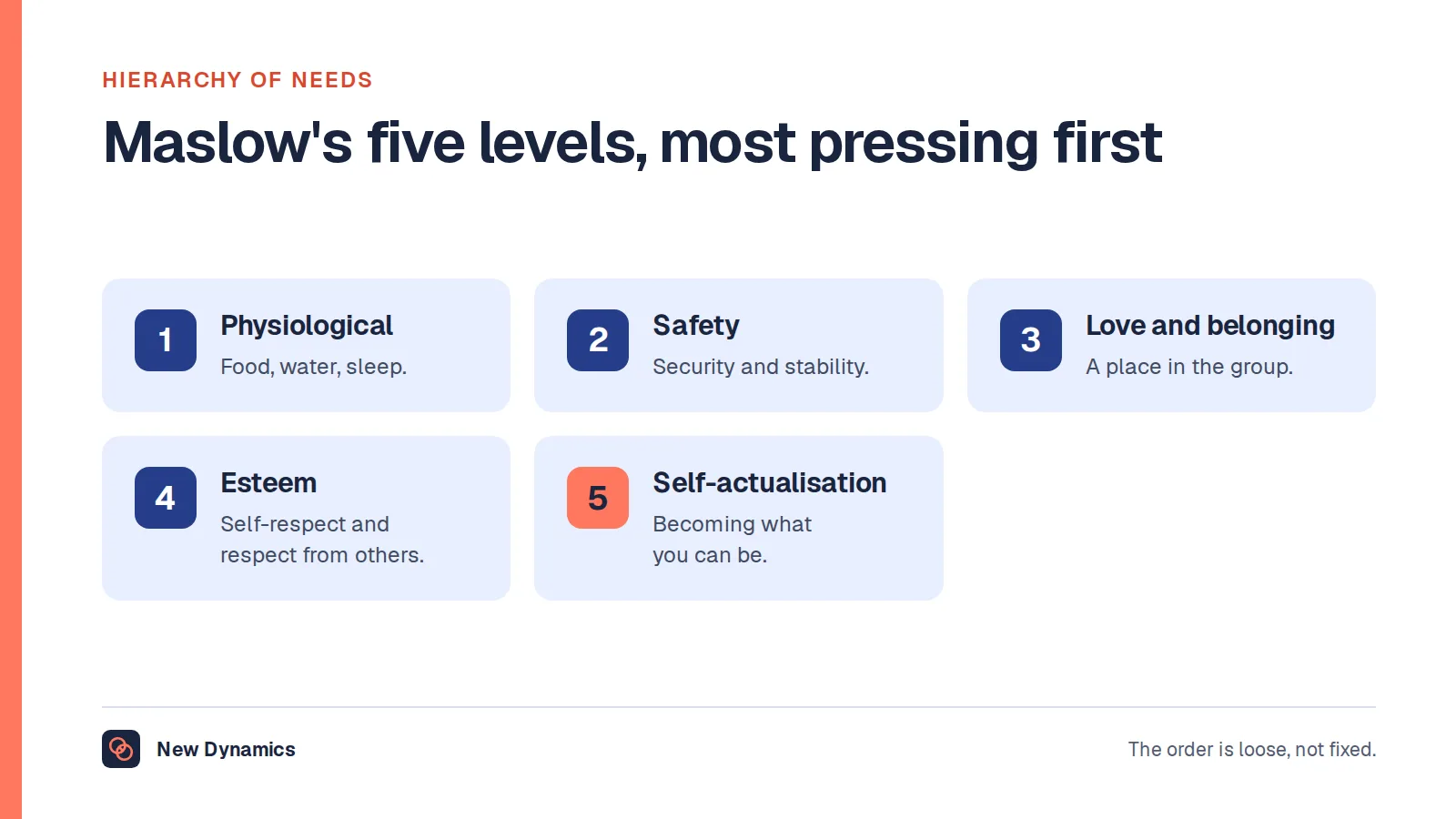
Abraham Maslow's paper A Theory of Human Motivation, published in 1943, proposed five sets of needs. His own summary reads: “There are at least five sets of goals, which we may call basic needs.” They are physiological, safety, love, esteem and self-actualisation. The more basic needs tend to press first, and his best-known line for managers is that “a satisfied need is not a motivator”.
Use it for: a checklist. Fair pay, security, belonging, recognition and growth all matter. Beware of: the rigid pyramid, which Maslow himself did not draw. Our guide to the hierarchy of needs goes further.
2. Herzberg's two-factor theory
Frederick Herzberg argued that the things that make people dissatisfied at work are different from the things that motivate them. Hygiene factors, such as pay, conditions, company policy and supervision, cause dissatisfaction when they are poor, but do not motivate when they are good. Motivators, such as achievement, recognition, responsibility and the work itself, produce real satisfaction.
The subtitle of his Harvard Business Review article, One More Time: How Do You Motivate Employees?, sums it up: “Forget praise. Forget punishment. Forget cash. You need to make their jobs more interesting.”
Use it for: job design. Fix the hygiene factors, then enrich the work. Our article on job enrichment shows how. Beware of: treating pay as irrelevant. Poor pay still drives people out.
3. Vroom's expectancy theory
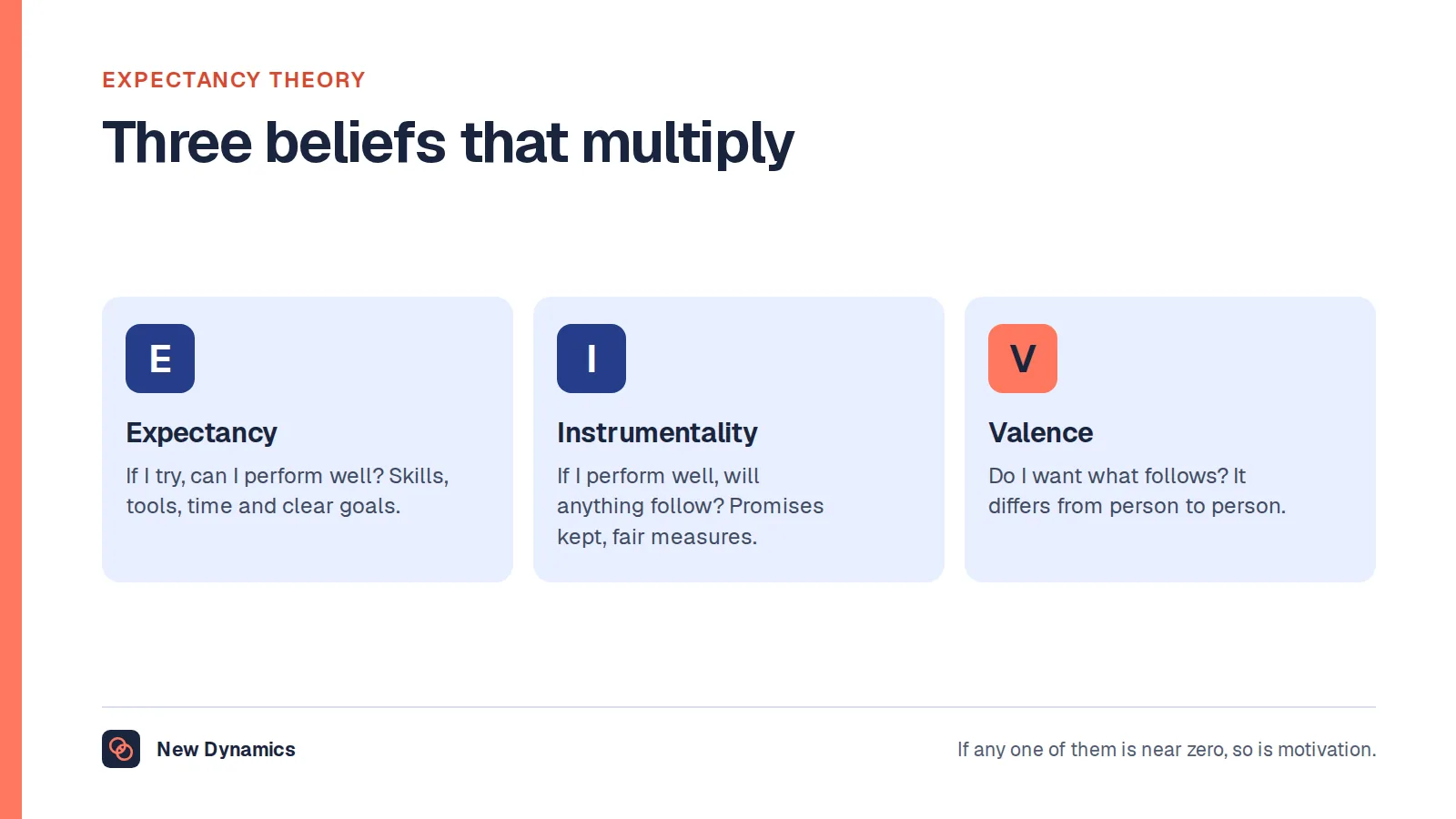
Victor Vroom proposed that effort depends on three beliefs: that effort will lead to performance, that performance will lead to a reward, and that the reward is worth having. If any of the three is near zero, motivation collapses, however large the prize.
Use it for: diagnosing a scheme that is not working. Ask which link is broken. Beware of: assuming that people calculate as coolly as the formula suggests. Our guide to expectancy theory explains the three links.
4. Adams's equity theory
J. Stacy Adams observed that people judge fairness by comparison. They weigh what they put in, such as effort, skill and hours, against what they get out, such as pay, recognition and status, and compare that ratio with other people's. When the comparison seems unfair, they act to restore balance: by working less, asking for more or leaving.
Use it for: understanding why a pay rise can demotivate, if a colleague's was larger. Beware of: secrecy, which leaves people to guess, and they usually guess unfavourably.
5. Goal-setting theory
Edwin Locke and Gary Latham built goal-setting theory over decades of studies. Their article Building a practically useful theory of goal setting and task motivation, published in American Psychologist in 2002, summarises “35 years of empirical research on goal-setting theory”. The central finding is that specific, challenging goals lead to higher performance than vague goals or an instruction to do your best, provided that people are committed to the goal, have the ability and receive feedback.
Use it for: everyday management. It is the evidence behind SMART goals and OKRs. Our guide to what the SMART goals acronym stands for applies it. Beware of: goals so narrow that people hit the target and miss the point.
6. Self-determination theory
Edward Deci and Richard Ryan distinguish intrinsic motivation, doing something because it is interesting or satisfying, from extrinsic motivation, doing it for a separate result. Their article on self-determination theory, also in American Psychologist, describes “three innate psychological needs”: competence, autonomy and relatedness. When these are satisfied, the authors write, they “yield enhanced self-motivation and mental health”. When they are thwarted, motivation and wellbeing fall.
Use it for: understanding why controlling management backfires. People who are trusted with how to do the work tend to care more about it. Our article on the definition of micromanaging describes the opposite. Beware of: reading autonomy as absence. People still need clear goals and support.

Motivational theorists at a glance
| Theorist | Theory | Core idea |
|---|---|---|
| Abraham Maslow | Hierarchy of needs | Five sets of needs, with the more basic pressing first |
| Frederick Herzberg | Two-factor theory | Hygiene factors prevent dissatisfaction, and motivators motivate |
| David McClelland | Acquired needs | People differ in needs for achievement, affiliation and power |
| Douglas McGregor | Theory X and Theory Y | Managers' assumptions about people shape how people behave |
| Victor Vroom | Expectancy theory | Effort depends on expectancy, instrumentality and valence |
| J. Stacy Adams | Equity theory | People compare their rewards and efforts with those of others |
| Edwin Locke and Gary Latham | Goal-setting theory | Specific, challenging goals with feedback raise performance |
| Edward Deci and Richard Ryan | Self-determination theory | Autonomy, competence and relatedness sustain motivation |
McGregor deserves a note. Theory X assumes that people dislike work and must be controlled. Theory Y assumes that people will direct themselves towards goals that they accept. His point was that each assumption tends to come true, because managers create the behaviour that they expect.
Five questions that the theories give a manager
The theories overlap more than they conflict. Put together, they suggest five questions to ask about any team.
- Are the basics fair? Pay, security and conditions. Maslow and Herzberg agree that nothing else works well until these are in order.
- Is the work interesting? Responsibility, variety, achievement and the chance to grow. This is Herzberg's motivators and Deci and Ryan's competence.
- Are the goals clear? Specific, challenging and agreed, with regular feedback. This is Locke and Latham.
- Is reward fair, and linked to effort? People must believe that effort leads to results, that results are noticed and that the outcome is fair beside their colleagues'. This is Vroom and Adams.
- Do people have autonomy and belonging? A say in how the work is done, and a team that they feel part of. This is Deci and Ryan again, and the middle of Maslow's list.
A low answer to any one can undo high answers to the others. A team with clear goals and unfair pay is not motivated. Nor is a well-paid team with nothing interesting to do.
For ways to act on the answers, see our guides to team morale and employee recognition ideas.

Common mistakes
Choosing one theory and ignoring the rest. Each explains part of the picture.
Assuming that everyone is motivated as you are. McClelland's point was that people differ. Ask them.
Relying on money alone. Pay matters, and unfair pay demotivates, but more pay rarely makes dull work interesting.
Setting goals without feedback. Goal-setting theory depends on people knowing how they are doing.
Controlling what you want people to care about. Close monitoring can buy compliance and lose commitment.
Treating the theories as proven laws. Some have stronger evidence than others. Goal setting and self-determination theory rest on large bodies of research. Maslow's hierarchy is better seen as a useful framework.
Frequently asked questions
What are motivation theories?
Motivation theories are explanations of why people put effort into some things and not others. In management they are used to understand what employees need from work and how they decide whether extra effort is worthwhile.
What are the main theories of motivation?
Six cover most of what managers need: Maslow's hierarchy of needs, Herzberg's two-factor theory, Vroom's expectancy theory, Adams's equity theory, Locke and Latham's goal-setting theory, and Deci and Ryan's self-determination theory. McClelland's acquired needs and McGregor's Theory X and Theory Y are also widely taught.
What is the difference between content and process theories?
Content theories describe what motivates people, in terms of needs such as security, belonging, achievement and growth. Process theories describe how motivation works, in terms of expectations, comparisons and goals. Maslow and Herzberg are content theorists. Vroom, Adams and Locke are process theorists.
Who are the main motivational theorists?
The names met most often are Abraham Maslow, Frederick Herzberg, David McClelland, Douglas McGregor, Victor Vroom, J. Stacy Adams, Edwin Locke and Gary Latham, and Edward Deci and Richard Ryan.
Which motivation theory is best?
None is best for every purpose. Goal-setting theory is the most directly useful for day-to-day management. Herzberg is strongest on job design, equity theory on pay, and self-determination theory on management style. Use them together.
How can a manager apply motivation theory?
Ask five questions about the team: whether the basics are fair, whether the work is interesting, whether goals are clear and come with feedback, whether reward is fair and linked to effort, and whether people have autonomy and belonging. Then work on the weakest answer.
Your next step: score your team on the five questions
- Give each of the five questions a score from one to five for your team.
- Ask two or three team members to do the same, privately.
- Compare the answers. The gaps between your view and theirs are as useful as the scores.
- Choose the lowest score, and agree one change this month.
For a fuller method for listening and acting, read and download our employee engagement guide. The guide is free to read, and the PDF uses our short download form.
Want clear goals, regular feedback and recognition in one place? Book a New Dynamics demo and bring your current approach. You can also email contact@new-dynamics.com.