TL;DR
- To micromanage is to control every part of a situation, even small details. At work it means a manager who dictates how each task is done, checks constantly and cannot let a decision be made without them.
- Close supervision is sometimes right, for a new starter or a high-risk task. It becomes micromanagement when it does not ease as the person proves capable.
- The cure is to agree outcomes, standards and check-in points in advance, and then to leave the method to the person doing the work.
Ask people to describe the worst manager they have had, and the word arrives quickly: micromanager. Ask managers whether they micromanage, and almost none say yes. Both things cannot be true, which is why a clear definition helps.
This article gives the definition of micromanaging, ten signs to check yourself against, the reasons managers fall into it, what it costs, how it differs from proper supervision, and what to do about it, whether you are the manager or the person being managed.
The alternative to checking everything is a regular, structured conversation. See how New Dynamics continuous feedback supports check-ins that keep managers informed without hovering.
What does micromanaging mean?
The Cambridge Dictionary defines micromanage as “to control every part of a situation, even small details”. Its example sentence is about work: “The head teacher shouldn't be trying to micromanage what happens in the classroom.” Micromanagement, the noun, is “the act of controlling every part of a situation, including small details”.
At work, then, micromanaging means managing the method as well as the outcome. The manager decides what is to be done, and also how, in what order, with what wording and by which minute, and then checks at every stage.
The word describes a pattern. One detailed review of an important document is not micromanagement. A habit of rewriting every email is.
Ten signs of micromanaging
The signs fall into five groups. Be honest about how many you recognise.
Dictating the method
- You tell people how to do tasks that they already know how to do.
- You are irritated when someone reaches the right result by a different route.
Constant checking
- You ask for updates more often than the work changes.
- You want to be copied on every email.
Approving everything
- Small decisions wait for your sign-off.
- Work stops when you are on holiday.
Redoing work
- You rewrite or redo work that was good enough, and do not explain why.
- You take tasks back when they are not done your way.
Hoarding information
- You hold back context, so that only you can make the decision.
- Your team brings you questions that they could answer themselves, because they have learned that you will overrule them anyway.
The sixth and tenth are the most telling. Micromanagement trains a team to stop thinking.

Why managers micromanage
Few people set out to do it. The usual causes are these.
- Promotion from expert to manager. You were promoted because you did the work well. Letting someone else do it less well, at first, feels like a drop in standards.
- Pressure from above. When your own manager demands detail at short notice, you pass the demand down.
- Fear of mistakes. One painful error can turn a relaxed manager into a checker.
- Unclear goals. If you have not defined what good looks like, the only way to get it is to inspect everything.
- Lack of trust in a particular person. Sometimes this is a fair reading of their performance. More often it has never been tested.
- Remote work. When you cannot see people working, it is tempting to replace sight with status requests.
What micromanaging costs
It works against what good managers do. Google's research into its own managers, known as Project Oxygen, analysed more than 10,000 data points from performance reviews and surveys. Its list of the behaviours of highly effective managers puts this second: “Empower the team without micromanaging”.
It removes control, which affects health. The UK Health and Safety Executive treats control as one of its six Management Standards for work-related stress. Its Control standard concerns how much say a person has in the way they do their work. It expects that, where possible, employees have control over their pace of work, and that they “are encouraged to use their skills and initiative to do their work”.
It wastes skill. The open textbook Introduction to Business, published by OpenStax, describes employee empowerment as “delegating decision-making authority to employees at all levels of the organization, trusting employees to make the right decision”. It rests on the premise that employees “are capable of contributing much more of their skills and abilities” when they are allowed to take part in decisions.
It makes the manager the bottleneck. Every decision that waits for you is a delay. The better your team, the more that costs.
It drives good people out. Capable people want room to work. Our guide to job enrichment explains why autonomy and responsibility matter to motivation.
Micromanagement or proper supervision?
Close attention is sometimes exactly what the situation needs. The test is whether it fits the person and the risk, and whether it eases over time.
| Close supervision is right when | It has become micromanagement when |
|---|---|
| Someone is new to the job or the task | The person has shown that they can do it, and nothing has changed |
| The task is high-risk, regulated or safety-critical | The same scrutiny applies to routine, low-risk work |
| Performance has slipped, and you have agreed a plan | Nobody has told the person why they are being watched |
| The person has asked for more guidance | The checking serves your anxiety, not their need |
| You check the outcome against an agreed standard | You check the method against your personal preference |
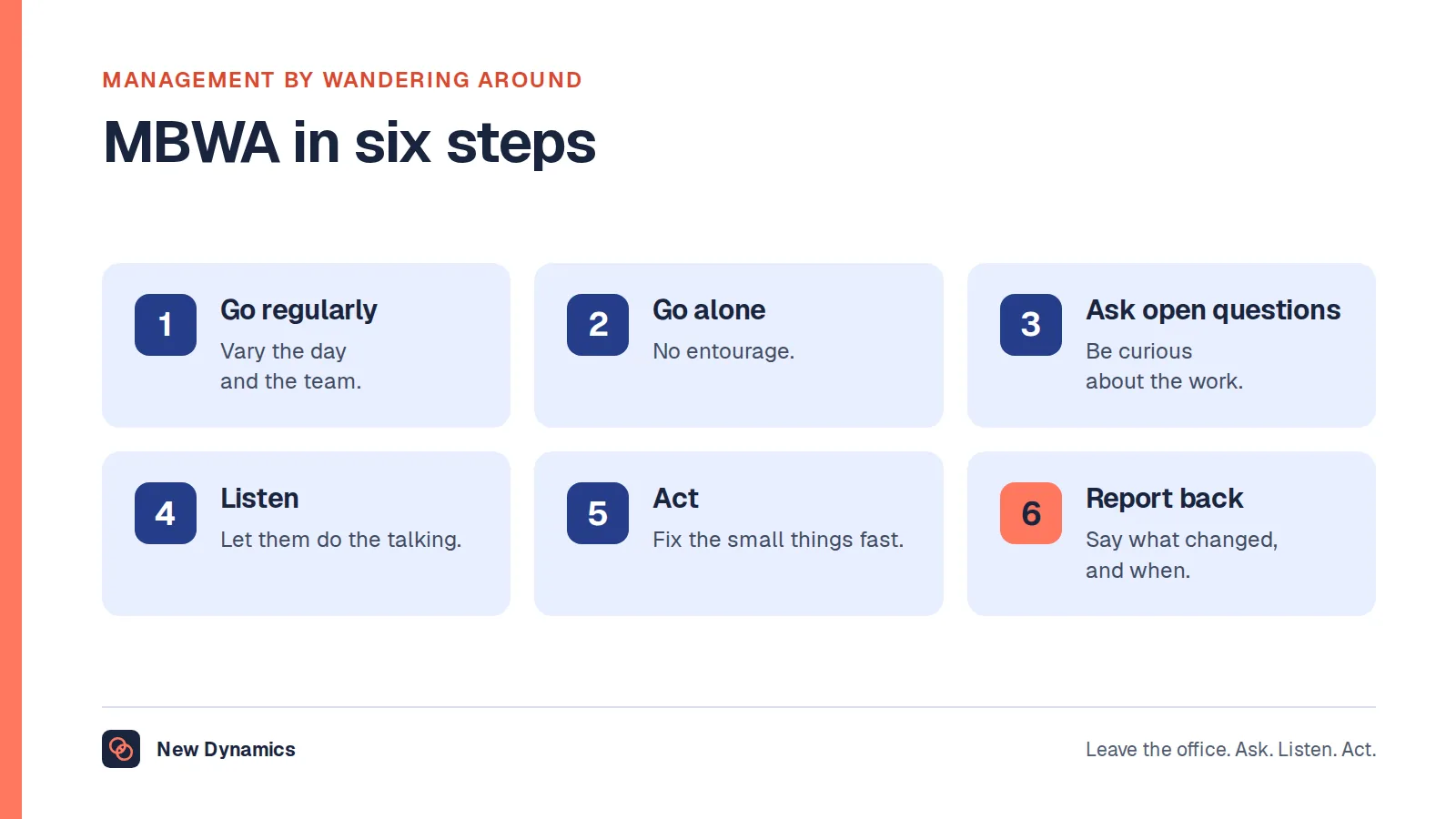
Staying close to the work is a good thing in itself. Our article on management by wandering around shows how to be present without taking over.
How to stop micromanaging: six steps
- Define the outcome. Say what finished looks like, by when, and to what standard. Write it down. Most micromanagement is a substitute for this step.
- Agree the check-in points in advance. “Show me the outline on Tuesday and the draft on Friday” is supervision. Dropping in whenever you feel uneasy is not.
- Hand over the method. Ask “how are you planning to approach it?”, listen, and step in only if you can see a real risk.
- Match your attention to risk and experience. Give new people and high-stakes work more of it. Tell people that it will reduce, and then reduce it.
- Review results, and coach on the gap. When work misses the standard, explain what was missing and let the person fix it. Do not fix it yourself.
- Ask for feedback. Once a quarter, ask your team: “Where am I too involved, and where not enough?” Our one-to-one meeting questions include more.
Expect to feel uncomfortable. Work will be done differently from the way you would do it, and some of it will be worse for a while. That is the price of a team that can work without you.

If you are being micromanaged
Start by assuming anxiety before malice. Most micromanagers are worried about something, and it helps to find out what. Then try five moves.
- Get ahead of the questions. Send a short update before it is asked for. Many managers relax once information arrives reliably.
- Ask for the outcome. “What does a good result look like to you, and when do you need it?” moves the conversation away from method.
- Propose check-in points. “Could I show you on Wednesday and again on Friday?” gives the manager security and gives you space between.
- Earn trust in small steps. Ask to own one piece of work fully, deliver it, and ask for the next.
- Say it, carefully. “I do my best work when I have room to plan it myself. Could we try that on this project?” Our difficult conversations examples can help with the wording.
If it crosses a line, escalate. Constant criticism, humiliation or monitoring that damages your health goes beyond style. Speak to HR or use the formal route.

Frequently asked questions
What is the definition of micromanaging?
To micromanage is to control every part of a situation, even small details. At work it describes a manager who dictates how tasks are done, checks progress constantly and needs to approve even minor decisions.
What are the signs of a micromanager?
Common signs are telling capable people how to do their tasks, asking for updates more often than the work changes, wanting to be copied on every email, holding up small decisions for sign-off, and redoing work that was good enough.
Why is micromanaging bad?
It slows work down, wastes people's skills and teaches a team to stop thinking for itself. It also takes away people's say over how they work, which the UK Health and Safety Executive treats as a factor in work-related stress.
Is micromanaging ever appropriate?
Close supervision is appropriate for a new starter, a high-risk task or an agreed performance plan. It becomes micromanagement when it continues after the person has shown that they can do the work, or when it is applied to routine tasks.
How do I stop micromanaging my team?
Define the outcome and the standard, agree check-in points in advance, leave the method to the person, match your attention to risk and experience, coach on gaps without redoing the work, and ask your team where you are too involved.
How do I deal with a manager who micromanages?
Send updates before they are asked for, ask what a good result looks like, propose fixed check-in points and build trust by delivering small pieces of work fully. If that fails, say what you need in a calm, specific conversation.
Your next step: hand over one method
- Pick one task this week where you would normally specify how it should be done.
- Agree the outcome, the standard and two check-in points. Say nothing about the method.
- At the check-ins, ask questions before you give opinions.
- Afterwards, ask the person how it felt, and what they would like you to do next time.
For agendas and questions that keep you informed without hovering, read and download our one-to-one meeting guide. The guide is free to read, and the PDF uses our short download form.
Want goals and check-ins that make outcomes visible, so that managers can let go of the method? Book a New Dynamics demo and bring your team's current habits. You can also email contact@new-dynamics.com.