TL;DR
- The recognition that people value most costs little: specific thanks, given soon, by someone whose opinion matters to them. Rewards and awards add to that. They do not replace it.
- These 50 ideas are grouped into everyday habits, peer recognition, growth, time, team celebrations, milestones, and awards and rewards. Choose a few that suit your people, and ask them what they would value.
- Check two things before you spend: that recognition is spread fairly, and how gifts and vouchers are taxed. In the UK and the US, cash and vouchers are treated differently from small non-cash gifts.
Ask people about the best recognition they ever received at work, and they rarely mention the voucher. They remember the manager who noticed what they had done, said exactly why it mattered and told other people about it.
This article gives you 50 employee recognition ideas, from free everyday habits to formal awards. It starts with five rules that decide whether any of them will work, and ends with the tax points to check before you buy anything.
To make appreciation a habit across your organisation, see how New Dynamics employee recognition helps people to thank each other for specific work.
Five rules that make recognition work
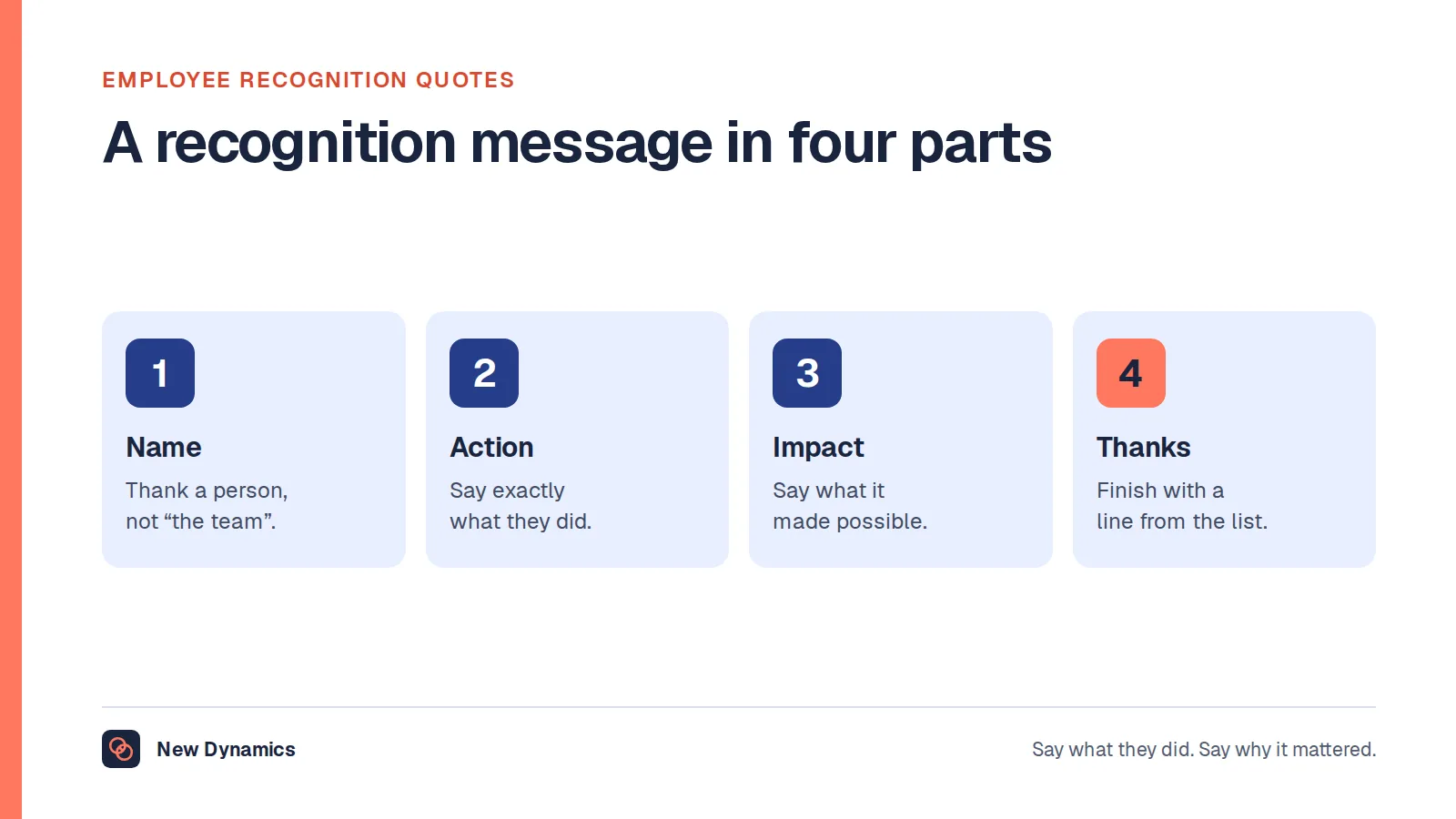
- Be specific. Name the person, what they did and what it made possible. “Great job, everyone” reaches nobody.
- Be prompt. Thanks within days lands harder than praise at the annual review.
- Be fair. Notice the quiet work that prevents problems, as well as the visible heroics. Keep an eye on who gets thanked, and who never does.
- Make it personal. Some people love applause. Others would prefer a quiet note. Ask, or watch.
- Link it to what you value. Say which behaviour you are recognising, so that others can see what good looks like.
Our guide to expectancy theory explains the mechanism behind these rules. People keep putting in effort when they believe that good work will be noticed, and that it will lead somewhere.

50 employee recognition ideas
Free and everyday
- Say thank you in person, the same day, naming what the person did and why it mattered.
- Send a two-line note to the person, and copy their manager.
- Open the weekly team meeting with a round of thanks.
- Pass customer praise on to the person who earned it, word for word.
- Write a handwritten card. It will be kept long after an email is deleted.
- Tell a senior leader about someone's work, and ask them to mention it to the person.
- Ask someone to present their own work to the leadership team.
- Create a “wins” channel, where anyone can thank anyone.
- Start a Friday habit of naming one thing that a colleague did well this week.
- Thank people for preventing problems, as well as for fixing them.
- Recognise effort on projects that failed for good reasons.
- Ask for someone's advice. Being consulted is a form of recognition.
Peer to peer
- Set up a simple nomination form, open to everyone, tied to your values.
- Run a “pass it on” trophy that each holder awards to the next, with a reason.
- Give every employee a few thank-you cards a year to give to colleagues.
- Add a “thank a colleague” slot to project retrospectives.
- Let teams nominate another team each quarter for the best cross-team help.
- Invite new starters to name the person who helped them most in their first month.
Growth and opportunity
- Offer a stretch project that matches the person's career aims.
- Fund a course, a conference or a qualification that they choose.
- Invite them to mentor, to teach a session or to represent the team externally.
- Give them a meeting with a senior leader whom they would like to learn from.
- Put their name on the work: the report, the release note or the case study.
- Give them first choice of the next interesting assignment.
- Recognise expertise with a title or a role, such as subject lead.
Time and flexibility
- Give an afternoon off after an intense period of work.
- Offer an extra day of leave for an exceptional contribution.
- Let the team leave early on the day that a big project ships.
- Protect a meeting-free day for someone who has carried a heavy load.
- Offer flexibility on hours or location for a while, as a thank you.
Team celebrations
- Mark the end of a project before starting the next one.
- Hold a team lunch in working hours, with the reason stated.
- Celebrate milestones that the team chooses, such as the hundredth customer.
- Create a simple wall or page of finished work.
- Bring in the customer to tell the team what their work made possible.
- Make a short film or slide show of the year's achievements for the end-of-year meeting.
Milestones and life events
- Mark work anniversaries personally. See our 20 year work anniversary ideas.
- Welcome new starters with a note signed by the team.
- Recognise qualifications and promotions in public, if the person is happy with that.
- Mark the end of probation with a conversation about what has gone well.
- Give leavers a proper send-off. The people who remain are watching.
Awards and rewards
- Hold quarterly awards with clear criteria, nominated by peers and decided by a mixed panel.
- Offer a choice of reward of similar value, because tastes differ.
- Give a small, thoughtful gift that reflects the person's interests.
- Make a donation to a charity that they choose.
- Offer an experience, such as a meal or tickets, that they can share with family.
- Pay a spot bonus for exceptional contributions, with the reason written down.
- Upgrade their equipment: a better chair, a second screen or good headphones.
- Name an award after a respected colleague, and let that person present it.
- Publish the stories behind the awards, so that others can see what good looks like.
For words to use with any of these, see our employee recognition quotes.

How to choose the right ideas
- Ask your people. A short poll, “Which three of these would you value most?”, beats guesswork.
- Start with the free ones. Ideas 1 to 12 do most of the work. If everyday thanks is missing, awards will feel hollow.
- Match the scale to the contribution. A thank-you note for a helpful handover. Something more for six months on a difficult project.
- Offer choice. A night out is no treat for someone with caring responsibilities. A bottle of wine is no gift for someone who does not drink.
- Include everyone who works for you, including remote staff, night shifts, part-timers and support functions.
- Make managers responsible. Recognition is part of the job of managing, not an HR programme. See what makes a good manager.
Recognition for remote and hybrid teams
Distance makes good work harder to see, so recognition has to be more deliberate.
- Thank people in the channel where the team gathers, as well as privately.
- Send cards and gifts to home addresses.
- Make sure that remote colleagues are nominated and celebrated at the same rate as those in the office. Check the numbers.
- Start video meetings with a minute of thanks.
- Record short messages of thanks from colleagues and customers.
Tax on gifts and rewards: check before you buy
This is general information, not tax advice. Rules and limits change, so check current guidance, or ask your payroll provider.
United Kingdom
GOV.UK's guidance on trivial benefits says that you do not have to pay tax on a benefit for an employee if all of the following apply: “it cost you £50 or less to provide”, “it isn't cash or a cash voucher”, “it isn't a reward for their work or performance” and “it isn't in the terms of their contract”.
The third condition surprises many people. A small gift given as a reward for performance does not meet the definition of a trivial benefit, so it may be taxable. A birthday gift of the same value may not be. Ask payroll how they want to handle performance rewards.
United States
The Internal Revenue Service's Publication 15-B explains that a de minimis benefit is property or a service of “so little value” that accounting for it would be unreasonable. It gives examples that include low-value holiday or birthday gifts, other than cash, and flowers or fruit provided on account of illness, a family crisis or outstanding performance. It is explicit about cash: “Cash and cash equivalent fringe benefits (for example, gift certificates, gift cards, and the use of a charge card or credit card), no matter how little, are never excludable as a de minimis benefit.”
So in both countries, gift cards and cash are treated as pay. Small non-cash gifts may be treated differently, within limits. Long-service awards have their own rules, which we cover in our article on the 20 year work anniversary.
Mistakes to avoid
The same few names. If recognition always goes to the visible roles, everyone else stops believing in it.
Generic praise. “Thanks for all your hard work” is wallpaper.
Recognition as a substitute. Kind words do not make up for low pay, unfair treatment or an unmanageable workload.
Praising hours. Thanking people for working late teaches everyone to stay late. Recognise results and care.
Employee of the month on autopilot. When the award rotates to whoever has not had it yet, it means nothing.
Surprises that embarrass. Check how the person feels about public attention.
Launch and forget. A scheme without reminders and visible leadership support tends to fade.

Frequently asked questions
What are good employee recognition ideas?
The most valued are specific and prompt: a thank you that names what the person did, a note copied to their manager, customer praise passed on, a chance to present their own work, a stretch project, an afternoon off after a hard period and peer-nominated awards with clear criteria.
What are free ways to recognise employees?
Say thank you in person the same day, send a two-line note, open meetings with a round of thanks, pass on customer praise, write a handwritten card, tell a senior leader about someone's work, ask for their advice and thank people who prevent problems.
How do you recognise employees without money?
Use attention, opportunity and time: specific thanks, public credit, a chance to present or to lead, first choice of an interesting assignment, a meeting with a senior leader, flexibility and an early finish after a big delivery.
How often should employees be recognised?
Often. Aim for specific thanks whenever it is earned, which for most managers means several times a week across a team. Formal awards can be quarterly or yearly. Frequent, small and sincere recognition matters more than an occasional grand gesture.
Are employee gifts and gift cards taxable?
It depends on the country and the gift. In the UK, a small non-cash benefit can be exempt, but not if it is a reward for work or performance. In the US, cash and gift cards are never excludable as de minimis benefits. Check official guidance.
What makes employee recognition meaningful?
It is specific about what the person did and why it mattered, it comes soon after the event, it is fair across the team, it suits the person's preferences and it comes from someone whose opinion they value.
Your next step: pick three ideas
- Choose one everyday habit, one peer idea and one team celebration from the list.
- Ask your team which rewards they would value, and which they would not.
- Put a weekly reminder in your calendar to thank someone specifically.
- After a month, check who has been recognised, and who has been missed.
For a complete approach to making appreciation specific, timely and fair, read and download our employee recognition guide. The guide is free to read, and the PDF uses our short download form.
Want recognition to be part of everyday work, connected to goals and feedback? Book a New Dynamics demo and bring your current approach. You can also email contact@new-dynamics.com.