TL;DR
- SMART stands for specific, measurable, achievable, relevant and time-bound. It is a checklist for turning an intention into an agreement two people can review.
- The words vary. Achievable is sometimes attainable or assignable, and relevant is sometimes realistic. Pick one version and use it consistently.
- SMARTER adds evaluated and reviewed. SMART checks how a goal is written. It does not tell you whether it is the right goal, so agree priorities first.
Ask five managers what the SMART goals acronym stands for and you may hear five slightly different answers. Is the A achievable or attainable? Is the R relevant or realistic? Does it matter?
This article gives you the standard answer, explains each letter in plain language, shows the common variations and covers the longer SMARTER version. It finishes with a worked example and an honest look at what SMART can and cannot do.
If you want goals written this way to stay visible and reviewed through the year, explore New Dynamics Goals & OKRs.
What does SMART stand for?
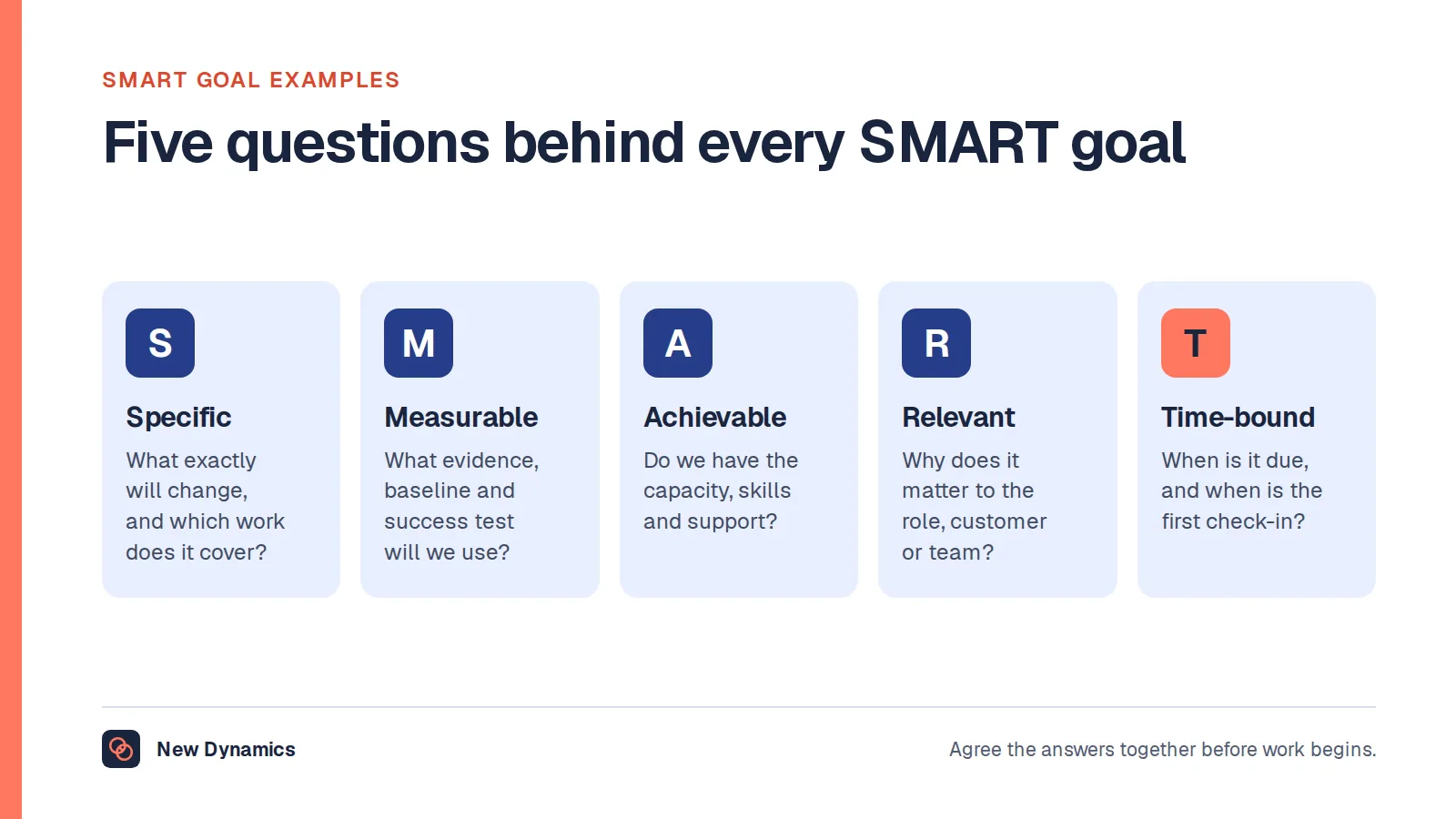
SMART stands for specific, measurable, achievable, relevant and time-bound. The CIPD performance management factsheet uses the same five words. Each letter asks a question of the goal:
| Letter | Stands for | The question it asks |
|---|---|---|
| S | Specific | What exactly will change? |
| M | Measurable | How will we know? |
| A | Achievable | Can it be done with the time and support available? |
| R | Relevant | Why does it matter now? |
| T | Time-bound | By when, and when do we check progress? |
A goal that answers all five questions is an agreement two people can review later without arguing about what was meant.

Where the SMART goals principle comes from
The acronym is usually credited to George T. Doran, a consultant and former corporate planning director. His short article, “There's a S.M.A.R.T. way to write management's goals and objectives”, appeared in Management Review in November 1981 (volume 70, issue 11, pages 35 to 36).
Doran's original words were specific, measurable, assignable, realistic and time-related. Two of the five have since shifted in everyday use. Assignable, meaning someone is clearly responsible, became achievable. Realistic is now more often relevant.
Doran also made a point that tends to be forgotten. He did not claim that every objective at every level could be quantified, or that each one had to satisfy all five criteria. The principle was a prompt for clearer thinking. It was never meant as a pass-or-fail test.
What each letter of SMART means
S is for specific
A specific goal names the outcome and the work it covers. “Improve communication” could mean anything. “Send a weekly project update covering progress, the next decision and blockers” tells everyone what to expect.
Test: could a colleague who was not in the room explain what you have agreed to do?
M is for measurable
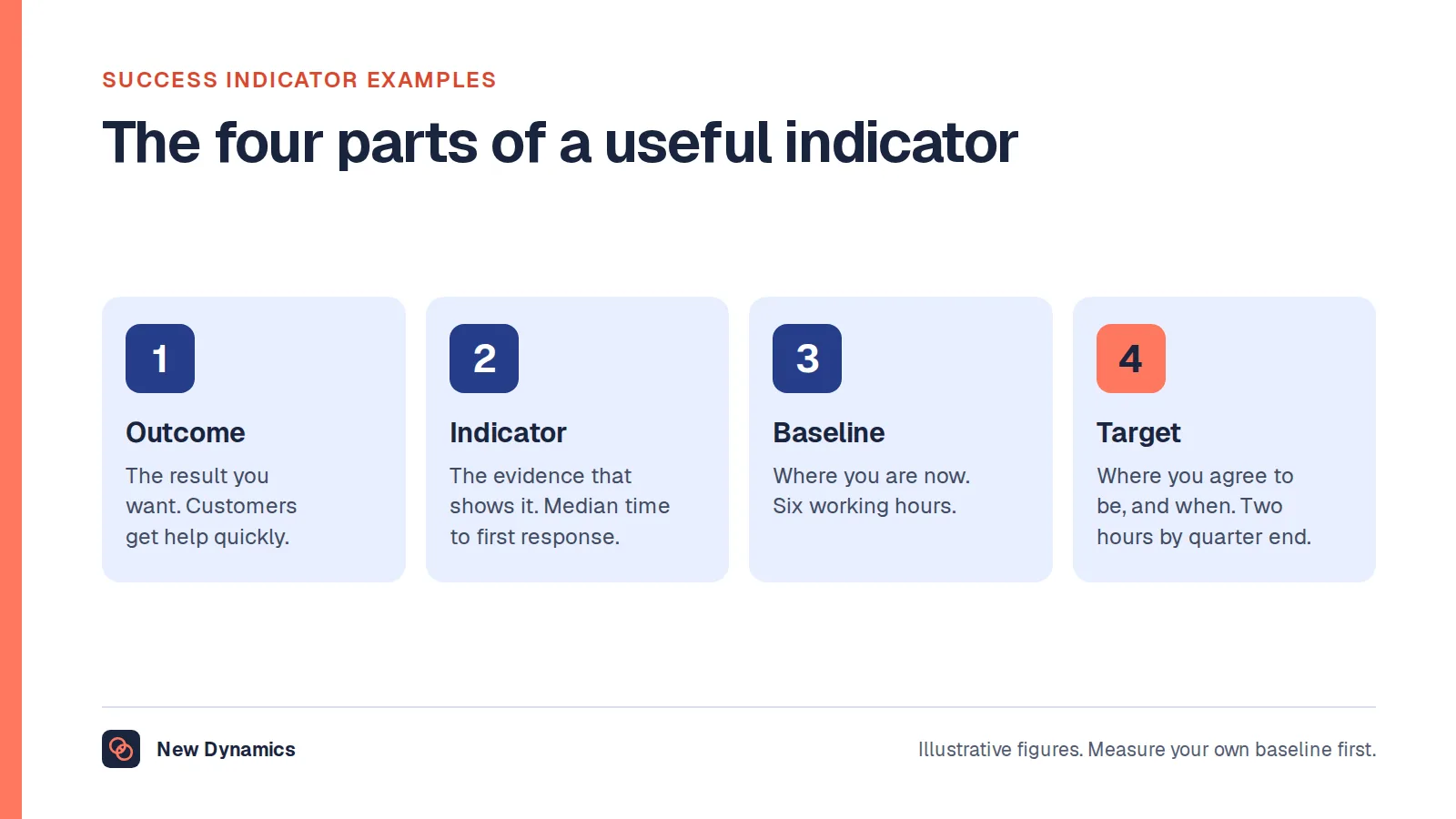
Measurable means you have agreed the evidence of progress. That is often a number with a baseline, such as moving from 75% to 90% of tasks completed on time. It can also be an observable standard, such as a handover that a colleague can follow without asking questions.
Test: at the review, will you both look at the same evidence and reach the same conclusion? Our success indicator examples will help you choose the measure.
A is for achievable
Achievable asks whether the goal can be reached with the time, skills, budget and support available. It does not mean easy. A good goal stretches someone without setting them up to fail. If the goal depends on another team, record that dependency.
Test: what will this person stop doing, or get help with, to make room for the goal?
R is for relevant
Relevant links the goal to something that matters: a team priority, a customer need or the person's development. It is the letter that stops people working hard on the wrong thing.
Test: if this goal were achieved in full, who would notice, and why would they care?
T is for time-bound
Time-bound sets a completion date and, ideally, an earlier checkpoint. Without a date, a goal becomes a permanent intention. Without a checkpoint, problems surface too late to fix.
Test: is the first progress check already in the diary?
Common variations of the SMART acronym
You will meet different words for the same letters. None is wrong. They emphasise different things.
| Letter | Most common | Also used |
|---|---|---|
| S | Specific | Strategic and specific |
| M | Measurable | Rarely changed |
| A | Achievable | Attainable, assignable, agreed, action-oriented |
| R | Relevant | Realistic, reasonable, results-based, resourced |
| T | Time-bound | Timely, time-based, time-limited, time-related |
One combination causes confusion. If A is achievable and R is realistic, two letters ask the same question and nothing asks why the goal matters. Using relevant for R avoids that overlap.
Whichever version you choose, write it down and use it everywhere. Mixed definitions in one organisation lead to goals that cannot be compared.
What does SMARTER stand for?
SMARTER adds two letters. The most common version is evaluated and reviewed:
- E for evaluated: progress is checked against the evidence at agreed points.
- R for reviewed: the goal itself is reconsidered and adjusted when circumstances change.
Other versions exist, such as exciting and recorded. The useful idea behind all of them is that a goal needs attention after it is written. If your team already holds regular check-ins, you are following SMARTER without the extra letters.
A SMART goal example, letter by letter
Take the intention “get better at customer support”. Apply each letter in turn:
- Specific: routine support tickets, handled by me.
- Measurable: median resolution time, moving from two working days to one and a half.
- Achievable: a new reply template library and a weekly review with my manager.
- Relevant: customers get answers faster, which supports the team's retention priority.
- Time-bound: by the end of the quarter, with a check at the halfway point.
The finished goal reads: “By the end of the quarter, reduce median resolution time for routine support tickets from two working days to one and a half, while keeping the reopened-ticket rate at or below 5%.” The last clause is a quality safeguard. It stops speed being bought at the cost of accuracy. The figures are illustrative.

For many more, see our 50 SMART goal examples, grouped by role. The University of California also publishes worked SMART goal examples that show how each letter applies to the same goal.
Why SMART goals are important, and where they fall short
SMART has lasted for decades because it fixes common problems cheaply:
- Clarity. Both people know what was agreed.
- Fairness. Reviews rest on evidence agreed in advance. Recent events and general impressions carry less weight.
- Focus. A deadline and a measure make it easier to say no to other work.
- Better conversations. Writing the goal exposes hidden assumptions about time, support and priorities.
It also has limits, and knowing them makes you a better user of it:
- SMART checks the wording. It cannot choose the goal. A perfectly SMART goal can still be the wrong priority. Agree what matters first, then write it well. Frameworks such as OKRs help with that step. So does connecting goals between levels, which we cover in how to cascade goals at work.
- It can encourage safe targets. If missing a goal is punished, people set goals they know they will hit. Treat ambitious goals that fall slightly short as a success.
- Not everything important is countable. The CIPD notes that for complex tasks it is usually better to focus on learning outcomes or open-ended objectives than on rigid targets.
- Measures can be gamed. Pair a number with a quality safeguard, as in the example above.

A quick SMART criteria checklist
Before you save a goal, check that you can answer yes to each question:
- Does it name the outcome and the work it covers?
- Have we agreed the evidence and the starting point?
- Does the person have the time, skills and support to do it?
- Can we both explain why it matters now?
- Is there a completion date and an earlier checkpoint?
- Have we added a safeguard so that the number is not reached the wrong way?
Frequently asked questions
What do SMART goals stand for?
SMART goals stand for specific, measurable, achievable, relevant and time-bound. Together the five words describe a goal that names a clear outcome, has agreed evidence of progress, is possible with the support available, matters to the team or the person, and has a deadline.
What does the A in SMART stand for?
The A most often stands for achievable. Some versions use attainable, which means the same, or agreed. The original article used assignable, meaning that responsibility for the goal is clearly given to someone.
What does the R in SMART goals stand for?
The R usually stands for relevant: the goal matters to the role, the team or the organisation. Some versions use realistic. Relevant is the more useful choice when A already stands for achievable, because otherwise two letters ask the same question.
What does the T in SMART goals stand for?
The T stands for time-bound. The goal has a completion date and, ideally, an earlier checkpoint. You may also see timely, time-based or time-related, which mean the same thing.
What does the M in a SMART goal stand for?
The M stands for measurable. You have agreed how progress will be shown, either with a number measured from a known baseline or with an observable standard that both people can assess.
What is the SMARTER acronym?
SMARTER adds E and R to SMART. The most common meaning is evaluated and reviewed: progress is checked against evidence at agreed points, and the goal is adjusted when circumstances change. Other versions use words such as exciting and recorded.
Who created SMART goals?
The acronym is usually credited to George T. Doran, who set it out in Management Review in November 1981. His version used specific, measurable, assignable, realistic and time-related. The wording has changed since, but the purpose is the same.
Your next step: test one goal against the five letters
- Pick a goal you have already set, or one you are about to agree.
- Ask the five questions in the table at the top of this article.
- Rewrite the weakest part. For most goals that is the measure or the reason it matters.
- Book the first check-in.
For a one-page form to fill in, use our free SMART goal template. For a worksheet to use in that conversation, read and download our SMART goals guide. The guide is free to read, and the PDF uses our short download form.
Want goals, feedback and reviews to work together around your process? Book a New Dynamics demo and bring a goal you find hard to write. You can also email contact@new-dynamics.com.