TL;DR
- The hierarchy of needs is Abraham Maslow's 1943 theory that people are moved by five sets of basic needs: physiological, safety, love and belonging, esteem and self-actualisation. The more basic needs tend to press first.
- Maslow did not describe rigid steps. He wrote that the order can vary, that needs are usually only partly satisfied and that most behaviour has several motives at once.
- At work the idea is best used as a checklist. Fair pay and rest, security, belonging, recognition and growth all matter, and a gap in one is not repaired by extra effort on another.
Almost everyone who has sat through a management course has seen the pyramid: five coloured layers, with food and shelter at the bottom and something called self-actualisation at the top. Far fewer people have read the paper behind it, which is more careful, and more useful, than the diagram.
This article gives a plain definition of the hierarchy of needs, sets out the five levels in Abraham Maslow's own words, explains what the popular version gets wrong, summarises what later research found and shows how a manager can use the idea at work.
One of the five needs is esteem, which includes respect from other people. See how New Dynamics employee recognition makes thanks specific and visible across the whole organisation.
What is the hierarchy of needs?
The hierarchy of needs is a theory of human motivation. It says that people are moved by a small number of basic needs, and that these needs are arranged in a rough order of urgency. When a more basic need is badly unmet, it tends to dominate. As it is met, other needs come forward.
The theory comes from the American psychologist Abraham Maslow. He set it out in A Theory of Human Motivation, a paper published in the journal Psychological Review in 1943. His own summary begins: “There are at least five sets of goals, which we may call basic needs.”
He went on to say that these goals are related to each other, “being arranged in a hierarchy of prepotency”. Prepotency means taking priority. The most pressing unmet need takes over a person's attention, and the others fade into the background for a while.
Maslow gave a memorable illustration. A person who lacks food, safety, love and esteem, he wrote, “would most probably hunger for food more strongly than for anything else”. Once there is plenty of food, other needs emerge and take over.
What are the five levels of the hierarchy of needs?
Here are the five sets of needs, in the order that Maslow gave them.
- Physiological needs. Food, water, sleep and the other needs of the body. Maslow called these the most pressing of all needs when a person is missing everything.
- Safety needs. Security, stability and freedom from danger. Among adults, Maslow saw these needs in ordinary choices, such as “the common preference for a job with tenure and protection, the desire for a savings account, and for insurance of various kinds”.
- Love and belonging. Affection, friendship and membership of a group. Maslow wrote that a person at this stage will hunger “for a place in his group”.
- Esteem. Self-respect and the respect of others. Maslow stressed that healthy self-esteem is “soundly based upon real capacity, achievement and respect from others”.
- Self-actualisation. The need to become what you are capable of becoming. Maslow put it in one line: “What a man can be, he must be.” (He spelled the word self-actualization, and wrote in the language of his time.)
Maslow also discussed the desire to know and to understand, and the conditions that make it possible to meet the basic needs at all, such as fairness, honesty and freedom to speak. Some later versions of the model add further levels. This article keeps to the original five.

What the pyramid gets wrong
The word “pyramid” does not appear anywhere in the 1943 paper. The diagram came later, and it suggests a rigid staircase that Maslow took care to avoid. Five points from the paper correct the popular version.
- The order is not fixed. Maslow wrote of the hierarchy that “it is not nearly as rigid as we may have implied”. He listed exceptions, including people for whom self-esteem matters more than love, and people who give up everything for an ideal.
- Needs are partly met, not ticked off. A need does not have to be fully satisfied before the next one appears. Maslow offered what he called “arbitrary figures for the sake of illustration”: an average person might be satisfied 85 per cent in physiological needs, 70 per cent in safety, 50 per cent in love, 40 per cent in self-esteem and 10 per cent in self-actualisation.
- New needs emerge gradually. As one need is increasingly met, the next grows slowly. It does not switch on at a threshold.
- Most behaviour has several motives. In Maslow's words, “most behavior is multi-motivated”. A person works for pay, for security, for company, for respect and for interest, often all in the same afternoon.
- A met need stops motivating. Maslow's phrase was that “a satisfied need is not a motivator”. On this view, once pay is fair, more pay adds less, and people who feel secure start to ask for more interesting work.

Is the hierarchy of needs supported by evidence?
Partly. Maslow was candid about the limits of his own paper. He based it largely on clinical experience, and he described self-actualisation as “a challenging problem for research”.
A large later study tested the central ideas. In Needs and subjective well-being around the world, published in the Journal of Personality and Social Psychology in 2011, Louis Tay and Ed Diener examined need fulfilment and wellbeing in a sample of 123 countries. Their abstract reports three findings that matter here.
- Meeting needs was consistently associated with wellbeing in every region of the world. That supports Maslow's claim that the needs are widely shared.
- Different needs were linked to different parts of wellbeing. How people rated their lives was most associated with basic needs. Positive feelings were most associated with social and respect needs.
- The link between each need and wellbeing was “largely independent of whether other needs were fulfilled”. That counts against a strict ladder. People gain from friendship and respect even when their basic needs are not fully met.
The fair summary is that the list of needs has held up better than the strict order. For a manager, that points to a simple rule: attend to all five, and do not wait for one to be perfect before starting on the next.
The hierarchy of needs at work
Maslow was not writing about employment, so any workplace version is an interpretation. The one below is ours. It treats the five needs as five questions that an employer can ask.
| Need | At work, this looks like | A question to ask |
|---|---|---|
| Physiological | Pay that covers the basics, breaks, rest, a decent workplace | Can people live on this pay and recover from this work? |
| Safety | Physical safety, job security, predictable hours, fair rules | Do people know where they stand? |
| Love and belonging | A team, a manager who knows you, being included | Does everyone have a place in the group? |
| Esteem | Recognition, respect, real responsibility | Do people hear that their work matters, and why? |
| Self-actualisation | Learning, stretch, work that uses your abilities | Is each person growing this year? |
Some practical steps follow from each row.
- Pay and rest. Check pay against the cost of living where your people live, and check that breaks and holidays are actually taken. Our guide to the definition of compensation explains the parts of a pay package.
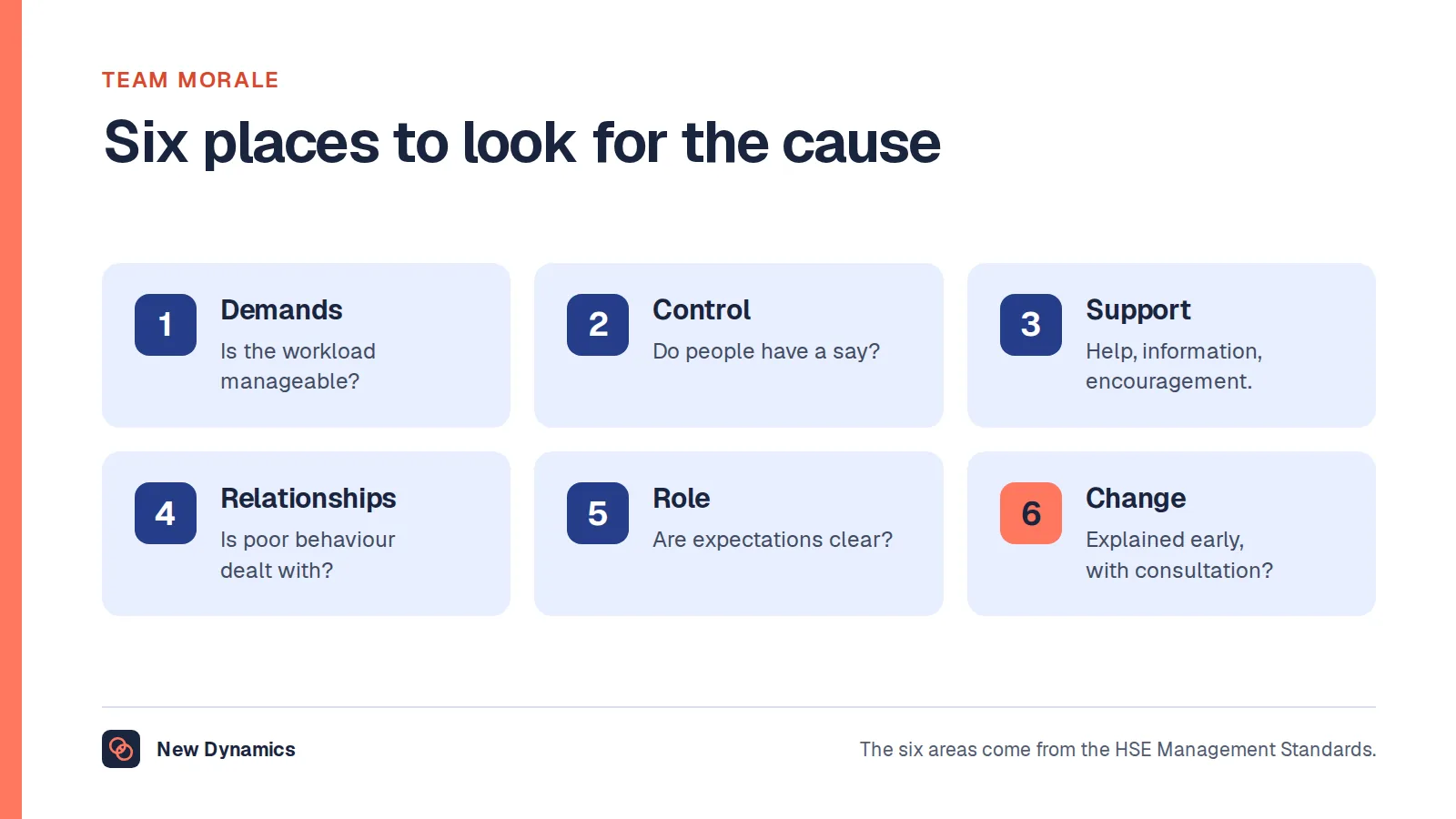
- Security and safety. Tell people early about changes that affect their jobs. Keep rotas and rules predictable. The UK Health and Safety Executive's Management Standards cover “six key areas of work design” that employers should manage: demands, control, support, relationships, role and change.
- Belonging. Hold regular one-to-ones, include remote and part-time staff in team routines and deal with exclusion quickly. Our guide to workplace relationships goes further.
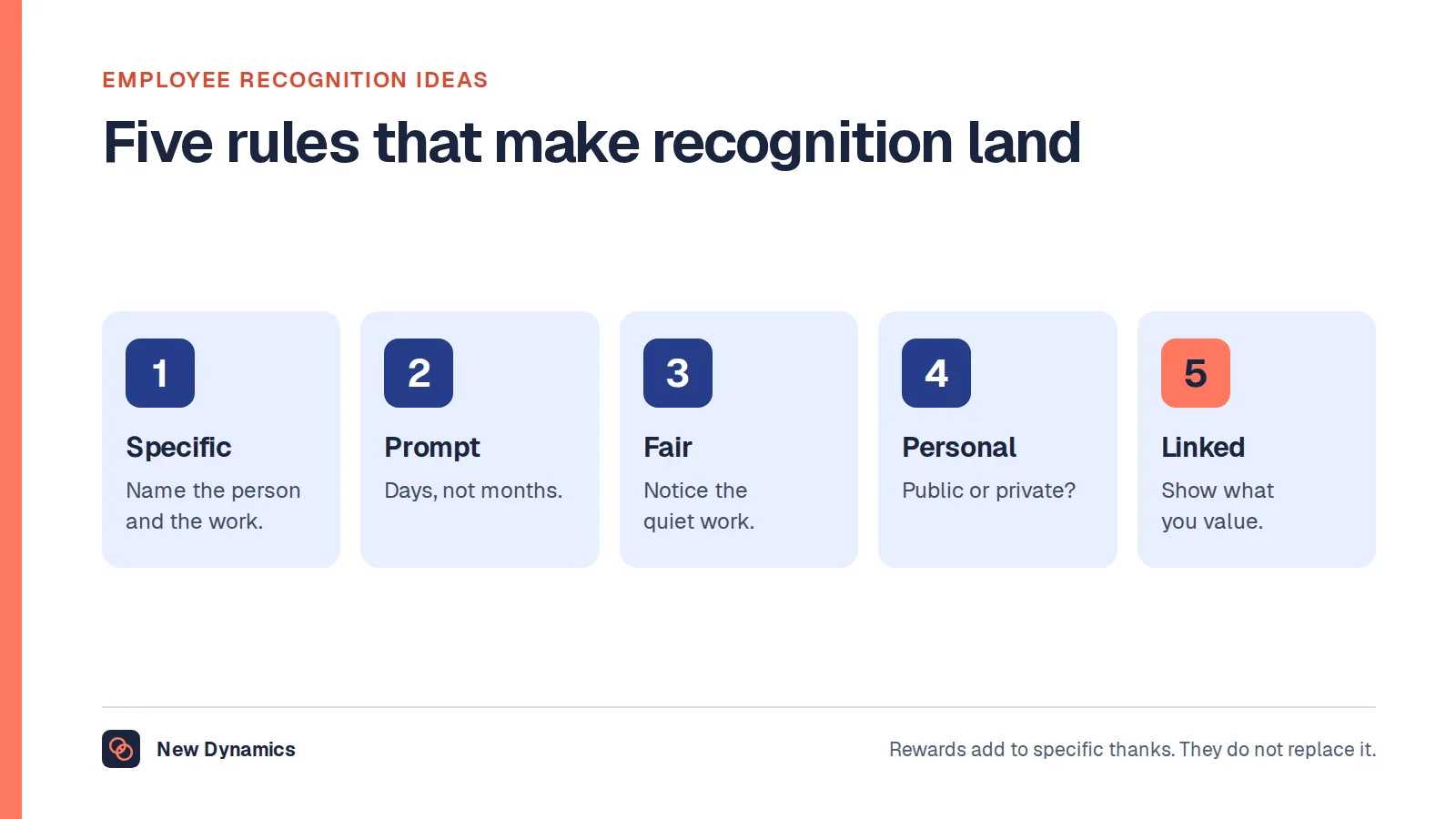
- Recognition. Thank people for specific work, and give real responsibility with it. See our employee recognition ideas for ways to start.
- Growth. Agree a short employee development plan with each person, and find stretch work that uses their abilities.

How managers can use the hierarchy
Use it as a checklist. Walk through the five questions for your team once or twice a year. It takes little time, and it shows gaps that a survey score can hide.
Fix the basics first, but do not stop there. A recognition scheme will not make up for pay that people cannot live on, or for a rota that changes every week. Equally, fair pay alone will not hold people who feel invisible or bored.
Ask. Maslow noted that needs are often unconscious, and that people differ. You cannot tell from outside which need is pressing for a particular person. A one-to-one question such as “What would make work better for you at the moment?” reveals more than any model.
Watch for change. Needs shift with circumstances. A new parent, a person with a sick relative or someone whose rent has just risen may care far more about security and flexibility than they did a year ago.
Listen to the whole team. Patterns matter as well as individuals. A short workplace engagement survey can show whether a concern is widespread, and our guide to team morale explains how to respond.
Common mistakes
Treating the model as a ladder. Nobody finishes one level and graduates to the next. Most people are partly satisfied on all five at once.
Assuming that lower-paid staff care only about pay. Tay and Diener's findings suggest that respect and social needs matter to people whatever their circumstances.
Using it to label people. “She is a level three” is neither kind nor accurate. The model describes needs that everybody has.
Skipping the basics. Away-days and awards ring hollow where people feel insecure or underpaid.
Forgetting culture and difference. Maslow acknowledged that there are different cultural paths to the same goal. What signals respect or belonging differs between people and places.
Quoting the pyramid as science. It is a useful framework with partial support. Present it that way.
Frequently asked questions
What is the hierarchy of needs?
The hierarchy of needs is Abraham Maslow's theory that people are moved by five sets of basic needs: physiological, safety, love and belonging, esteem and self-actualisation. The more basic needs tend to press first, and other needs come forward as they are met.
What are the five levels of the hierarchy of needs?
The five levels are physiological needs such as food and sleep, safety needs such as security and stability, love and belonging, esteem, which covers self-respect and the respect of others, and self-actualisation, which means becoming what you are capable of becoming.
Who created the hierarchy of needs?
The American psychologist Abraham Maslow set it out in a paper called “A Theory of Human Motivation”, published in the journal Psychological Review in 1943.
Did Maslow draw the pyramid?
The 1943 paper does not contain the word pyramid, and it describes a looser arrangement than the diagram suggests. Maslow wrote that the order is not rigid, that needs are usually only partly satisfied and that most behaviour has several motives at once.
Is the hierarchy of needs still valid?
In part. A 2011 study of 123 countries by Louis Tay and Ed Diener found that fulfilling needs was consistently linked to wellbeing, which supports the list of needs. It also found that each need mattered largely independently of the others, which counts against a strict order.
How does the hierarchy of needs apply to the workplace?
Employers can treat it as a checklist of five questions: whether pay and rest are adequate, whether people feel secure, whether everyone belongs, whether good work is recognised and whether each person is growing. A gap in one area is not repaired by extra effort in another.
Your next step: ask the five questions
- Write the five needs down the side of a page.
- For your team, note one piece of evidence against each: what tells you that the need is met, or not?
- Pick the weakest row and agree one action this month.
- In your next one-to-ones, ask each person what would make work better for them now.
For a fuller method, read and download our employee engagement guide. The guide is free to read, and the PDF uses our short download form.
Want recognition, feedback and development in one place, so that no need is left to chance? Book a New Dynamics demo and bring your current approach. You can also email contact@new-dynamics.com.