TL;DR
- A director of operations, or operations director, is the senior manager responsible for how an organisation delivers its products or services across departments, sites or regions. O*NET lists Operations Director among the titles for general and operations managers, who plan, direct or coordinate the operations of public or private sector organizations, overseeing multiple departments or locations. The Bureau of Labor Statistics groups the role with top executives, who plan strategies and policies to ensure that an organization meets its goals.
- The duties fall into seven groups: turning strategy into an operating plan, owning the operating budget, running the day-to-day through the managers who report in, setting policies and processes, managing suppliers and the supply chain, measuring performance and driving improvement, and building the management team. The director does this through operations managers, not instead of them.
- Write the position description around scope (which departments, sites and budget), the reporting line (CEO, COO or managing director), the numbers the role owns and the management team it leads. Say whether this is the most senior operations role in the company or a director beneath a COO; the two are different jobs with the same title.
A company hires its first director of operations when the founder can no longer run everything and the operations managers need one person to report to. The director of operations job description is therefore about scope and accountability: which parts of the business this person owns, who they lead, what numbers they answer for and where they sit between the operations managers and the chief executive.
This article explains what a director of operations does using two primary sources, the US O*NET occupational database and the Bureau of Labor Statistics handbook, distinguishes the role from an operations manager and a chief operating officer, sets out seven duties, the skills, the numbers the role is judged on and a position description template to adapt. The sources are American; the duties are the same in a British or European company.
Directors of operations are judged on numbers that should be agreed, visible and reviewed. See how New Dynamics Goals & OKRs keep the operating plan's targets and progress in one place, from the director's objectives down to each site.
Before writing any director role, settle which kind it is: our director job description covers the statutory office as well as the job title.
What does a director of operations do?
The O*NET database places Operations Director among the sample titles for general and operations managers, alongside general manager, plant superintendent and district manager. It describes the occupation in one line: “Plan, direct, or coordinate the operations of public or private sector organizations, overseeing multiple departments or locations.” The words that matter are “multiple departments or locations”. An operations manager runs one; a director of operations runs several, through the managers who run each.
The Bureau of Labor Statistics groups general and operations managers with top executives, who “plan strategies and policies to ensure that an organization meets its goals”, and describes them as overseeing “activities that are too diverse to be classified into one area of management or administration”. That is the second defining feature: the director of operations owns whatever is left when sales, finance, marketing and HR have taken their share. In a manufacturer that is production, supply chain, quality and logistics; in a services firm it is delivery, customer operations and facilities; in a charity it is programmes and the back office.
Director of operations vs operations manager vs COO
| Role | Scope | Reports to | Owns |
|---|---|---|---|
| Operations manager | One site, plant, department or region | Director of operations or GM | Daily output, quality, cost and people of that unit |
| Director of operations | Several sites or departments; the operating system | CEO, MD or COO | The operating plan, budget, processes and management team |
| Chief operating officer | All operations of the company; often deputy to CEO | CEO and the board | Company-wide execution, strategy delivery, sometimes P and L |
The titles overlap. In a company of 80 people the director of operations is the most senior operations role and does much of what a COO does elsewhere. In a group of 5,000 there may be several directors of operations, one per division, all reporting to a COO. State in the advert which of these you mean, because candidates for the two jobs are different people. The operations manager job description covers the rung below.
Director of operations duties: seven responsibilities
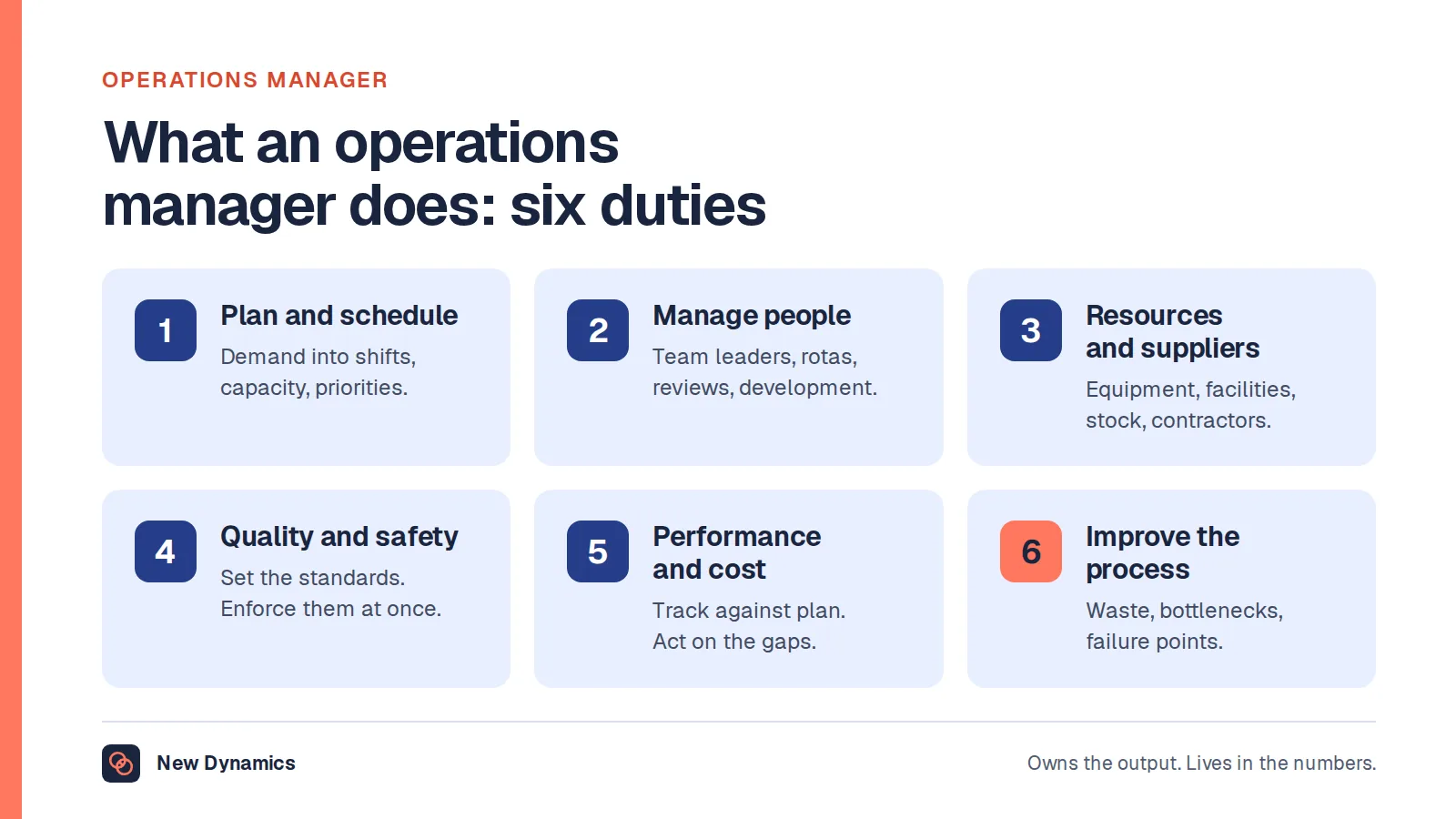
O*NET's task list for the occupation and the BLS's duties for top executives, grouped for a position description, give seven areas of responsibility.
- Turn strategy into an operating plan. The BLS lists “establish and carry out departmental or organizational goals, policies, and procedures”. The director takes the company's objectives and turns them into targets, capacity and priorities for each site or department for the year and the quarter.
- Own the operating budget. O*NET: “direct or coordinate financial or budget activities to fund operations”; the BLS adds analysing “financial statements, sales reports, and other performance indicators” and identifying “places to cut costs and to improve performance”. The director builds the budget, tracks it and answers for the variance.
- Run the day-to-day through managers. O*NET's core task is to “direct and coordinate activities of businesses or departments concerning production, pricing, sales, or distribution”. The director does this through operations managers, with a rhythm of reviews, not by managing the floor.
- Set policies, processes and standards. O*NET: “establish or implement departmental policies, goals, objectives, or procedures”. The director decides how work is done across sites so that quality, safety and cost are consistent.
- Manage suppliers and the supply chain. O*NET lists monitoring suppliers “to ensure efficient provision of goods or services within budgetary limits” and managing “the movement of goods into and out of production facilities”. The BLS adds negotiating or approving “contracts and agreements”.
- Measure performance and drive improvement. O*NET's first task is to “review financial statements, sales or activity reports, or other performance data to measure productivity”. The director owns the operational KPIs and the improvement programme behind them.
- Build the management team. The BLS lists appointing “department heads and managers”; O*NET includes personnel functions “such as selection, training, or evaluation”. The director hires, develops and reviews the operations managers, and plans who comes next.

Skills and experience to ask for
O*NET names active listening, monitoring, reading comprehension, speaking and critical thinking as the essential skills for the occupation, and places it in Job Zone Four: considerable preparation, usually a bachelor's degree and several years of related experience, though it notes that some people in the occupation do not hold a degree. The BLS lists communication, decision-making, leadership, problem-solving and time-management as the important qualities for top executives, and says they need “considerable work experience”, with many advancing from lower management positions within their organisations.
For a director of operations specifically, ask for:
- A track record of running more than one unit. Evidence of managing managers, not only teams.
- Financial fluency. Building and defending an operating budget; reading a P and L.
- Process and systems judgement. Knowing which standardisation helps and which strangles a site.
- Improvement method. Lean, Six Sigma or an equivalent discipline, with results they can describe honestly.
- Sector knowledge where it matters. Regulated production, healthcare and logistics each have rules the director must already know.
- The ability to hire and let go. The management team is the director's main tool.
The numbers a director of operations is judged on
The advert should say which of these the role owns and what good looks like. The examples are not benchmarks.
- Delivery: on-time delivery or service-level attainment across all sites.
- Cost: operating cost against budget; cost per unit or per case.
- Quality: defect, complaint or rework rates; audit results.
- Safety and compliance: incident rates, regulatory findings, actions closed.
- Capacity and productivity: output per person or per site; utilisation.
- People: turnover and vacancies in the operations teams; completion of the review cycle across sites.
Set these as quarterly objectives that the director and each operations manager can see. Our OKR guide shows how to cascade them without turning them into a spreadsheet nobody reads.

Director of operations position description template
Job title: Director of Operations (or Operations Director)
Reports to: Chief Executive Officer, Managing Director or Chief Operating Officer; state which
Direct reports: Operations managers for each site or department; name them; typically also quality, supply chain or facilities leads
Scope: State the departments, sites, regions, headcount and operating budget the role owns.
Purpose: Lead the organisation's operations so that products and services are delivered to plan, on budget and to standard, through a capable management team.
Responsibilities:
- Translate company strategy into an annual operating plan and quarterly targets for each site or department.
- Build, manage and report the operating budget; own the variance and the improvement actions.
- Lead the operations managers through a regular rhythm of performance reviews and site visits.
- Set and maintain the policies, processes and standards for quality, safety, cost and service across all units.
- Manage key suppliers and the supply chain; negotiate and approve contracts within delegated limits.
- Own the operational KPIs and the continuous improvement programme.
- Recruit, develop, review and, where necessary, replace members of the operations management team; plan succession for critical roles.
- Represent operations on the senior leadership team; report to the board as required.
Skills and experience:
- Several years leading multi-site or multi-department operations, including managing managers.
- Financial literacy: budgets, forecasts and profit and loss.
- A recognised improvement discipline and evidence of results.
- Strong communication with the board, the management team and the front line.
- Sector-specific regulatory knowledge where the business requires it.
Working pattern: Based at head office with regular travel to sites; state the expected proportion.
Adapt the scope line first. It is the sentence candidates read.

Common mistakes in director of operations adverts
- Listing an operations manager's duties. If the advert is about rotas, stock counts and shift cover, you are hiring a manager, not a director.
- Hiding the reporting line. Candidates need to know whether a COO sits above the role.
- No scope. Headcount, sites and budget are the three numbers that define the job. Leave them out and the strongest candidates assume the worst.
- A wish list of sectors. Ask for the regulatory knowledge you need and no more.
- No numbers. A director who does not know what they will be judged on cannot judge whether to apply.
Frequently asked questions
What does a director of operations do?
They lead the delivery of an organisation's products or services across several departments, sites or regions, through the operations managers who run each. The US occupational database describes the occupation as planning, directing or coordinating operations while overseeing multiple departments or locations; the duties cover the operating plan, the budget, processes and standards, suppliers, performance and the management team.
What is the difference between a director of operations and a COO?
Scope and seniority. A chief operating officer is usually the most senior operations role, responsible to the chief executive and the board for company-wide execution. A director of operations may be the top operations role in a smaller company, or one of several directors reporting to a COO in a larger one. The advert should say which.
What is the difference between a director of operations and an operations manager?
An operations manager runs one site, plant or department and its daily output. A director of operations runs several, through those managers, and owns the operating plan, budget and processes that connect them.
What qualifications does a director of operations need?
The US occupational database places the occupation in Job Zone Four, where most roles need a bachelor's degree and considerable experience, though some people reach it without a degree. The BLS says top executives need considerable work experience and often rise through lower management roles. In practice, a track record of running more than one unit matters more than any particular qualification.
What is a director of operations judged on?
Delivery against plan, operating cost against budget, quality, safety and compliance, productivity and capacity, and the health of the operations teams, including turnover and the completion of the review cycle. The advert should say which of these the role owns and what good looks like.
Your next step: write the scope line first
- State the departments, sites, headcount and budget the role owns.
- Name the reporting line and whether a COO sits above.
- List the seven duties in your own words, with the numbers attached.
- Describe the management team the director will lead and develop.
For a method that turns the operating plan into quarterly objectives every site can see, read and download our OKR guide. The guide is free to read, and the PDF uses our short download form.
Want the director's objectives, each site's targets and the management team's reviews in one place? Book a New Dynamics demo and bring your current operating plan. You can also email contact@new-dynamics.com.