TL;DR
- An operations manager runs the part of an organisation that produces and delivers what it sells or provides: the people, processes, resources and systems that turn the plan into output, safely, on time, to standard and within budget.
- The six duties are planning and scheduling, managing people, managing resources and suppliers, keeping quality and safety standards, monitoring performance and controlling cost, and improving the process. The mix depends on the sector.
- Employers ask for organisation, leadership, analysis, communication and commercial judgement. In England the role sits at level 5 in the apprenticeship standards, managing teams and projects in line with the organisation's operational strategy.
Every organisation has a plan and an output, and someone whose job is the distance between them. In a factory, a warehouse, a hospital department, a call centre, a charity or a software company, that person is usually called the operations manager, and the title means something different in each.
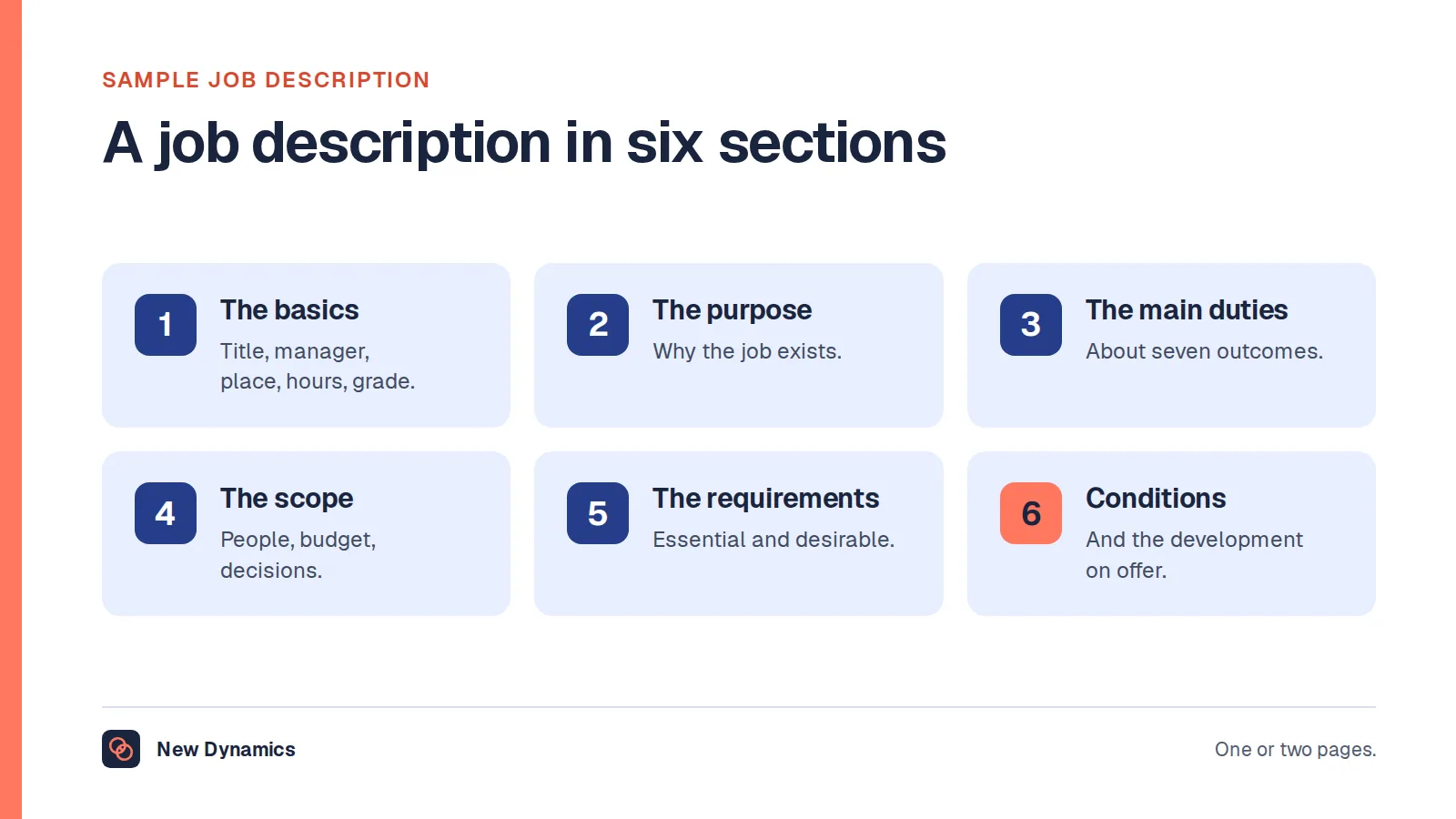
This operations manager job description explains what the role has in common across sectors, sets out six duties, shows how the job varies and how it differs from a chief operating officer, lists the skills employers ask for, describes the numbers the job is judged on and gives a position description template that you can adapt.
Operations managers are judged on numbers that should be agreed, visible and reviewed. See how New Dynamics Goals & OKRs keep targets and progress in one place, so that output, quality and cost targets are the same in the manager's head and on the board's page.
What is an operations manager?
An operations manager runs the part of an organisation that produces and delivers what it sells or provides. They are responsible for the people, processes, resources and systems that turn the plan into output, safely, on time, to the agreed standard and within budget. The title is not defined in the general dictionaries we cite, and this is our definition.
In England the role sits within the apprenticeship standards. Skills England's listing for the operations manager standard, at level 5 and typically 24 months, describes the occupation as “Managing teams and projects in line with a private, public, or voluntary organisation's operational or departmental strategy.”
Three things distinguish the role from other managers.
- They own the output. Sales owns the promise; operations owns keeping it.
- They manage through others. Team leaders, supervisors and specialists report to them; the operations manager rarely does the work.
- They live in the numbers. Output, quality, cost, safety and time, every day.
Operations manager duties: six responsibilities
- Plan and schedule. Turn demand and the organisation's plan into a schedule of work, shifts, capacity and priorities. Prospects, the UK graduate careers service, lists “plan and draw up a production schedule” first among a production manager's tasks.
- Manage people. Lead team leaders and supervisors, set expectations, run one-to-ones and reviews, plan rotas and cover, recruit and develop.
- Manage resources and suppliers. Equipment, facilities, stock, materials and the suppliers and contractors behind them. Prospects describes managing resources, including equipment and facilities, and ensuring stock levels remain adequate.
- Keep quality and safety standards. Set and enforce the quality standards, and, in Prospects' words, “ensure health and safety guidelines are followed at all times, addressing any concerns immediately”.
- Monitor performance and control cost. Track output, productivity, quality and spend against plan, and act on the gaps.
- Improve the process. Find waste, bottlenecks and failure points, and change the process, the layout, the system or the skills to remove them.

How the job varies by sector
| Sector | What "operations" means | Typical numbers |
|---|---|---|
| Manufacturing | Production lines, plant, materials, maintenance | Output, yield, downtime, cost per unit |
| Logistics and warehousing | Receiving, storage, picking, dispatch, fleet | Orders on time, accuracy, cost per order |
| Hospitality and retail | Sites, shifts, stock, standards, customer flow | Sales per labour hour, waste, audit scores |
| Health and care | Clinics, wards, rotas, patient flow, compliance | Waiting times, staffing levels, incidents |
| Services and technology | Delivery teams, support, systems, vendors | Service levels, utilisation, cost to serve |
| Charities and public bodies | Programmes, sites, volunteers, compliance | Beneficiaries served, cost, funder reporting |
Prospects describes the logistics version plainly: a logistics and distribution manager's role “is to organise the storage and distribution of goods” and to ensure “the right products are delivered to the right location on time and at a reasonable cost”. Swap the nouns and the sentence describes operations management anywhere.
Operations manager and chief operating officer
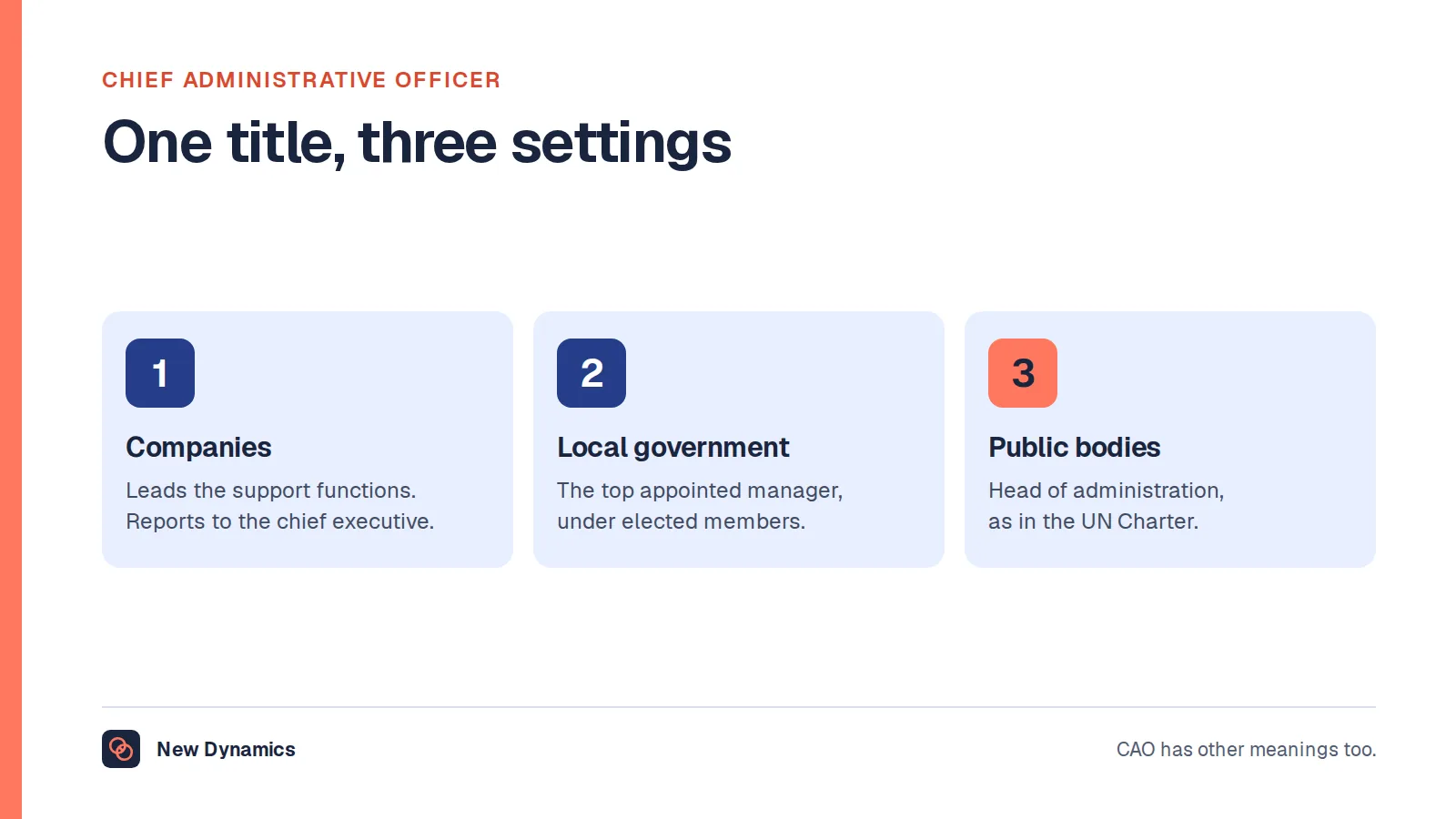
A chief operating officer runs the operations of the whole organisation and sits on the executive team. An operations manager runs one site, department, region or function within it, and usually reports to a director or the COO. In a small organisation the operations manager may be the most senior operational person there is. Our guide to the chief administrative officer explains how the COO differs from the roles around it.

Skills employers ask for
Prospects lists what a production manager needs, and the list travels well. Organisation skills “to plan, run, and monitor the entire production process”; the ability to build relationships and “communicate clearly and persuasively with your team, managers, and clients”; leadership skills and the confidence to motivate others and act decisively; and analytical skills, including the ability to collect and interpret data to improve processes.
Three more matter in every version of the job.
- Commercial judgement. Knowing what a decision costs, and what a delay costs more.
- Composure. Operations fail daily in small ways. The manager who stays calm keeps the team solving rather than blaming.
- Systems literacy. Planning, stock, workforce and quality systems are the manager's instruments.
The numbers an operations manager is judged on
Most operations roles come down to five measures, weighted differently by sector.
- Output or service delivered against plan.
- Quality, as defects, complaints, returns or audit scores.
- Cost, as spend against budget and cost per unit of output.
- Safety and compliance, as incidents, near misses and audit findings.
- Time, as on-time delivery, lead time or waiting time.
Good adverts state which of these the role owns and what good looks like. Good objectives do the same, quarter by quarter. Our OKR guide shows how to set them.

Operations manager position description template
Adapt the template to your sector. Keep every line true, and fill in the numbers.
Job title: Operations manager, [site, department or region]
Reports to: [Operations director, general manager or chief operating officer]
Direct reports: [Team leaders, supervisors, specialists], with a total team of [number]
Purpose of the role: To deliver [the output or service] safely, on time, to standard and within budget, and to improve how it is delivered.
Main duties:
- Plan and schedule work, capacity and shifts against demand
- Lead and develop team leaders and their teams
- Manage equipment, facilities, stock, suppliers and contractors
- Maintain quality, health and safety and compliance standards
- Monitor output, quality, cost and time against plan and act on gaps
- Lead improvement projects and manage change
- Report performance to [the director or executive team]
Measures: [Output], [quality], [cost], [safety], [time], with targets agreed each quarter
Skills and experience:
- Experience of managing operations in [the sector] through team leaders
- Planning, analysis and confident use of [the systems you use]
- Clear communication with teams, senior managers and customers
- Commercial judgement and calm under pressure
- [Qualifications or certifications the sector requires]
We provide: Objectives agreed each quarter, regular one-to-ones with the director, a development plan and support for professional qualifications.
Name the site, the team size, the budget and the numbers. "Operations manager" alone could be a team of six or six hundred. Our job description template explains the structure.
Common mistakes in operations manager adverts
No numbers. Team size, budget and the measures the role owns are the facts candidates need.
Everything is "operations". If the role also covers HR, finance and IT, say so, and consider whether it is one job.
Asking for the sector and nothing else. Operations skills transfer. Ask for the skills and the numbers, and treat sector experience as desirable unless regulation requires it.
Confusing the role with a supervisor. A supervisor runs a shift. An operations manager runs the supervisors, the plan and the budget.
Hiring for firefighting. The candidate who thrives on daily crises may never remove their causes. Ask about improvement, not just rescue.
Frequently asked questions
What does an operations manager do?
An operations manager runs the part of an organisation that produces and delivers what it sells or provides. They plan and schedule work, manage people through team leaders, manage resources and suppliers, keep quality and safety standards, monitor performance and cost, and improve the process.
What is the difference between an operations manager and a COO?
A chief operating officer runs the operations of the whole organisation and sits on the executive team. An operations manager runs one site, department, region or function and usually reports to a director or the COO. In small organisations the two roles can merge.
What skills does an operations manager need?
Organisation and planning, leadership through others, analysis of data to improve processes, clear and persuasive communication, commercial judgement, composure under pressure and confident use of planning, stock, workforce and quality systems.
What qualifications does an operations manager need?
Usually experience of managing operations through team leaders, in the sector or a related one. In England the operations manager apprenticeship standard sits at level 5. Some sectors require specific certifications, such as health and safety or quality qualifications, and regulated sectors have their own.
What are operations manager KPIs?
Most reduce to five: output or service delivered against plan, quality, cost against budget and per unit, safety and compliance, and time such as on-time delivery or waiting time. The weighting depends on the sector and should be stated in the job description.
What should an operations manager position description include?
The site or function, who the role reports to, the team size and structure, the purpose, six or seven main duties, the measures the role owns with targets, the skills and experience needed, any required certifications, and the support and development offered.
Your next step
If you are hiring, write the measures line of the template first, with real numbers, and build the rest of the advert around it. If you are applying, write one line for each of the five measures showing what you have moved and by how much.
For a method that turns operational targets into quarterly objectives the team can see, read and download our OKR guide. The guide is free to read, and the PDF uses our short download form.
Want output, quality, cost and safety targets agreed and tracked in one place? Book a New Dynamics demo and bring your current approach. You can also email contact@new-dynamics.com.