TL;DR
- The Civil Service HR Career Framework gives a usable definition: OD practitioners “help organisations understand their current states and work towards a desired future”, applying “behavioural science, systems thinking, and a systemic approach”.
- The published scope is wide, structures, systems, policies, metrics, role design, culture, capability, values, behaviours and relationships, which is why OD is hard to distinguish from everything else HR does.
- The same framework lists “the confidence to speak truth to power” as an essential attribute. An OD function that cannot do that is a project team with a different name.
Most definitions of organization development explain it using the words organisation and development, which leaves everyone where they started.
This article gives a published definition, sets out what the work covers, separates OD from HR, change management and organisation design, and explains the requirement that decides whether an OD function is useful.
Design work starts from what the organisation is actually shaped like now. See how New Dynamics org charts keep that current.
A definition worth using
The UK Civil Service publishes an HR career framework that describes Organisational Design and Development as a specialism. Its summary is unusually concrete:
"OD&D practitioners help organisations understand their current states and work towards a desired future. They identify issues and opportunities, supporting people, teams, and organisations to deliver effective and impactful change. This involves applying behavioural science, systems thinking, and a systemic approach to enable organisational effectiveness."
Three things are doing work there. Current state before desired future, diagnosis precedes design. Systems thinking, the unit of analysis is the whole, not a department. And effectiveness, not engagement or satisfaction.
What the work covers

The framework describes work spanning "design, structures, frameworks, systems, policies, metrics, and role design and development, culture, capability, values, behaviours, and relationships", with collaboration "across departments... and with senior decision-makers" described as fundamental.
That is a very wide scope, and it explains why OD is hard to pin down. In practice it clusters into four:
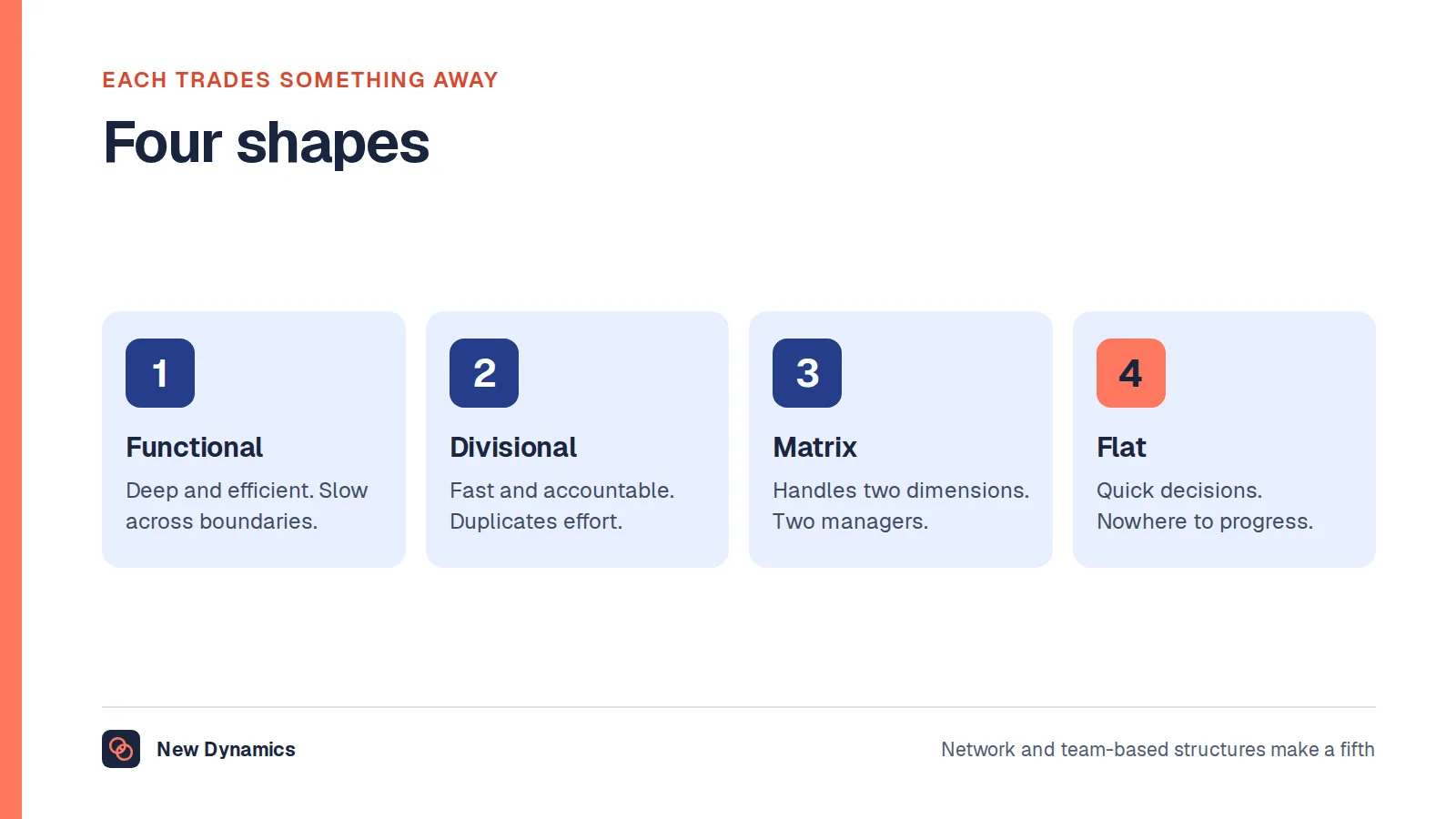
- Structures and systems. How the organisation is arranged and what its processes reward. Our organizational structure post covers the shapes and what each trades away.
- Roles and capability. Role design, and whether people can do what the design assumes.
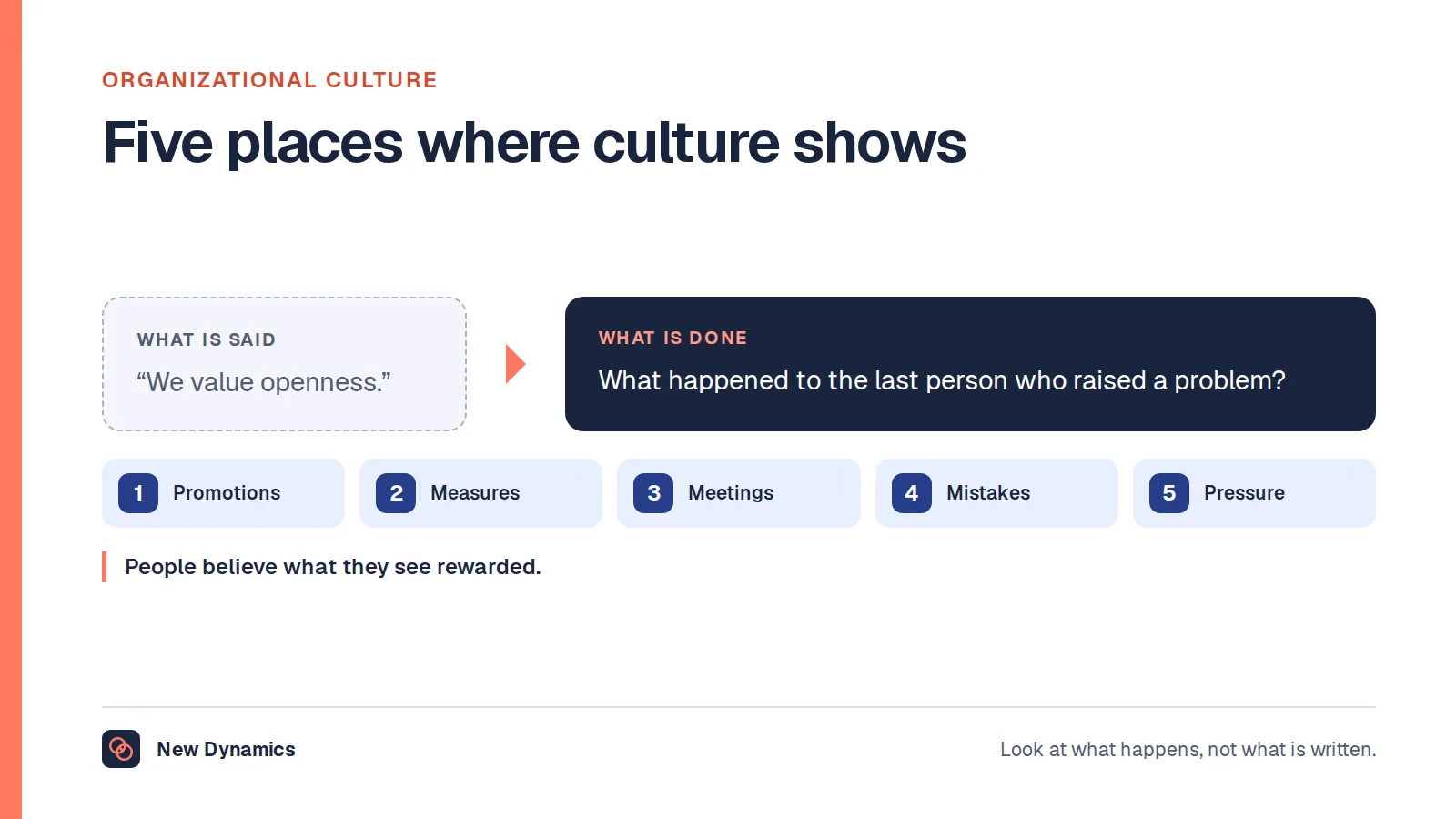
- Culture and behaviours. What is actually rewarded, as against what is stated.
- Evaluation. Whether the change worked, which is the part most often missing.
What it is not

Not HR generalist work. HR runs the employment relationship, hiring, cases, pay, records. OD works on how the organisation is put together. The two overlap and are not the same job.
Not change management. Change management delivers a decided change: plan, communicate, train, embed. OD includes deciding whether the change is the right one, and is entitled to conclude that the problem is elsewhere.
Not organisation design alone. Design is the structural half. Development is the behavioural half. The Civil Service framework puts them together for a reason: a new structure with the old behaviours produces the old results.
The uncomfortable requirement
The framework lists what the job needs: "the ability to collaborate effectively, influence decision-making, and negotiate with tact, guiding organisations without dictating outcomes". And then, among personal attributes: "resilience, adaptability, and the confidence to speak truth to power".
It is rare for a published job framework to say that. It matters because it names the failure mode. An OD practitioner with no authority and no licence to challenge becomes a facilitator of workshops that confirm decisions already taken. The discipline's value lies precisely in the part that is uncomfortable to exercise.
The framework also notes that OD&D roles "typically start at Working Level due to the scope, complexity, and scale of the work", it is not an entry-level specialism.
What an intervention has to satisfy
Whatever the method, an OD intervention lands on people, and there is a published standard for how change should be handled. HSE's Change standard expects employees to indicate "that the organisation engages them frequently when undergoing an organisational change", and sets out what should be happening:
- "Timely information to enable them to understand the reasons for proposed changes."
- "Adequate employee consultation on changes", with "opportunities for employees to influence proposals".
- Awareness of "the probable impact of any changes to their jobs", and training "to support any changes in their jobs" where needed.
- Awareness of "timetables for changes", and "access to relevant support during changes".
Six checkable conditions. An OD programme that cannot answer them is generating the problem it was hired to solve. This is general information rather than legal advice.
The weak point is evaluation
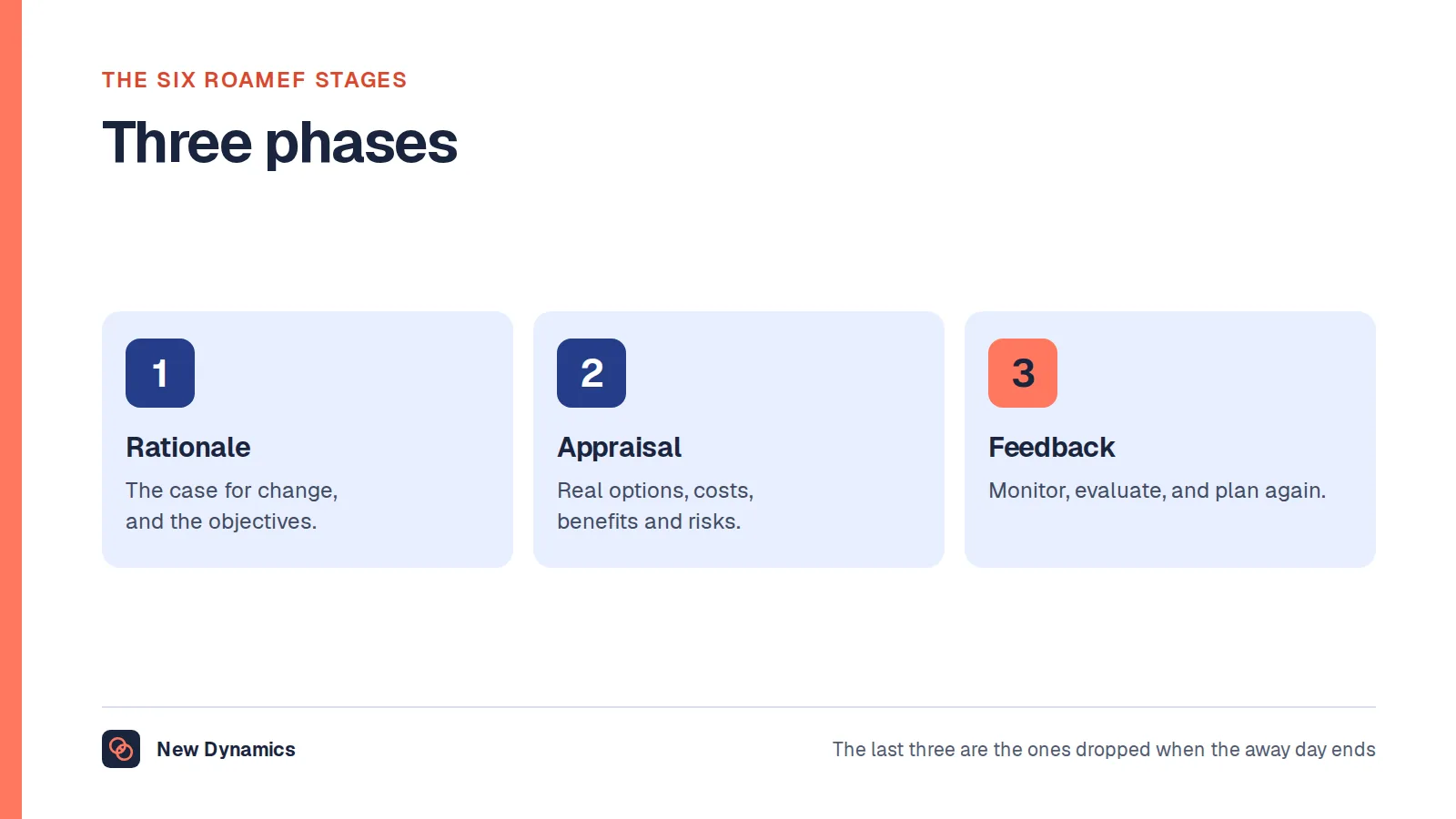
The framework expects practitioners to "assess the effectiveness of design work and processes, using robust evaluation methodologies that can also inform benefits realisation". That is the hardest part, and the National Audit Office's report on a major government merger shows why: the department "did not clearly articulate or measure the range of anticipated benefits", and its approach to tracking costs "was incomplete and changed over time".
The NAO's warning applies to any OD work: "the indirect costs in terms of disruption, diverted effort and the impact on staff morale should not be under-estimated. These factors should be considered against the potential benefits ahead of any major change."
Write the benefits and the measures before the intervention, or you will be asked afterwards and have only anecdotes.
Getting into OD

- Start from a discipline, usually HR, organisational psychology or delivery, and add the systemic view.
- Learn diagnosis before intervention. The common error is arriving with a favourite method.
- Practise influence without authority, because that is the working condition, not an obstacle to it.
- Get good at evaluation, since it is the scarcest skill and the one that makes the case for the next piece of work.
Our strategic planning post covers the appraisal discipline that pairs with this.
When you need OD, and when you do not
You need OD when the problem keeps coming back after being fixed, when two parts of the organisation are rationally pursuing incompatible aims, or when a structure was changed and nothing improved.
You need a project manager when the decision is made, the outcome is clear and the work is delivery. Hiring OD for that produces expensive facilitation; hiring delivery for the first set produces a well-run change to the wrong thing.
Frequently asked questions
What is organization development?
A practice that helps an organisation understand its current state and move towards a desired future, applying behavioural science and systems thinking to improve effectiveness. The Civil Service HR career framework describes it as supporting people, teams and organisations to deliver effective and impactful change.
What does an OD practitioner do?
Work spanning design, structures, systems, policies, metrics, role design, culture, capability, values, behaviours and relationships, in collaboration with senior decision-makers. In practice: diagnose, design, support the change, and evaluate whether it worked.
What is the difference between OD and HR?
HR runs the employment relationship, hiring, cases, pay and records. OD works on how the organisation is put together and how it behaves. They overlap, and in smaller organisations the same person does both, but they answer different questions.
What is the difference between OD and change management?
Change management delivers a change that has been decided. OD includes deciding whether the change is the right one, and can conclude that the real problem lies elsewhere. Change management without that step delivers well-run changes to the wrong things.
Is organisation design the same as organisation development?
They are usually paired. Design is the structural half, the shape, roles and reporting lines. Development is the behavioural half. A new structure with unchanged behaviours reproduces the old results, which is why published frameworks treat them together.
What skills does OD need?
Collaboration, influencing decisions and negotiating with tact, guiding organisations without dictating outcomes. The Civil Service framework also lists resilience, adaptability and the confidence to speak truth to power as essential attributes, alongside robust evaluation methods.
How do you get into organisation development?
Usually from HR, organisational psychology or delivery, adding a systemic view. The Civil Service notes that OD roles typically start above entry level because of the scope and complexity of the work, so early experience tends to come from supporting more experienced practitioners.
Your next step: write the diagnosis down
- Describe the current state in observable terms before proposing anything.
- Name the benefits you expect and how they will be measured.
- Check your plan against the six change conditions people are entitled to.
- Decide who will tell the sponsor if the answer is that the problem lies elsewhere.
For running the change once the diagnosis is agreed, read and download our HR change management guide. The guide is free to read, and the PDF uses our short download form.
Want the current state visible before you redesign it? Book a New Dynamics demo and bring your current structure. You can also email contact@new-dynamics.com.