TL;DR
- Strategic planning is deciding what an organisation will do over a period longer than a budget year, and (the part usually missing) what it will stop doing to fund it.
- HM Treasury's Green Book describes the discipline in public: six stages known as the ROAMEF cycle, a longlist of options tested against critical success factors, and SMART objectives set before any option is chosen.
- The Green Book supplies the rule that disposes of most bad plans: “an option can only be value for money if it meets the proposal's objectives”. Generating a single option is not appraisal.
The away day produces a deck. The deck produces agreement. Nothing is defunded, nobody is reassigned, and next year's away day starts from the same slide.
This article explains what strategic planning means, how strategy differs from a plan and a budget, who is responsible for it, the six stages of the process, and the single test that separates a plan from a document.
A plan that nobody can see the progress of reverts to a document. See how New Dynamics goals and OKRs keep objectives and progress visible between planning cycles.
What it means
Strategic planning is deciding what an organisation will do over a period longer than one budget year, and what it will stop doing in order to fund that.
The second half is the part people leave out, and it is the part that makes the exercise strategic rather than aspirational. A list of everything you would like to achieve, with no choices in it, is a wish list with a cover page.
Strategy, plan, objectives, budget
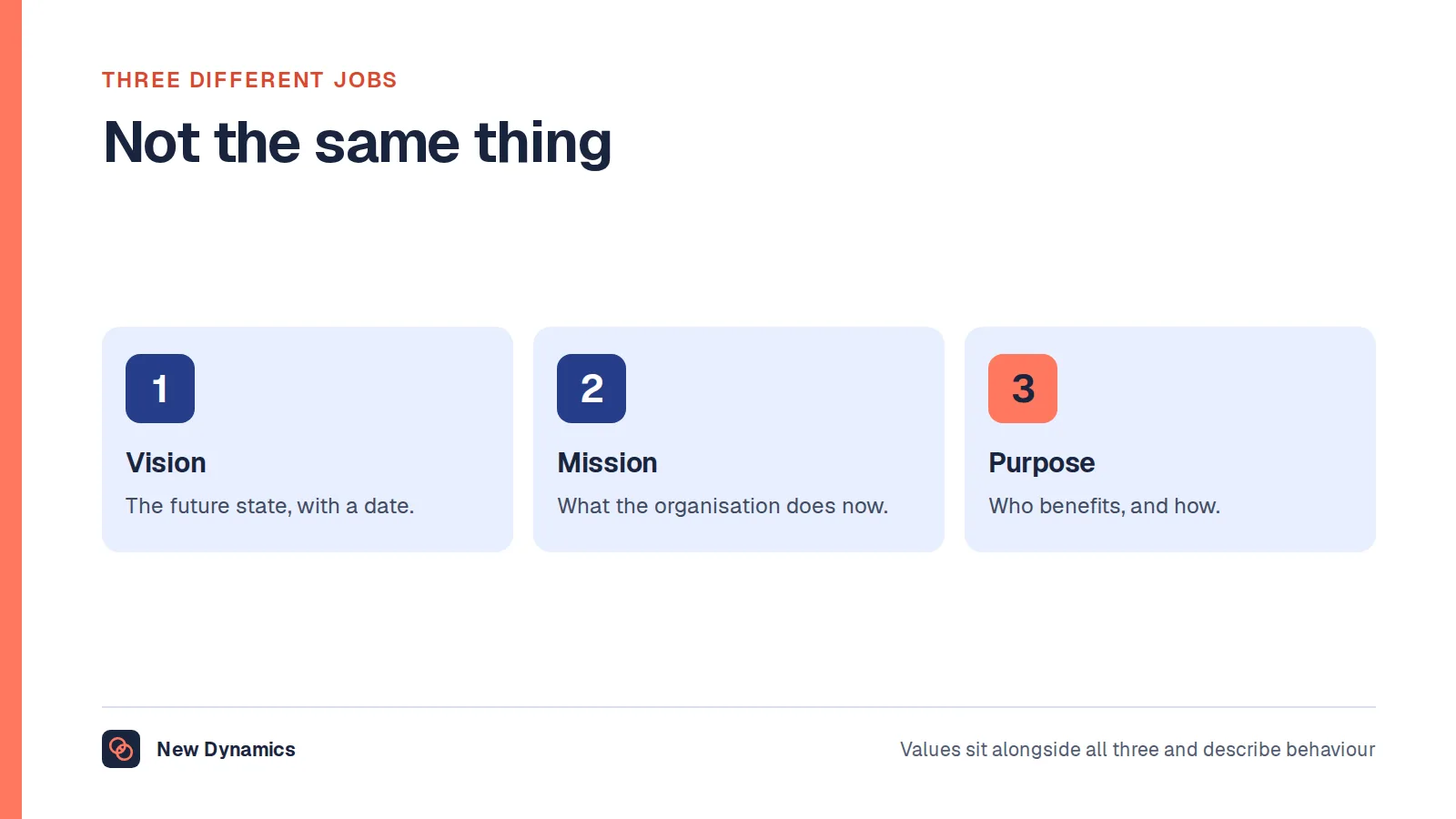
- Strategy is the choice: where you will compete or operate, for whom, and what you will not do.
- A plan is the sequence: what happens, in what order, by when, and who owns each part.
- Objectives are the results the plan is supposed to produce, written so you can tell whether they happened.
- The budget is the plan expressed in money. If it looks the same as last year's, the strategy did not change anything.
Our post on the definition of goal setting covers writing the objectives themselves.
Who owns it
In a UK company, strategy sits with the directors, and the law describes what they must weigh. Section 172 of the Companies Act requires a director to act in the way they consider "would be most likely to promote the success of the company for the benefit of its members as a whole", having regard among other things to "the likely consequences of any decision in the long term", "the interests of the company's employees", business relationships with "suppliers, customers and others", "the impact of the company's operations on the community and the environment", the company's "reputation for high standards of business conduct", and "the need to act fairly as between members".
Charities have an equivalent. The Charity Commission's guidance for trustees says trustees "are responsible for deciding and planning how your charity will carry out its purposes", and that trustees of larger charities "should take responsibility for setting the charity's strategic aims and direction, and agreeing appropriate future plans". It adds that involving "staff, volunteers and others with an interest in the charity in the planning process can be helpful", advice, not decoration.
This is general information rather than legal advice.
The six stages

The clearest public description of planning discipline in the UK is HM Treasury's Green Book. It is written for central government appraisal, but the structure transfers to any organisation choosing between options with a constrained budget.
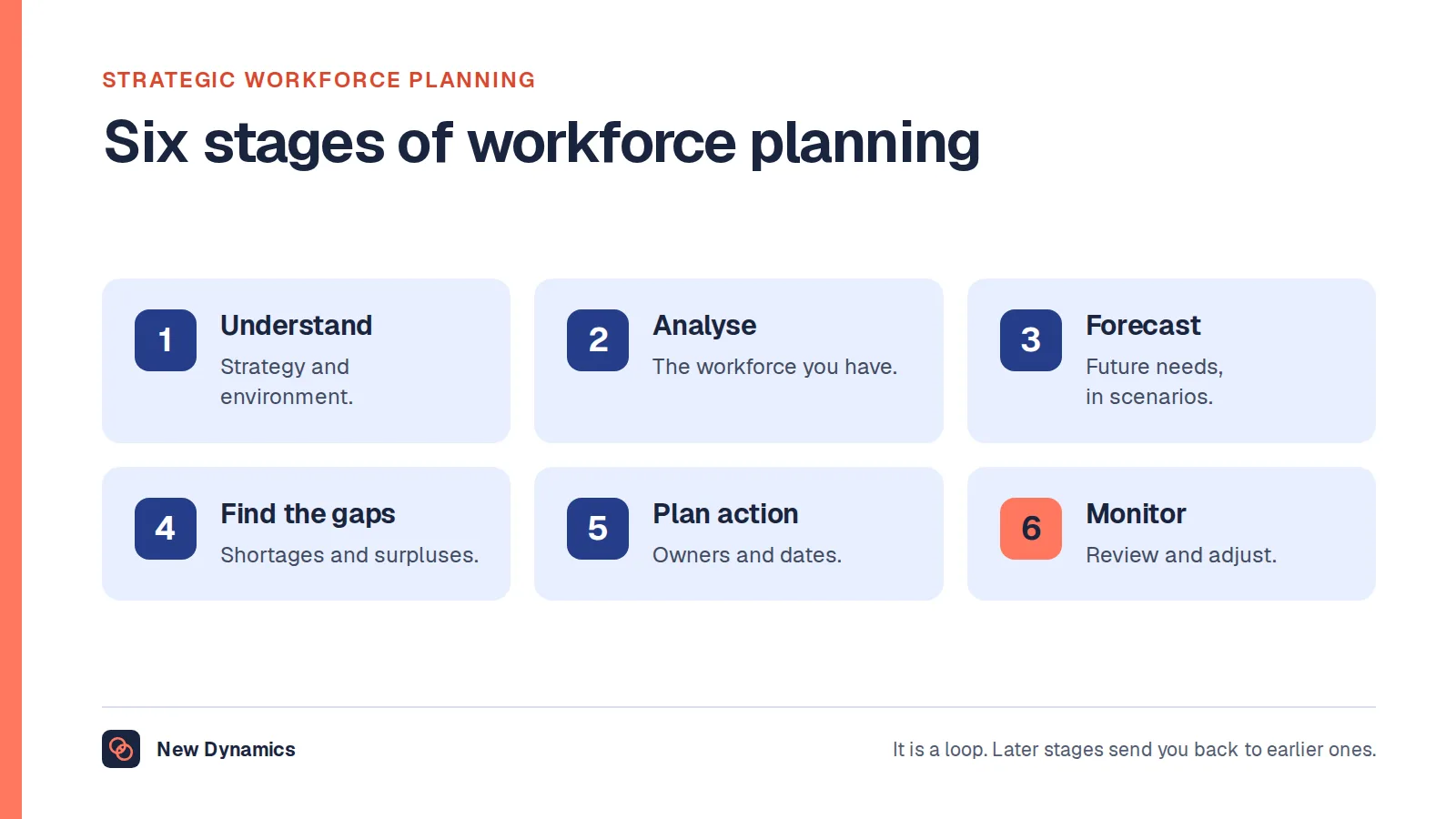
It describes a proposal progressing through "six stages: rationale, objectives, appraisal, monitoring, evaluation and feedback", together "known as the ROAMEF cycle". Appraisal itself is defined as "the process of assessing the costs, benefits and risks of different options for achieving government objectives", to help decision makers "understand the potential impacts and trade-offs of different options, based on robust evidence and analysis".
Two features of that sentence are worth borrowing. Options, plural. And trade-offs, stated rather than implied.
What the rationale stage has to produce

The Green Book's framework is specific about what exists before anyone picks a direction:
- The case for change. Why the current position is not acceptable.
- The theory of change. How the intervention is supposed to produce the result, written down so it can be wrong.
- Business as usual. What happens if you do nothing, the comparison everything else is measured against.
- SMART objectives, and strategic fit. What success is, and how the proposal relates to what the organisation already exists to do.
Most planning exercises skip the third. Without a business-as-usual comparison, every option looks better than nothing, because nothing is never described.
The longlist discipline
Then comes the step almost nobody outside government performs. The Green Book asks you to "define critical success factors", "generate a longlist of the options that might feasibly achieve the objectives and critical success factors", assess that longlist to see "which options best meet the objectives and critical success factors", and only then "identify a shortlist of options and label one of those as the preferred way forward".
It follows with the sentence that disposes of most bad plans:
"An option can only be value for money if it meets the proposal's objectives. Any option that does not meet the objectives should have been ruled out at the longlist appraisal stage."
If your planning process generated one option and then justified it, you did not appraise anything. You wrote a business case for a decision already taken, and the risk is that nobody in the room can say so.
The test of whether a plan is real

Four questions, asked a month after the plan is agreed.
- Did a budget move? Money going to the same places means the choices were not made.
- Did anyone's objectives change? If the plan implies different work and nobody's targets changed, it did not reach the work.
- What was stopped? A plan with no cancellations is an addition to everyone's workload.
- Who owns each part, by name? A plan owned by a committee is owned by nobody.
An organisation that can answer those four has a strategy. One that cannot has a document, however good the document is.
Monitoring, evaluation and feedback
The last three stages of the cycle are the ones that get dropped when the planning away day ends. They are what turn a plan into an organisation that learns: monitoring tells you what is happening, evaluation tells you whether it worked, and feedback puts that into the next round of planning.
The Charity Commission makes the same point in fewer words: trustees "should periodically review what the charity is achieving, and how effective the charity's activities are". Our strategic workforce planning post covers the people half of that review.
The small-organisation version
You do not need an appraisal summary table to plan a thirty-person business. You do need the same four things:
- A written statement of what is not acceptable about the current position.
- Two or three genuine options, one of which is carrying on as you are.
- Objectives you could fail, with dates.
- A named owner per objective, and one thing stopped for each thing started.
That fits on two pages, takes an afternoon, and is more use than a fifty-slide deck with no choices in it.
Frequently asked questions
What is strategic planning?
Deciding what an organisation will do over a period longer than one budget year, and what it will stop doing to fund that. It covers the choice of direction, the objectives that define success, and the sequence of work that follows, with named owners.
What are the steps in strategic planning?
HM Treasury's Green Book describes six: rationale, objectives, appraisal, monitoring, evaluation and feedback, known as the ROAMEF cycle. In practice that means establishing the case for change, setting SMART objectives, comparing real options against them, then tracking, evaluating and feeding the result into the next cycle.
What is the difference between strategy and a plan?
Strategy is the choice of where to operate and what not to do. A plan is the sequence of work that follows, with dates and owners. An organisation can have a detailed plan and no strategy, which usually shows up as a budget that never changes shape.
Who is responsible for strategic planning?
In a UK company, the directors, whose statutory duty includes having regard to the likely long-term consequences of decisions. In a charity, the trustees, who the Charity Commission says are responsible for deciding and planning how the charity carries out its purposes.
How long should a strategic plan cover?
Long enough that it cannot be delivered by working harder within the current budget, and short enough that the assumptions are still plausible. What matters more than the horizon is whether the plan is reviewed and fed back into the next cycle.
Why do strategic plans fail?
Most often because only one option was ever considered, because business as usual was never described, or because nothing was stopped to make room for what was started. A plan that changes no budget and no objectives has not reached the work.
What is a business-as-usual comparison?
A description of what happens if you do nothing. The Green Book requires it because every option looks attractive when the alternative is left undefined, and because doing nothing is sometimes the right answer.
Your next step: check last year's plan
- Open the plan agreed a year ago and list what was stopped because of it.
- Find one budget line that moved as a result.
- Name the owner of each objective, as a person rather than a team.
- Write down what business as usual would have looked like, and compare.
For turning the plan into objectives people can act on, read and download our OKR guide. The guide is free to read, and the PDF uses our short download form.
Want objectives that stay visible between planning cycles rather than surfacing at year end? Book a New Dynamics demo and bring last year's plan. You can also email contact@new-dynamics.com.