TL;DR
- An organisational structure sets who decides what, who reports to whom and which groups are measured together. Titles and boxes are consequences of those three choices.
- Each type trades something away. Functional structures are efficient and slow across boundaries; divisional structures are fast and duplicate effort; matrix structures resolve that by making conflict somebody's job.
- The National Audit Office's verdict on a major merger applies widely: the indirect costs “in terms of disruption, diverted effort and the impact on staff morale should not be under-estimated”.
Every organisation chart is the answer to a question nobody wrote down: when two people disagree, who decides?
This article explains what an organizational structure is, the main types and what each trades away, how hierarchy and span of control work, and what changing a structure actually costs.
Structures only work when people can see them. See how New Dynamics org charts show roles, reporting lines and the relationships between them.
Structure is the design half: our post on organization development covers the behavioural half it is paired with. For the HR function's own shape, see our post on HR structure.
What a structure decides
Three things, and everything else follows:
- Who decides. Which decisions sit at which level, and who breaks a tie.
- Who reports to whom. Including the dotted lines, which are where most of the trouble lives.
- What is grouped and measured together. People grouped together optimise for the same number.
Titles, boxes and the shape of the chart are consequences. Changing the chart without changing those three things changes nothing.
The main types

Functional. Grouped by discipline: finance, operations, engineering, marketing. Good at depth, standards and efficiency within each function. Bad at anything that crosses boundaries, because no one below the chief executive owns the whole customer.
Divisional. Grouped by product, market or geography, each division holding most functions. Good at speed and accountability for a result. Bad at duplication and at sharing anything, since each division rationally optimises for itself.
Matrix. People report both to a function and to a product, project or region. It is the honest answer when work genuinely has two dimensions. The cost is that every person has two managers with different priorities, and unless someone is explicitly named to resolve that, the conflict lands on the individual.
Flat. Few levels, wide spans. Good at speed and at not employing people whose job is to relay information. Bad at development, because there is nowhere to progress to, and at consistency, since a manager with thirty reports cannot hold thirty proper conversations.
Network or team-based. Small stable teams with a thin coordinating centre, often with contracted or partner capacity around the edges. Good at flexibility. Bad at accumulating institutional knowledge, and dependent on excellent written communication.
Most real organisations are hybrids, and describing yours accurately is more useful than picking a label.
Hierarchy, levels and span
Cambridge Dictionary defines a hierarchy as "a system in which people or things are arranged according to their importance". In an organisation, the practical measures are the number of levels between the front line and the chief executive, and the span of control, how many people report to each manager.
The two trade against each other. Narrow spans produce many levels, which slows decisions and adds relay cost. Wide spans produce few levels, which speeds decisions and thins out supervision, development and the chance of anyone noticing a problem early.
There is no correct number. There is only the question of what a manager is expected to do: a manager expected to coach, review and develop can hold far fewer people than one coordinating routine work. Our post on hierarchy culture covers what a steep structure does to how people behave.
The test at the individual level

A structure works when the person inside it can answer four questions. HSE's Role Management Standard puts them as conditions an organisation has to meet: employees should "understand their role and responsibilities"; the organisation "ensures that, as far as possible, the different requirements it places upon employees are compatible"; it "provides information to enable employees to understand their role and responsibilities"; and systems exist "to enable employees to raise concerns about any uncertainties or conflicts they have in their role and responsibilities".
The second of those is the matrix test. If two managers place incompatible requirements on the same person and nothing exists to resolve it, the structure has pushed a design problem down onto an individual, where it becomes a wellbeing problem.
Changing a structure

The National Audit Office has examined this more honestly than most. Its report on the merger of the FCO and DFID recalls the key principles it set out for reorganising central government: "ensuring broad support for the change; communicating well with staff and stakeholders; quickly establishing solid reporting systems; being clear about the outcomes sought; breaking down old 'silos'; and ensuring that normal business is maintained during the transition".
Those six transfer to any organisation. So does what the NAO found when it measured against them. The department "has made substantial progress with integrating structures and aligning HR and finance policies, helping to remove the practical barriers to people being able to work together effectively", and yet "more than three years on, there is still work to do to resolve remaining issues". Structural change takes far longer to finish than to announce.
The costs nobody counts
The NAO's sharpest finding is about measurement. The department "did not clearly articulate or measure the range of anticipated benefits of the merger, and its approach to tracking the costs of the merger was incomplete and changed over time".
And then the sentence worth quoting in any restructure paper:
"The estimated direct costs of the merger are small compared to the overall expenditure of the department, but the indirect costs in terms of disruption, diverted effort and the impact on staff morale should not be under-estimated. These factors should be considered against the potential benefits ahead of any major change."
Direct costs (redundancy, systems, premises) are the ones that appear in the business case. Diverted effort and morale are the ones that do not, and they are usually larger. This was central government, but the pattern holds wherever benefits are asserted rather than measured.
How to choose
- Start from the decisions, not the boxes. List the ten decisions that matter most and ask where each should sit.
- Name what you are trading away. Every structure is worse at something; choose which.
- Decide who resolves conflict between any two lines on the chart, by name.
- Write down the benefits and how you will measure them before the announcement, not after.
- Protect normal business through the transition, which is the principle most often ignored.
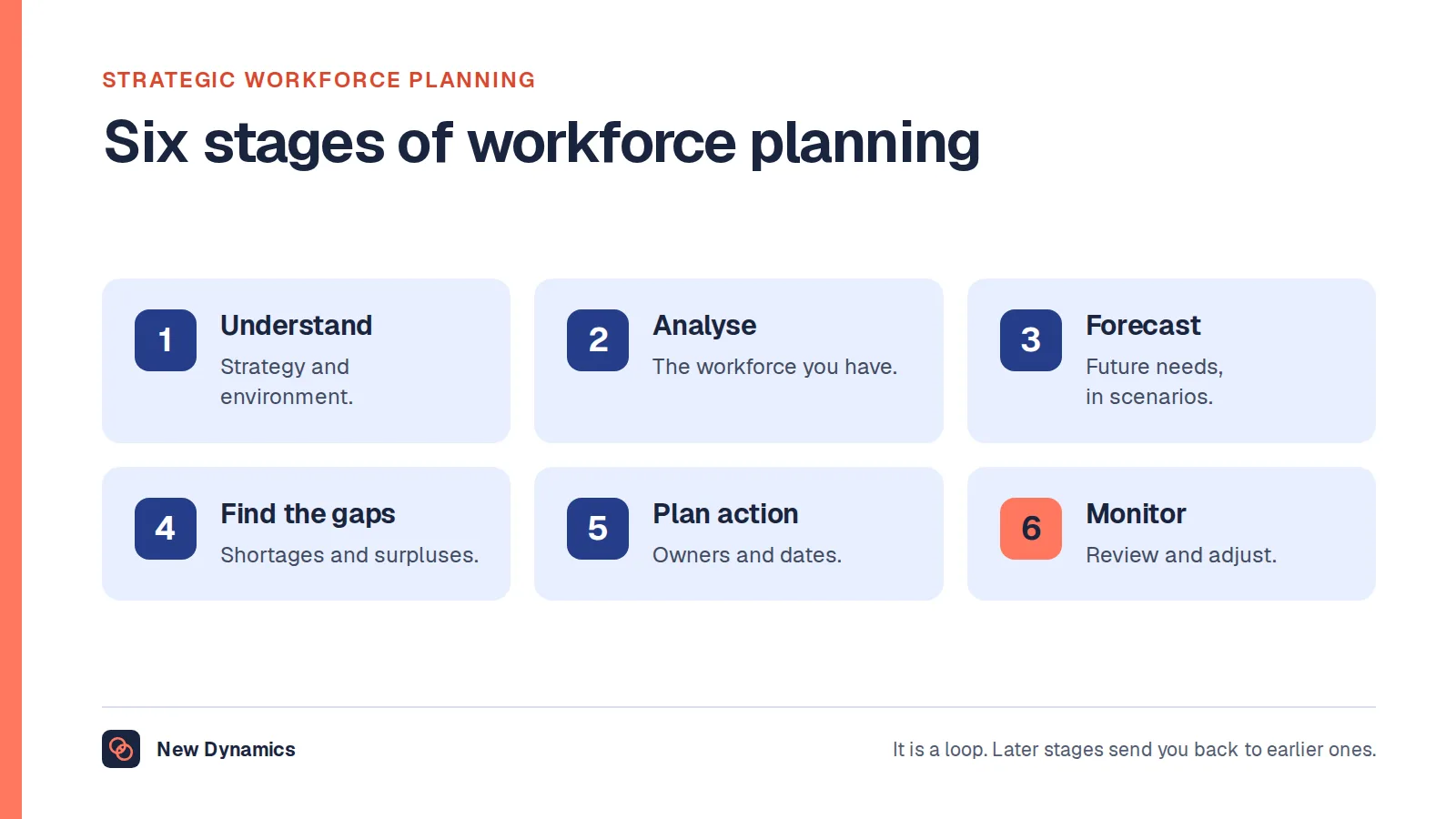
Our strategic workforce planning post covers checking you have the people the new shape requires.
Frequently asked questions
What is an organizational structure?
The arrangement that sets who decides what, who reports to whom, and which groups are measured together. Titles, reporting lines and the shape of the chart follow from those three choices rather than the other way round.
What are the main types of organizational structure?
Functional, grouped by discipline; divisional, grouped by product, market or geography; matrix, where people report to two dimensions; flat, with few levels and wide spans; and network or team-based, with a thin coordinating centre. Most organisations are hybrids.
What is the difference between a functional and a divisional structure?
A functional structure groups people by discipline and is strong on depth and efficiency but weak across boundaries. A divisional structure groups them around a product, market or region, which speeds up accountability for results but duplicates effort between divisions.
What is a matrix structure?
One where people report both to a function and to a product, project or region. It suits work that genuinely has two dimensions, but it only works if someone is explicitly named to resolve conflicting priorities, rather than leaving that to the person with two managers.
What is span of control?
The number of people reporting to one manager. Wide spans mean fewer levels and faster decisions but thinner supervision and development; narrow spans mean more levels, more relay and slower decisions. The right number depends on what the manager is expected to do.
How do you know if a structure is working?
Ask the people inside it. HSE's Role standard expects employees to understand their role and responsibilities, and expects the requirements placed on them to be compatible. Where two managers make incompatible demands and nothing resolves it, the structure is failing.
How much does a restructure cost?
More than the business case says. The National Audit Office found that direct merger costs were small relative to spending, but warned that indirect costs from disruption, diverted effort and the effect on staff morale should not be under-estimated, and should be weighed before any major change.
Your next step: write down the three decisions
- List the ten decisions that matter most and where each currently sits.
- Name who resolves conflict between any two reporting lines.
- Write the benefits of any proposed change, and how you will measure them.
- Decide what the new structure will be worse at, and say so out loud.
For running the change itself, read and download our HR change management guide. The guide is free to read, and the PDF uses our short download form.
Want a structure people can actually see, including the dotted lines? Book a New Dynamics demo and bring your current chart. You can also email contact@new-dynamics.com.