TL;DR
- A med surg nurse, short for medical-surgical nurse, is a registered nurse who cares for adult patients who are preparing for or recovering from surgery, or who have complications of long-term illnesses.
- The work is assessment, medication and treatment, monitoring, escalation, coordination of the care team and patient education, usually for several patients at once. It demands strong organisation and prioritisation.
- In the United States there are two specialty certifications, CMSRN and MEDSURG-BC. A good job description states the patient group, the unit, the duties and the licence needed, and separates what is essential from what is preferred.
Picture a medical-surgical unit at the start of a shift. Several patients, each with a different condition, each at a different stage, and one nurse who holds the whole picture for all of them.
This article explains what a med surg nurse is, what medical-surgical nurses do, where they work, the skills and certifications involved, and how the role develops. It includes a job description template for nurse managers and HR teams, and a section on reviewing performance fairly. The certification details are for the United States.
A job description is where performance management starts. See how New Dynamics performance reviews bring goals, feedback and development into one fair discussion.
This is general career and management information. It is not clinical guidance, and it does not replace your regulator's standards or your employer's policies.
What is a med surg nurse?
“Med surg” is short for medical-surgical. A med surg nurse is a registered nurse who works in the medical-surgical specialty.
The open textbook Medical-Surgical Nursing, published by OpenStax, describes the role in its introduction: “Medical-surgical nurses provide care for adult patients of all ages who are preparing for or recovering from surgery, as well as for patients with complications related to a variety of long-term illnesses.”
Three points from that introduction give the picture.
- Whom they care for. Adults of all ages, before and after surgery, and adults with complications of long-term illnesses.
- Where they work. Inpatient settings, which OpenStax lists as hospitals, skilled nursing facilities and long-term care facilities, and outpatient settings, which include clinics, same-day surgery centers and patients' homes.
- What they are good at. OpenStax says that medical-surgical nurses develop “advanced organizational and prioritization skills, as well as strong assessment and communication skills”.
It is a large field. OpenStax states that medical-surgical nursing “has become one of the largest nursing specialties”. It is also a specialty in its own right, and the professional body is firm on the point. The Academy of Medical-Surgical Nurses (AMSN) says, in a position statement on professional competencies: “Medical-surgical nursing is a nursing specialty, and professional competencies demonstrate the depth and breadth of expertise required of medical-surgical nurses”.

What does a medical-surgical nurse do?
OpenStax describes the nurse's role in its section on professional nursing practice. Nurses “assess patients' symptoms and vital signs, document changes in condition, and evaluate the response to treatment. They also administer medications and operate medical equipment.”
On a medical-surgical unit, that becomes six duties.
- Assess. Check each patient's symptoms and vital signs, at admission and through the shift.
- Treat. Give medications and carry out treatments as prescribed, and operate the equipment involved.
- Monitor and document. Record changes in condition and how the patient responds to treatment.
- Escalate. OpenStax notes that the nurse “is typically the first health-care worker to recognize when a patient is having a medical issue”, and must report it to the relevant provider at once.
- Coordinate. Medical-surgical nurses, in OpenStax's words, “are the leaders who coordinate patient care among the interdisciplinary team”. That includes handovers, transfers and discharge. AMSN calls skilled transitions of care a hallmark of the specialty.
- Teach and advocate. AMSN states that “patient education is fundamental to patient care”. Nurses explain conditions, medicines and what to do at home, and speak up for the patient's needs.
All of this is done for several patients at the same time. AMSN's position statement says that medical-surgical nurses use their assessment, practice and communication skills, and their time-management skills, for several patients concurrently.

How many patients does a med surg nurse look after?
It varies by hospital, unit and shift, and by how ill the patients are. There is a professional recommendation. In its recommendations for safe, effective medical-surgical nurse staffing, AMSN says that “a direct patient care registered nurse shall not be assigned more than five patients, as a guideline”, with adjustments for patient acuity, the demands of the unit and the nurse's experience.
That is a recommendation from a professional association. It is not a legal limit. Candidates are right to ask about ratios at interview, and employers should answer plainly.
Skills of a med surg nurse
- Clinical assessment. Noticing what has changed, and what it may mean.
- Prioritisation. Deciding, many times a shift, which patient needs you first.
- Organisation and time management. Planning care for several patients, and re-planning when something happens.
- Communication. With patients and families, and in handovers and escalation to colleagues.
- Teamwork. With physicians, therapists, pharmacists, nursing assistants and others.
- Patient education. Explaining clearly, and checking that it has been understood.
- Accurate documentation.
- Composure. The work is busy and unpredictable.
The exam for the CMSRN certification, described below, gives a sense of the balance. Its five domains are patient and care management (32 percent of the exam), nursing teamwork and collaboration (21 percent), elements of interprofessional care (17 percent), holistic patient care (15 percent) and professional concepts (15 percent). More than a third of the weight is on working with other people.
Licence, education and certification in the United States
Licence. A med surg nurse is a registered nurse, so the starting point is an RN licence. OpenStax explains that each state sets the nursing scope of practice through its Nurse Practice Act and the rules of its board of nursing. Employers should check the requirements of the state in which the nurse will work.
Specialty certification. Certification is voluntary. It shows experience and tested knowledge in the specialty. There are two main credentials.
- CMSRN, the Certified Medical-Surgical Registered Nurse. It is awarded by the Medical-Surgical Nursing Certification Board. Its page on CMSRN certification asks for a current, unencumbered RN licence in the United States, its territories or Canada, and 2,000 practice hours in a medical-surgical setting within the past three years. It recommends two full years of practice. The exam has 150 multiple choice questions and lasts three hours.
- MEDSURG-BC, Medical Surgical Nurse, Board Certified. It is awarded by the American Nurses Credentialing Center. Its page on the medical-surgical nursing certification asks for a current, active RN licence, the equivalent of two years of full-time practice as a registered nurse, a minimum of 2,000 hours of clinical practice in medical-surgical nursing within the last three years, and 30 hours of continuing education in the specialty within the last three years. The credential is valid for five years.
Requirements and fees change, so check both pages before you apply or before you write a certification into a job description.

Career path
AMSN's med-surg career roadmap describes four stages.
- Student. Explore the specialty through placements, internships and externships.
- New to practice. Look for a nurse residency, preceptorship or mentoring, and ask experienced nurses for feedback.
- Mid-career. Join unit councils and quality improvement work, and pursue certification.
- Experienced. Move into charge nurse, nurse manager, educator or executive roles, precept newer nurses, or study for an advanced degree.
AMSN says that medical-surgical nursing offers the newly licensed nurse the chance “to build confidence, sharpen clinical judgment, and care for a diverse patient population”. Some nurses move on to other specialties with that grounding. Others stay, and become the experts on whom a unit relies.
Med surg nurse job description template
Adapt this to your unit, your state and your policies. Text in square brackets is for you to complete. It is a starting point, written by our editorial team, and it should be checked by your nursing leadership.
Job title: Registered Nurse, Medical-Surgical
Reports to: Nurse Manager, [unit name]
Unit and schedule: [Number of beds. Patient group. Shift pattern, weekends and holidays. Typical nurse-to-patient assignment.]
Purpose of the role: To provide safe, patient-centred nursing care to adult patients on the medical-surgical unit, and to coordinate that care with the wider team.
Main duties
- Assess patients on admission and throughout the shift, and recognise changes in condition.
- Plan, deliver and evaluate nursing care, in line with the unit's policies and the prescribed plan of treatment.
- Administer medications and treatments safely, and operate the unit's equipment.
- Report concerns about a patient promptly to the responsible provider, using the unit's escalation procedure.
- Document care accurately and on time in [the record system].
- Coordinate care with physicians, therapists, pharmacists and others, and give clear handovers.
- Prepare patients and families for discharge, including education about medicines and care at home.
- Delegate to, and supervise, nursing assistants as the state's rules and the employer's policies allow.
- Take part in quality improvement, required training and unit meetings.
Essential requirements
- A current RN licence in [state].
- [The life support certification that your organisation requires.]
- [The degree, if your organisation requires one.]
Preferred
- Experience in an acute medical-surgical setting. [Say whether new graduates are welcome, and what residency or preceptorship you offer.]
- CMSRN or MEDSURG-BC certification.
Working conditions: [Physical demands, exposure risks and the adjustments available.]
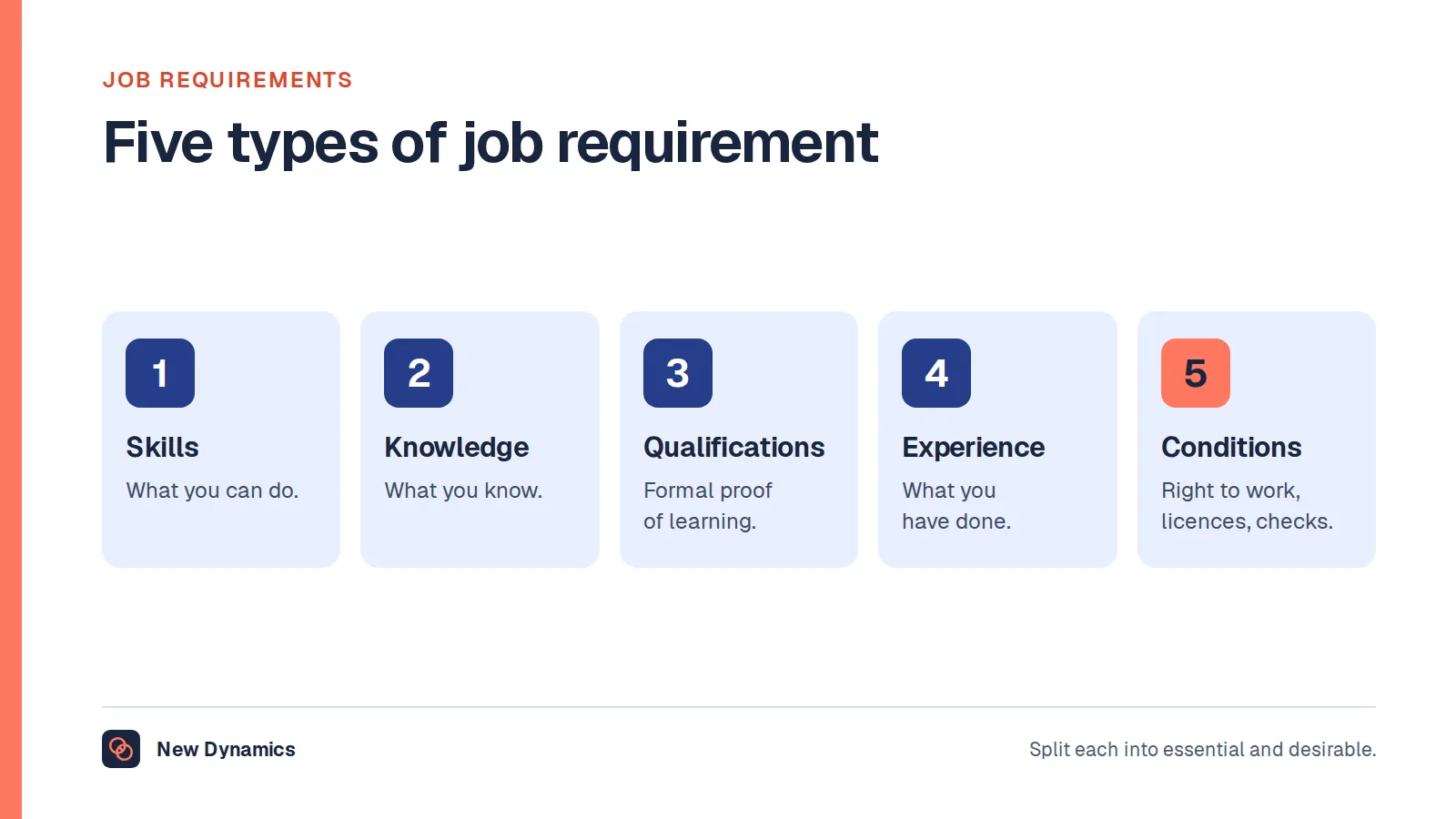
Keep the essential list honest. Each item that you add shrinks your pool of candidates. Our guide to job requirements explains how to separate what is essential from what is merely familiar.
Reviewing a med surg nurse's performance
AMSN's position statement describes how nursing skills are usually assessed: by a review of experience, and by skills checklists that are unique to each facility and unit and are not standardized. Its own competency framework is offered as a way to strengthen annual competency and performance evaluation, and to identify skill gaps and training priorities.
Whichever framework you use, a fair review of a med surg nurse has four parts.
- Competencies described as behaviour. “Escalates a change in condition promptly and clearly” can be observed. “Good clinical judgement” cannot.
- Evidence from the whole year, and from more than one person: the charge nurse, a preceptor, colleagues.
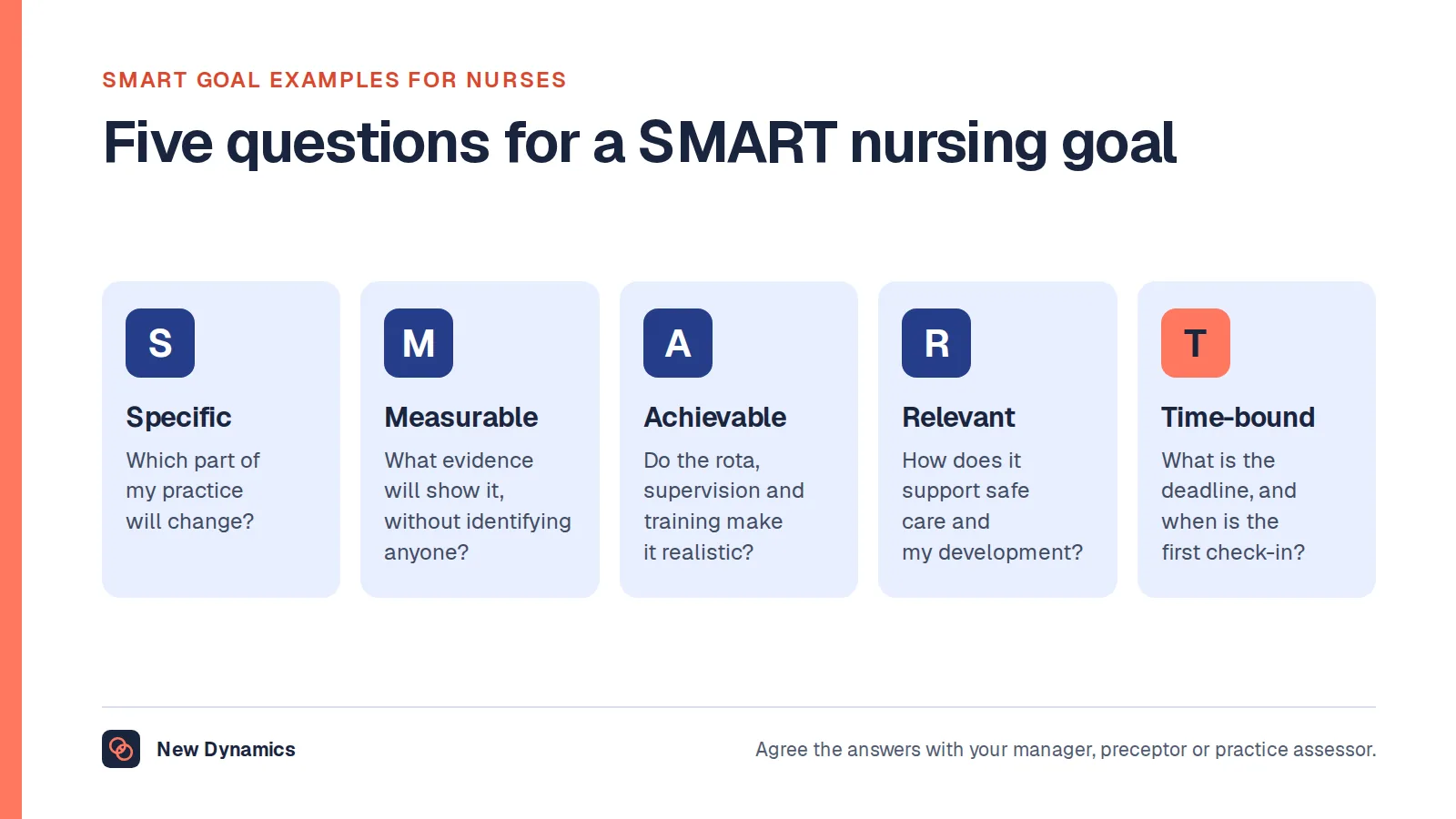
- A few goals that the nurse can influence. Our SMART goal examples for nurses offers examples for clinical skills, communication, documentation and development.
- A conversation about workload. A nurse who is looking after too many patients cannot show their best work. Do not mark an individual down for a staffing problem.
Do not put patient-identifiable information into a performance record.
Common mistakes in hiring and managing med surg nurses
Treating the unit as a stepping stone. If the job advertisement implies that med surg is where you wait for something better, do not be surprised when people leave.
A vague job description. “Provides nursing care” tells a candidate nothing. Name the patient group, the unit and the shift pattern.
Hiding the ratio. Candidates will find out. Tell them.
Requiring certification for a first post. Both certifications need 2,000 hours of practice in the specialty. A new graduate cannot hold them.
A thin orientation. AMSN advises new nurses to look for residency, preceptorship and mentorship programmes. Offer them. Our guide to employee orientation covers the first days.
A checklist instead of a review. A signed list of skills does not tell a nurse how they are doing, or what to work on next.
Frequently asked questions
What is a med surg nurse?
A med surg nurse is a registered nurse in the medical-surgical specialty. They care for adult patients who are preparing for or recovering from surgery, and for adults with complications of long-term illnesses, usually on a hospital unit.
What does a medical-surgical nurse do?
They assess patients, give medications and treatments, monitor and document changes, report concerns to the responsible provider, coordinate care with the wider team, and teach patients and families. They do this for several patients at once.
Where do med surg nurses work?
OpenStax lists inpatient settings such as hospitals, skilled nursing facilities and long-term care facilities, and outpatient settings such as clinics, same-day surgery centers and patients' homes.
What certification can a med surg nurse get?
In the United States there are two main credentials: the CMSRN from the Medical-Surgical Nursing Certification Board, and MEDSURG-BC from the American Nurses Credentialing Center. Both require an RN licence and 2,000 hours of medical-surgical practice within the last three years.
How many patients does a med surg nurse have?
It depends on the employer, the unit and the patients' needs. The Academy of Medical-Surgical Nurses recommends, as a guideline, that a registered nurse in direct patient care should not be assigned more than five patients.
What should a med surg nurse job description include?
It should give the job title, the unit and its patient group, the shift pattern, the purpose of the role, the main duties, the licence and any required certifications, the preferred experience and the working conditions. Separate essential requirements from preferred ones.
Your next step: check one job description
- Take your current med surg nurse job description, and compare it with the template above.
- Add the unit, the patient group, the shift pattern and the typical assignment, if they are missing.
- Move anything that is not truly essential into the preferred list.
- Turn the main duties into four or five competencies, described as behaviour, for your next review cycle.
For help with that last step, read and download our competency-based feedback guide. The guide is free to read, and the PDF uses our short download form.
Want goals, feedback and reviews for clinical teams in one place? Book a New Dynamics demo and bring your current review form. You can also email contact@new-dynamics.com.