TL;DR
- Payroll certification covers four different things: a professional-body qualification, a short course certificate, an apprenticeship with an end-point assessment, and a software vendor's badge. Only the first two are usually what an employer means.
- The National Careers Service lists four routes into payroll (a college course, an apprenticeship, working towards the role, and applying directly) and the apprenticeships “take around 2 years to complete”.
- The professional-body ladder runs from a level three technician certificate through a level four specialist certificate and a level five diploma to foundation degrees and beyond. You join it where your experience already sits.
Payroll is one of the few parts of an organisation where being slightly wrong is a reportable event. Nobody, though, has to hold a licence to run one.
That gap is why payroll certification matters more than it looks. This article explains what the phrase covers, the routes into the occupation, the qualification ladder and its levels, and what a certificate does and does not prove.
A qualification is a development goal like any other, and it needs a date and an owner. See how New Dynamics goals and OKRs keep that visible instead of buried in an appraisal form.
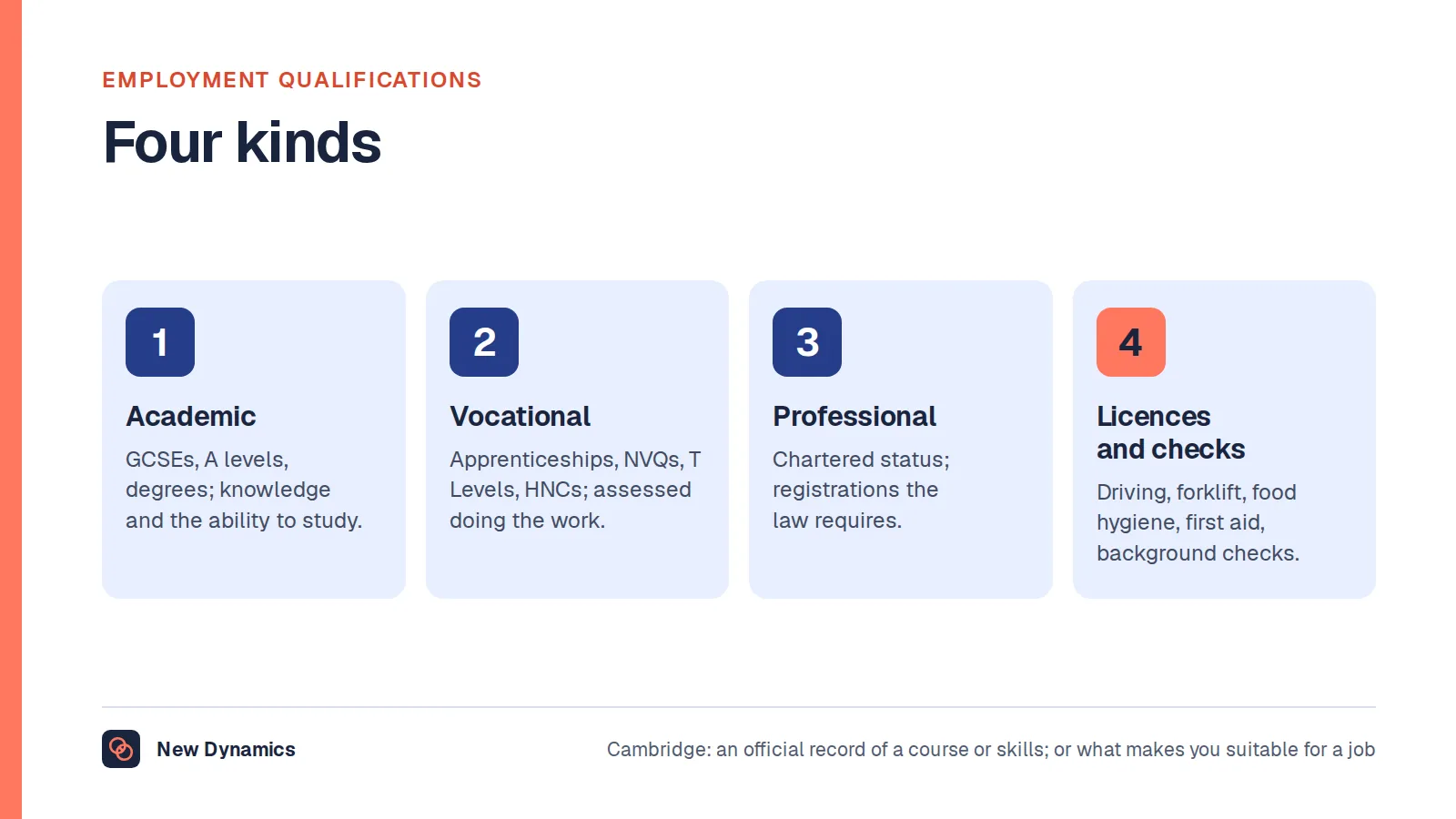
Four things the phrase means

- A professional-body qualification. Studied over months, assessed, and awarded at a stated level. This is what most employers mean.
- A course certificate. Proof you attended and completed something. Useful, but it says what you were taught rather than what you can do.
- An apprenticeship. Paid work plus study, ending in an independent assessment against an occupational standard.
- A software badge. Proof you can operate one product. Not a payroll qualification, and worth separating out before you pay for anything.
The routes in

The National Careers Service's profile for a payroll administrator lists four ways in: "a college course", "an apprenticeship", "working towards this role" and "applying directly".
- College. Courses include "bookkeeping", "computerised payroll" and "a T Level in accounting", some of which can be studied "at college or by distance learning".
- Apprenticeship. A "Payroll Administrator Level 3 Advanced Apprenticeship", or, "if you want to train for management", a "Payroll Assistant Manager Level 5 Higher Apprenticeship". Both "take around 2 years to complete".
- Working towards it. Joining a payroll team as an assistant, or picking up payroll duties inside a finance or HR role, then training "through a professional body".
- Direct application. Employers "will expect you to have GCSEs at grades 9 to 4 (A* to C), or equivalent, including maths", and while payroll experience "is not always essential to start", a background "in bookkeeping or accounts could help improve your job prospects".
An advanced apprenticeship usually asks for "5 GCSEs at grades 9 to 4 (A* to C), or equivalent, including English and maths". Our post on employment qualifications covers how to word requirements like these in a job advert without excluding people unnecessarily.
What the apprenticeship actually assesses
The occupational standards are public, which makes them the clearest statement anywhere of what a competent payroll person is expected to do.
The payroll administrator standard covers the "gathering, creation and processing of payroll-related information to ensure employees are paid on time and accurately". The important clause is the next one: this "will be via payroll software, though it's use must be accompanied by the ability to perform this manually". It also covers "compliance with legislative and contractual obligations" and "internal and external reporting of payroll information to deadlines".
The payroll assistant manager standard sets the purpose as ensuring "the employer's workforce is paid on time and accurately in accordance with worker contractual and United Kingdom regulatory/statutory obligations", and adds a duty that never ends: the holder "must keep up to date with key changes affecting payroll, whether that is to do with legislation, guidance, or technology".
Read those two sentences together and you have the honest test for any payroll credential. Can the holder do the calculation without the software, and are they keeping up with what changed?
The qualification ladder

The National Careers Service points to the Chartered Institute of Payroll Professionals as one of the bodies offering on-the-job training, with courses "available from introductory level to foundation degree and higher". Its awarding arm publishes a qualification listing that shows the shape of the ladder:
- Technician, level three. A Payroll Technician Certificate over "26 weeks", with an advanced version over "36 weeks" that covers "complex legislation and contractual obligations".
- Specialist, level four. A Payroll Specialist Certificate over "38 weeks", taking people "beyond the basic knowledge and skills of payroll administration".
- Management, level five. A Payroll Management Diploma aimed at payroll managers.
- Degree level. Foundation degrees in payroll management at levels four to five, awarded by university partners, then leadership and management qualifications at levels six and seven.
You join where your experience already sits, rather than at the bottom. There is a recognition-of-prior-learning assessment for exactly that purpose.
What a certificate proves, and what it does not
It proves that somebody outside your organisation tested the knowledge. That is genuinely useful in an occupation with no licensing, where the alternative is a manager's impression of how few complaints a person generates.
It does not prove current knowledge, because payroll legislation changes and a certificate is dated. It does not prove judgement under pressure, which is what a difficult month looks like. And it does not prove the thing employers most often assume it does, that the holder knows your payroll, with its historic arrangements and local agreements.
So treat a qualification as one input. The others are a manual calculation done in front of you, and a conversation about what changed recently and how they found out.
Software badges are a separate thing
A vendor certificate shows that somebody can drive one system. It expires when you change system, and it tells you nothing about whether the numbers the system produced are right.
The career advice is blunt about where software skill sits: "you'll get training in payroll software when you start a job", while "good computer skills, especially with spreadsheets, will give you an advantage when looking for work". Software is assumed. The legislation is what is being examined.
Why the stakes make this checkable
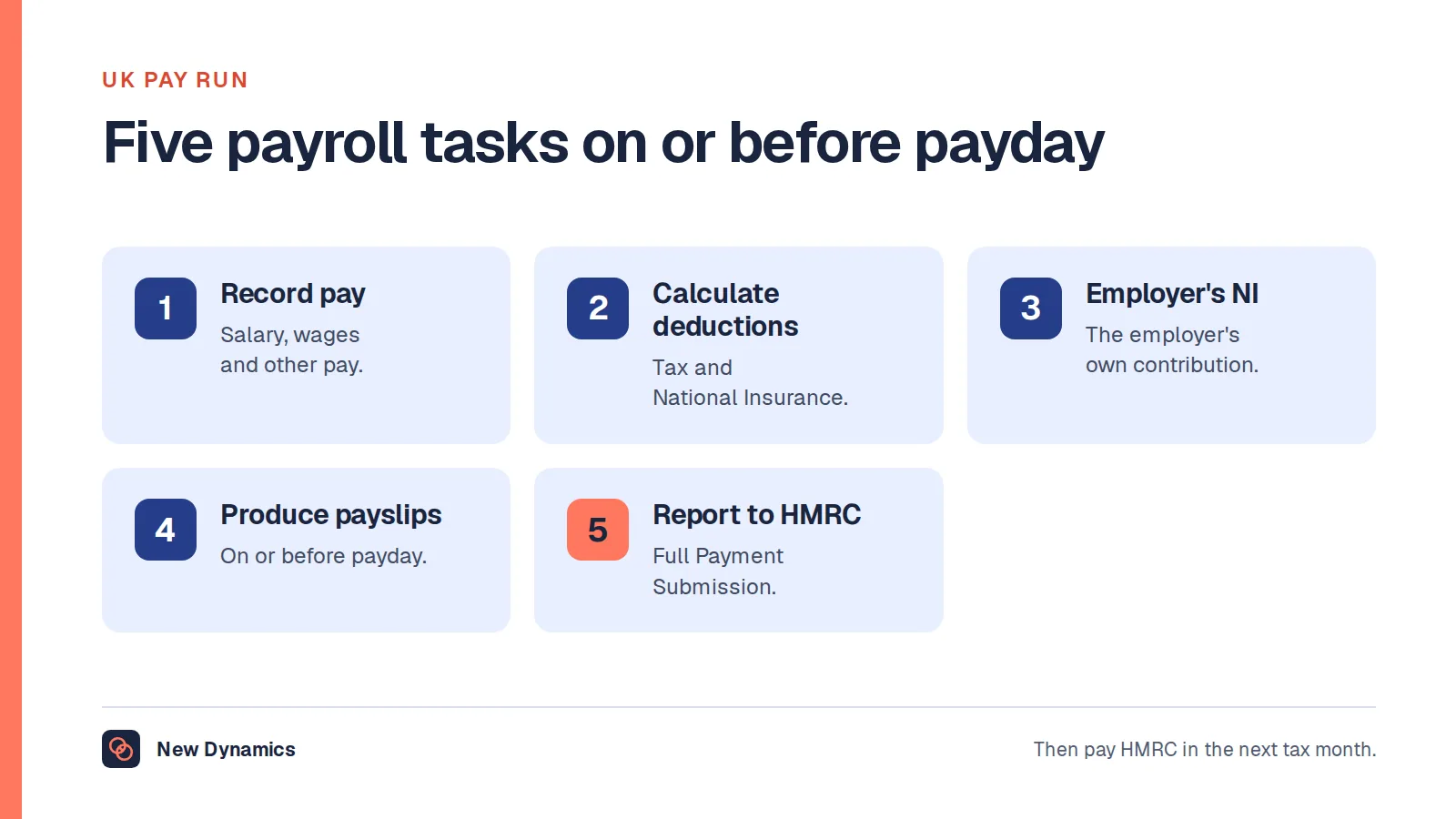
Payroll is not judged on effort. GOV.UK's guidance on running payroll sets out what has to happen on or before every payday: record pay, "calculate deductions from their pay, like tax and National Insurance", calculate the employer's National Insurance, "produce payslips for each employee", and "report their pay and deductions to HMRC in a Full Payment Submission (FPS)".
Each of those is a dated, evidenced obligation. That is what makes payroll competence unusually easy to assess compared with most office roles, and why a qualification that examines the legislation is worth funding. Our payroll definition post covers the pay run itself in more detail.
Outside the UK
Credentials are country-specific because payroll law is. A qualification built around PAYE and National Insurance does not transfer to a country with different withholding rules, and the sensible move is to check what the local tax authority requires and which body the local market recognises.
What does seem to travel is the shape of the occupation. O*NET's profile for payroll and timekeeping clerks records that "previous work-related skill, knowledge, or experience is required", and that people in these roles "usually need one or two years of training involving both on-the-job experience and informal training with experienced workers". Experience-led, not licence-led, in both places.
Choosing your next qualification
- Start from the work you are doing next year, not the job title you want eventually.
- Check the level, not the name. A certificate at level three and a certificate at level five are different things.
- Ask whether prior learning can be recognised, so you do not pay to be taught what you do every month.
- Confirm who awards it, and whether local employers ask for it.
- Agree the study time with your manager in writing, because the failure mode is a funded course with no hours to study it.
Requirements and fees change, so check the awarding body's own site before you apply. This is general information rather than careers or legal advice.
For employers: fund it properly or do not fund it
Paying the fee is the easy half. The half that decides whether anyone finishes is protected study time during a month that also contains a pay run.
Two things make it work. Treat the qualification as a goal with a date, a named owner and a review point. And be clear about which gap it closes, our skills gap analysis guide covers doing that at team level rather than approving courses one at a time.
Frequently asked questions
What is payroll certification?
A qualification awarded by a professional body or education provider that tests payroll knowledge (legislation, calculations, deductions and reporting) rather than the ability to operate one piece of software. The phrase is also used loosely for course certificates, apprenticeships and vendor badges, which are different things.
Do you need a certification to work in payroll?
No. There is no licence requirement, and the National Careers Service lists applying directly as one of the routes in. A qualification helps you get shortlisted, formalises knowledge picked up on the job, and becomes more important as you move towards supervising other people's work.
How long does a payroll qualification take?
It depends on the level. A technician certificate runs over about 26 weeks and an advanced version over 36, a specialist certificate over 38 weeks, and foundation degrees over three years. Apprenticeships in payroll take around two years including the end-point assessment.
What is the difference between a payroll certificate and an apprenticeship?
A certificate is a qualification you study for, often alongside a job you already have. An apprenticeship is a paid training role combining work and study, ending in an independent assessment against a published occupational standard. The apprenticeship route is the usual way in for someone starting out.
Is a payroll software certification worth having?
It is worth having in addition, not instead. A vendor badge shows you can operate one product and stops being useful when the employer changes system. The published occupational standard is explicit that software use "must be accompanied by the ability to perform this manually".
What qualifications do payroll managers need?
Managing payroll is examined at level five and above, a payroll management diploma, then foundation and honours degree level qualifications. The assistant manager occupational standard also expects a manager to keep up to date with changes in legislation, guidance and technology, which is a continuing obligation rather than a qualification.
Where can payroll lead as a career?
The National Careers Service lists becoming a payroll or finance department manager, moving "into pensions management or human resources", training "to qualify as an accountant", working "in payroll software development", or managing "an agency that provides payroll services to businesses".
Your next step: pick the level, then the course
- Write down the payroll work you will be responsible for in the next year.
- Find the qualification level that matches it, rather than the most recognisable name.
- Ask the awarding body whether your existing experience can be recognised.
- Agree protected study hours with your manager before the fee is paid.
For deciding which gaps to close across the team rather than one person at a time, read and download our skills gap analysis guide. The guide is free to read, and the PDF uses our short download form.
Want qualifications tracked as goals with dates and owners rather than remembered at appraisal time? Book a New Dynamics demo and bring your current development plans. You can also email contact@new-dynamics.com.