TL;DR
- An employment qualification is, in the Cambridge Dictionary's first sense, an official record showing that you have finished a training course or have the necessary skills; in its second, an ability, characteristic or experience that makes you suitable for a particular job. Adverts use the word in both senses, and the confusion between them is why so many list a degree they do not need and leave out the experience they do.
- Formal qualifications come in four kinds: academic, such as GCSEs, A levels and degrees; vocational, including apprenticeships, NVQs, HNCs and T Levels; professional and regulated, from chartered status to a nursing registration; and licences and checks, from a driving licence to a background check. In England, Wales and Northern Ireland the GOV.UK guide places most of them on a ladder from entry level to level 8, so a level 3 apprenticeship, an A level and a T Level are comparable, and a degree apprenticeship sits with an honours degree at level 6.
- Acas says an employer must be able to prove a good reason for any job requirement in an advert, and that phrases such as recent graduate can discriminate on age. The practical rule is to ask for a qualification only where the job cannot be done or lawfully held without it, to say whether each one is required, preferred or open to equivalents, and to check and record the ones that matter after hiring.
Two adverts for the same office job. One asks for “a degree or equivalent”; the other asks for “five GCSEs including English and maths, or equivalent experience, and confident use of spreadsheets”. The first will lose candidates who could do the job and attract some who cannot; the second says what the work needs. Employment qualifications are the part of a job advert most often copied from the last advert and least often thought about, and the topic confuses candidates as much as employers: which jobs and qualifications go together, what the levels mean, and whether “qualifications required” means required.
This article explains what employment qualifications are, using the Cambridge Dictionary's definition, the GOV.UK guide to qualification levels and Acas's advice on advertising a job; sets out the four kinds and the eight levels; matches jobs to qualifications with examples; explains the difference between required, preferred and equivalent; and gives a way to write qualifications into an advert and to read them as a candidate.
Qualification checks belong to a stage in the hiring and onboarding process, not to a folder on someone's desk. See how New Dynamics workflows run your own stages and checklists with a completion view, so the right-to-work, registration and certificate checks are done and recorded for every starter.
What are employment qualifications?
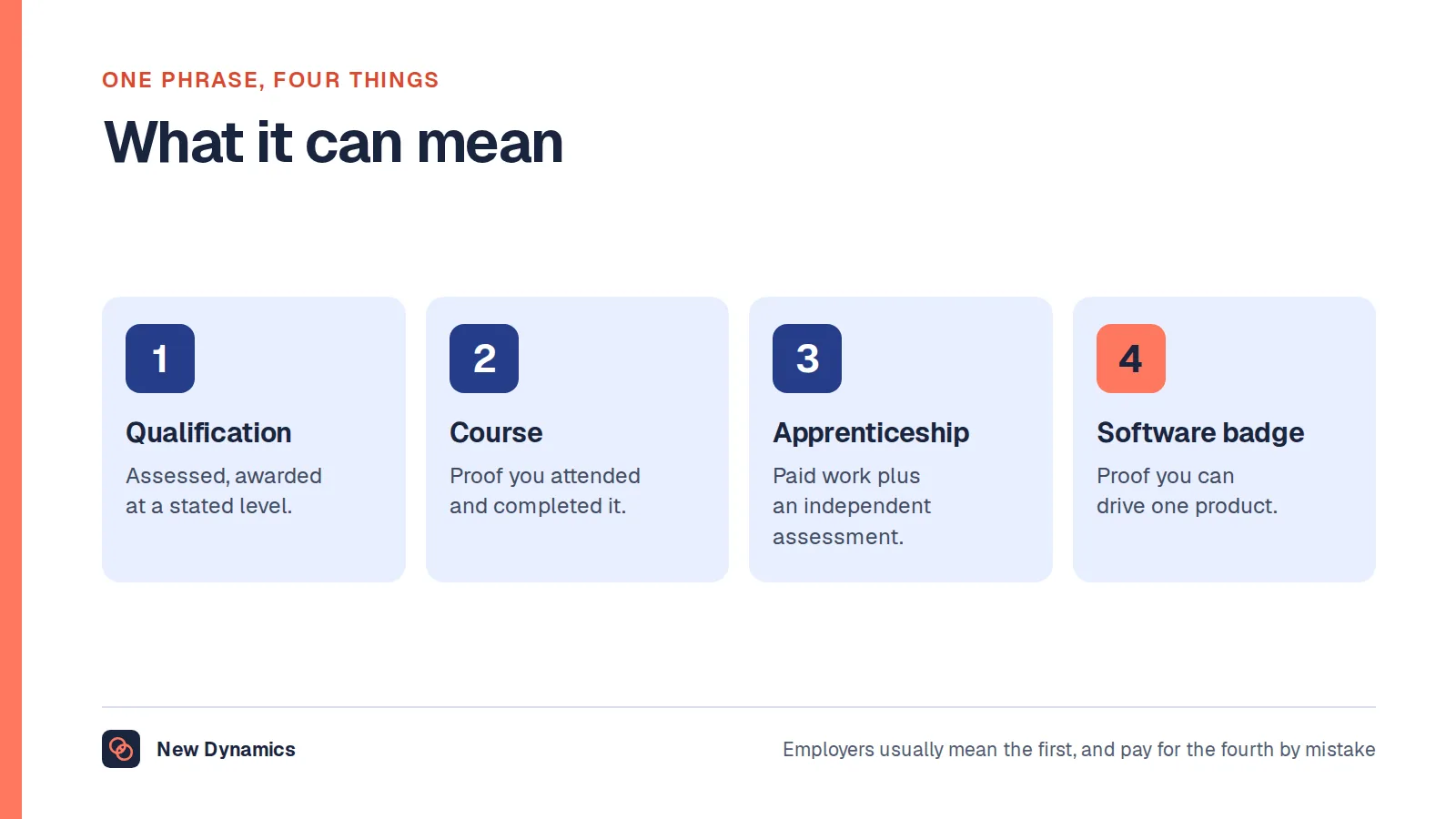
The Cambridge Dictionary gives two senses of qualification. The first is “an official record showing that you have finished a training course or have the necessary skills”, with the examples of teaching, legal, medical, secretarial and academic qualifications. The second is “an ability, characteristic, or experience that makes you suitable for a particular job or activity”, with the example that some nursing experience is a necessary qualification for this job.
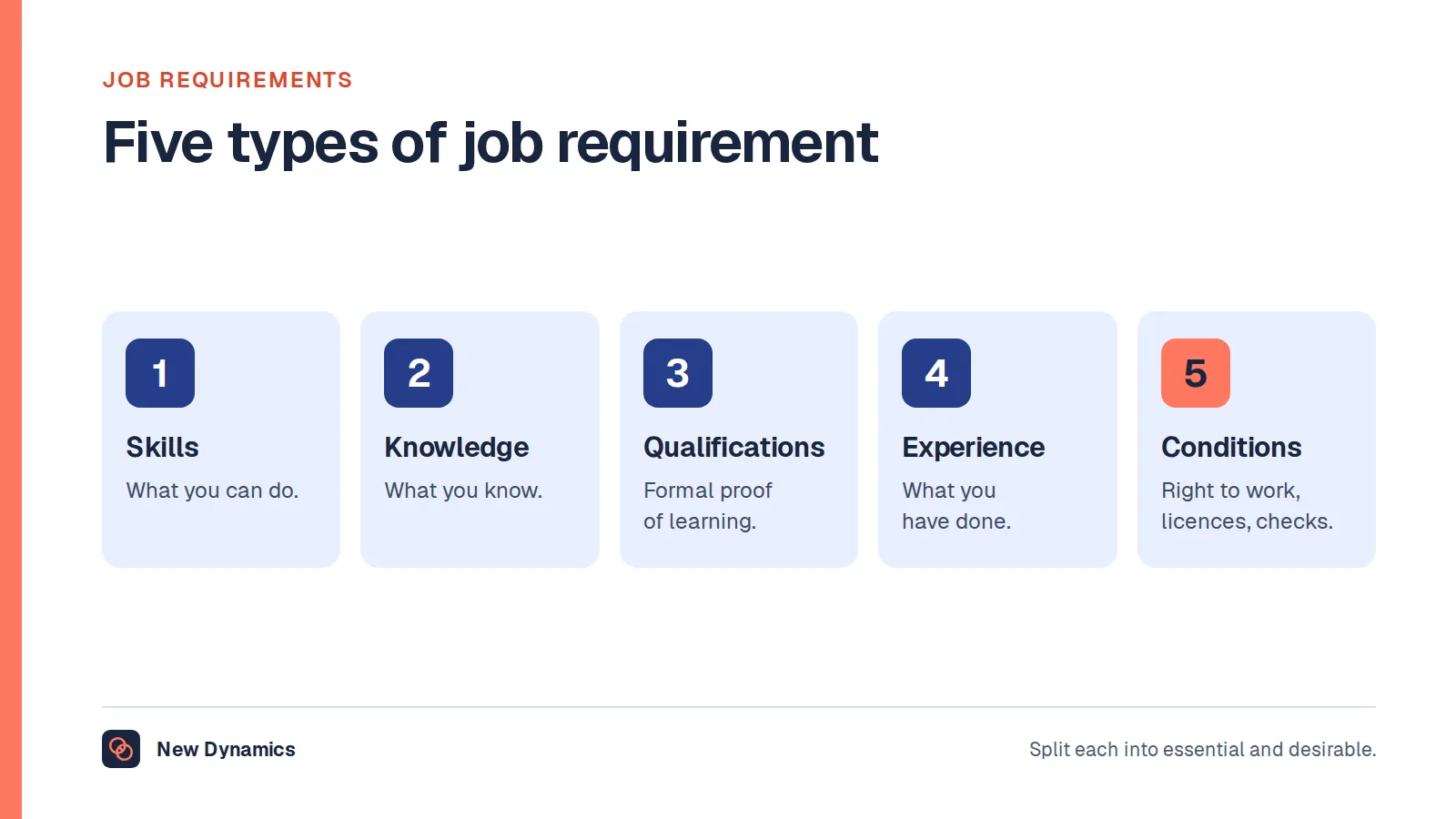
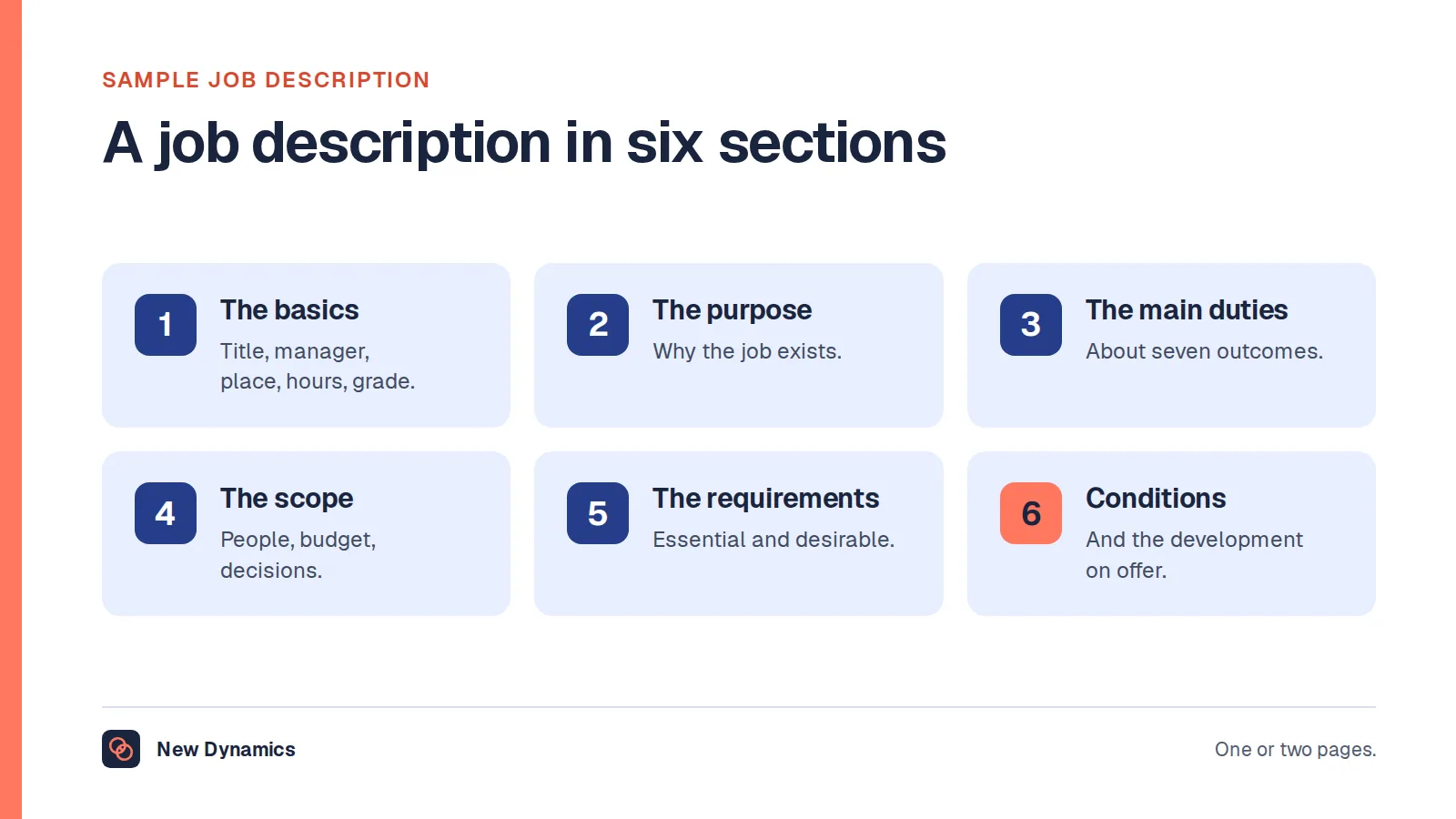
Both senses appear in adverts, usually without saying which. A person specification that lists “qualifications” may mean certificates, or may mean everything that qualifies someone for the job: skills, experience, characteristics and certificates together. Our guide to job requirements covers the whole person specification; this article is about the first sense, the formal qualifications, and how they fit with the rest.
The four kinds of formal qualification
- Academic. GCSEs, A levels, the International Baccalaureate, foundation degrees, honours degrees, master's degrees and doctorates. They show knowledge and the ability to study; they rarely show that someone can do a specific job.
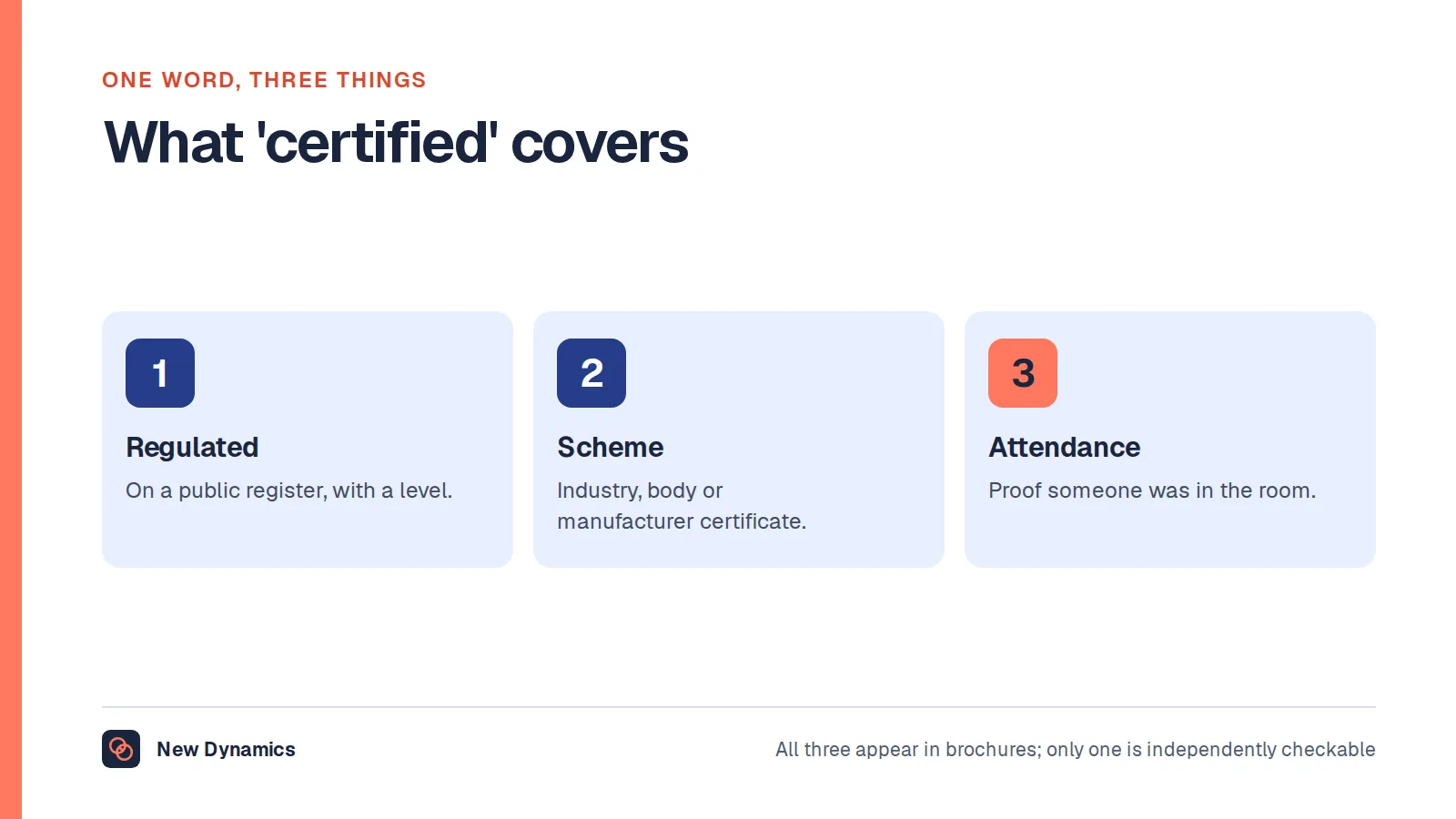
- Vocational and apprenticeship. NVQs, BTEC national certificates and diplomas, T Levels, HNCs and HNDs, and apprenticeships from intermediate to degree level. They show that someone has been assessed doing the work, or something close to it.
- Professional and regulated. Membership or chartered status with a professional body, and the registrations that some jobs require by law: a nurse, a paramedic, a solicitor, a gas engineer. Some are optional signals of standing; some are conditions of doing the job at all.
- Licences and checks. A driving licence, a forklift licence, a food hygiene certificate, a security licence, a first aid certificate, an enhanced background check. Often the only qualification the job cannot be done without.

The eight levels
In England, Wales and Northern Ireland, most qualifications sit on a ladder of difficulty. The GOV.UK guide to qualification levels lists what sits at each:
| Level | Examples from the GOV.UK list |
|---|---|
| Entry level | Entry level certificates, functional skills, ESOL, at sub-levels 1 to 3 |
| Level 1 | GCSE grades 3 to 1 (D to G), level 1 NVQ, level 1 functional skills |
| Level 2 | GCSE grades 9 to 4 (A* to C), intermediate apprenticeship, level 2 NVQ, level 2 diploma |
| Level 3 | A level, advanced apprenticeship, T Level, access to higher education diploma, level 3 NVQ |
| Level 4 | Higher apprenticeship, HNC, certificate of higher education, level 4 NVQ |
| Level 5 | Foundation degree, HND, diploma of higher education, level 5 NVQ |
| Level 6 | Degree with honours, degree apprenticeship, graduate diploma, level 6 NVQ |
| Level 7 | Master's degree, integrated master's, postgraduate certificate and diploma, PGCE, level 7 NVQ |
| Level 8 | Doctorate, level 8 award, certificate and diploma |
Three things follow. A level 3 apprenticeship, an A level and a T Level are comparable in level, so an advert that asks for A levels and would accept an apprenticeship should say “level 3”. A degree apprenticeship is level 6, the same as an honours degree. And, as GOV.UK notes, qualifications at the same level sometimes cover different amounts of a subject: AS and A levels are both level 3, but the A level covers more. Scotland has its own framework, and GOV.UK provides a way to compare qualifications from other countries; say in the advert that equivalents are welcome.

Jobs and qualifications: which needs which
The honest match between jobs and qualifications comes from the job, not the level the employer would like. Examples drawn from the job descriptions on this site:
- Jobs where a licence or check is the qualification. A daycare teacher needs an enhanced background check and, usually, a level 2 or 3 childcare qualification; a delivery driver needs the right licence category. Ask for these first.
- Jobs where a level 2 or 3 vocational qualification fits. An accounting clerk with a level 2 accounting certificate or the accounts or finance assistant apprenticeship; an HR coordinator with a level 3 HR qualification. A degree adds little to these jobs and excludes good candidates.
- Jobs where a degree is usual but experience substitutes. A recruiter or an account executive: employers value drive and a record over the certificate. Write “degree or equivalent experience” and mean it.
- Jobs where a degree and registration are conditions. A paramedic needs an approved degree and registration with the regulator; an aerospace engineer usually needs a level 6 engineering degree or degree apprenticeship and, for some roles, security clearance. Here the qualification is required, and the advert should say so plainly.
Required, preferred or equivalent
Most adverts fail at this line. Three words, used consistently, fix it:
- Required. The job cannot be done or lawfully held without it: a registration, a licence, a check, a qualification the regulator or client insists on. Acas's advice on advertising a job is that “you must be able to prove you have a good reason for any job requirement in your advert”; a required qualification needs that reason written down.
- Preferred. Useful evidence that the person can do the job, but not the only evidence. Say what else would count.
- Equivalent. A qualification at the same level, from another country, or experience that shows the same thing. Say that equivalents are welcome and give an example.
Acas warns that words such as “recent graduate” or “highly experienced” can discriminate on age, and that inclusive language “defines the job not the applicant”. A qualification asked for without a reason can have the same effect: a degree requirement for a job that does not need one excludes people by age, background and route into work. Our job requirements guide covers the discrimination law in more detail.
How to write qualifications required in an advert
- Start from the duties. For each duty, ask what someone must hold on day one to do it lawfully and safely. Those are the required qualifications, and usually there are fewer than the last advert listed.
- Name the level, not just the certificate. “Level 3 in early years (for example a level 3 diploma or advanced apprenticeship)” rather than a single course title; “level 6 degree or degree apprenticeship in engineering” rather than “BEng”.
- Label each one required, preferred or equivalent, and say what equivalent experience looks like.
- State the checks and licences separately from the qualifications, with who pays and when they are done.
- Say what the employer will train. A willingness to study towards a qualification, with support, widens the field and is often the honest position.
How to read qualifications as a candidate
Read the list the way the employer should have written it. Anything that is a registration, licence or check is required; do not apply without it, or apply and say when you will have it. Anything academic that is not tied to a registration is usually preferred, whatever the advert says; if you have the experience the duties describe, apply and show it. Where the advert says “or equivalent”, decide what your equivalent is and name it in the first paragraph of your application. And if a qualification level is given, place your own on the GOV.UK ladder before deciding it does not match.
After hiring: check and record
A qualification asked for and never checked was not required. For the ones that are, see the certificate, registration or licence before the start date, record the number and expiry where there is one, and put renewals in the calendar: registrations lapse, licences expire, first aid certificates run out. Make the check a stage in onboarding, with an owner and a date, rather than a question asked at the interview.

Frequently asked questions
What are employment qualifications?
The formal qualifications a job asks for, in the Cambridge Dictionary's first sense of the word: official records that someone has completed a course or has the necessary skills, such as academic, vocational, professional or licensing qualifications. The dictionary's second sense, an ability, characteristic or experience that makes someone suitable for a job, covers the rest of a person specification.
What are the qualification levels in the UK?
In England, Wales and Northern Ireland, GOV.UK lists a ladder from entry level to level 8: GCSEs at levels 1 and 2, A levels, T Levels and advanced apprenticeships at level 3, HNCs and higher apprenticeships at level 4, HNDs and foundation degrees at level 5, honours degrees and degree apprenticeships at level 6, master's degrees at level 7 and doctorates at level 8. Scotland has its own framework.
What is the difference between required and preferred qualifications?
A required qualification is one the job cannot be done or lawfully held without, such as a registration, licence or check; Acas says the employer must be able to prove a good reason for any requirement in an advert. A preferred qualification is useful evidence that the person can do the job but not the only evidence, and the advert should say what else would count.
Can an employer ask for a degree for any job?
An employer can ask for one, but Acas's advice is that any requirement in an advert needs a good reason the employer can prove, and phrases such as recent graduate can discriminate on age. A degree requirement for a job that does not need one narrows the field and carries a risk of indirect discrimination; the safer and more useful approach is to ask for the level the duties need and to accept equivalents.
What does "or equivalent" mean in a job advert?
A qualification at the same level on the GOV.UK ladder, a comparable qualification from another country, or experience that demonstrates the same knowledge and skill. Employers should give an example of what they would accept; candidates should name their equivalent in the application rather than leaving the employer to guess.
Your next step: justify every qualification in the advert
- For each qualification in your current advert, write the reason the job cannot be done without it, or move it to preferred.
- Replace course names with levels and add “or equivalent” with an example.
- List licences and checks separately, with who pays and when.
- Put the qualification check into onboarding as a stage with an owner, a date and a renewal reminder.
For a fair, consistent way to assess candidates against the requirements once the advert is right, read and download our recruitment and selection guide. The guide is free to read, and the PDF uses our short download form.
Want hiring stages, onboarding checklists and qualification renewals in one place, on your own forms, without chasing? Book a New Dynamics demo and bring your current person specification. You can also email contact@new-dynamics.com.