TL;DR
- Payroll deductions split into two: the statutory ones an employer must take, and everything else, which needs a specific legal basis.
- Acas sets out the grounds under the Employment Rights Act, and the list is closed. If your reason is not on it, the deduction is unlawful however reasonable it seems.
- Deductions cannot normally take pay below the National Minimum Wage, cannot touch tips an employer controls, and in retail are capped at 10% of gross pay for till or stock shortages.
A payslip arrives with something unexpected taken off it. The question that follows is not really "what is this?" but "were they allowed to?"
This article covers both. It explains what payroll deductions are, gives the statutory and voluntary examples, sets out the closed list of grounds an employer may deduct on, and the limits that apply even when a deduction is otherwise lawful.
Deductions go wrong when a step is skipped rather than when a decision is taken. See how New Dynamics workflows make each step's owner and due date explicit.
Two kinds

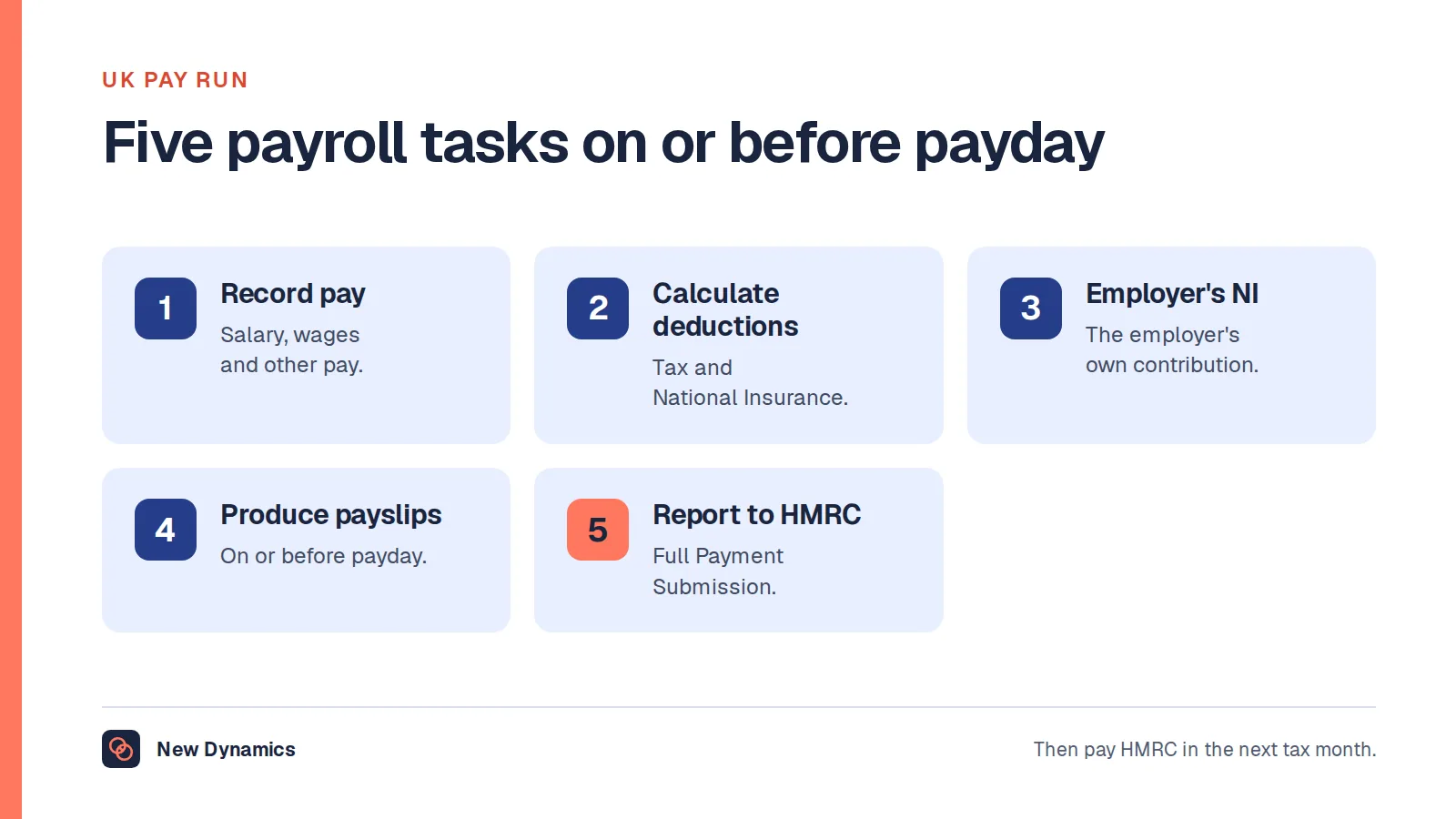
Statutory. Required by law and not optional for either side. GOV.UK's guidance on running payroll requires an employer, on or before payday, to "calculate deductions from their pay, like tax and National Insurance", to calculate the employer's National Insurance, to "produce payslips for each employee", and to report in a Full Payment Submission.
Contractual and agreed. Pension contributions above automatic enrolment, trade union subscriptions, salary sacrifice arrangements, season ticket loan repayments, cycle scheme payments, charitable giving.
Court-ordered. Attachment of earnings and similar orders, where a court directs the employer to pay part of someone's wages to a third party.
Our payroll definition post covers the pay run these sit inside.
When an employer may deduct at all

This is the part that matters. Acas's guidance on deductions from pay and wages states that "by law (Employment Rights Act 1996), an employer can only make a deduction from someone's wages if":
- "it's required by law – for example tax";
- "the employment contract specifically allows the deduction";
- "they overpaid someone by mistake";
- "it's something the worker agreed to in writing beforehand – for example paying a trade union subscription";
- "the worker missed work because they were on strike or taking industrial action";
- "it's a result of a court ordering the employer to make debt payments from a worker's wages to a third party";
- "it's a result of a court ordering a worker to make a payment to their employer", where "the worker must have agreed in writing that the employer can make the deduction";
- "the worker and employer have agreed a salary sacrifice arrangement".
That list is closed. An employer who believes a deduction is fair, proportionate and obviously deserved still needs it to fall within one of those grounds. Acas adds that "deductions must be clearly stated in a worker's payslip", and that before making a deduction a worker does not expect, an employer "should notify the worker as soon as possible".
Training costs are a common example. They may be deducted only where "it's agreed in the contract" or "agreed in writing beforehand", and a deduction for mandatory training "must not take the worker's wages below the National Minimum Wage".
This is general information rather than legal advice; the Acas helpline advises on individual cases.
What cannot be deducted from
The rules reach wages, and not everything paid through payroll is wages. Acas lists what deductions can come from, "monthly, weekly or hourly pay", "holiday pay", "statutory payments – for example statutory sick pay (SSP) or statutory maternity pay", and "bonuses or commission", and then what they cannot:
- Loans, "for example a pay advance for a season ticket".
- Expenses.
- Pension payments.
- Redundancy pay.
The minimum wage floor
Deductions must not take someone's pay below the National Minimum Wage. Acas gives the exceptions: "tax or National Insurance", "something a worker's done which their contract says they're liable for, such as damage to a vehicle through reckless driving", "repayment of a wage advance or loan", and "an overpayment made by mistake".
The same floor applies to salary sacrifice, which Acas describes as "an agreement to reduce a worker's cash pay", usually for a non-cash benefit. Setting one up "needs to change the terms of the employment contract", both parties must agree, and the employer "must put limits on any agreed pay reductions" so that pay does not fall below the minimum wage. Our post on fringe benefits covers the benefits side of those arrangements.
Tips, and the retail rule
Tips. Employers "must not make deductions from: tips; service charges; gratuities that they have 'control or significant influence' over". The only exception is "usual tax and National Insurance deductions".
Retail shortages. Where a contract allows it, an employer may deduct for "till shortages or stock shortfalls", but the rules are tight: a maximum of "10% of someone's weekly or monthly 'gross pay'", a limit that "does not apply to someone's final wages if they leave their job". The employer "must let the worker know in writing if they owe them money", explain "how they'll claim it back before the next pay day", and "must reclaim the money within 12 months of finding the shortage or shortfall".
Overpayments
An overpayment made by mistake is one of the lawful grounds, and it is also one of the exceptions to the minimum wage floor. That does not make recovery automatic in practice: Acas's advice to notify the worker as soon as possible applies, and agreeing a repayment schedule usually resolves matters faster than taking the whole sum from one payslip.
What a payslip must show
GOV.UK's guidance on payslips sets the transparency requirement. An employer "must provide you with a payslip", other than for people who are "not an employee or 'worker'", the police service, merchant seamen and share fishermen. Payslips "must be provided on or before payday", and must show:
- "your earnings before and after any deductions";
- "the amount of any deductions that may change each time you're paid, for example tax and National Insurance";
- "the number of hours you worked, if your pay varies depending on time worked".
Fixed deductions (a season ticket loan, say) can be explained either on the payslip or in a separate written statement, which must be sent "before the first payslip" and updated "every year".
Before you deduct

- Find the ground. Which of the eight does this fall under? If none, stop.
- Find the writing. A contractual clause or prior written agreement, dated before the deduction.
- Check the floors. Minimum wage, the 10% retail cap where relevant, and whether the payment is wages at all.
- Tell the person first, in writing, with the amount and the timing.
Our HR compliance post covers the wider set of pay duties.
Frequently asked questions
What are payroll deductions?
Amounts taken from pay before it reaches the employee. They split into statutory deductions such as tax and National Insurance, contractual or agreed ones such as pension contributions and union subscriptions, and court-ordered payments to a third party.
What are examples of payroll deductions?
Income tax and National Insurance, pension contributions, student loan repayments, trade union subscriptions, salary sacrifice arrangements, season ticket and cycle scheme repayments, charitable giving, and attachment of earnings orders.
When can an employer deduct money from wages?
Only on the grounds Acas sets out under the Employment Rights Act: required by law, allowed by the contract, an overpayment made by mistake, agreed in writing beforehand, industrial action, a court order to a third party, a court order to the employer with written agreement, or a salary sacrifice arrangement.
Can an employer take money for training costs?
Only where it is agreed in the contract or agreed in writing beforehand. A deduction for mandatory training must not take the worker's pay below the National Minimum Wage.
Can a deduction take pay below the minimum wage?
Not normally. Acas lists the exceptions: tax or National Insurance, something the contract makes the worker liable for such as damage through reckless driving, repayment of a wage advance or loan, and an overpayment made by mistake.
Can deductions be made from tips?
No, where the employer has control or significant influence over them. Tips, service charges and gratuities cannot have deductions taken from them, other than the usual tax and National Insurance.
What must a payslip show about deductions?
Earnings before and after deductions, the amount of any deduction that varies each pay period such as tax and National Insurance, and hours worked where pay varies by time. Fixed deductions can be explained in a separate annual written statement instead.
Your next step: check one unexpected deduction
- Identify which of the eight lawful grounds it falls under.
- Find the contractual clause or written agreement that supports it.
- Check it does not take pay below the minimum wage.
- Confirm it appears clearly on the payslip.
For setting pay rules you can explain to the people they apply to, read and download our compensation policy guide. The guide is free to read, and the PDF uses our short download form.
Want pay-related steps to have an owner and a date rather than a good intention? Book a New Dynamics demo and bring your current process. You can also email contact@new-dynamics.com.