TL;DR
- Payroll register is an American term for the per-run summary. In the UK the question that matters is the statutory record-keeping duty, which names seven categories.
- Records must be kept “for 3 years from the end of the tax year they relate to”, and must show you have reported accurately.
- If you do not keep full records, “HMRC may estimate what you have to pay and charge you a penalty of up to £3,000”.
A payroll register sounds like a specific document you might be missing. In the UK it is better understood as a question about record-keeping, and that question has a precise statutory answer.
This article covers what a payroll register is, what each pay run produces, the records you must keep, how long for, and what happens if they are not there when HMRC asks.
Records go missing at handovers, not at decisions. See how New Dynamics workflows make each step's owner and due date explicit.
The term, and the UK equivalent
A payroll register is the per-run summary: everyone paid in that run, their gross pay, each deduction, the net figure and the employer's own costs. It is a normal output of payroll software and the term is more common in the United States than here.
What UK law actually requires is not a document with that name, but a set of records. The useful question is therefore not "do I have a payroll register?" but "can I show what I paid, what I deducted and what I reported?" Our payroll definition post covers the pay run itself.
What each run produces

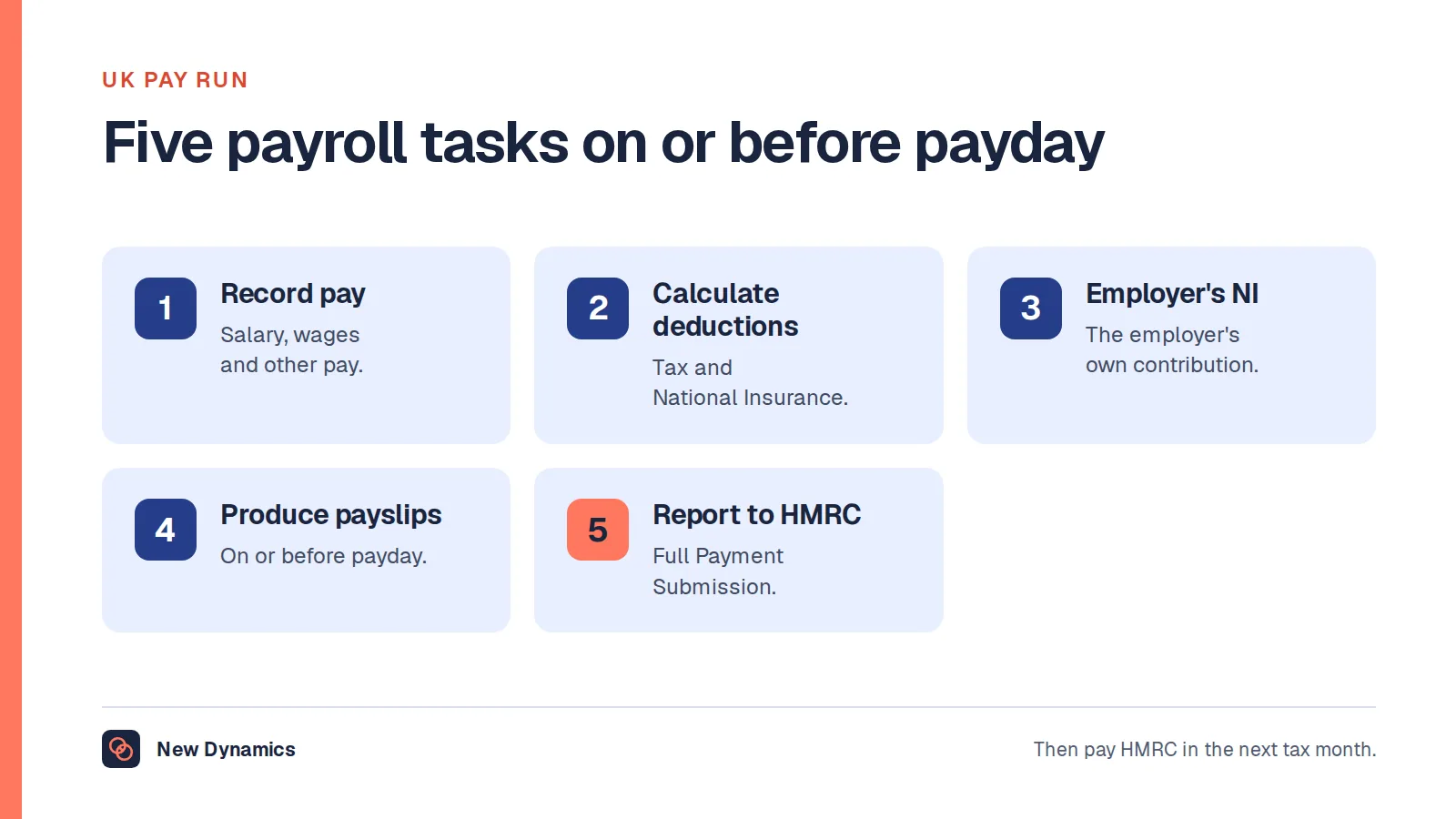
GOV.UK's guidance on running payroll sets out what happens on or before every payday: "record their pay", "calculate deductions from their pay, like tax and National Insurance", calculate the employer's National Insurance, "produce payslips for each employee", and "report their pay and deductions to HMRC in a Full Payment Submission (FPS)".
Those five outputs, kept run by run, are in practice your payroll register. The month then continues: the balance owed can be viewed from the 10th, an Employer Payment Summary goes in "by the 19th to claim any reduction on what you'll owe HMRC", and HMRC is paid "by the 22nd (or the 19th if paying by post) - you may have to pay a penalty if you do not".
What you must keep

GOV.UK's guidance on keeping records lists seven categories. An employer "must collect and keep records of":
- "what you pay your employees and the deductions you make";
- "reports you make to HM Revenue and Customs (HMRC)";
- "payments you make to HMRC";
- "employee leave and sickness absences";
- "tax code notices";
- "taxable expenses or benefits";
- "Payroll Giving Scheme documents, including the agency contract and employee authorisation forms".
Two of those surprise people. Leave and sickness absence records sit inside the payroll duty, not only the HR one. And expenses and benefits belong here too, our fringe benefits post covers what counts.
How long, and what if you do not
Records "must show you've reported accurately", and "you need to keep them for 3 years from the end of the tax year they relate to". HMRC "may check your records to make sure you're paying the right amount of tax".
The consequence of not having them is specific: "if you do not keep full records, HMRC may estimate what you have to pay and charge you a penalty of up to £3,000." An estimate made without your records is unlikely to be the estimate you would have made.
If records are lost, stolen or destroyed, the guidance is to "tell HMRC as soon as possible if you do not have records and cannot replace them", and "you must also do your best to recreate them".
This is general information rather than tax or legal advice.
Three years is not the answer to everything
The three-year period is the PAYE duty. GOV.UK notes there are "different rules for keeping records to prove you've paid the correct minimum wage, provided the correct statutory leave and paid the correct holiday pay".
So a retention policy that says "payroll: three years" and stops is incomplete. Check each of those separately, because they are the records you will need in exactly the disputes where memory is least reliable.
Estimated and provisional figures
There is a disclosure duty at year end that is easy to miss. You "must tell HMRC if your final payroll report of the tax year includes figures that are: estimated - that you want HMRC to accept as final" or "provisional - that you'll update later with actual figures".
Sending an approximate number without flagging it is a different thing from sending an estimate you have declared.
The annual calendar

GOV.UK's guidance on annual reporting gives the year-end sequence and its dates:
- Send the final payroll report of the year, "on or before your employees' payday".
- Update employee payroll records, "from 6 April".
- Update payroll software, "from 6 April, or earlier if the software provider asks you to".
- Give your employees a P60, "by 31 May".
- Report employee expenses and benefits, "by 6 July".
Four dated obligations after the tax year ends, each of which generates records that fall under the same duty.
Data protection
Payroll records are personal data, often including health information through sickness absence. GOV.UK puts it plainly: "you must follow rules on data protection if your business stores or uses personal information."
That means the retention question has two answers to reconcile, the minimum you must keep for HMRC, and the principle that you should not keep personal data longer than you need it. Where they conflict, write down the reasoning rather than defaulting to keeping everything forever.
A retention checklist
Per run: pay, deductions, employer National Insurance, payslips issued, FPS submitted.
Per month: EPS where relevant, payment to HMRC, and the amount owed.
Per year: final report, P60s, expenses and benefits report.
Continuous: leave and sickness, tax code notices, Payroll Giving documents.
Retention: three years from the end of the tax year for PAYE, with minimum wage, statutory leave and holiday pay checked separately.
Our HR compliance post covers the wider duties these sit inside.
Frequently asked questions
What is a payroll register?
The per-run summary of a payroll: everyone paid, their gross pay, each deduction, net pay and the employer's costs. It is an American term; UK law requires a set of records rather than a document with that name.
How long do you have to keep payroll records?
Three years from the end of the tax year they relate to, for PAYE purposes. Minimum wage, statutory leave and holiday pay have their own record-keeping rules, so check those separately rather than applying three years to everything.
What payroll records must an employer keep?
What you pay employees and the deductions made, reports to HMRC, payments to HMRC, employee leave and sickness absences, tax code notices, taxable expenses or benefits, and Payroll Giving Scheme documents including the agency contract and employee authorisation forms.
What happens if you do not keep payroll records?
HMRC may estimate what you have to pay and charge a penalty of up to £3,000. If records are lost, stolen or destroyed, tell HMRC as soon as possible and do your best to recreate them.
What is in a payroll register example?
Per employee for one pay period: gross pay, each deduction such as tax and National Insurance, net pay, and the employer's National Insurance. Alongside it sits the payslip issued and the Full Payment Submission sent to HMRC for that run.
When do you have to give employees a P60?
By 31 May after the end of the tax year. The final payroll report goes on or before the last payday, employee records and software are updated from 6 April, and expenses and benefits are reported by 6 July.
Are payroll records personal data?
Yes, and often special category data where sickness absence is recorded. Data protection rules apply, so retention needs to balance the statutory minimum against not keeping personal information longer than necessary.
Your next step: check one tax year
- Pick a tax year within the last three and find all seven record categories for it.
- Check the P60s and the final report for that year are retrievable.
- Note which records are held only inside a system you could lose access to.
- Write down your retention periods, including the ones outside the PAYE duty.
For handling the personal data side properly, read and download our employee data protection guide. The guide is free to read, and the PDF uses our short download form.
Want payroll tasks to have an owner and a due date rather than a habit? Book a New Dynamics demo and bring your current calendar. You can also email contact@new-dynamics.com.