TL;DR
- In UK tax the vocabulary is expenses and benefits, not fringe benefits. The general rule is that an employer providing them must usually report them to HMRC and pay tax and National Insurance on them.
- HMRC publishes an A to Z that settles what counts, from company cars and medical insurance to Christmas bonuses, long-service awards and staff parties.
- Small gifts can escape entirely under the trivial benefits exemption, but only if all four conditions hold: £50 or less, not cash, not a reward for work, and not in the contract.
The generous impulse usually arrives before the tax question. Somebody suggests gym membership, or a voucher at Christmas, and nobody in the room knows whether it lands on a P11D.
This article sets out what fringe benefits are, what HMRC's own list includes, which small gifts escape entirely, and what salary sacrifice can and cannot do.
Benefits land hardest in the first week, when nobody knows what they have. See how New Dynamics onboarding puts that in one clear path.
The term, and the rule
Fringe benefit is American in origin. HMRC's vocabulary is expenses and benefits, and its general rule is short: an employer who provides expenses or benefits to employees or directors "must usually: report them to HM Revenue and Customs (HMRC)" and "pay tax and National Insurance on them".
GOV.UK's guidance for employers offers its own examples ("company cars", "health insurance", "travel and entertainment expenses" and "childcare") and adds the sentence that makes this subject awkward: "there are different rules for what you have to report and pay depending on the type of expense or benefit that you provide."
There is no single treatment. There is a list, and each item has its own rules. This is general information rather than tax advice.
What counts: HMRC's own list

GOV.UK publishes an A to Z of expenses and benefits, which is the authoritative answer to "what is considered a fringe benefit". Grouped, it covers:
Transport and travel. Company cars and fuel, company vans and fuel, business travel mileage for employees' own vehicles, car parking charges, parking spaces, congestion charges, public transport, and bikes for employees.
Health and wellbeing. Medical or dental treatment and insurance, counselling for employees, compensation for injuries at work, and items for disabled employees.
Money and things. Bonuses, Christmas bonuses, cash sum payments, long-service awards, employee suggestion schemes, loans provided to employees, assets bought, sold or given, computers loaned to an employee, mobile phones, home phones, and office and workshop equipment.
Time, family and lifestyle. Accommodation, holidays, childcare, school fees for an employee's child, scholarships for a family member, club membership, sporting or recreational facilities, social functions and parties, meals, food and groceries, clothing, relocation costs and homeworking.
The page also draws a line worth remembering: "employee expenses and benefits are different from the costs of running a business."
The £50 exemption

Most of the small, kind things an employer wants to do fall under the trivial benefits rule. GOV.UK's guidance on trivial benefits says there is no tax to pay "if all of the following apply":
- "It cost you £50 or less to provide."
- "It's not cash or a cash voucher."
- "It's not a reward for their work or performance."
- "It's not in the terms of their contract."
Where all four hold, "you do not need to pay tax or National Insurance or let HM Revenue and Customs (HMRC) know". Fail any one and the benefit is reportable in the ordinary way.
The third condition is the one that trips people up. A gift because someone's child was born is trivial; the identical gift given because they closed a deal is a reward, and reportable. The fourth matters just as much: writing "birthday gift" into a handbook as an entitlement can remove the exemption from something that previously qualified.
Two further limits. Trivial benefits provided "as part of a salary sacrifice arrangement" are not exempt. And a director of a "close" company ("a limited company that's run by 5 or fewer shareholders") "cannot receive trivial benefits worth more than £300 in a tax year".
Salary sacrifice, and the floor under it
A salary sacrifice arrangement is "an agreement to reduce an employee's entitlement to cash pay, usually in return for a non-cash benefit". HMRC's guidance for employers is clear that this is a contractual change: an employer sets it up "by changing the terms of your employee's employment contract", and "your employee needs to agree to this change".
Three practical consequences:
- There is a hard floor. The arrangement "must not reduce an employee's cash earnings below the National Minimum Wage (NMW) rates", and "employers must put procedures in place to cap salary sacrifice deduction and ensure NMW rates are maintained". For lower-paid staff this can rule the scheme out entirely, which is a fairness question as well as a compliance one.
- Every change is a contract change. If an employee wants to opt in or out, "you must alter their contract with each change", and the contract "must be clear on what their cash and non-cash entitlements are at any given time".
- Life events are foreseeable. HMRC notes arrangements can allow opting in or out on lifestyle changes such as marriage, divorce, or a partner becoming redundant or pregnant. Build that in rather than handling each case as an exception.
Designing a package with this in mind
The tax treatment should not decide what you offer, but it should decide how you describe it. Three rules keep things honest:
- Quote the cost to the employee, not just to you. A benefit worth £600 that adds £600 to taxable pay is not a £600 gift.
- Keep gifts out of the contract if you want them to stay flexible, and be honest that flexible means they can stop.
- Do not promise a benefit before checking which A to Z entry it falls under. Withdrawing one is far harder than never offering it.
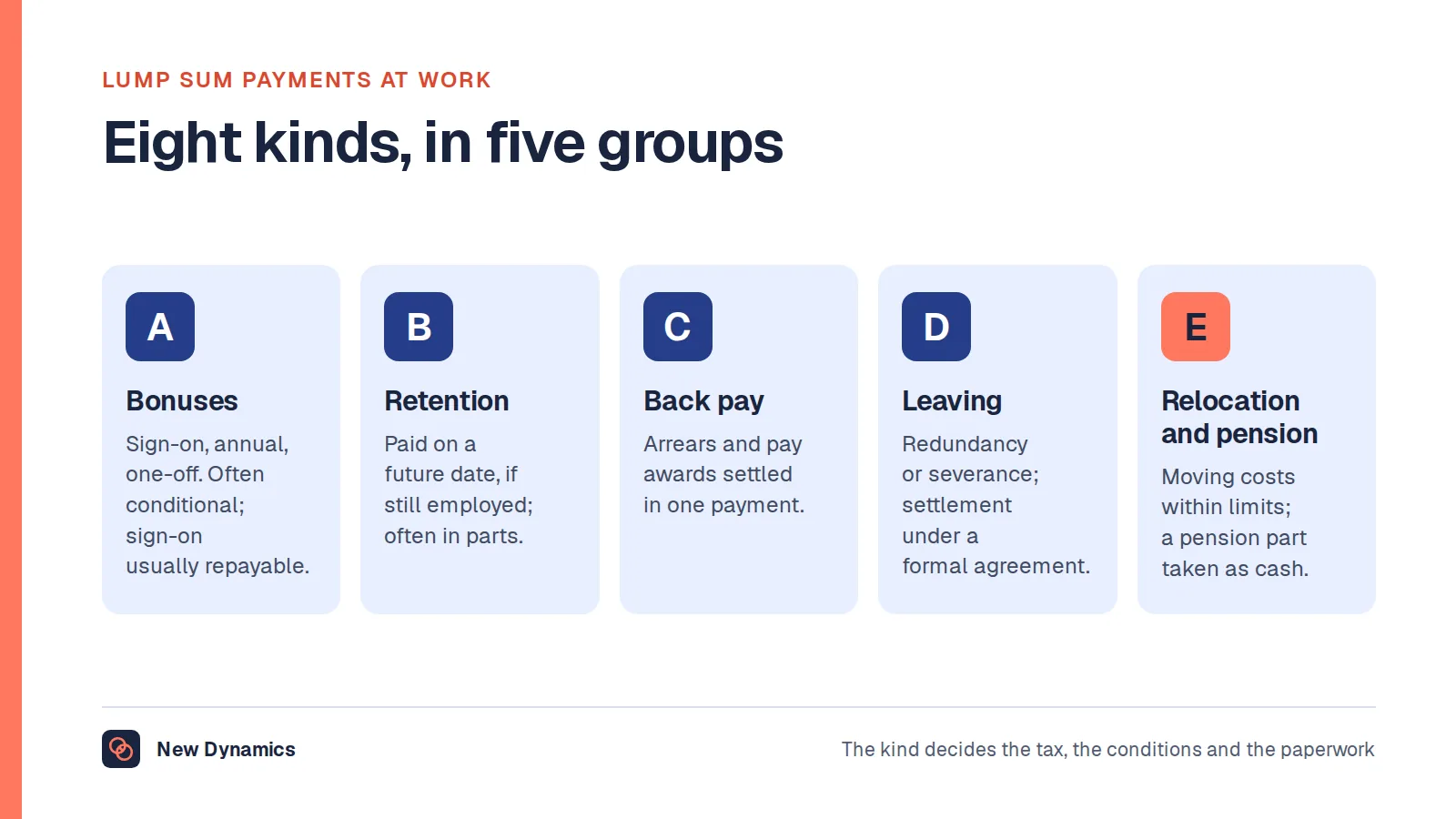
Our post on the lump sum payment covers one-off cash awards, which are treated differently again.
Before you promise anything

- Find the item in the A to Z and read its own page.
- Check the four trivial conditions if it is small, and be honest about the reward condition.
- Decide contract or not, knowing that putting it in the contract makes it permanent and reportable.
- Check who is excluded, especially anyone whose pay is close to the minimum wage.
For deciding pay and benefits in a way you can explain, read and download our compensation policy guide. The guide is free to read, and the PDF uses our short download form.
Frequently asked questions
What are fringe benefits?
Non-cash rewards an employer provides on top of pay, company cars, medical insurance, childcare, gym or club membership, loans, accommodation and similar. In UK tax they are called expenses and benefits, and an employer providing them must usually report them to HMRC and pay tax and National Insurance.
What are examples of fringe benefits?
HMRC's A to Z includes company cars and fuel, medical or dental insurance, childcare, accommodation, loans to employees, long-service awards, mobile phones, staff parties, sporting facilities, relocation costs, school fees and club membership, among many others.
Are all fringe benefits taxable?
Most are reportable and taxable, but each item has its own rules. Small gifts can be exempt under the trivial benefits rule if they cost £50 or less, are not cash or a cash voucher, are not a reward for work, and are not in the contract.
What is a trivial benefit?
A benefit meeting all four HMRC conditions: £50 or less to provide, not cash or a cash voucher, not a reward for work or performance, and not part of the employment contract. Where all four hold, there is nothing to report or pay.
Can directors receive trivial benefits?
Yes, with a cap. A director of a close company (a limited company run by five or fewer shareholders) cannot receive trivial benefits worth more than £300 in a tax year.
What is salary sacrifice?
An agreement to reduce an employee's cash pay in return for a non-cash benefit, made by changing the employment contract with the employee's agreement. It cannot reduce cash earnings below the National Minimum Wage, and employers must cap the deduction to make sure it does not.
Are staff parties a taxable benefit?
Social functions and parties appear in HMRC's A to Z of expenses and benefits, so they fall within the reporting regime and have their own rules. Check the specific guidance for the event you are planning before assuming it is covered.
Your next step: check what you already provide
- List every benefit currently offered, including informal ones.
- Match each to its entry in HMRC's A to Z.
- Identify which small gifts rely on the trivial exemption, and check all four conditions hold.
- Check that no salary sacrifice arrangement brings anyone near the minimum wage.
Want new starters to see what they actually get, from day one? Book a New Dynamics demo and bring your current benefits list. You can also email contact@new-dynamics.com.