TL;DR
- The performance review completion rate is the share of reviews that were due in a cycle and were actually finished: completed reviews divided by reviews due, as a percentage. Four decisions decide what the number means — who is in scope, what counts as complete, when the clock stops, and whether you count the form or the conversation.
- It is worth measuring because the cycle has a floor to clear. Acas says employers should conduct regular performance reviews for anyone with the legal status of employee, that it is a good idea to do them at least once a year, and that a written record should be kept and shared with the employee.
- Report it by manager and by team rather than as one company figure, show it over time rather than at the deadline, and never report it alone. On its own it rewards the manager who filled the form in on the last afternoon and says nothing about the person who had a real conversation in week two.
Every review cycle ends with a number going to the board: the share of reviews that got done. It is the easiest thing in performance management to count and the easiest to misread. A department can hit 100 per cent and have had no conversation worth the name, and a department at 80 per cent can be the one actually managing performance.
This article sets out what the performance review completion rate measures, how to calculate it, the four decisions that change the answer, how to report it so it stays honest, what it cannot tell you, and how to raise it by fixing the cycle instead of chasing people harder.
The number is only as good as the cycle underneath it. See how New Dynamics performance reviews bring goals, feedback and development into one fair discussion. If the number only moves when someone sends reminders, our guide to chasing managers for performance reviews covers why they run late and what to do instead.
What the completion rate measures
The performance review completion rate is the proportion of the reviews that were due in a cycle that were actually finished:
completion rate = completed reviews ÷ reviews due × 100
It is a process measure, not an outcome measure. It tells you whether the organisation did the thing it said it would do. That is worth knowing, because the cycle has a floor to clear. Acas says that "Employers should conduct regular performance reviews for anyone with the legal status of employee" and that "It's a good idea to do them at least once a year". It also says that "It's important to keep a written record of what is discussed", and that the record "should be shared with the employee afterwards". A review that never happened leaves no record to share.
The open textbook Principles of Management, published by OpenStax, makes the wider case in its section on performance management: performance management "isn't a human resources process—it is a mission-critical business process", because "If a business manager can't track and drive performance at the individual level, then the overall organization won't know how it's tracking on overall organizational goals." Completion is the first, crudest check that the process ran at all.
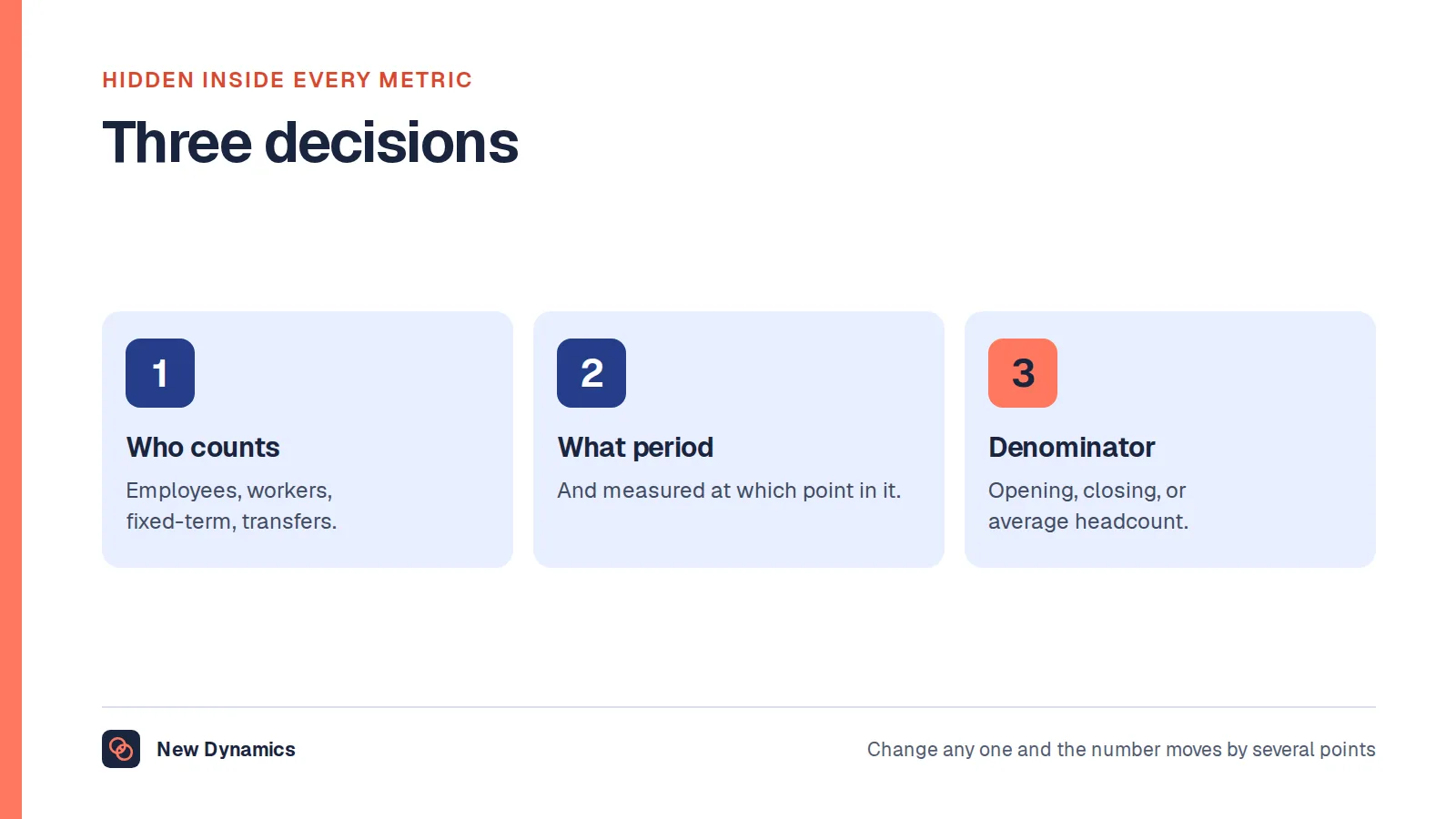
The four decisions behind the number
Two organisations can both report 92 per cent and mean entirely different things. The difference is in four choices, which should be written down before the cycle opens.
- Who is in scope. Everyone employed on the cycle's start date? People who joined mid-cycle? Those on long-term sick leave, maternity leave or notice? Leavers? Each exclusion is defensible; an undocumented exclusion is how a figure quietly inflates.
- What counts as complete. The manager's form submitted? Both forms submitted? The meeting held? The employee's acknowledgement recorded? The strictest definition is the most useful, and the least flattering.
- When the clock stops. At the published deadline, or whenever the last straggler files? Measuring at the deadline tells you about the process. Measuring afterwards tells you only that persistence works.
- Form or conversation. A system can prove a form exists. It cannot prove a conversation happened. If your definition counts only the form, say so when you report the number.

A worked example
Take a team of 60. Eight people joined after the cycle opened and are out of scope under your rule, so 52 reviews are due. By the deadline, 44 manager forms are in, 39 of those have an employee self-assessment attached, and 35 meetings are recorded as held. The numbers here are made up, but the shape is the point:
| Definition of "complete" | Count | Rate |
|---|---|---|
| Manager form submitted | 44 | 85% |
| Both forms submitted | 39 | 75% |
| Meeting recorded as held | 35 | 67% |
One cycle, three defensible numbers, an eighteen-point spread. Pick the definition that matches what you actually care about, write it down, and keep it stable between cycles so the trend means something.
What the number cannot tell you
- Whether the conversation was any good. A form completed in four minutes counts the same as an hour of preparation.
- Whether anything changed. Completion says nothing about objectives agreed, support offered or development started.
- Whether people found it fair. That needs asking them.
- Where the work actually went. A high rate achieved by an HR team chasing for three weeks is not the same as a high rate achieved by managers who planned for it.
This is why completion belongs in a small group of measures rather than on its own. Our guide to HR metrics covers choosing a set that answers a question, and our performance appraisal article covers the quality side of the same cycle.
Reporting completion honestly
- Cut it by manager and team, not just by company. One company figure hides the two managers who did not start.
- Show the curve, not the endpoint. A chart of completion per week through the cycle shows whether the work was spread or crammed into the final days. The shape of that curve predicts next cycle better than the final number does.
- Report the definition beside the number, every time, in one line.
- Pair it with one quality measure. The share of reviews with agreed objectives recorded, or a short question to employees about whether the conversation was useful.
- Separate "late" from "never". They have different causes and different fixes.
- Never put it on a slide alone. A number with no context invites the wrong instruction, which is usually "chase harder".

Raising it without chasing harder
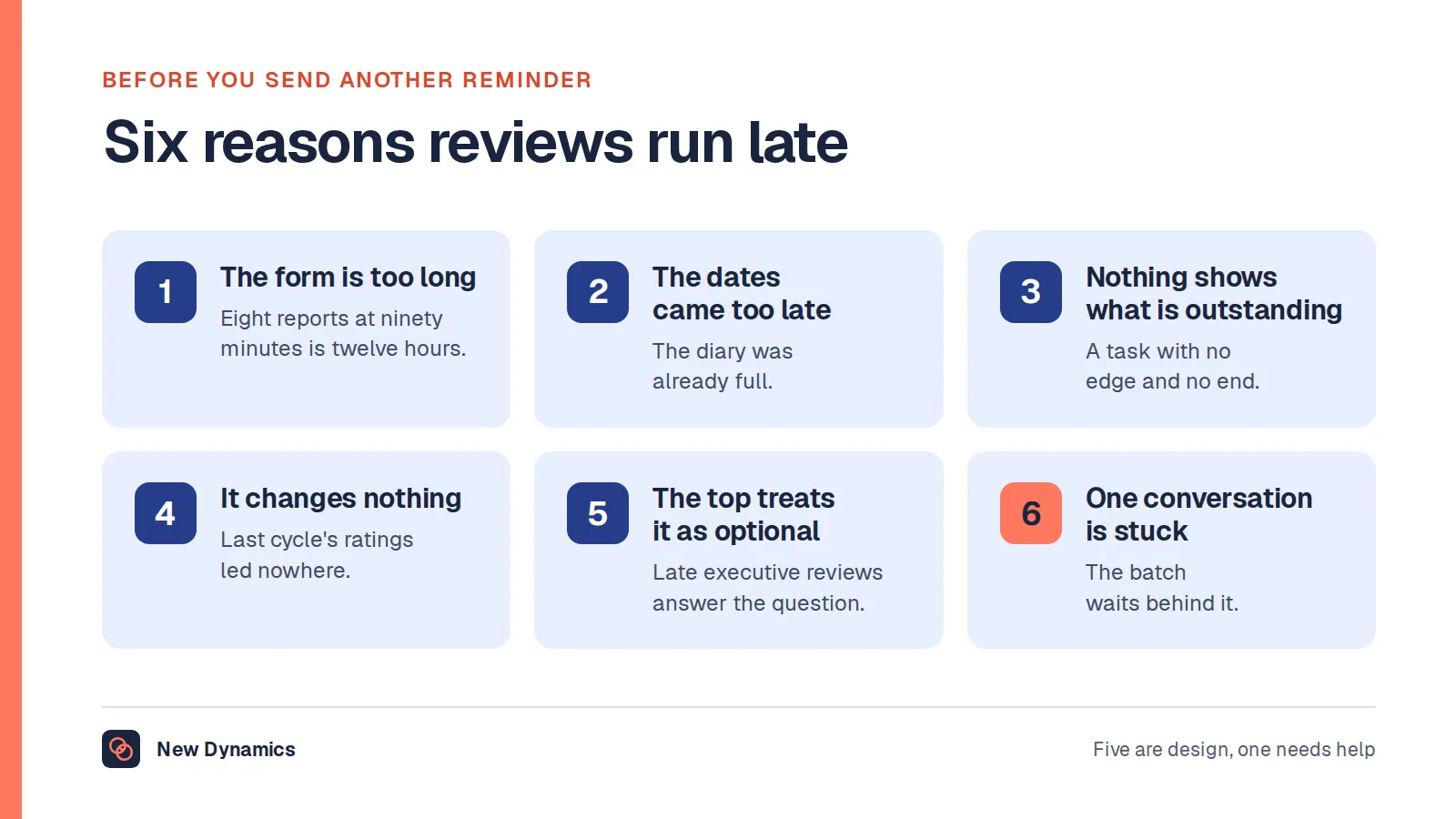
Chasing is a symptom. If HR has to chase, the cycle is asking for more than it has made easy.
- Publish the dates before the cycle opens, far enough ahead that managers can book the meetings into a diary that is already full.
- Shorten the form. Every field is a reason to postpone. Ask what you would do differently if a field were blank; if the answer is nothing, remove it.
- Make the next action obvious. A manager should be able to see, in one place, who is outstanding and what step is next.
- Stage the deadlines. Self-assessments one week, manager drafts the next, meetings in the following two. A single end date pushes everything to the final afternoon.
- Let managers see their own number during the cycle, not after it.
- Fix the repeat offenders as a management issue, not an admin one. If the same three managers are late every cycle, that is a performance conversation of its own.
- Count the conversation, not the paperwork, if you can. People do what is measured, so measure the part that matters.

Frequently asked questions
What is a performance review completion rate?
It is the share of the performance reviews due in a cycle that were actually finished: completed reviews divided by reviews due, expressed as a percentage. It is a process measure that shows whether the cycle ran, not whether the conversations were useful.
How do you calculate the performance review completion rate?
Divide the number of completed reviews by the number of reviews due in the cycle and multiply by 100. The answer depends on four decisions: who is in scope, what counts as complete, when you stop the clock, and whether you count the form or the conversation. Record those decisions and keep them stable between cycles.
What is a good performance review completion rate?
There is no published benchmark worth quoting, because the figure depends entirely on how an organisation defines completion and scope. A rate measured at the deadline under a strict definition is not comparable with one measured weeks later under a loose one. Compare your own cycles with each other instead.
What counts as a completed review?
Whatever you decide, written down in advance. Common definitions are the manager's form submitted, both the manager's and the employee's forms submitted, or the meeting recorded as held. The strictest definition is the most honest, and usually the lowest number.
Why is our completion rate low?
Usually because the cycle asks for more than it makes easy: a long form, a single deadline, dates published too late to book meetings, or no visibility for managers of what is outstanding. Persistent lateness from the same managers is a management issue rather than an administrative one.
What should we report alongside the completion rate?
The definition used, the split by team and manager, the completion curve across the cycle rather than the final figure alone, the split between late and never, and at least one measure of quality, such as the share of reviews with agreed objectives recorded.
Your next step: write the definition down
- Decide who is in scope and which absences are excluded, and record it.
- Decide what counts as complete, and tell managers before the cycle opens.
- Report completion by team, with the curve across the cycle, and the definition beside it.
- Add one quality measure so that the number never travels alone.
For an operating model that makes the cycle easier to finish, read and download our modern performance management guide. The guide is free to read, and the PDF uses our short download form.
Want completion visible to each manager while the cycle is running, rather than counted after it? Book a New Dynamics demo and bring your current review calendar. You can also email contact@new-dynamics.com.