TL;DR
- Extending is right when something outside the manager's control broke the cycle: a reorganisation mid-cycle, a system failure, a genuine capacity shock, or a form that turned out to be too long. It is wrong when it rewards the managers who ignored the date, when it is the second extension, or when it pushes a review past the point where it still describes the year.
- Make it one short, firm, final extension, announced once with a reason. A rolling extension teaches everyone that the published deadline is an opening position, and the next cycle will be worse.
- Settle five things in writing before announcing: who decides, what conditions justify it, how long, what happens to anything downstream — pay decisions, calibration, reporting — and what happens to the reviews still outstanding at the new date.
Two days before the cycle closes, a third of the reviews are outstanding and someone asks the obvious question: can we push the date? Usually the answer is yes, and usually it is given in a hurry, by whoever happens to be in the room, with no conditions attached. That is how a cycle acquires a second extension, and then a reputation.
This article covers when extending a performance review deadline is the right call, when it is not, how long an extension should be, the five decisions to settle in writing, what moving the date affects downstream, and why probation extensions are a different thing entirely.
An extension is usually a symptom of an invisible task. See how New Dynamics performance reviews bring goals, feedback and development into one fair discussion.
First, what the request is telling you
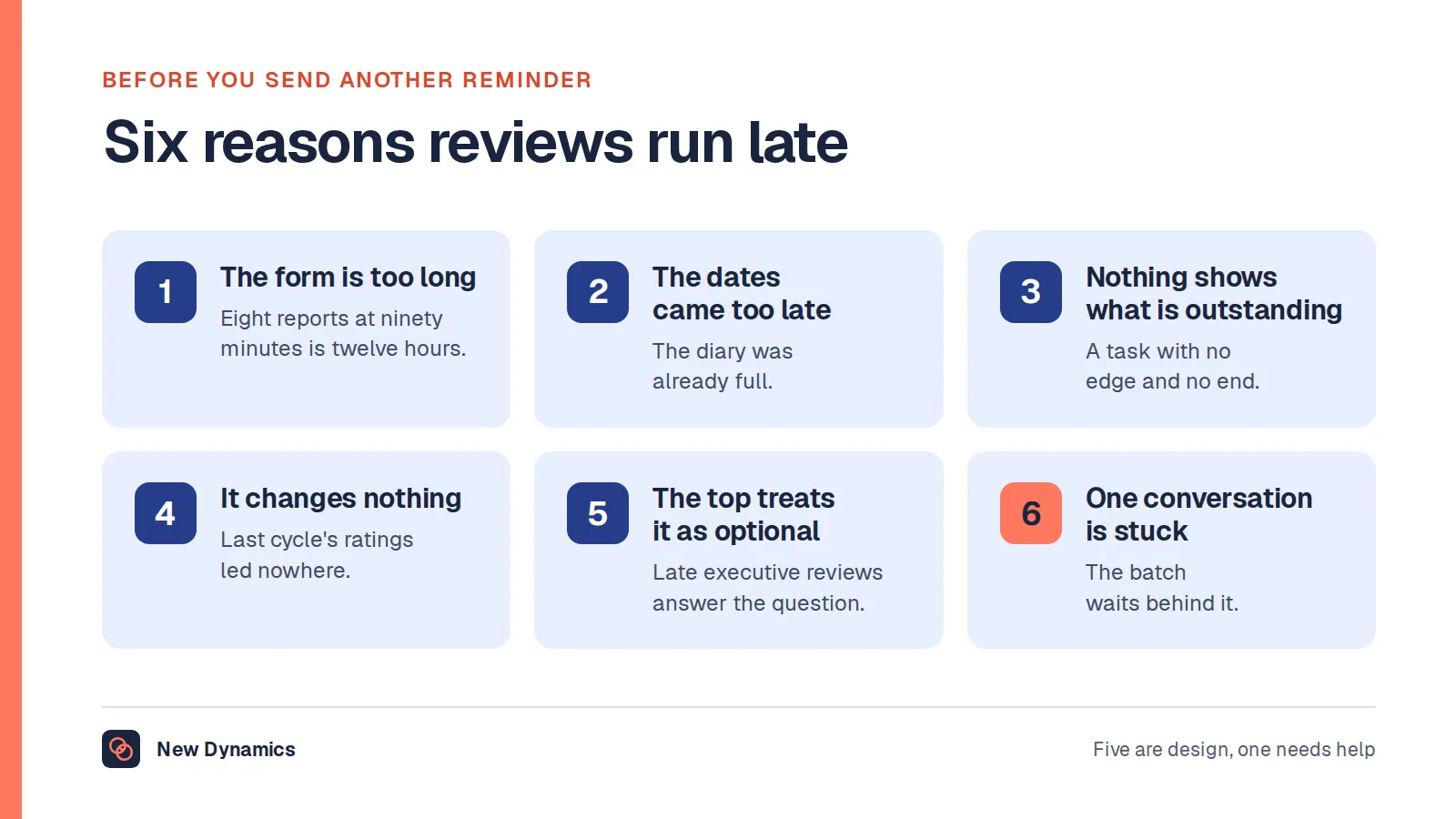
Before deciding, find out why the cycle is behind. The causes are predictable — a form that takes longer than the time available, dates that arrived after diaries were full, no visible list of what is outstanding — and our guide to chasing managers for performance reviews sets out all six and what to do about each.
This matters for the decision because an extension fixes exactly one of those causes: not enough time. If the real cause is a ninety-minute form or a manager avoiding one conversation, two more weeks will produce the same conversation about a new date.
When extending is the right call
- Something structural changed mid-cycle. A reorganisation moved people between managers, and reviews would be written by someone who has managed the person for three weeks.
- The process failed, not the people. The system was down, the form was wrong, the instructions were unclear or the dates were published too late to book meetings.
- A genuine capacity shock. A site lost a third of its managers to an incident, a peak trading period moved, a team absorbed another team.
- Extending improves the output. If two more weeks turns rushed forms into real conversations, that is the whole point of the exercise.
When it is the wrong call
- It rewards ignoring the date. If the managers who planned ahead finished and the ones who did not get more time, you have taught the organisation which approach works.
- It is the second extension. The first can be a correction. The second is a statement that deadlines here are provisional.
- The review would stop describing the year. A review written months late is a reconstruction. Acas treats reviews as a regular discussion, saying that "Employers should conduct regular performance reviews for anyone with the legal status of employee" and that it is a good idea to do them at least once a year. An extension that pushes a cycle towards the next one defeats that.
- Something downstream cannot move. If pay decisions, promotion rounds or budget submissions depend on the cycle closing, the honest answer is to hold the date and handle the stragglers individually.
- It is being used to avoid a conversation. Extending because one manager will not deliver difficult feedback postpones the problem and adds months to it.

How long to extend
Short, single and final. One to two weeks is usually enough to clear a backlog caused by time pressure; anything longer suggests the cause was not time.
Three rules make it work:
- Set the new date at a point you will hold. If you would not escalate on the new date, you have not set a deadline, you have set an expectation.
- Say it is the only extension, and mean it. The value of the sentence comes entirely from it being true next cycle too.
- Keep the original date for everyone who met it. Their reviews are done; do not reopen the cycle for them or you punish the people who planned.
The five decisions to settle in writing
Review cycles have no legal machinery, so the discipline has to be borrowed. Acas's guidance on extending a probation period is a useful model, because that is the one extension with real consequences attached. It says an employer "should have clear conditions for when they can extend probation", that an employer must "confirm an extension before the original probation period ends", and that the employer should agree with the employee the length of the extension, the review points, the expectations, when the final review will happen and the possible outcomes.
None of that is legally required for a review cycle, but all five questions are worth answering before you announce anything:
- Who decides. Name the role, not the room. HR proposes; the executive sponsor decides.
- What conditions justify it. Write them down once, in the cycle's own documentation, so the decision is not made under pressure each time.
- How long, and that it is final.
- What happens downstream. Pay, promotion, calibration meetings, board reporting: either they move too, or they do not and you say so.
- What happens to anything still outstanding at the new date. If the answer is nothing, the new date is not a date.

What moving the date actually costs
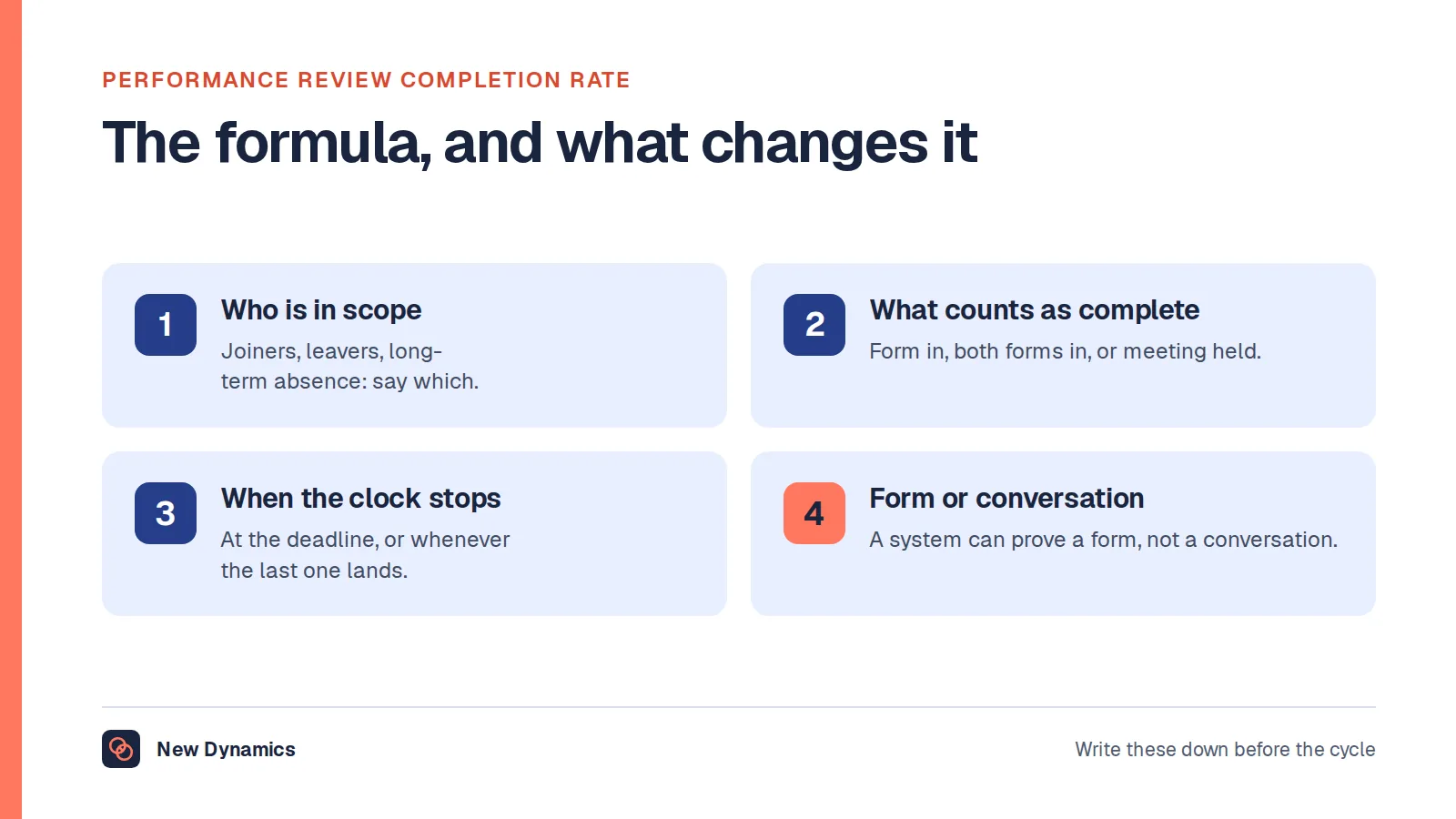
- Calibration slips. Moderation meetings need everyone's ratings in. One late team can hold up the comparison that makes ratings fair, which our performance review completion rate article covers from the measurement side.
- Pay and promotion timing. If the cycle feeds a pay round, an extension either delays people's increases or forces decisions on incomplete evidence.
- The employees who are waiting. For the person whose self-assessment went in three weeks ago, an extension is another month of not knowing what their manager thinks.
- Your reporting. A completion figure achieved after two extensions is not comparable with last cycle's. Report the extension alongside the number or the trend is fiction.
- Next cycle. Managers learn the real deadline is the extended one, and plan for that instead.
Announcing it
Once, to everyone affected, with the reason and the new date. Do not bury it in a reminder.
Subject: Review cycle now closes on [new date]
Hello [name],
The review cycle has been extended by [one week] and now closes on [new date]. This is because [the forms were unavailable for three days last week].
This is the only extension to this cycle. Reviews still outstanding on [new date] will be reported to [the leadership team] and followed up with each manager's own manager.
If your reviews are already complete, there is nothing to do, and thank you.
[Your name]
That last line matters. The people who finished on time are reading this too, and an extension is bad news for them unless you say otherwise. Our six performance review reminder email templates cover the rest of the cycle's messages.
Probation extensions are a different thing
Do not borrow the words from one to the other. Extending a probation period has contractual consequences: Acas says an employer must "confirm an extension before the original probation period ends", warning that failing to do so "could be a breach of contract", and must update the employee's written statement of employment particulars within one month. It also says the employer should agree the length, the review points, the expectations and the possible outcomes with the employee.
A review cycle extension is an internal scheduling decision affecting a process. A probation extension changes an individual's position and needs its own letter, its own conversation and, usually, advice. This article is general information about running a review cycle, not legal advice.

Frequently asked questions
Should you extend a performance review deadline?
Extend when something outside managers' control broke the cycle — a reorganisation, a system failure, a capacity shock — or when more time will turn rushed forms into real conversations. Do not extend to reward people who ignored the date, for a second time in one cycle, or when something downstream such as a pay round cannot move.
How long should a performance review extension be?
One to two weeks is usually enough, because an extension only fixes a shortage of time. If the backlog is caused by a form that is too long or a conversation being avoided, a longer extension produces the same problem at a later date.
Who should decide whether to extend the review cycle?
Name the role before the cycle opens rather than deciding under pressure: in most organisations HR proposes and the executive sponsor decides. Writing down the conditions that justify an extension is what stops the decision being made by whoever is in the room at the time.
How do you announce a performance review deadline extension?
Once, to everyone affected, with the new date, the reason, a statement that it is the only extension, what happens to anything still outstanding, and a line acknowledging the people who already finished. Do not slip it into a reminder email.
What does extending a review deadline affect?
Calibration meetings, pay and promotion timing, board reporting, the employees waiting for their own review, and the credibility of next cycle's deadline. Report the extension beside any completion figure, because a rate achieved after two extensions is not comparable with a previous cycle's.
Is extending a probation period the same as extending a review deadline?
No. Acas says an employer must confirm a probation extension before the original period ends, warning that failing to do so could be a breach of contract, and must update the written statement of employment particulars within a month. A review cycle extension is an internal scheduling decision with no such machinery, which is exactly why it needs its own written conditions.
Your next step: decide it before you need it
- Write the conditions that would justify an extension into the cycle's documentation now.
- Name the role that decides, and the role that is told.
- Decide in advance what happens to calibration, pay timing and reporting if the date moves.
- Draft the announcement wording once, so it is never written in a hurry.
For an operating model where the date rarely needs moving, read and download our modern performance management guide. The guide is free to read, and the PDF uses our short download form.
Want to see what is outstanding early enough that extending is a choice rather than a rescue? Book a New Dynamics demo and bring your current review calendar. You can also email contact@new-dynamics.com.