TL;DR
- A reminder works when it is addressed to one person, names the specific reviews still outstanding, gives a date, says what happens next and links straight to the task. A message that says "performance reviews are due" to everyone asks the reader to work out whether it means them, and most will decide it does not.
- Six templates cover the cycle: the opening announcement, the self-assessment reminder to employees, the week-to-go nudge, deadline day, the private overdue message, and the escalation to the manager's own manager. Each is short, because long reminders get read later, which means never.
- Send fewer and time them better. The Behavioural Insights Team's EAST framework puts it as making a behaviour timely: prompt when the person can actually act, not days before they can start or after they have stopped reading.
Most review reminders fail in the subject line. "Reminder: performance reviews" tells a manager with eleven reports nothing about whether they are finished, how many are left or what happens if they do nothing, so it joins the pile of messages to read later.
This article gives six reminder templates covering a full cycle, the five rules that decide whether a reminder gets acted on, when to send each one, subject lines worth stealing and the mistakes that make reminders easy to ignore.
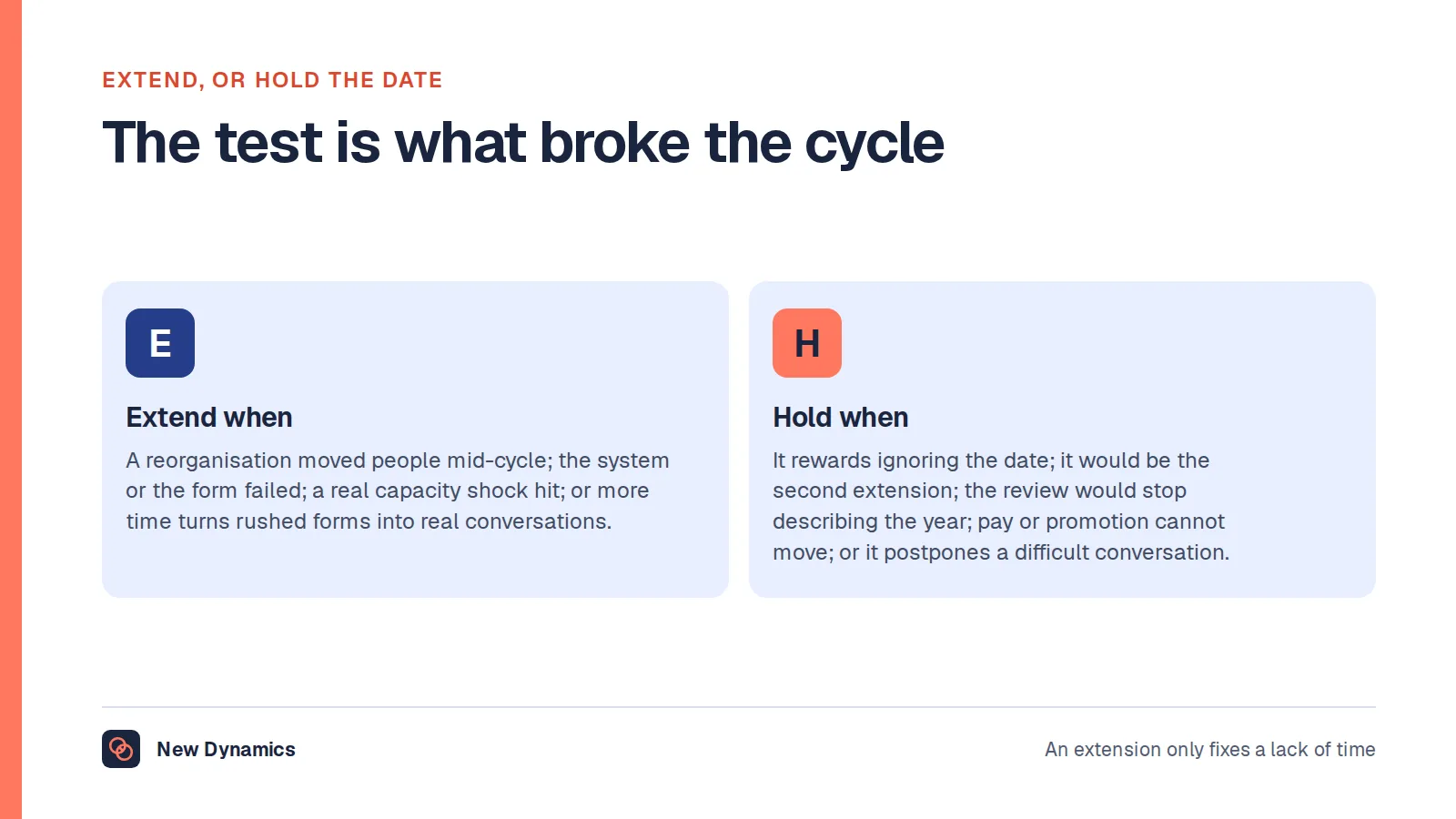
A reminder is only needed when the task is invisible. See how New Dynamics performance reviews bring goals, feedback and development into one fair discussion. If the cycle is far enough behind that you are considering moving the date, our guide to the performance review deadline extension covers when that helps and what it costs.
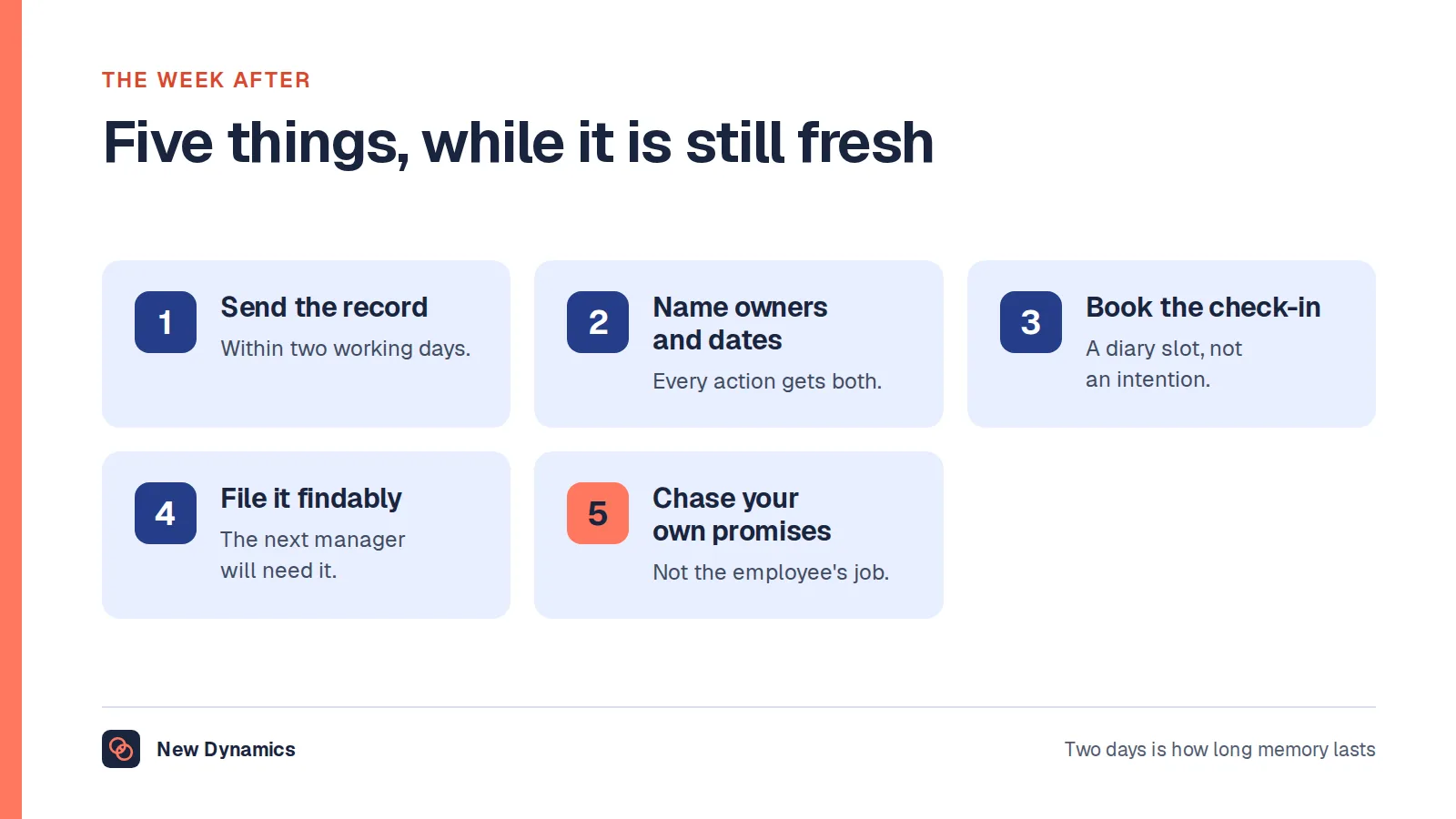
The last email of the cycle matters as much as the first: what happens after a performance review covers the written record, the follow-up wording and who owns each action.
About these templates: all of them were written by the New Dynamics editorial team. Use and adapt them freely. The names and details in them are invented, so replace every bracket with your own.
The five rules of a reminder that works
- One named recipient. A message to all managers is a message to no manager. Send each one their own.
- The specific reviews outstanding. "Priya and Tom are still to be completed" beats "your reviews are outstanding", because it removes the work of finding out.
- A date, not a period. "By Friday" is a deadline. "This month" is a suggestion.
- What happens next. Say what follows the deadline: a report to the leadership team, a conversation with their manager, a closed cycle. A reminder with no consequence is a request.
- A link straight to the task. Not to the homepage of a system. Every extra click is a chance to postpone.
Keep it to five lines. The longer the reminder, the more certain it is to be read later.

When to send each one
Timing matters more than frequency. The Behavioural Insights Team distils the evidence into four principles — "make a behaviour Easy, Attractive, Social, and Timely" — and timeliness is the one reminders get wrong. A prompt sent when the person cannot act is noise; the same words sent when they can are a nudge.
| When | To | Purpose |
|---|---|---|
| Four weeks before the cycle | All managers | Dates, what is needed, book the meetings |
| Cycle opens | All employees | Self-assessment, with the deadline |
| One week before the deadline | Each manager | Their own outstanding names |
| Deadline day | Those not done | Last call, with what happens next |
| Three days after | Those not done | Private, specific, offers help |
| One week after | Their manager | Facts, not complaint |
Six messages across a cycle is enough. Beyond that each one is worth less than the last, and the people who finished on time are reading all of them.
Six templates
1. Four weeks before: the cycle opens
Subject: Review cycle opens on [date] — two things to do now
Hello [name],
The [autumn] review cycle opens on [date] and closes on [date].
Two things to do this week:
- Book a one-hour meeting with each of your [six] reports before [date].
- Read their objectives so nothing in the meeting is a surprise.
The form takes about [20] minutes per person. You can start here: [link].
[Your name]
2. Cycle opens: the self-assessment reminder
Subject: Your self-assessment is open until [date]
Hello [name],
Your self-assessment for the [autumn] review is open until [date]. It takes about [15] minutes, and your manager sees it before your meeting on [date].
Write it here: [link].
Worth doing properly: it is the one part of the review where you choose what gets discussed.
[Your name]
3. One week before: the named nudge
Subject: [Two] reviews to complete by Friday
Hello [name],
Two of your reviews are still open: [Priya] and [Tom]. Both need to be completed by [Friday date].
Complete them here: [link].
If either meeting has not happened yet, tell me today and I will help you find a slot.
[Your name]
4. Deadline day
Subject: Closing today: [Priya] and [Tom]
Hello [name],
The cycle closes at [5pm] today and these are still open: [Priya], [Tom].
[Link].
Anything not completed today appears as outstanding in the report that goes to [the leadership team] on [Monday]. If that is going to be a problem, call me.
[Your name]
5. Three days overdue: private and specific
Subject: [Priya] and [Tom] — what would help?
Hello [name],
[Priya] and [Tom] are still outstanding, [three] days after the cycle closed.
I would rather fix the cause than send another reminder. Is it time, the form, or a conversation you are not looking forward to? Any of those I can help with — the last one more than you might expect.
Fifteen minutes today or tomorrow? [Link to book].
[Your name]
6. One week overdue: the escalation
Subject: [Sam]'s team: [two] reviews outstanding
Hello [name],
For your information, rather than as a complaint: [two] of [Sam]'s [eight] reviews are outstanding a week after the cycle closed — [Priya] and [Tom].
We have offered help twice and extended once. The employees have both completed their self-assessments and are waiting.
Could you raise it at your next one-to-one? Happy to join if that is useful.
[Your name]

Subject lines worth stealing
- [Two] reviews to complete by Friday — the count and the date do the work.
- Closing today: [Priya] and [Tom] — names make it impossible to file away.
- Review cycle opens on [date] — two things to do now — tells them the message is useful before they open it.
- Your self-assessment is open until [date] — personal, dated, singular.
Avoid "Reminder", "Urgent", "Action required" and "Final call". They describe the sender's feelings rather than the reader's task, and the fourth one is rarely true.
What to avoid
- The all-staff blast. Read mostly by people who have finished, and it teaches everyone the first deadline was not real. Our guide to chasing managers for performance reviews sets out the escalation ladder to use instead.
- Naming late managers to their peers. It buys a short-term result and a long-term reputation.
- Guilt. "We are still waiting on a few of you" is both vague and sour.
- A deadline you will not hold. If reminders keep going after the date, the date was fiction.
- Attaching the form. Link to the task; an attachment cannot be completed.
- Naming someone's circumstances. It is fine to write that a review is outstanding; it is not fine to explain in an email to a third party why the employee has been absent. Keep reminders to the facts of the process.
Acas is a useful reminder of what the emails are actually serving: it says "Employers should conduct regular performance reviews for anyone with the legal status of employee", that it is a good idea to do them at least once a year, and that "It's important to keep a written record of what is discussed", shared with the employee afterwards. The reminder exists to get that record written, not to get a box ticked.

Frequently asked questions
How do you write a performance review reminder email?
Address it to one person, name the specific reviews still outstanding, give a date rather than a period, say what happens after that date, and link straight to the task. Keep it to about five lines; longer reminders get postponed.
How many reminders should you send in a review cycle?
About six across the whole cycle: an opening announcement four weeks ahead, a self-assessment prompt to employees, a week-to-go nudge, a deadline-day message, a private note a few days after, and an escalation to the manager's own manager a week after. More than that and each one is worth less than the last.
What should the subject line of a review reminder say?
The count, the names or the date — something that tells the reader what is left before they open it. "Two reviews to complete by Friday" works; "Reminder: performance reviews" does not. Avoid "Urgent" and "Final call" unless both are true.
Should you send review reminders to everyone at once?
Rarely. An all-staff message is read mostly by the people who have already finished and signals that the published deadline is negotiable. Send each manager their own outstanding list instead, and keep group messages for the opening announcement.
When should you escalate an overdue performance review?
After a private, specific message has been sent and a short conversation has been offered — usually about a week after the deadline. Escalate with facts to the manager's own manager: who is outstanding, how many, how late, and what help was offered.
Can you name employees in a reminder email?
Naming whose review is outstanding is ordinary process information and is normally fine for the manager responsible. Explaining why someone has been unavailable, or anything about their health or circumstances, is not: keep reminders to the facts of the cycle and send them only to the people who need them.
Your next step: write the six once
- Write the six messages for your next cycle and store them where whoever runs the cycle can find them.
- Replace every bracket with a real name, date and link before sending.
- Diarise the send dates with the cycle, so reminders are planned rather than reactive.
- After the cycle, delete any template that did not change behaviour.
For an operating model where the reminders are mostly unnecessary, read and download our modern performance management guide. The guide is free to read, and the PDF uses our short download form.
Want managers to see their own outstanding reviews instead of waiting to be emailed? Book a New Dynamics demo and bring your current reminder wording. You can also email contact@new-dynamics.com.