TL;DR
- As a working default: 45 to 60 minutes for an annual review, 30 for a mid-year, 20 to 30 for a regular check-in. Those are our recommendations rather than a standard, and the right number depends on how much ground the conversation has to cover that the year has not already covered.
- The meeting is the small part. Counting self-assessment, the manager's preparation and writing, the meeting itself and the follow-up, a single review costs roughly two to three hours of combined time — and a manager with eight reports is being asked for ten to sixteen hours in a cycle that nobody took out of their diary.
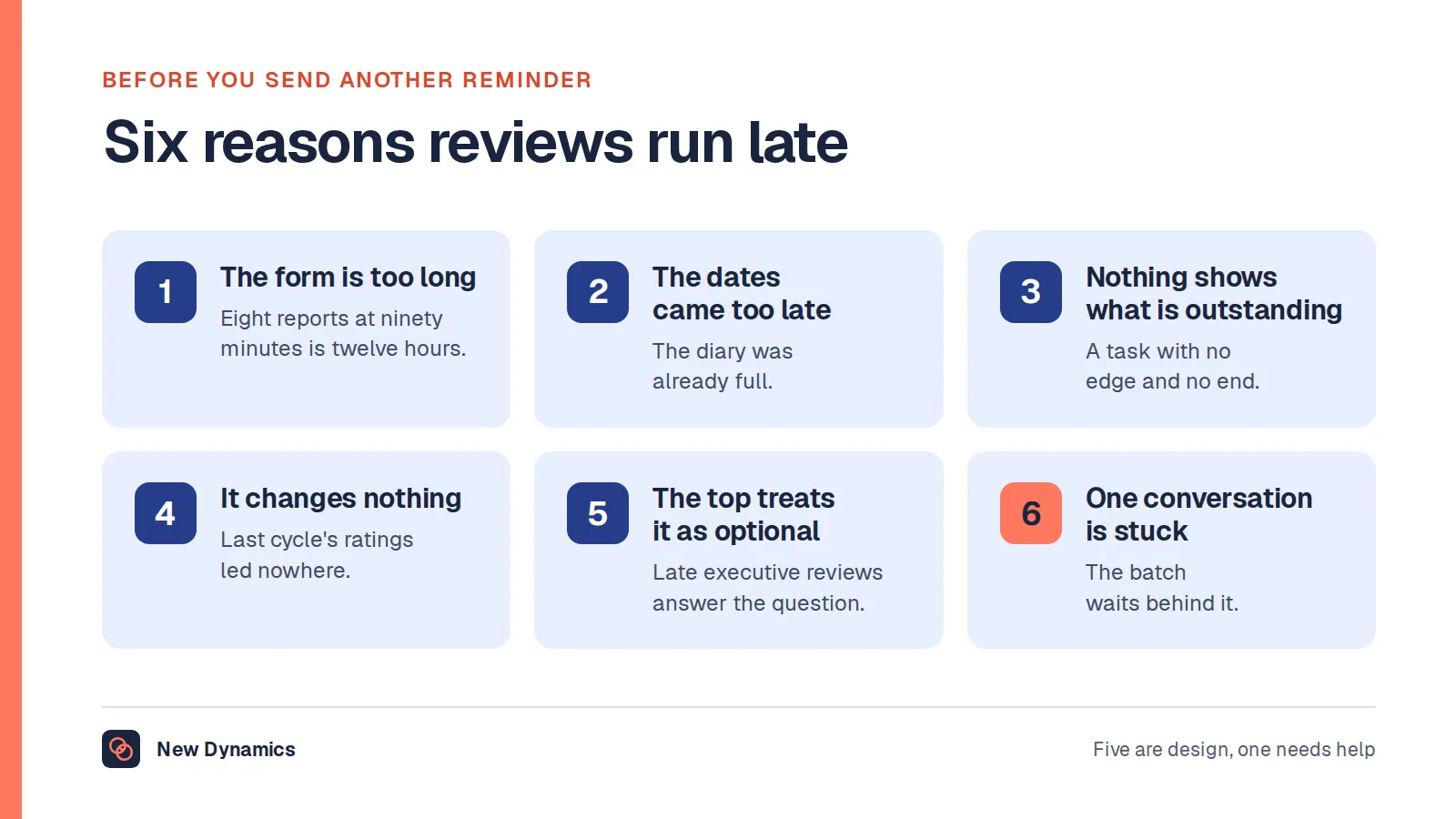
- Reviews overrun for five reasons: no notes were kept through the year, the employee is hearing something for the first time, a live performance problem is being handled in the wrong meeting, the form is being completed during the conversation, and there is no agenda. Each has a fix that shortens the meeting without thinning it.
"How long should a performance review take?" is usually asked by someone building a template or defending a diary. Both deserve a straight answer, so here is ours: 45 to 60 minutes for an annual review, 30 for a mid-year, 20 to 30 for a regular check-in.
Those are recommendations rather than a standard, and the meeting is the part that matters least to whether the cycle survives. The number that decides that is the total — preparation, writing and follow-up, multiplied by the size of the team.
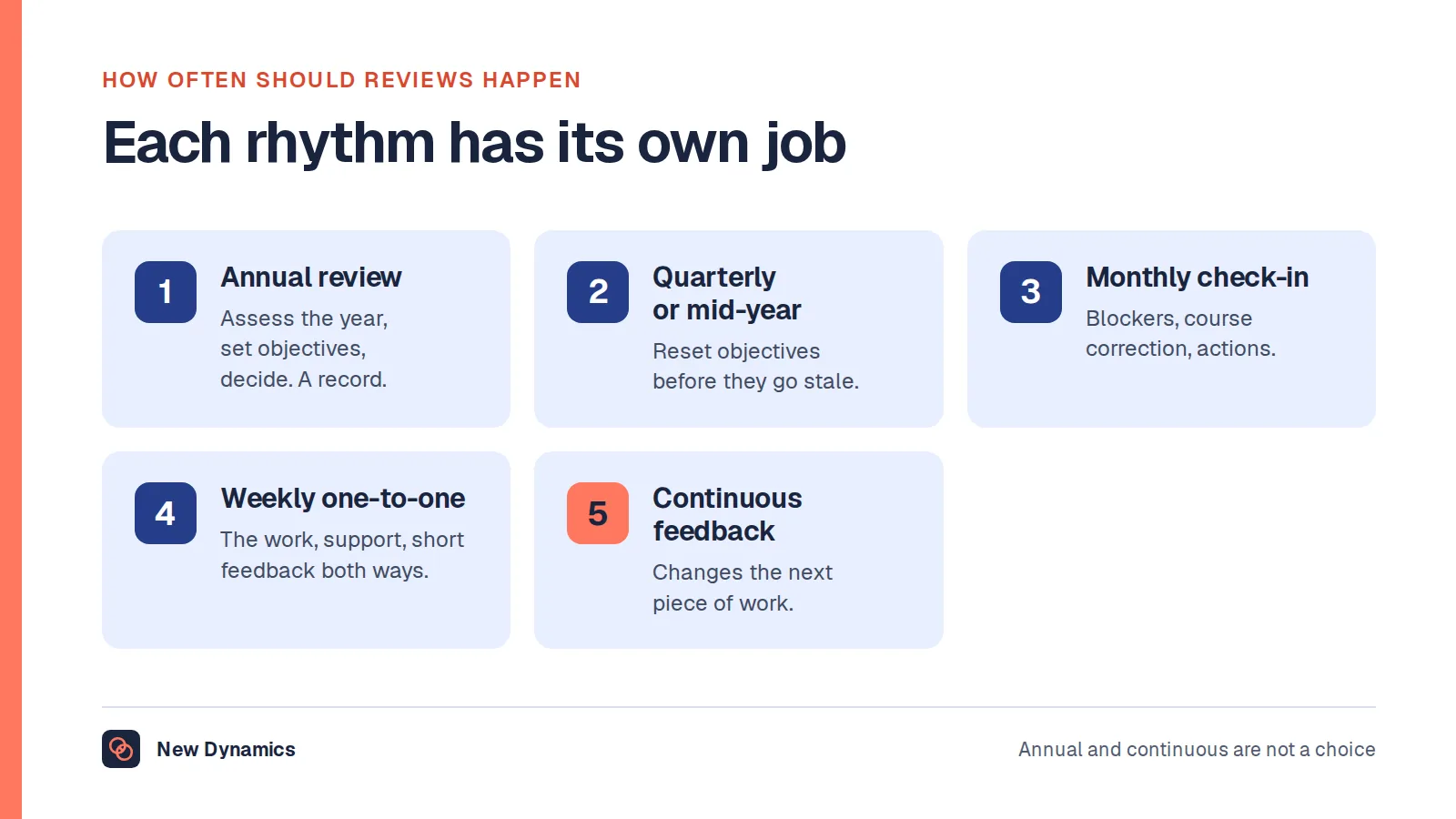
Time disappears when the year's evidence has to be reassembled from memory. See how New Dynamics performance reviews bring goals, feedback and development into one fair discussion. For the matching question of how often to hold one, see our guide to performance review frequency.
How long each conversation should take
| Conversation | Working default | Why |
|---|---|---|
| Annual or end-of-year | 45 to 60 min | A year of evidence, objectives for the next one, development |
| Mid-year | 30 min | Progress against objectives and any correction needed |
| Regular check-in | 20 to 30 min | Current work, blockers, short feedback both ways |
| Probation review | 30 min | A decision against known criteria, with a clear outcome |
| Development conversation | 45 min | Separate from the review, because it loses when combined |
Two caveats worth stating. An annual review that needs 90 minutes is usually carrying work the year should have done: this is the first time the person is hearing something, or the first time the objectives have been looked at since they were set. And a review that genuinely takes 20 minutes is either a model of continuous feedback or a formality, and the difference is visible in whether anything was agreed.

The total nobody budgets for
Per employee, a review is five pieces of work:
- The employee's self-assessment — 20 to 40 minutes, done properly.
- The manager's preparation — 20 to 30 minutes: reading the objectives, the self-assessment, any feedback from others, and deciding what to say.
- Writing the review — 20 to 30 minutes, if the notes exist. Considerably more if they do not.
- The meeting — 45 to 60 minutes.
- Follow-up — 10 to 15 minutes: recording what was agreed and sharing it, which Acas treats as part of the job, saying it is "important to keep a written record of what is discussed" and that the record should be shared with the employee afterwards.
That is roughly two to three hours of combined time for one review. The manager's share is around 90 minutes to two hours of it, which is the number that actually decides whether your cycle finishes: a manager with eight reports is being asked for ten to sixteen hours of work inside a normal quarter. Our guide to chasing managers for performance reviews covers what happens when nobody takes that out of their diary first.

Why reviews overrun
- No notes were kept. Reconstructing a year from memory in the meeting is slow and unfair, and it favours whatever happened in the last six weeks.
- Something is a surprise. A first hearing needs processing time, a reaction and often a second conversation. Nothing in an annual review should be new.
- A live performance problem is in the wrong meeting. This is the big one, and it is worth handling separately.
- The form is being filled in live. Writing while talking does both badly.
- There is no agenda. Without a shape, the conversation goes to whatever is most comfortable, which is rarely what matters.
The performance problem belongs in its own meeting
If someone is not performing, the annual review is the wrong container for it. Acas frames the response around what kind of problem it is, saying performance issues "might be to do with: capability – someone's ability to do their job" or "conduct – someone's behaviour at work", and that what kind of problem it is affects how the employer should respond. For capability it points to support such as coaching, mentoring or training, and notes that employers must provide "adequate resources" to enable someone to do their job.
None of that fits in the last ten minutes of a review that was supposed to end at four o'clock. Hold the review, then hold a separate meeting with its own purpose, notice and record.
Making reviews shorter without making them worse
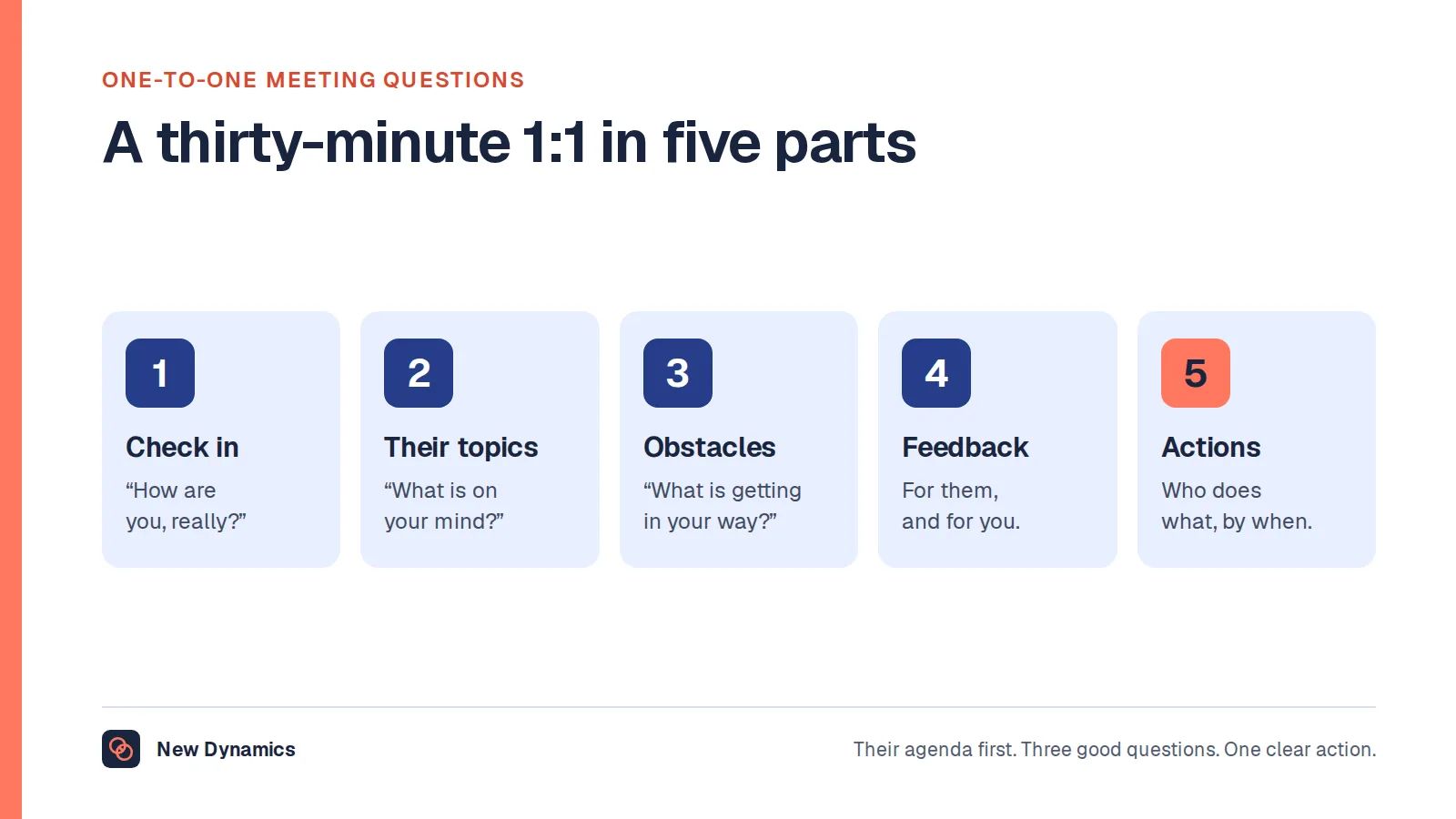
- Keep notes through the year. Ten minutes after each one-to-one removes most of the writing time later. Our one-to-one meeting questions give the conversation a shape worth recording.
- Send the self-assessment and the draft before the meeting. Reading silently together is the most expensive way to read.
- Put an agenda on it. Last period, this period, development, anything they want to raise.
- Cut the form to what someone acts on. Every field is time spent twice, once writing and once reading.
- Separate the development conversation rather than squeezing it into the final five minutes.
- Start on time and book 60 minutes even if you expect 45; a meeting that runs over into another is how an hour becomes two.
What never to shorten
- The employee's talking time. If they speak for less than half of it, it was a briefing.
- Anything being heard for the first time. If something is new, slow down and expect to meet again.
- What was agreed. The last five minutes decide whether anything changes.
- The written record. It is the part that survives the meeting, and the part Acas asks for.

Frequently asked questions
How long should a performance review take?
As a working default, 45 to 60 minutes for an annual review, 30 for a mid-year and 20 to 30 for a regular check-in. The right length depends on how much the conversation has to cover that the rest of the year has not, so a review that needs 90 minutes usually signals a gap in the year rather than a complex employee.
How long should a manager spend preparing for a performance review?
About 20 to 30 minutes per person if notes were kept through the year: reading the objectives, the self-assessment and any feedback from others, and deciding what to say. Without notes, preparation and writing expand considerably, because the year has to be reconstructed.
How much total time does one performance review cost?
Roughly two to three hours of combined time: the employee's self-assessment, the manager's preparation, writing the review, the meeting and the follow-up record. The manager's share is around 90 minutes to two hours, which is the figure to multiply by team size when planning a cycle.
Why do performance reviews overrun?
Because notes were not kept, because something is being heard for the first time, because a live performance problem is being handled in the wrong meeting, because the form is being completed during the conversation, or because there is no agenda.
Should a performance problem be discussed in the annual review?
Raise it, but handle it separately. Acas distinguishes capability from conduct and says the type of problem affects how an employer should respond, with support such as coaching, mentoring or training for capability issues. That needs its own meeting, notice and record rather than the last ten minutes of a review.
Is a 20-minute performance review too short?
Not necessarily. If feedback has been continuous all year and the review is confirming a shared picture and agreeing objectives, 20 minutes can be enough. It is too short if anything is new, if the employee did most of the listening, or if nothing was agreed.
Your next step: cost your own cycle
- Multiply your manager-side estimate — around 90 minutes to two hours — by the number of reviews each manager owes.
- Compare that with the working time available between the dates you have published.
- If the total does not fit, shorten the form or lengthen the window before the cycle opens, not after.
- Put ten minutes of note-taking after each one-to-one into the manager's routine, which is where the time comes back.
For the conversation the whole cycle rests on, read and download our one-to-one meeting guide. The guide is free to read, and the PDF uses our short download form.
Want objectives, feedback and notes already in front of the manager when they sit down to write? Book a New Dynamics demo and bring your current review form. You can also email contact@new-dynamics.com.