TL;DR
- Skipping a leaver's review feels like tidiness and is actually a decision about three things that outlast their employment: the written record, the reference you may later have to stand behind, and any pay that depends on a rating.
- Review the period that was worked, drop everything whose only purpose is the future, and keep the rating honest in both directions. Leaving is not a performance fact, and neither guilt nor irritation belongs in the score.
- Resignation and dismissal or redundancy notice are different situations. In the second, keep the performance process and the dismissal or selection process apart, and take advice before combining anything.
Someone resigns three weeks before the review cycle opens. The manager's instinct is to leave them out of it: they are going, the form is long, and the deadline is for people who will still be here. It feels like common sense and it quietly settles three questions that will outlive the notice period.
This article covers why the review still matters for a leaver, what it should cover and what it should drop, how the record relates to the reference, what the notice period itself should contain, and why resignation and redundancy need different handling. It describes the position in Great Britain and the UK and is general information, not legal advice.
A cycle that records the period worked, whoever is still in the building at the deadline, is a process question rather than a judgement call. See how New Dynamics performance reviews keep one record of what each person did.
Three things that outlast the notice

The record. The work happened. If the last twelve months never get written down, the file ends with whatever was last recorded, which may be a year old and may be the one quarter that went badly.
The reference. GOV.UK says that an employer "does not usually have to give a work reference - but if they do, it must be fair and accurate", and that a reference "can include details about your performance and if you were sacked". On a disputed reference, it adds that the "previous employer must be able to back up the reference, such as by supplying examples of warning letters". A reference written from memory eight months later, with no contemporaneous record behind it, is the worst position to be in.
The money. Bonus schemes, commission plans and pay reviews often turn on a rating. If no rating is produced, the question of what the person is owed has been answered by default rather than by decision, and the person who notices is usually a payroll team three months later.
Decide the rule once, before you know whose name it is
Write the policy down: for example, anyone employed for a defined minimum part of the period gets a review covering the time they worked, whether or not they are serving notice at the deadline. Decide it in the abstract, because decided case by case it will track how the manager feels about the departure.
Two practical additions. State who completes the review if the person leaves mid-cycle, and state how the bonus or commission scheme treats a leaver, in the scheme's own documentation rather than in an email.
What the review covers, and what it drops

It still covers the period worked: what was delivered, against which objectives, with the evidence. It should name that period explicitly, in the same way a review for someone who was away for part of the year does, as our post on reviewing an employee on long-term sick leave sets out.
It drops everything whose purpose is the next period: objectives for a year the person will not be here for, a development plan, a career conversation, anything tied to retention or "potential". Those sections are not shortened, they are deleted, and the meeting gets shorter as a result.
Two failure modes, equally common. The first is marking someone down because they resigned, which turns leaving into a performance fact and shows up in the file as a last-minute drop in a previously steady record. The second is inflating the rating out of guilt, goodwill or the hope of an easier reference conversation. GOV.UK's requirement that a reference be fair and accurate cuts both ways, and a glowing final review that contradicts everything before it is not a kindness to anyone, including the person's next employer.
Objectives for the notice period itself
During notice, the work is the handover. That is a real objective and it can be written down like one: the documents to be produced, the named person each thing transfers to, the accounts or systems to be reassigned, and the dates. GOV.UK notes that a notice period "usually runs from the start of the day after you handed your notice in", so the clock is known from the first day and the plan can be built against it.
Where someone is placed on garden leave, GOV.UK describes it as the employer asking you "not to come into work, or to work at home or another location during your notice period", with "the same pay and contractual benefits". There is no work to assess in that period, so the review closes at the last working day and the handover has to happen before the garden leave starts, not during it.

Resignation is not the same as dismissal or redundancy notice
Acas defines a notice period as "the amount of time an employee has to work for their employer after they resign, are dismissed or made redundant", and notes that how much notice applies depends on length of service, the contract or written statement, and which of those three things happened.
Everything above is written for the resignation case. Where the notice follows a dismissal or a redundancy, the sequence is different and the care required is higher:
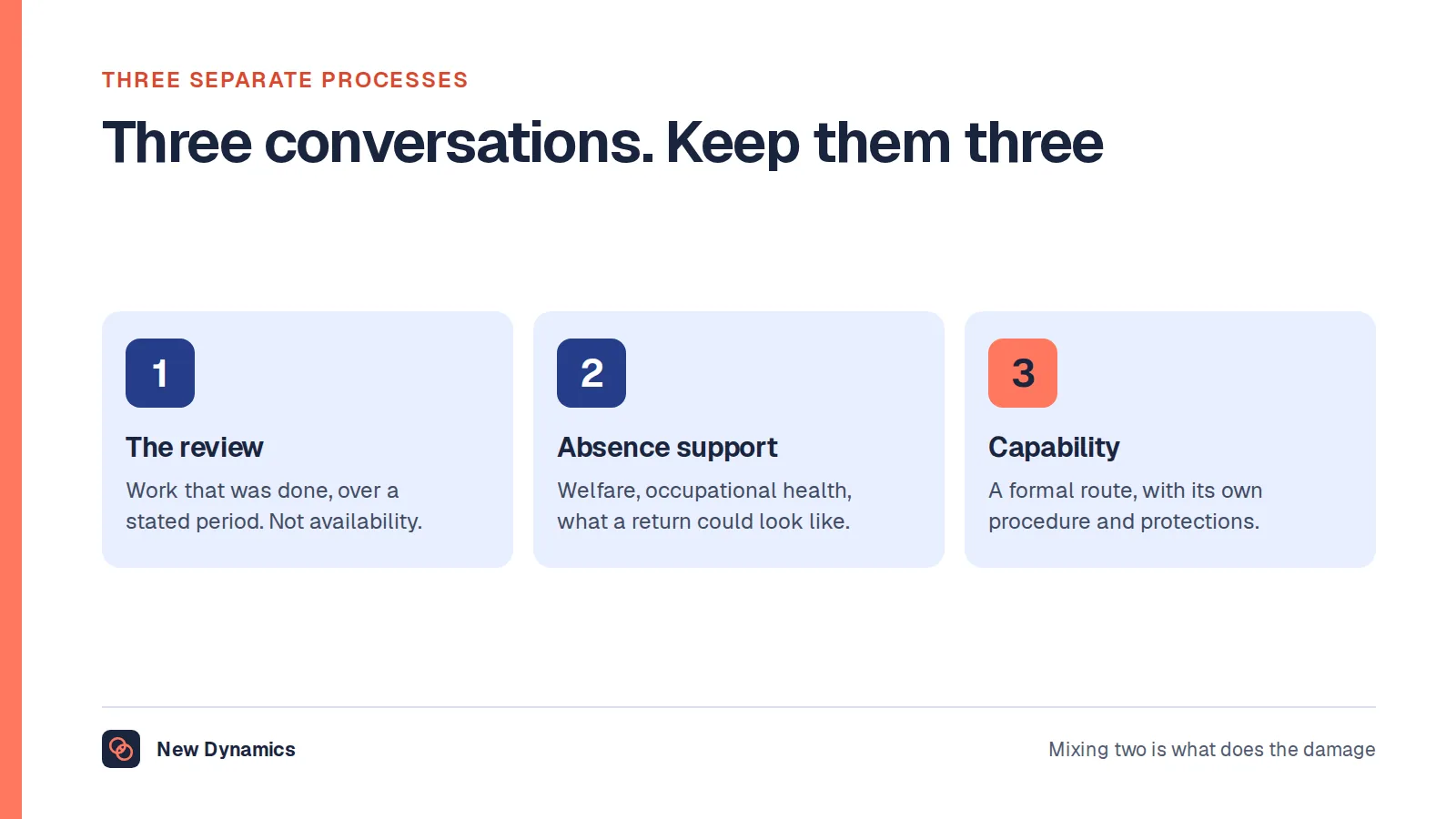
- Keep the processes separate. A performance review is not part of a dismissal procedure, and a dismissal procedure has its own steps and its own records.
- Scoring during a redundancy consultation is selection, not review. If an assessment feeds a selection matrix, it belongs to that process, with that process's fairness requirements, and should not be dressed up as the annual cycle.
- Do not write the review to justify the decision. A rating produced after the fact, lower than everything before it, is exactly the document that gets read back later.
- Take advice before combining anything. This is the point in the article where the honest answer is that the facts matter too much for a general rule.
The review and the exit interview are different meetings
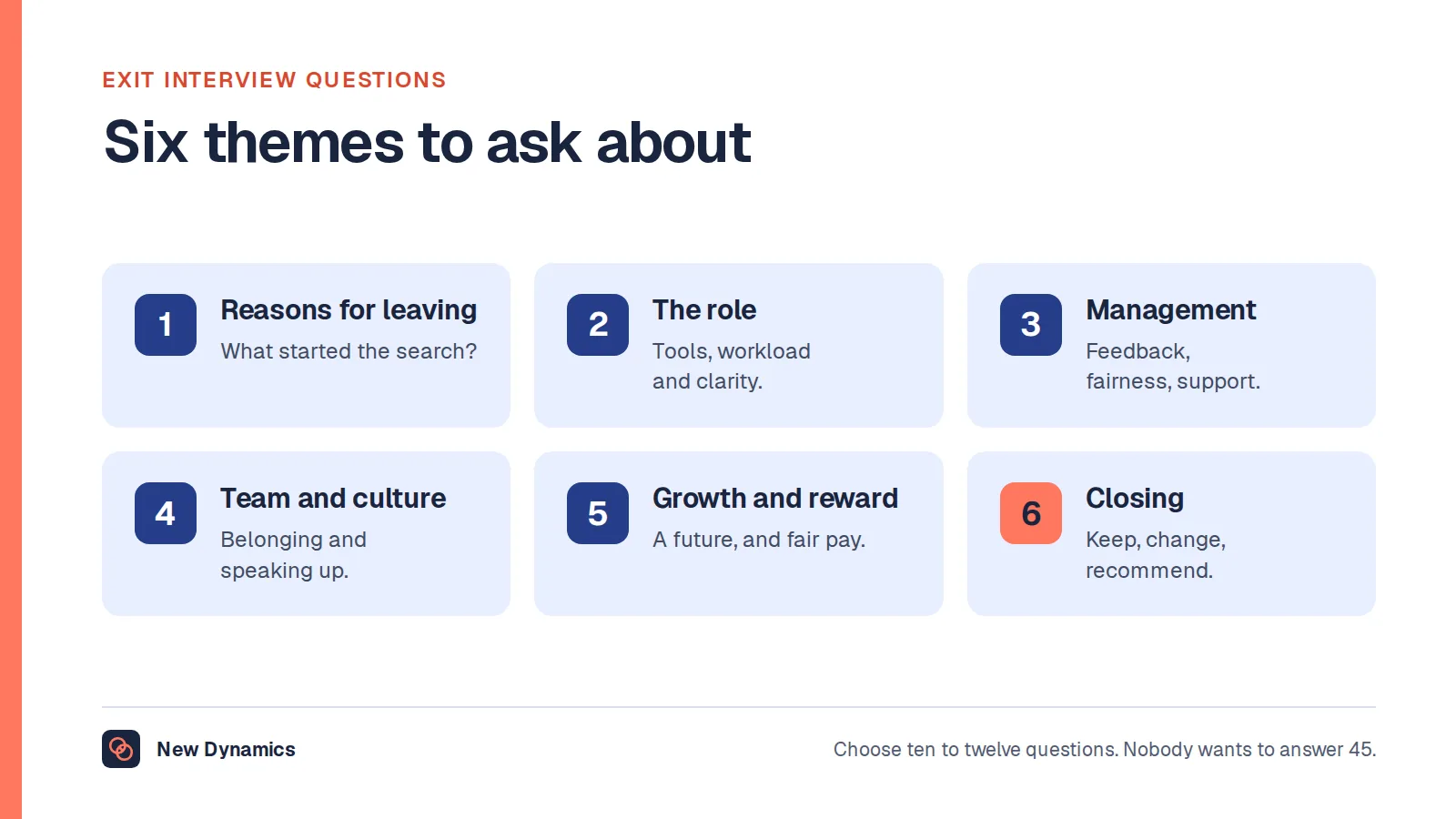
The review looks backwards at the work and belongs to the manager. The exit interview looks at why the person is leaving, usually belongs to someone other than the manager, and produces organisational information rather than an individual record. Running them together means the employee tells you less about both, and our post on exit interview questions covers what the second conversation should actually ask.
Writing a record the reference can rely on
A reference later has to be fair and accurate, so the file has to be able to support it. That means:
- Facts and dates, not impressions. "Managed the migration, delivered in the third quarter" survives scrutiny; "a safe pair of hands" does not say anything.
- Consistency with what the person was told at the time. A concern that never appeared in a review should not make its first appearance in a reference.
- The period covered, stated. Especially where the review stops at the last working day.
- Nothing added after the departure. If something was not recorded while the person could respond to it, it is not evidence.
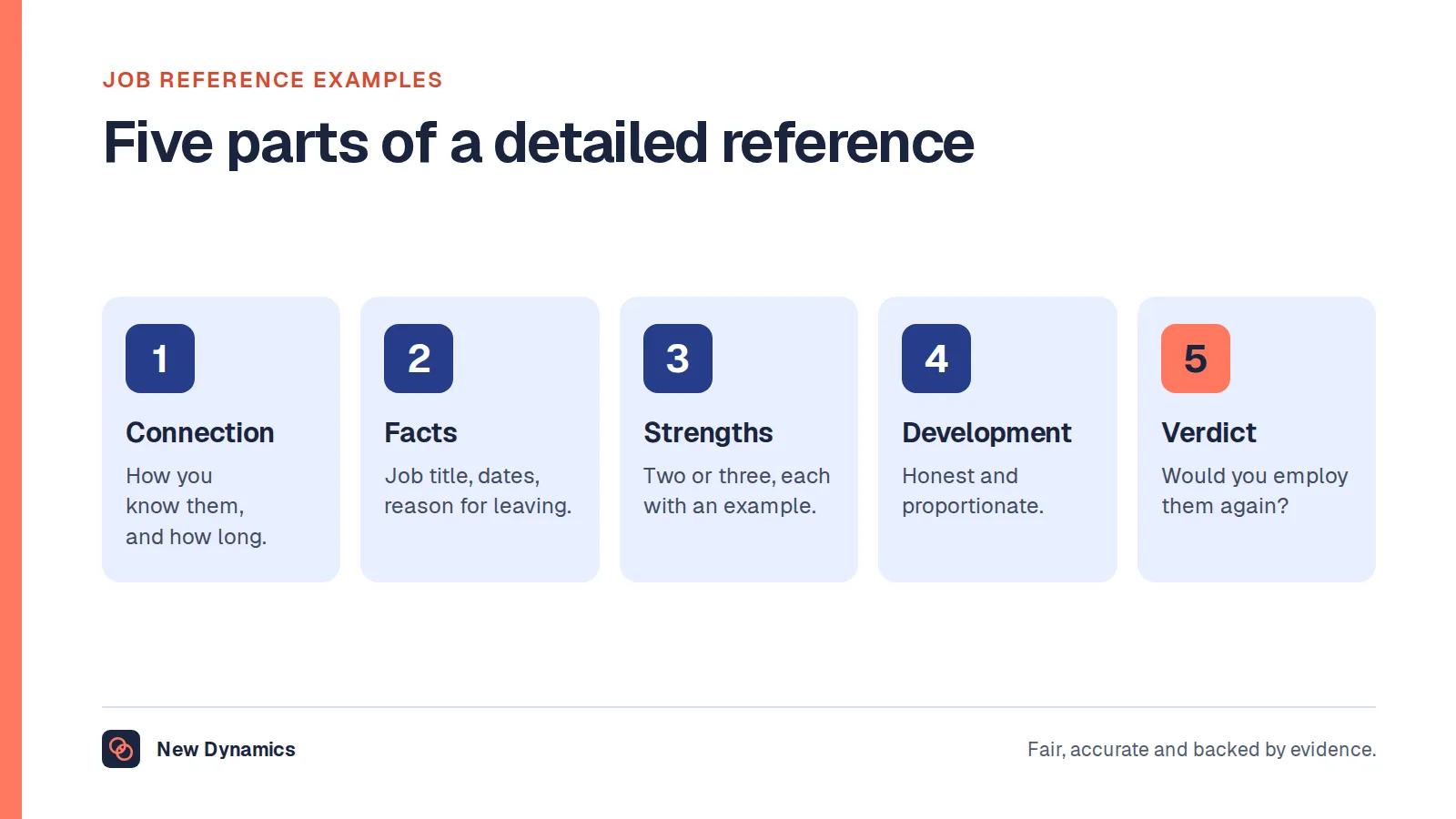
Our job reference examples post covers the wording side, including how brief a factual reference can legitimately be.
Frequently asked questions
Should you do a performance review for someone on notice?
Usually yes, covering the period they worked. The record outlasts them, any reference you give has to be fair and accurate and will be easier to write with a contemporaneous review behind it, and bonus or commission decisions often depend on a rating. Drop the forward-looking sections: objectives, development plans and career conversations serve no purpose for someone who is leaving.
Can a performance rating be lowered because someone resigned?
It should not be. Resigning is not a performance fact, and a last-minute drop in an otherwise steady record is visible to anyone who reads the file later. The reverse is also worth avoiding: inflating the rating out of goodwill creates a document that contradicts the rest of the record and is no help to the person's next employer.
Does a leaver still get their bonus or pay review?
That depends on the scheme rules, which should be written down rather than decided case by case. What matters here is that a missing review can silently decide the question, because a scheme that pays on rating cannot pay without one. Settle the leaver treatment in the scheme's own documentation before the situation arises.
What should someone work on during their notice period?
The handover, treated as a real objective: the documentation to produce, the named person each responsibility transfers to, the systems and accounts to reassign, and dates for each. Notice usually runs from the day after notice was handed in, so the available time is known from the start and can be planned against.
Can you review someone who is on garden leave?
There is nothing to assess for that period, because the employer has asked them not to work. GOV.UK describes garden leave as being asked not to come into work while still receiving the same pay and contractual benefits. Close the review at the last working day, and complete the handover before the garden leave begins.
How does a performance review relate to a reference?
GOV.UK says a reference must be fair and accurate if one is given, can include details about performance, and that an employer must be able to back up a disputed reference with evidence. A review written at the time, consistent with what the employee was told, is the evidence. This is general information, not legal advice.
Your next step: write the leaver rule down
- Add one line to your review policy stating whether leavers are reviewed, and from what length of service in the period.
- Check your bonus and commission documents for what happens to a leaver, and fix the ones that are silent.
- Add a handover objective template to your offboarding process, with named recipients and dates.
- Read the last three references your organisation sent, and check each claim against the written record behind it.
For the mechanics of a cycle that still produces a usable record when someone leaves mid-period, read and download our performance review guide. The guide is free to read, and the PDF uses our short download form.
Want a record of each person's work that survives their last day? Book a New Dynamics demo and bring your offboarding checklist. You can also email contact@new-dynamics.com.