TL;DR
- Teach six things: what the review is for here, how evidence is gathered through the year, how to write a record, how to rate consistently and spot your own bias, how to hold the conversation, and what to do in the cases the form does not cover.
- Cut everything that does not touch your own form. Personality models, the history of performance management and generic feedback theory are not training, they are content, and managers forget them before the cycle opens.
- Measure it from documents rather than from a feedback form: the spread of ratings across managers, how much specific evidence appears in a sample of reviews, lateness, how often a concern appears for the first time at the review, and appeals.
Most organisations run performance review training as a one-hour deck a week before the deadline, delivered to people who are already behind. Then the ratings come in with half the managers using the top two points of the scale and the other half using the middle one, and the conclusion drawn is that managers do not care.
This article sets out what to teach, what to leave out, when to run it against your own timetable, and how to tell afterwards whether anything changed. It describes the position in Great Britain and the UK and is general information, not legal advice.
Training sticks better when the system it describes is the one managers actually use. See how New Dynamics performance reviews keep evidence, objectives and the record in one place.
Why this is worth two sessions
Two reasons, one practical and one legal.
The practical one: reviews drive pay, progression and who gets the interesting work. A process that is applied inconsistently across managers produces unfair outcomes at scale, and it is applied inconsistently by default because nobody has ever explained the scale.
The legal one is less obvious. Acas describes vicarious liability as when "an employer could be held responsible if one of their workers discriminates against someone", and says an employer could be held responsible for a worker's discrimination "unless they'd already taken all reasonable steps to prevent discrimination happening". Its illustration of an employer taking steps includes a company that "trains all their workers on equality, diversity and discrimination". Acas also notes that "it can still be discrimination even if the less favourable treatment was not intended", and lists "excluding someone from opportunities or benefits" among the things that can put someone at a disadvantage. Ratings decide opportunities and benefits.
Writing about absence policies, Acas puts the expectation simply: employers should "share absence policies with the whole organisation", "make policies clear and easy to follow" and "provide training on the policies". The same logic applies to a process that decides someone's pay.
Six modules

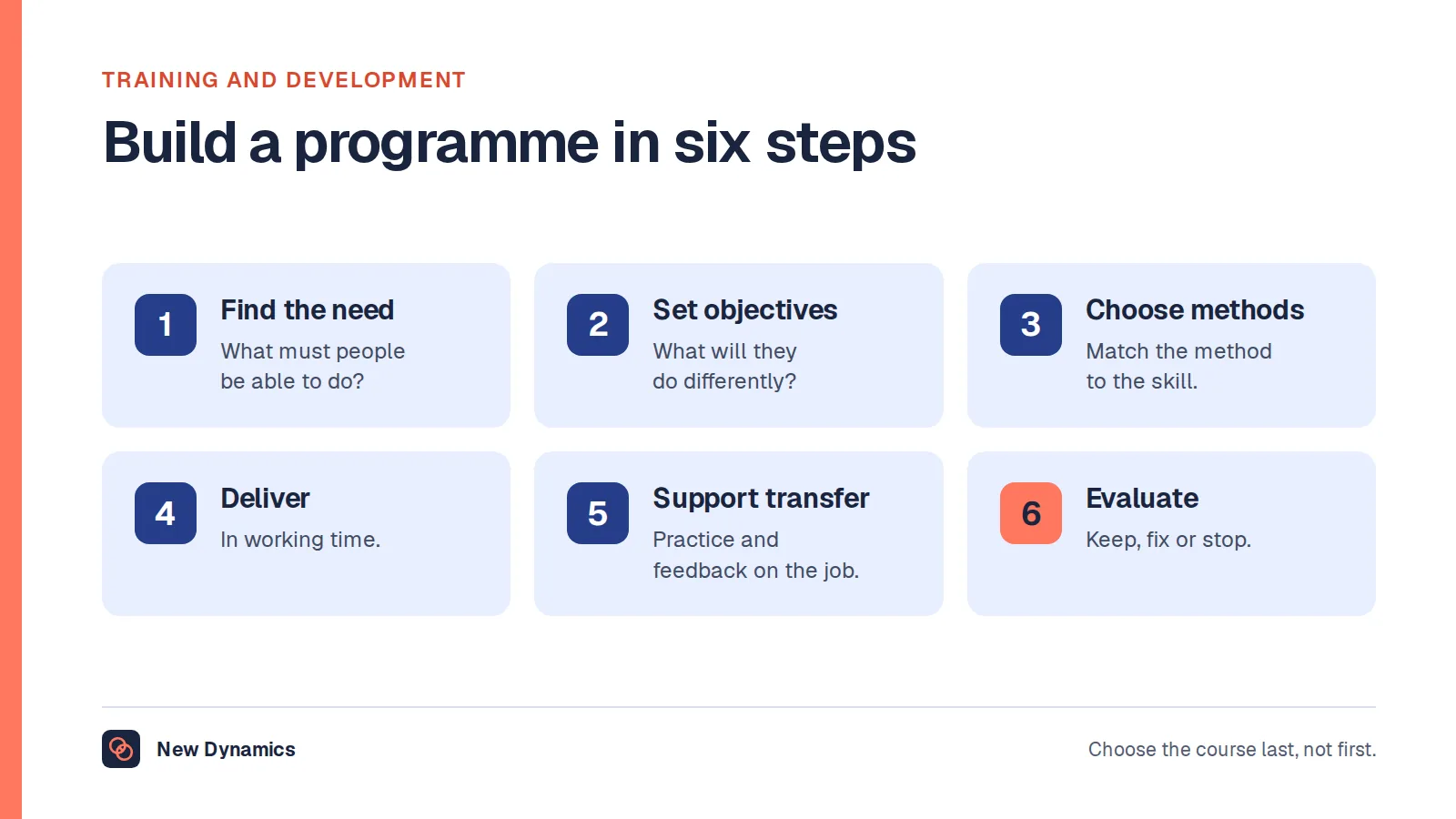
1. What the review is for here. Your cycle, your form, your scale, with written definitions of each rating and worked examples of the difference between adjacent points. This is the module organisations skip, and it is the one that causes the inconsistency they complain about. Acas describes a review as a chance to discuss "what they are doing well", "any areas for improvement", "whether they need more support or training" and "their career and any development objectives": decide which of those your form is actually trying to do.
2. Gathering evidence through the year. Where evidence comes from, and the fifteen minutes of note-writing after each one-to-one that produces it. Acas describes regular feedback, coaching and "regular check-ins, sometimes known as one-to-ones" as the ordinary accompaniment to the formal cycle.
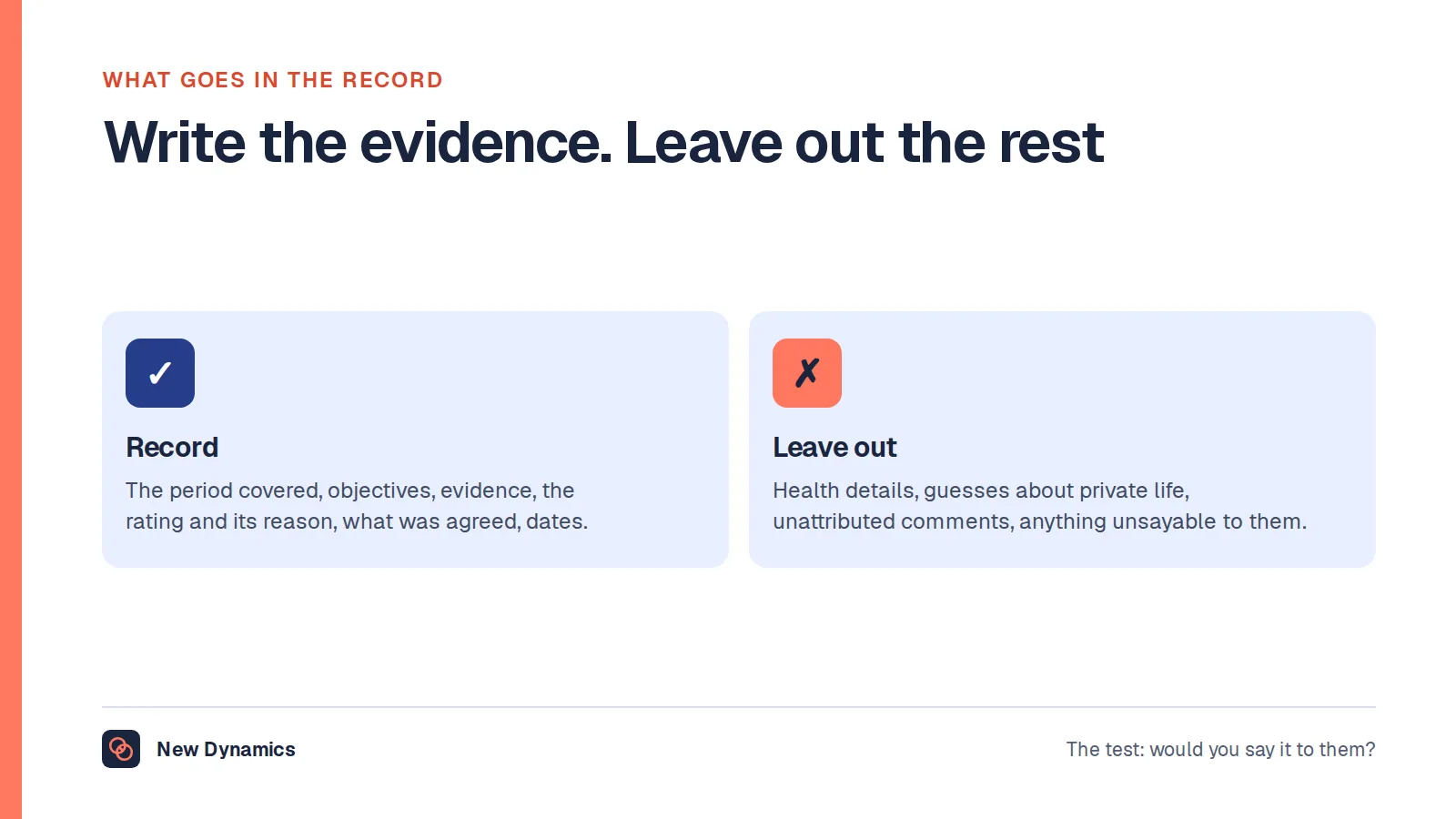
3. Writing the record. What belongs in a review and what does not. The ICO's data minimisation principle requires what you hold to be "adequate, relevant, and limited to what you need for your purposes", and its accuracy principle requires "all reasonable steps to keep any personal information you hold about your workers accurate and up-to-date". Teach managers to write facts and dates, to keep health details out, and to assume the person will read every word, because performance review record keeping gives them the right to.
4. Rating consistently, and your own bias. Recency, the halo from one visible success, the warmth gradient towards people you talk to most, and proximity bias towards those you physically see. Run this as practice: give everyone the same anonymised evidence pack and compare the ratings in the room. The gap in the room is the argument.
5. The conversation. No surprises, the employee speaks first, evidence rather than adjectives, and what to do when someone disagrees. Pair it with the record: Acas says "it's important to keep a written record of what is discussed" and that it should be shared with the employee afterwards.
6. The cases the form does not cover. Part-year employees, people on leave, long absences, leavers, and inheriting someone else's team. Every organisation has these every cycle and almost no training mentions them. Our posts on reviewing an employee who changed manager and reviewing part-time, shift and seasonal staff cover the material.
What to cut

Cut the history of performance management. Cut personality models and type indicators. Cut generic feedback frameworks with acronyms, unless you are going to use that acronym on your actual form. Cut the section where somebody reads the policy aloud.
The test is simple: if a slide does not change what a manager types into your form or says in your meeting, it is content rather than training.
Run it as practice, not as a presentation
Two sessions of ninety minutes beat one day, because the gap between them is where people try things.
- Everyone brings a real draft, anonymised if the group is mixed.
- Write a review in the room, against a shared evidence pack, then compare.
- Run a calibration dry run. Each manager defends two ratings in three sentences. Most of the learning happens here.
- Practise the hard five minutes, not the easy thirty: the disagreement, the person who cries, the one who says "so this means no pay rise then".
- Finish with their own list, three things each manager will do differently, written down and sent to themselves.
When to run it
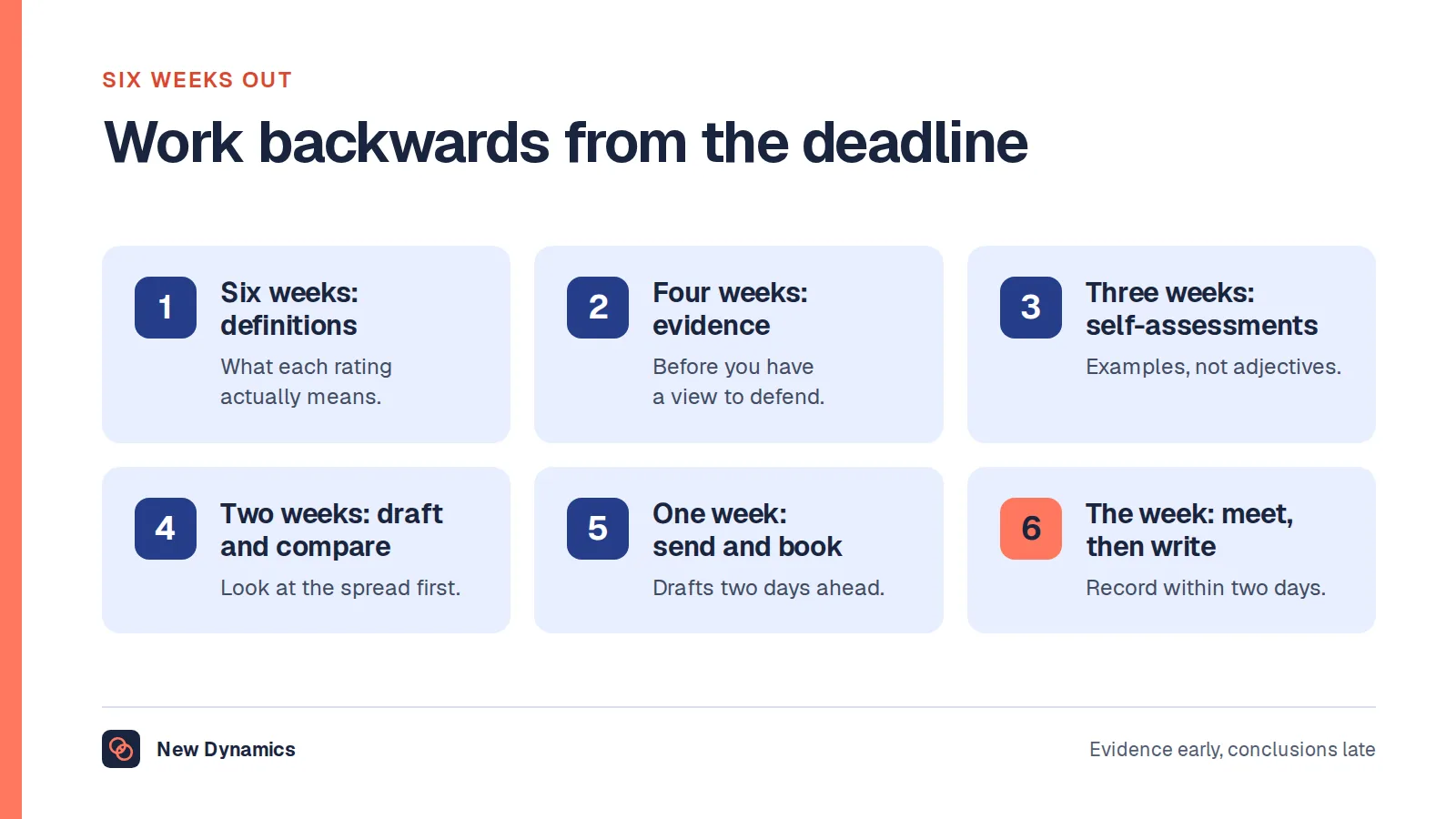
- Six weeks before the cycle: modules one to three, while there is still time to gather evidence that does not yet exist.
- Two weeks before: modules four to six, plus the calibration dry run, when drafts exist and the questions are real.
- Mid-cycle: a short session for managers who joined since, rather than making them wait a year.
- After the cycle: thirty minutes with the data from the measures below, which is the only part that improves next year's training.
Five measures that are not a feedback form

A satisfaction score at the end of a session measures the session. These measure the cycle.
- Rating spread by manager. Compare distributions before and after. Convergence is not the goal, but a manager using one point of a five-point scale is a finding.
- Evidence density. Sample ten completed reviews and count the specific, verifiable examples. Two per review is a reasonable floor.
- Lateness. How many reviews landed after the deadline, and how many needed chasing.
- The surprise rate. In a sample, how often does a concern appear at the review that appears nowhere earlier in the record? Each one is a failure of the eleven months before the meeting.
- Appeals and complaints about ratings. Both the formal ones and the quiet escalations to HR.
Add one employee question to whatever survey you already run: "my last review reflected what I actually did". It is worth more than the manager's own opinion of the training.
Who needs which part
New managers need all six modules and the practice, as our post on a first performance review as a new manager sets out. Experienced managers usually need four to six refreshed, plus anything that changed in the form. HR needs the calibration facilitation, which is a separate skill from writing reviews, and the people designing the form should sit in on module one to hear what managers think it means.
If you only have one hour
Twenty minutes on the scale, with written definitions and two worked examples. Twenty-five minutes writing a review from a shared evidence pack and comparing the ratings. Fifteen minutes on the hard five minutes of the conversation. No slides about why feedback matters.
Frequently asked questions
What should performance review training for managers cover?
Six things: what the review is for in your organisation and what each rating means, how to gather evidence through the year, how to write the record, how to rate consistently and recognise your own bias, how to hold the conversation including disagreement, and how to handle part-year, absence, leaver and inherited-team cases. Everything should touch your own form.
How long should manager review training be?
Two sessions of about ninety minutes, spaced a few weeks apart so people can try things in between, works better than a single day. If you only have an hour, spend it on the rating scale, writing a review from a shared evidence pack and the difficult part of the conversation.
When should you train managers on performance reviews?
Start about six weeks before the cycle, while there is still time to collect evidence, and run the second session two weeks out when drafts exist. Train new managers when they arrive rather than making them wait for the annual session.
How do you measure whether review training worked?
Use documents rather than feedback forms: the spread of ratings by manager, the amount of specific evidence in a sample of completed reviews, how many reviews were late, how often a concern appears for the first time at the review, and the number of appeals. Add one employee survey question asking whether the review reflected what they actually did.
Is manager training a legal requirement for performance reviews?
There is no specific training requirement for reviews to point to, but training is part of how employers show they took reasonable steps. Acas explains that an employer can be held responsible for discrimination by a worker unless they took all reasonable steps to prevent it, and its example of such steps includes training staff on equality and discrimination. This is general information, not legal advice.
What is the most common gap in performance review training?
The rating scale. Most organisations distribute a scale with labels and no definitions, then wonder why managers use it differently. Writing two worked examples of the difference between adjacent ratings, and having managers apply them to the same evidence pack, removes more inconsistency than any other hour you can spend.
Your next step: find the gap before you design the course
- Pull last cycle's rating distribution by manager. The shape tells you which module to lead with.
- Sample ten reviews and count the specific examples in each. If the average is below two, start with evidence.
- Ask three managers to define the middle rating without looking. If the answers differ, start with the scale.
- Book the two sessions in the calendar before the cycle dates are published, not after.
For the cycle this training supports, read and download our performance review guide. The guide is free to read, and the PDF uses our short download form.
Want a review process where the evidence is already there when training ends? Book a New Dynamics demo and bring your current form and rating scale. You can also email contact@new-dynamics.com.