TL;DR
- A coordinator is someone whose job is to make different groups work together in an organised way to achieve something. A project coordinator does that for a project: keeping the schedule, the actions, the documents, the meetings and the reporting in step so that the project manager can manage and the team can deliver.
- The job has eight responsibilities: maintain the plan and schedule, track actions and risks, organise meetings and record decisions, control documents, monitor progress and report, coordinate people and suppliers, handle budgets and orders, and support the project manager. A construction project coordinator adds site paperwork, deliveries, permits and subcontractor scheduling.
- It differs from a project manager in accountability: the coordinator runs the machinery of the project; the manager owns its outcome. Write the description around the projects, the tools and the reporting line.
Every project has two kinds of work: the work itself, and the work of keeping the work organised. The second kind is easy to underestimate until nobody is doing it, at which point the schedule drifts, the actions from last week's meeting are forgotten and three versions of the drawing are in circulation. The project coordinator is the person who does the second kind of work on purpose.
This article gives a project coordinator job description: what the role does, eight job responsibilities of a project coordinator, the skills, the difference from a project manager, a construction project coordinator variant, the routes in, and a template to adapt. The apprenticeship routes are for England; the role itself is universal.
Coordinators live by the plan. See how New Dynamics Goals & OKRs keep targets and progress in one place.
What is a project coordinator?
The Cambridge Dictionary defines a coordinator as “someone whose job is to make different groups work together in an organized way to achieve something”, and its first example is a coordinator appointed to oversee a project.
A project coordinator does that for one project or a small portfolio of them. Skills England's associate project manager apprenticeship, a level 4 standard of 18 months, summarises the occupation it leads to as “Managing project work and teams for businesses and other organisations.”; its project controls technician standard, at level 3, is about “Analysing progress and performance data on engineering, manufacturing, construction and infrastructure projects.” The project coordinator sits between those two: less analytical than a controls technician, less accountable than a manager, and in contact with everyone.
Titles vary. Project administrator, project support officer, project assistant and PMO coordinator overlap heavily. Whatever the title, the test is the same: does this person keep the plan, the actions and the documents current, and does everyone on the project rely on them for it?
Job responsibilities of a project coordinator
- Maintain the plan and schedule. Keep the project plan up to date, chase dates, flag slippage and update milestones.
- Track actions, issues and risks. Keep the logs, chase owners before the deadline, and escalate what is stuck.
- Organise meetings and record decisions. Agendas, invitations, rooms and links; minutes, decisions and actions circulated the same day.
- Control documents. One current version of every plan, drawing, specification and report, filed where the team can find it.
- Monitor progress and report. Collect status from workstreams, prepare the status report and the dashboard, and keep the numbers honest.
- Coordinate people and suppliers. Onboard new team members, keep contact lists, chase suppliers for deliverables and dates.
- Handle budgets and orders. Raise purchase orders, track invoices against the budget and flag variances.
- Support the project manager. Prepare papers for governance meetings, draft communications and cover for the manager on routine matters.

Project coordinator vs project manager
The difference is accountability, not seniority alone.
| Aspect | Project coordinator | Project manager |
|---|---|---|
| Owns | The machinery: plan, logs, documents, meetings | The outcome: scope, cost, time, quality, benefits |
| Decides | How the routine is run | What the project does when things change |
| Reports to | Project manager or PMO lead | Sponsor or steering group |
| Talks to | Everyone, daily | Sponsor, stakeholders, team leads |
| Typical route | Administration, level 3 or 4 apprenticeship, degree | Coordinator or specialist, then level 4 or 6 |
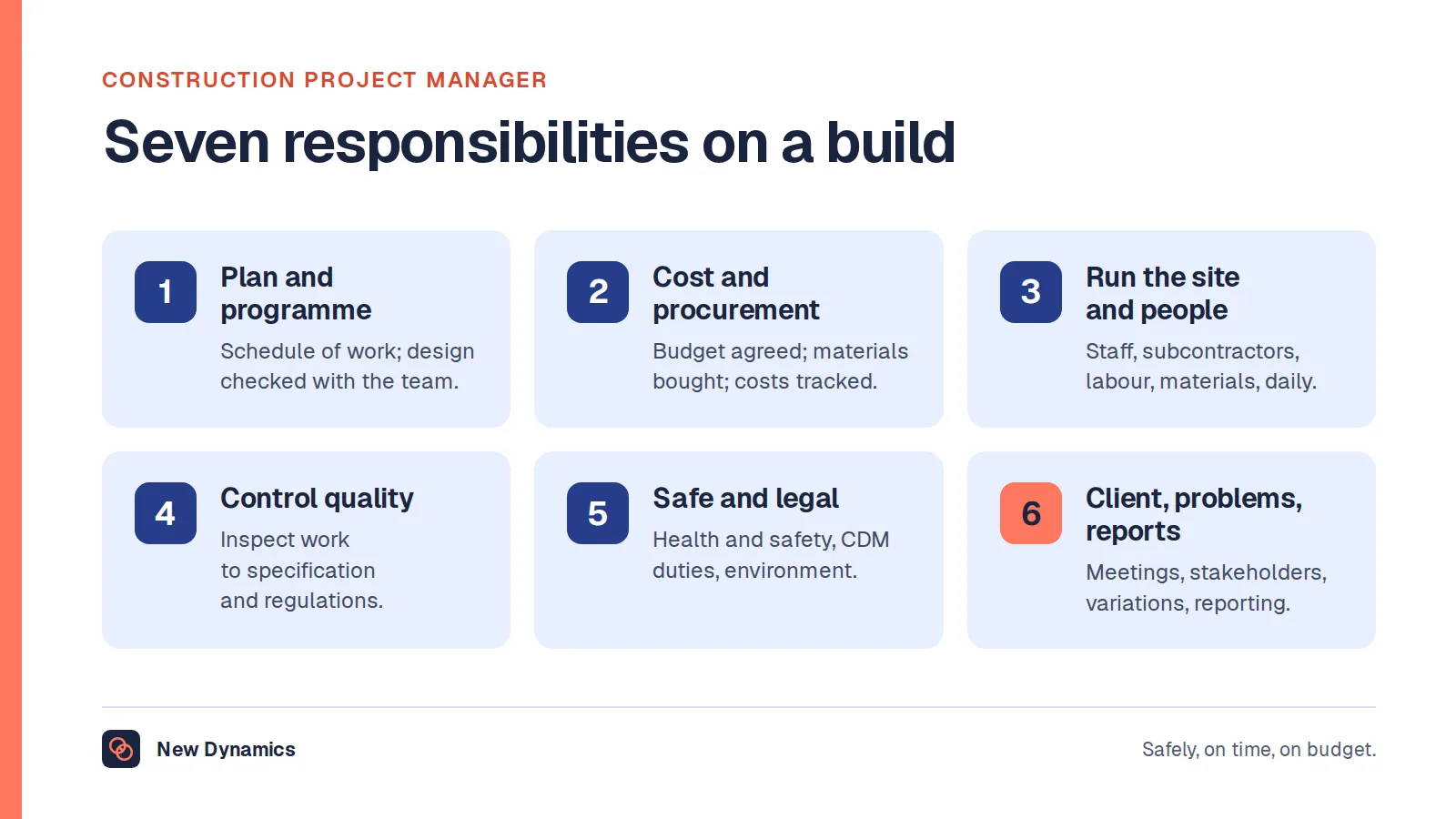
A coordinator who is doing the manager's job without the title, or a manager who is only doing coordination, is a sign that the roles need redrawing. Our construction project manager job description shows the manager's side in one sector.
Construction project coordinator
In construction the coordinator's work has a site and a legal framework around it. Alongside the eight responsibilities above, a construction project coordinator or construction coordinator typically:
- Keeps the site paperwork. Permits to work, inductions, method statements and risk assessments filed and current, and the health and safety file maintained for the principal contractor.
- Schedules subcontractors and deliveries. Trades on site in the right order, materials arriving when there is somewhere to put them.
- Tracks drawings and changes. Current revisions issued to the people building from them; requests for information logged and answered.
- Prepares site reports and meeting records for the site manager, the construction manager and the client.
- Coordinates inspections and handover documentation.
The National Careers Service profile for a construction site supervisor, a neighbouring role, lists tasks a coordinator often shares: managing orders and deliveries of construction materials, organising staff work schedules, monitoring progress and completing site reports for construction managers. Skills England's construction support technician standard, at level 3, describes an occupation “Working in an office or on a construction site.”, which is where most construction coordinators start.
Say in the description whether the coordinator is site-based or office-based, which projects and which contractor or client side they work for, and whether they need a CSCS card, a driving licence or site induction before day one.

Skills to ask for
- Organisation. The core skill: many moving parts, none dropped.
- Written communication. Minutes, reports and emails that are short, accurate and sent on time.
- Chasing without friction. Coordinators spend the day asking busy people for things; the good ones are persistent and pleasant.
- Attention to detail. Dates, versions, numbers.
- Tool fluency. Scheduling software, spreadsheets, document management and whichever collaboration tools the project uses.
- Numeracy. Budget tracking and simple analysis.
- Judgement about escalation. Knowing which slippage is normal and which needs the manager now.
- Sector knowledge. Construction, IT, events and healthcare each have their own vocabulary and rules.
Routes in and qualifications
Most coordinators arrive from administration, from a junior role in the sector, or from a project apprenticeship. In England the relevant standards are the associate project manager at level 4, the project controls technician at level 3 and, in construction, the construction support technician at level 3. Professional bodies offer foundation-level project management qualifications, and a degree is useful but rarely required. For the job description: ask for evidence of having run the machinery of a project, at whatever scale, rather than a specific certificate.
A project coordinator job description template
Job title: Project Coordinator (add the sector or programme)
Reports to: Project Manager or PMO Lead
Purpose: Keep the project's plan, actions, documents, meetings and reporting current and accurate so that the project manager can manage and the team can deliver.
Responsibilities:
- Maintain the project plan and schedule; chase dates and flag slippage.
- Keep the action, issue, risk and decision logs and chase owners.
- Organise project meetings and circulate minutes, decisions and actions the same day.
- Control project documents and versions.
- Collect status, prepare reports and dashboards, and maintain the project's data.
- Coordinate team members, suppliers and stakeholders; maintain contact lists and onboarding.
- Raise purchase orders, track invoices and report budget variances.
- Prepare governance papers and support the project manager.
- (Construction) Maintain site paperwork, schedule subcontractors and deliveries, control drawing revisions and prepare site reports.
Skills and experience:
- Experience coordinating projects or complex administration.
- Strong organisation, written communication and attention to detail.
- Confident with scheduling, spreadsheet and document tools (name yours).
- Foundation project management qualification or apprenticeship: desirable.
- (Construction) CSCS card, driving licence and site experience: state which are required.
Working pattern: Hours, location, site or office, travel between sites.
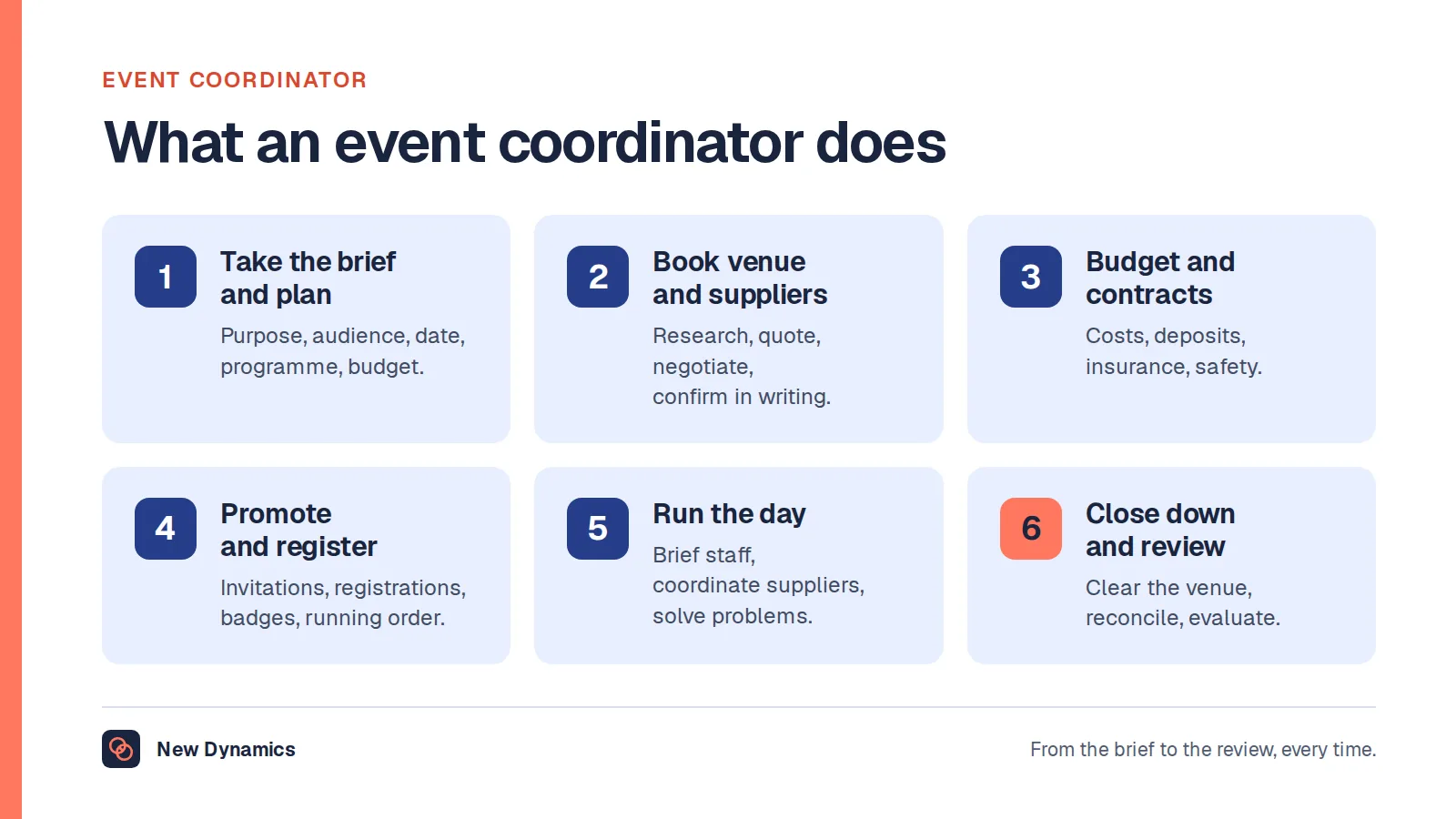
Our job description template explains each section. For a coordinator role built around a single date rather than a plan, see our event coordinator job description.

Frequently asked questions
What does a project coordinator do?
A project coordinator keeps a project organised: maintaining the plan and schedule, tracking actions, risks and issues, organising meetings and recording decisions, controlling documents, collecting status and preparing reports, coordinating people and suppliers, handling purchase orders and budget tracking, and supporting the project manager.
What are the job responsibilities of a project coordinator?
Eight areas: plan and schedule, actions and risks, meetings and decisions, document control, progress and reporting, people and suppliers, budgets and orders, and support to the project manager. In construction, add site paperwork, subcontractor and delivery scheduling, drawing revisions and site reports.
What is the difference between a project coordinator and a project manager?
The project manager is accountable for the outcome: scope, cost, time and quality. The project coordinator runs the machinery that makes the project manageable: the plan, the logs, the documents, the meetings and the reports. The coordinator usually reports to the manager.
What does a construction project coordinator do?
The same coordination work applied to a building project: site paperwork such as permits, inductions and risk assessments; scheduling subcontractors and deliveries; controlling drawing revisions and requests for information; preparing site reports; and coordinating inspections and handover documents. The role may be site-based or office-based.
What skills does a project coordinator need?
Organisation, clear written communication, the ability to chase people persistently and pleasantly, attention to detail, fluency with scheduling and document tools, numeracy for budget tracking, judgement about what to escalate, and knowledge of the sector's vocabulary and rules.
What qualifications does a project coordinator need?
Usually none specific. Experience in administration or a junior sector role, or an apprenticeship such as the associate project manager at level 4 or the project controls technician at level 3, is typical. Foundation project management qualifications help. In construction, a CSCS card and site experience are often required.
Your next step: describe the machinery
- List the projects the coordinator will support and who manages them.
- Name the tools: scheduling, document control, reporting.
- Decide what the coordinator decides and what goes to the manager.
- For construction, state site or office, and the cards and licences needed.
For the first weeks, when a coordinator learns the project's people and paperwork, read and download our employee onboarding guide. The guide is free to read, and the PDF uses our short download form.
Want project goals, check-ins and progress visible in one place for coordinators and managers alike? Book a New Dynamics demo and bring your current job descriptions. You can also email contact@new-dynamics.com.