TL;DR
- Most weak quality assurance interviews are weak before they start, because nobody decided whether the role is assurance or control, at which level, in which sector. Settle that first and the questions write themselves.
- These thirty questions cover seven groups: the role and the standard, procedures and documentation, audit and non-conformance, data and reporting, supplier and customer quality, influence when people do not want to hear it, and improvement. Each comes with what a good answer sounds like.
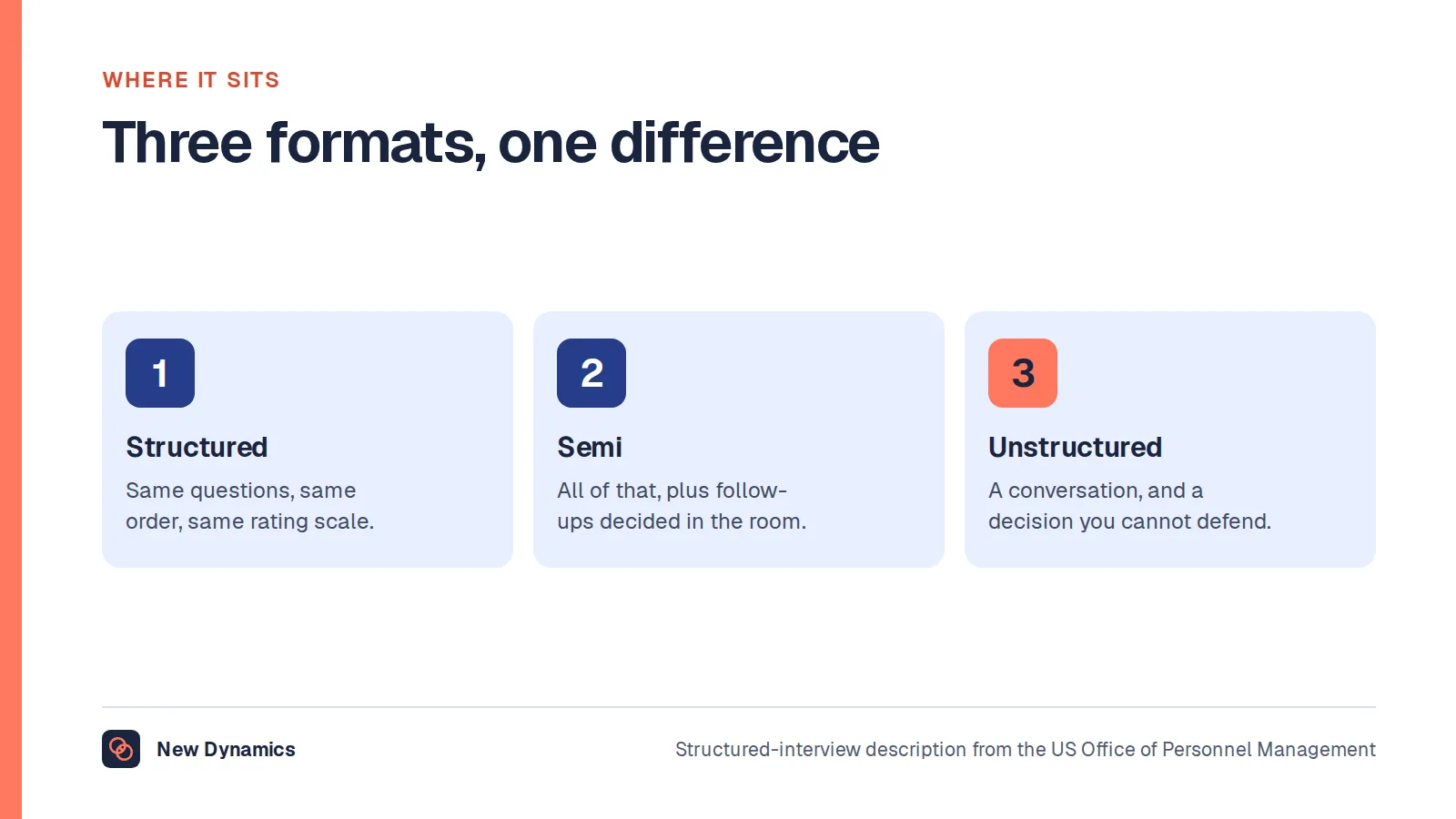
- Score them the same way for everyone. The US Office of Personnel Management describes a structured interview as one where “all candidates are asked the same predetermined questions in the same order” and “all responses are evaluated using the same rating scale and standards for acceptable answers”.
The awkward part of a quality assurance interview is that everyone can describe good quality, and almost nobody can describe what they personally did when quality was inconvenient. The questions below are built to find the difference.
This article gives thirty quality assurance interview questions in seven groups, what a good answer sounds like for each, two work-sample tasks, the questions to leave out, and a scoring method.
Quality runs on procedures, records and sign-offs, and a fair interview runs the same way. See how New Dynamics workflows let you define your own stages, forms and approvals, with a completion view instead of a spreadsheet.
If the role itself is not written down yet, start with our quality assurance job description and come back here.
Decide what you are hiring first

Three decisions, before anyone writes a question:
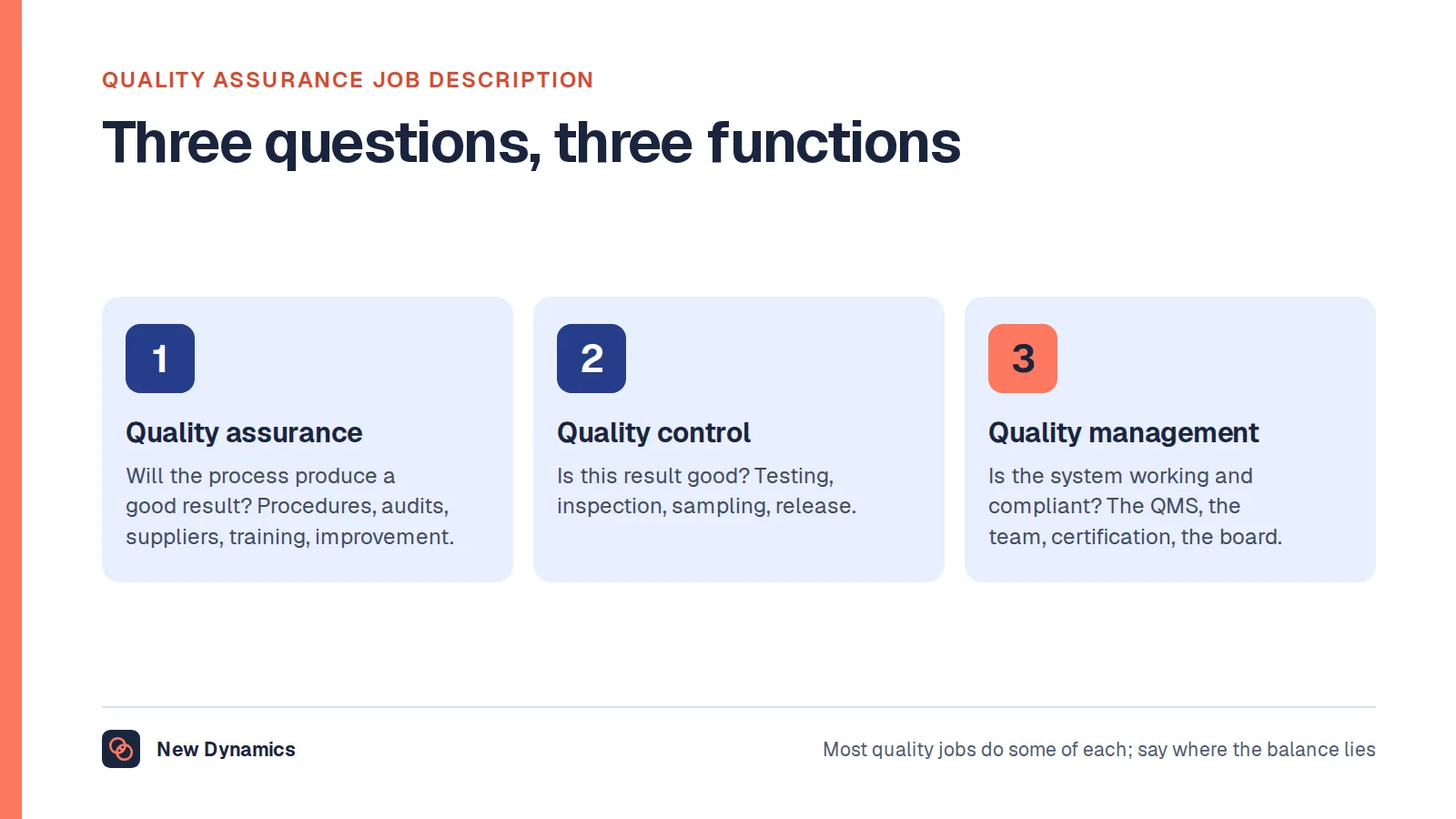
- Assurance or control. Assurance designs and runs the procedures, audits and improvement that prevent defects. Control tests and inspects to find them. Most roles do some of both, and the interview should be weighted to match.
- The level. At analyst level the work is testing and documentation: O*NET's Quality Control Analysts conduct "routine and non-routine analyses of in-process materials, raw materials, environmental samples, finished goods, or stability samples" and interpret "test results, compare them to established specifications and control limits". At manager level it is the system: Prospects describes the quality manager role as "concerned with monitoring and advising on the performance of the quality management system, producing data and reporting on performance, measuring against set standards".
- The sector and its standards. Food, pharmaceutical, aerospace, automotive, construction and software quality share vocabulary and little else. Ask about the standards the candidate has actually worked to, not the ones they can name.
The role and the standard: five questions

- "What is the difference between quality assurance and quality control, in the job you did last?" A good answer is specific to their own work rather than a textbook definition, and admits where the two overlapped.
- "What was the quality standard in your last role, and who set it?" Listen for whether the standard came from a customer, a regulator, a management system or an internal decision, and whether they know.
- "What does 'fit for purpose' mean for the product you worked on?" Prospects puts the quality manager's aim as making sure products or services are "fit for purpose, legally compliant and meet customer expectation". A strong candidate can say what each of those three meant concretely for them.
- "Which parts of your quality system worked well, and which were theatre?" Everyone has been inside a process that existed to satisfy an auditor. Honesty here predicts honesty later.
- "What would you want to look at in your first two weeks here?" Good answers ask for the non-conformance log, the complaints, the last audit report and the procedures, not the org chart.
Procedures and documentation: five questions
- "Take me through a procedure you wrote. Who was it for, and did they follow it?" The second half of that question does the work.
- "How do you write a procedure people actually use?" Listen for involving the people who do the work, short steps, and a version people can find.
- "What did you do when you found the documented process and the real process had drifted apart?" The wrong answer is retraining everyone. The right one starts with finding out why the workaround exists.
- "How do you manage document control and revisions?" For any regulated sector this is a competence question, not an administrative one: who approves, how changes are communicated and how superseded versions are withdrawn.
- "Describe a record you keep that nobody reads. Why keep it?" Good candidates can defend a record on its purpose or admit it should go.
Audit and non-conformance: five questions
- "Walk me through an audit you ran, from planning to closing the findings." Listen for evidence-gathering, sampling, and what happened after the report.
- "Tell me about a non-conformance you raised that was unpopular." The most useful answer in the whole interview. Look for how they handled the disagreement rather than whether they were proved right.
- "How do you get to the cause rather than the symptom?" Any method is fine if they can describe using it. Naming five whys or fishbone without an example is not an answer.
- "What do you do when the corrective action is agreed and then nothing happens?" Escalation, due dates, and how they keep a list that matters.
- "Tell me about a time an audit finding was against your own work." Rare and revealing.
Data and reporting: four questions
- "What did you measure, and who read it?" Prospects lists monitoring performance "by gathering relevant data and produce statistical reports" among the core responsibilities. A report nobody reads is a process problem.
- "Show me how you would present a rising defect rate to a production manager who disputes it." Assesses both the numbers and the conversation.
- "What is the difference between a trend and a bad week?" Listen for control limits, sample size and caution about overreacting to a single point.
- "What did you stop measuring, and why?" Almost nobody is asked this, and the answer separates people who own a system from people who inherited one.
Supplier and customer quality: four questions
- "How did you set quality requirements with suppliers?" Prospects lists working with purchasing staff "to establish quality requirements from external suppliers" as part of the role. Listen for specifications, incoming checks and what happened on failure.
- "Tell me about a supplier problem you solved without switching supplier."
- "How did customer complaints reach you, and what did you do with them?" Good answers connect complaints to the process that caused them rather than to individual blame.
- "How do you decide whether to release a batch, a build or a delivery when something is borderline?" Look for the decision rights: what they could decide alone and who they escalated to. O*NET's analysts "make recommendations on appropriateness of data for release", which is a recommendation rather than a unilateral call.
Influence and pushback: four questions
- "When did you last stop something going out of the door?" And what it cost, and what happened afterwards.
- "How do you say no to a manager more senior than you?" Quality roles are judged on this more than on technical knowledge.
- "Tell me about a time you were overruled. What did you do next?" Look for a record made, a risk stated plainly, and no sulking.
- "How do you train people who think quality paperwork is a waste of time?" Prospects lists providing "training, tools and techniques to enable others to achieve quality standards" among the responsibilities.
Improvement: three questions
- "Tell me about an improvement you made that reduced work rather than adding it."
- "How did you know the change worked?" Assessing "the effectiveness of changes made" is part of the job, and a candidate who never checked has not finished one.
- "What is the smallest change you have made that had the biggest effect?" The answer is usually about information reaching someone earlier, and it tells you how they think.
Two work-sample tasks
Ask a candidate to do fifteen minutes of the actual job. Both of these are ours, and both are quicker to mark than they look.
- Document review. Give them a one-page procedure with four deliberate problems, an undefined term, a step with no owner, a check with no acceptance criterion, and a revision date that does not match the header. Ask what they would change and why. You are testing attention and judgement about what matters, not whether they find all four.
- Non-conformance write-up. Describe a short scenario aloud: a batch, build or delivery that failed a check late on a Friday. Ask them to write the non-conformance in ten lines: what happened, the immediate action, the containment, the proposed investigation and who needs to know.
Score both against the same criteria for every candidate, and tell people the task is coming.
The questions to leave out
- Health, disability, pregnancy or caring responsibilities. Ask about the job's requirements instead, and offer adjustments for the interview.
- "Are you a perfectionist?" It rewards a rehearsed answer and tells you nothing.
- Standards trivia. Asking a candidate to recite clause numbers tests memory, not competence. Ask what they did under a standard instead.
- Hypotheticals with no anchor, such as "how would you improve our quality?" before they have seen anything. Ask it at the end of a site tour or not at all.
Scoring: run it as a structured interview

The US Office of Personnel Management describes a structured interview as "an assessment method designed to measure job-related competencies of candidates by systematically inquiring about their behavior in past experiences and/or their proposed behavior in hypothetical situations", and notes that structured interviews "ensure candidates have equal opportunities to provide information and are assessed accurately and consistently". Two of its listed features are the whole method:
- "All candidates are asked the same predetermined questions in the same order."
- "All responses are evaluated using the same rating scale and standards for acceptable answers."
In practice, for a QA role:
- Pick eight questions, weighted to the decision you made at the start, plus one work-sample task.
- Write what a 1, a 3 and a 5 sounds like for each, before you meet anyone.
- Score during the interview, not afterwards from memory.
- Compare scores before discussion, so the loudest panel member does not set the anchor.
Our recruitment and selection guide covers building that scoring sheet and keeping the essential criteria genuinely essential.
What a good candidate will ask you
Treat these as a positive signal rather than an interruption: who owns the quality management system; what the last audit found; whether they can stop a release and who can overrule them; how non-conformances are closed; what the complaint rate looks like; and who reads the quality report. A candidate who asks none of these has interviewed for the title rather than the job.
Frequently asked questions
What questions should I ask in a quality assurance interview?
Cover seven areas: the role and the standard they worked to, procedures and documentation, audit and non-conformance, data and reporting, supplier and customer quality, influence when people push back, and improvement. Ask for specific past examples rather than definitions, and include a short work-sample task such as reviewing a one-page procedure containing deliberate problems.
What is the best quality assurance interview question?
"Tell me about a non-conformance you raised that was unpopular." It reveals judgement, evidence-gathering and how the candidate behaves when quality is inconvenient, which is when the role matters. Follow it with what happened afterwards, and whether the corrective action was ever closed.
How do you interview for QA when you are not a quality specialist?
Ask about the work rather than the theory: what they measured, who read it, what they stopped, who overruled them and what they did next. Use a work-sample task so somebody with the domain knowledge can mark the output, and score every candidate against the same written standards.
What is the difference between quality assurance and quality control questions?
Assurance questions are about the system: procedures, audits, document control, corrective actions and improvement. Control questions are about testing and inspection: methods, specifications and control limits, calibration, documentation of results and what happens when a result is questionable. Weight the interview towards whichever the job mostly is.
Should a quality assurance interview include a test?
A short work sample is more informative than another hypothetical. Fifteen minutes is enough: a procedure review with deliberate faults, or writing up a non-conformance from a scenario described aloud. Tell candidates in advance and mark every submission against the same criteria.
How do you score quality assurance interview answers?
Decide the questions before the first interview, ask them in the same order, and write out what a weak, adequate and strong answer sounds like for each. Score as you go rather than from memory, and have panel members record scores independently before discussing them.
Your next step: build the sheet before the first interview
- Decide whether the role is assurance, control or a stated split, and at which level.
- Pick eight questions from the groups above, weighted to that decision.
- Write the rating standards for each question, and pick one work-sample task.
- Brief the panel on scoring independently before discussion.
For the scoring sheet, the essential criteria and a fair process end to end, read and download our recruitment and selection guide. The guide is free to read, and the PDF uses our short download form.
Want interview stages, scores and sign-offs in one place rather than in four inboxes? Book a New Dynamics demo and bring your current scoring sheet. You can also email contact@new-dynamics.com.