TL;DR
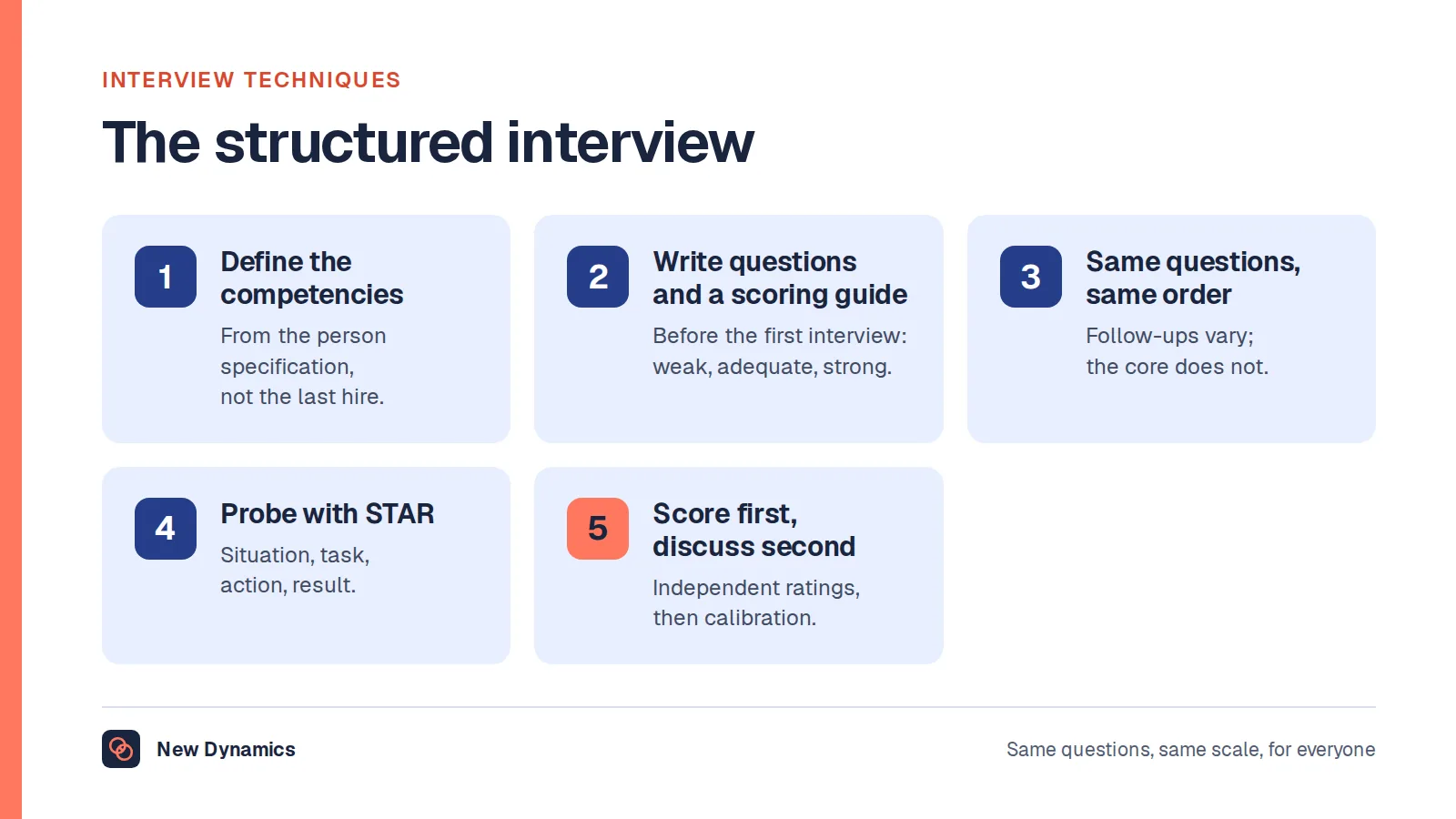
- A semi-structured interview uses the same core questions, in the same order, for every candidate, and allows the interviewer to follow up on what the person actually says. The questions and the scoring are fixed; the probes move.
- It sits between two other formats. The US Office of Personnel Management describes a structured interview as one where “all candidates are asked the same predetermined questions in the same order” and “all responses are evaluated using the same rating scale and standards for acceptable answers”. An unstructured interview has neither.
- The risk is unequal probing: following up generously with the candidate you already like. Acas advises asking each applicant the same questions where possible, so that applicants are treated in the same way, and deciding on how each one met each point in the job description and person specification.
Most real interviews are semi-structured, whether or not anyone planned it that way. Someone writes a list of questions, the conversation goes somewhere interesting, and the interviewer follows. Doing that deliberately is the difference between a useful interview and an anecdote.
This article explains what a semi-structured interview is, how it compares with the structured and unstructured formats, and gives a full worked example of an interview guide with core questions and agreed probes. It also covers the research meaning of the term, which brings a lot of people to this page.
An interview is a structured conversation, and so is everything that follows it. See how New Dynamics feedback keeps those conversations in one record rather than in someone's notebook.
The short definition
A semi-structured interview has a fixed set of core questions asked of everyone, in the same order, scored against the same standards, plus permission to ask follow-up questions based on what the candidate says.
Two things are fixed: the questions and the scoring. One thing moves: the probing.
Three formats compared

- Structured. The US Office of Personnel Management describes a structured interview as "an assessment method designed to measure job-related competencies of candidates by systematically inquiring about their behavior in past experiences and/or their proposed behavior in hypothetical situations", in which "all candidates are asked the same predetermined questions in the same order" and "all responses are evaluated using the same rating scale and standards for acceptable answers". Structured interviews, it notes, "ensure candidates have equal opportunities to provide information and are assessed accurately and consistently".
- Semi-structured. The same predetermined questions and the same rating scale, with follow-ups decided in the room.
- Unstructured. A conversation. Different questions for different people, no agreed standard for a good answer, and a decision that feels confident and is hard to defend.
Nothing about the semi-structured format requires abandoning the discipline of the structured one. It only moves the flexibility to a single place (the follow-up) and asks the interviewer to use it consciously.
A worked example: customer service adviser
Here is a complete guide for one role. The core questions are asked of everyone; the probes are used when an answer is thin, vague or interesting.
1. "Tell me about a customer who was angry with something that was not your fault."
- Probe: "What did you say first?"
- Probe: "What did you promise, and did it happen?"
- Probe: "What would you do differently?"
2. "Describe a day when you could not keep up."
- Probe: "How did you decide what to drop?"
- Probe: "Who did you tell?"
3. "Tell me about a time you did not know the answer."
- Probe: "How did you find out?"
- Probe: "What did you say to the customer while you were finding out?"
4. "When have you had to say no to a customer?"
- Probe: "How did they take it?"
- Probe: "What did you offer instead?"
5. "Tell me about feedback you received that stung."
- Probe: "What did you change?"
6. "How do you keep your notes and records straight in a busy shift?"
- Probe: "Show me what you would record after the call in question one."
7. "Tell me about a colleague you found difficult to work with."
- Probe: "What did you try?"
- Probe: "What happened next?"
8. "What do you want from this job that your last one did not give you?"
- Probe: "What would make you leave within a year?"
Eight core questions, twelve probes, one rating scale, and every candidate gets the same eight. That is a semi-structured interview.
Probes that work, and probes that do not

Good probes ask for specifics that a rehearsed answer does not contain:
- "What did you actually say?", moves the answer from summary to evidence.
- "What happened next?", finds out whether anything changed.
- "What did that cost?", time, money, a relationship.
- "Who else was involved, and what did they think?"
Probes to avoid:
- Leading ones. "So you escalated it, presumably?" hands the candidate the answer.
- Second questions in disguise. A probe should dig into the answer given, not introduce a new topic for one candidate only.
- Rescue probes. Helping a struggling candidate you like, and not helping the next one, is the single most common way a semi-structured interview becomes unfair.
Building the guide in four steps

- Take the criteria from the job description and person specification, and keep them to the essentials. Acas advises checking that decisions "are based on how each applicant met each point in the job description and person specification".
- Write one core question per criterion, and no more than eight in total for an hour.
- Write two or three probes under each, so that the follow-ups are planned rather than improvised.
- Write the rating standards (what a weak, adequate and strong answer sounds like) before you meet anyone.
Our interview techniques post covers behavioural and situational question design in more depth, and our recruitment and selection guide covers the scoring sheet.
Where it goes wrong
- Unequal probing. Twelve minutes of generous follow-up for one candidate and four for another produces two different interviews and one invalid comparison. Cap the probing time per question.
- Drift. By the fifth interview, the core questions have quietly changed. Keep the guide in front of you and tick the questions off.
- Scoring from memory. Notes and scores belong in the room, question by question.
- One interviewer. Acas says that "if possible, each interview should be carried out by more than 1 person to reduce the risk of discriminating".
- Confusing rapport with evidence. A good conversation is not a good answer, and the format is more vulnerable to this than a fully structured one.
Fairness, and what the rules require
Acas's guidance on interviewing job applicants sets the UK baseline, and it fits the semi-structured format without difficulty:
- Prepare a set of questions in advance, and remember that "questions must not discriminate".
- "When interviewing it's a good idea to ask each applicant the same questions where possible," so that applicants are treated in the same way.
- "By law you must ask anyone coming to an interview to tell you if they need reasonable adjustments so they can attend," with examples including an accessible office, extra time for a written test, or a sign language interpreter.
- If you record an interview, "you must get the person's permission first", and notes and recordings must be stored "securely and confidentially" under data protection rules.
This is general information rather than legal advice.
The other meaning: semi-structured interviews in research
The same term is standard in qualitative research, and many readers arrive here from a methods course rather than a hiring process. The idea is the same (a topic guide of planned questions, with the freedom to follow what the participant raises) but the purpose is different. A hiring interview compares candidates against criteria; a research interview seeks depth and understanding, and the interviewer's follow-ups are a deliberate instrument rather than a risk to consistency.
The UK Data Service describes qualitative data as "non-numeric information, such as in-depth interview transcripts, diaries, anthropological field notes, answers to open-ended survey questions, audio-visual recordings and images", and says the value of qualitative research "is that it gives a voice to the lived experience, offering researchers a deeper insight into a topic or individuals experiences". In that context the transcript is the data, so consent, recording, anonymisation and archiving matter as much as the questions do.
If you are designing a research interview rather than a hiring one, keep the topic guide, keep the consent process, and ignore the parts of this article about scoring.
Frequently asked questions
What is a semi-structured interview?
An interview with a fixed set of core questions asked of every candidate in the same order and scored against the same standards, plus the freedom to ask follow-up questions based on what the person says. The questions and the scoring are fixed; only the probing changes.
What is an example of a semi-structured interview question?
"Tell me about a customer who was angry with something that was not your fault", followed by planned probes such as "what did you say first?", "what did you promise, and did it happen?" and "what would you do differently?". The core question is asked of everyone; the probes are used when an answer is thin or interesting.
What is the difference between structured and semi-structured interviews?
A structured interview fixes everything: the same predetermined questions in the same order, evaluated with the same rating scale and standards for acceptable answers. A semi-structured interview keeps all of that and allows unplanned follow-up questions. An unstructured interview fixes neither the questions nor the standards.
How many questions should a semi-structured interview have?
For an hour, no more than eight core questions with two or three planned probes under each. Fewer questions asked properly, with time to follow up, beat a list of twenty that nobody can score.
Are semi-structured interviews fair?
They can be, if the core questions and the rating standards are the same for everyone and the probing is controlled. The usual failure is unequal follow-up (more generous probing for a candidate the panel already likes) so cap probing time, take notes in the room, and use more than one interviewer where possible.
What is a semi-structured interview in qualitative research?
A research interview run from a topic guide of planned questions, where the interviewer follows the participant's answers into areas the guide did not anticipate. The purpose is depth rather than comparison, and the transcript becomes the data, so consent, recording and anonymisation are part of the method.
Your next step: write the guide before the first interview
- List the essential criteria from the job description and person specification.
- Write one core question per criterion, to a maximum of eight.
- Write two or three probes under each, and agree a probing time limit.
- Write the rating standards, then score in the room rather than afterwards.
For the scoring sheet, the essential criteria and a process you can defend, read and download our recruitment and selection guide. The guide is free to read, and the PDF uses our short download form.
Want interview notes, scores and the conversations that follow a hire in one place? Book a New Dynamics demo and bring your current interview guide. You can also email contact@new-dynamics.com.