TL;DR
- Quality assurance is the work of making sure an organisation's products or services are fit for purpose, legally compliant and meet customer expectation, in Prospects' description of the quality manager's aim. QA designs and runs the procedures, standards, audits and improvement that prevent defects; quality control tests and inspects to find them. Most QA roles do some of both, and the job description should say how much.
- The responsibilities fall into seven groups: procedures and standards, customer and regulatory requirements, supplier quality, monitoring and audit, documentation and records, data and reporting, and improvement. At technician level the work is testing and inspection, as O*NET describes for quality control analysts; at specialist or engineer level it is procedures, audits and investigations; at manager level it is the quality management system, the team and compliance with standards such as ISO 9001.
- Write the job description around the level, the sector and its standards, the split between assurance and control, the systems and the numbers the role is judged on: defect and complaint rates, audit findings, right-first-time and the time taken to close corrective actions. Routes in run from science, engineering or business degrees and quality control technician roles, with the Chartered Quality Institute's qualifications marking the professional path.
Ask three companies for a quality assurance job description and you will get a lab technician who tests samples, an engineer who writes procedures and runs audits, and a manager who owns the quality management system. All three are quality assurance, at different levels, and the advert has to say which.
This article explains what quality assurance is and how it differs from quality control, sets out seven responsibilities using two primary sources, the UK graduate careers service Prospects and the US O*NET occupational database, describes the three levels and the sector variants, the skills and routes in, and gives a job description template with the numbers a QA role should be judged on.
Quality runs on procedures, sign-offs and records, and the same is true of the review cycle that judges the people who run it. See how New Dynamics workflows let you define your own stages, forms and approvals, with a completion view instead of a spreadsheet.
When the description is agreed and the role is advertised, our quality assurance interview questions cover thirty questions, what a good answer sounds like and how to score them.
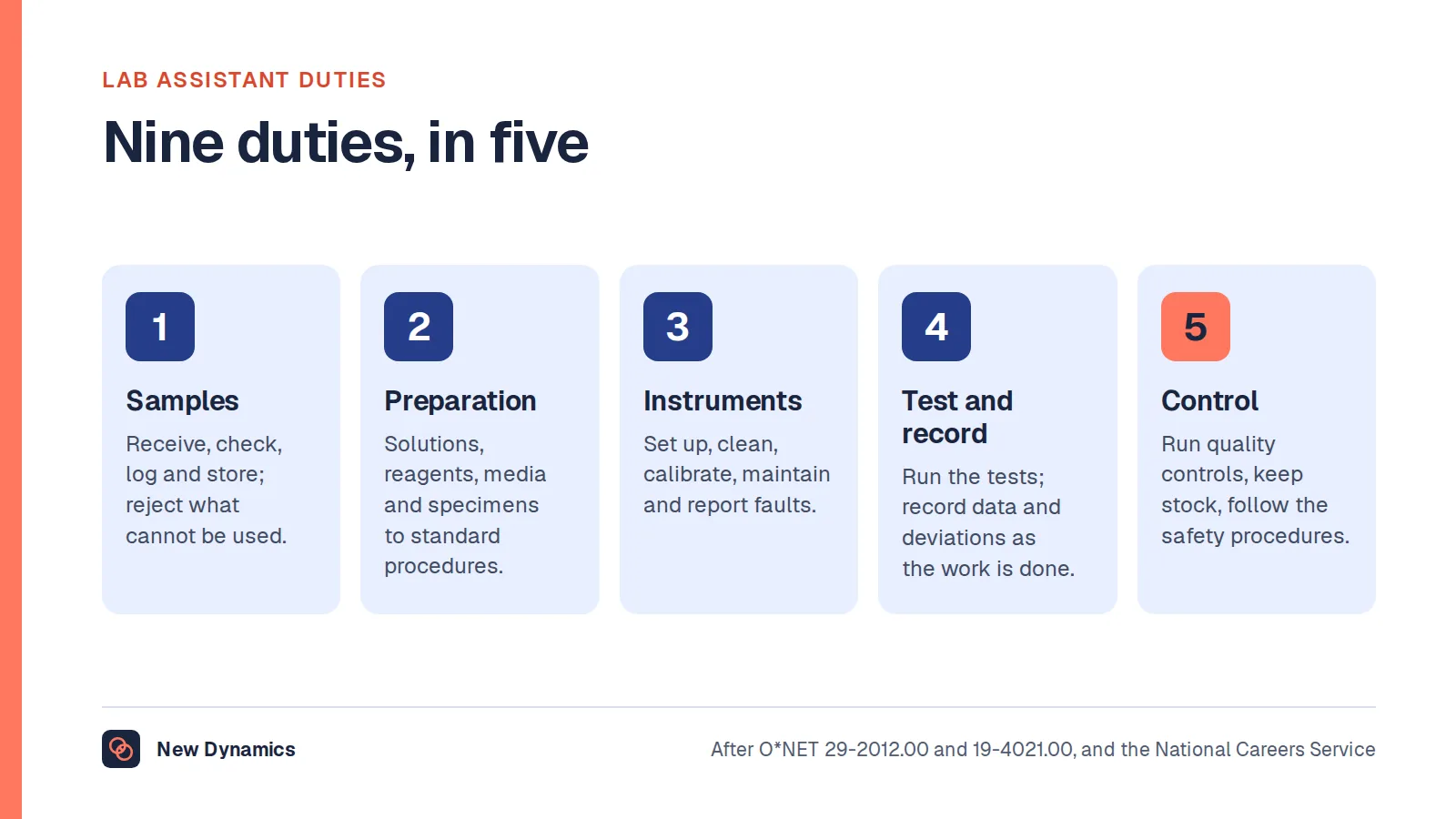
Where the testing happens in a laboratory, the records work the same way: our lab assistant job description sets out the duties and the competency ladder.
What is quality assurance?
Prospects describes the aim: quality managers “aim to ensure that the products or services an organisation provides are fit for purpose, legally compliant and meet customer expectation”. Quality assurance is the system of procedures, standards, audits and improvement that achieves that by preventing defects. Quality control is the testing and inspection that finds them. The two work together: QC results feed QA's understanding of where the process fails; QA's procedures decide what QC tests and when.
| Function | Question it answers | Typical work |
|---|---|---|
| Quality assurance | Will the process produce a good result? | Procedures, standards, audits, supplier approval, training, improvement |
| Quality control | Is this result good? | Testing, inspection, sampling, release decisions |
| Quality management | Is the whole system working and compliant? | The quality management system, the team, certification, the board report |
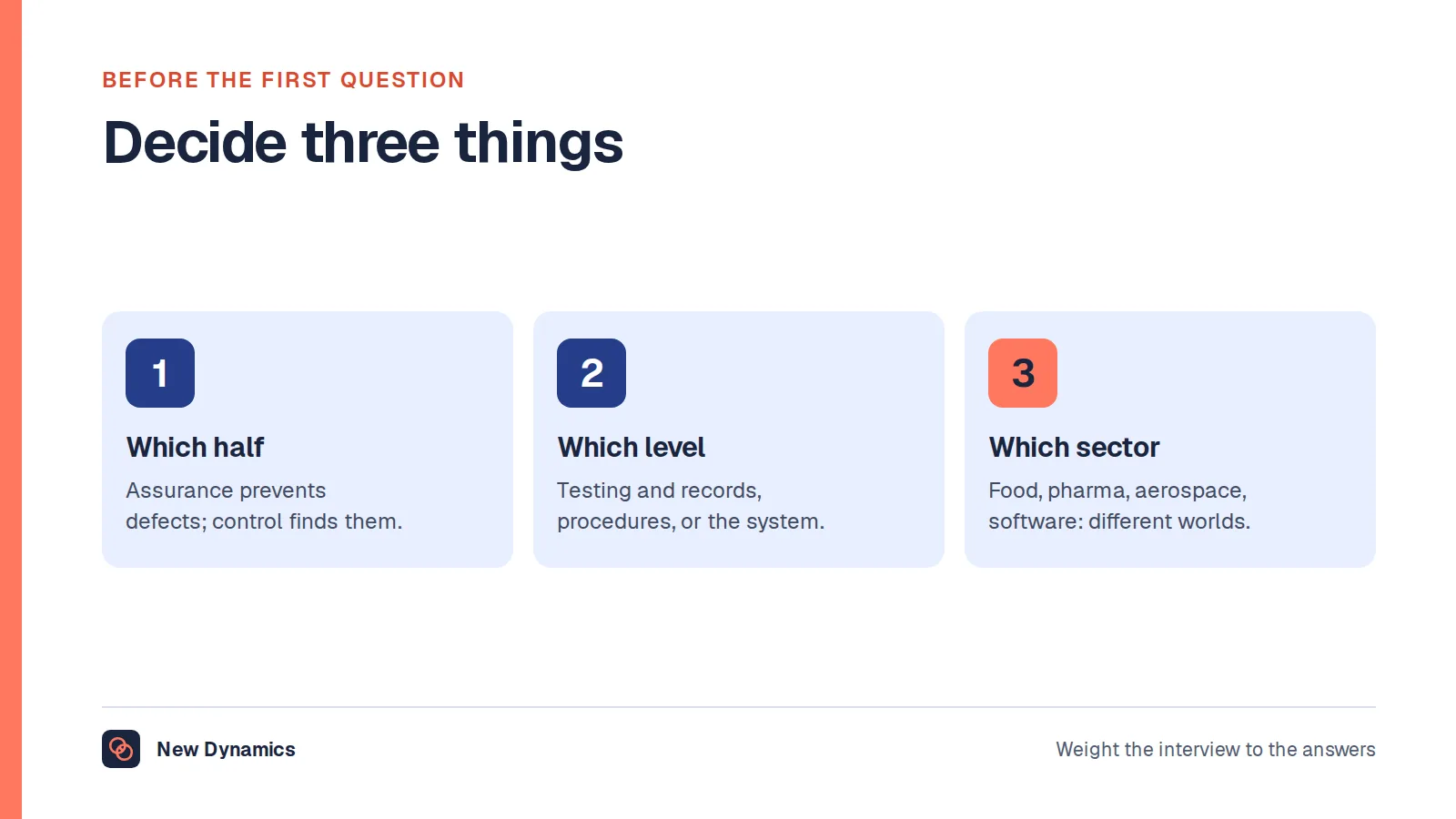
Prospects notes that the quality manager role is sometimes called quality assurance manager, and that quality control technician is the usual entry-level role. In practice most QA jobs do some control, and most QC jobs feed assurance; the job description should say where the balance lies.

Quality assurance responsibilities: seven groups
Grouped from the Prospects responsibilities and the O*NET tasks, the work has seven parts.
- Procedures and standards. Prospects: devise quality procedures and standards; maintain document controls. This is the core of assurance: writing down how the work is done so that it is done the same way every time.
- Customer and regulatory requirements. Prospects: review customer requirements and ensure they are met; ensure compliance with national and international standards, citing ISO 9001. In regulated sectors, the legal requirements sit here too.
- Supplier quality. Prospects: establish quality standards for suppliers and monitor their performance. Defects that arrive in the goods-in bay were built in somewhere else.
- Monitoring and audit. Prospects: monitor processes against standards. O*NET's quality control analysts “monitor testing procedures to ensure that all tests are performed according to established item specifications, standard test methods, or protocols” and perform inspections. Internal audits, process checks and the audit trail behind them.
- Documentation and records. O*NET: complete the documentation that supports testing, including data capture forms, equipment logbooks and inventory forms; write “technical reports or documentation, such as deviation reports, testing protocols, and trend analyses”. If it is not recorded, it did not happen.
- Data and reporting. Prospects: produce statistical reports; O*NET: compile test data, interpret results against specifications and control limits, and “investigate or report questionable test results”. Trends, complaints, defect rates and the report to management.
- Improvement. Prospects: recommend improvements, reduce waste and lead continuous improvement initiatives; O*NET: “identify quality problems and recommend solutions”. Corrective and preventive action is where QA earns its keep.
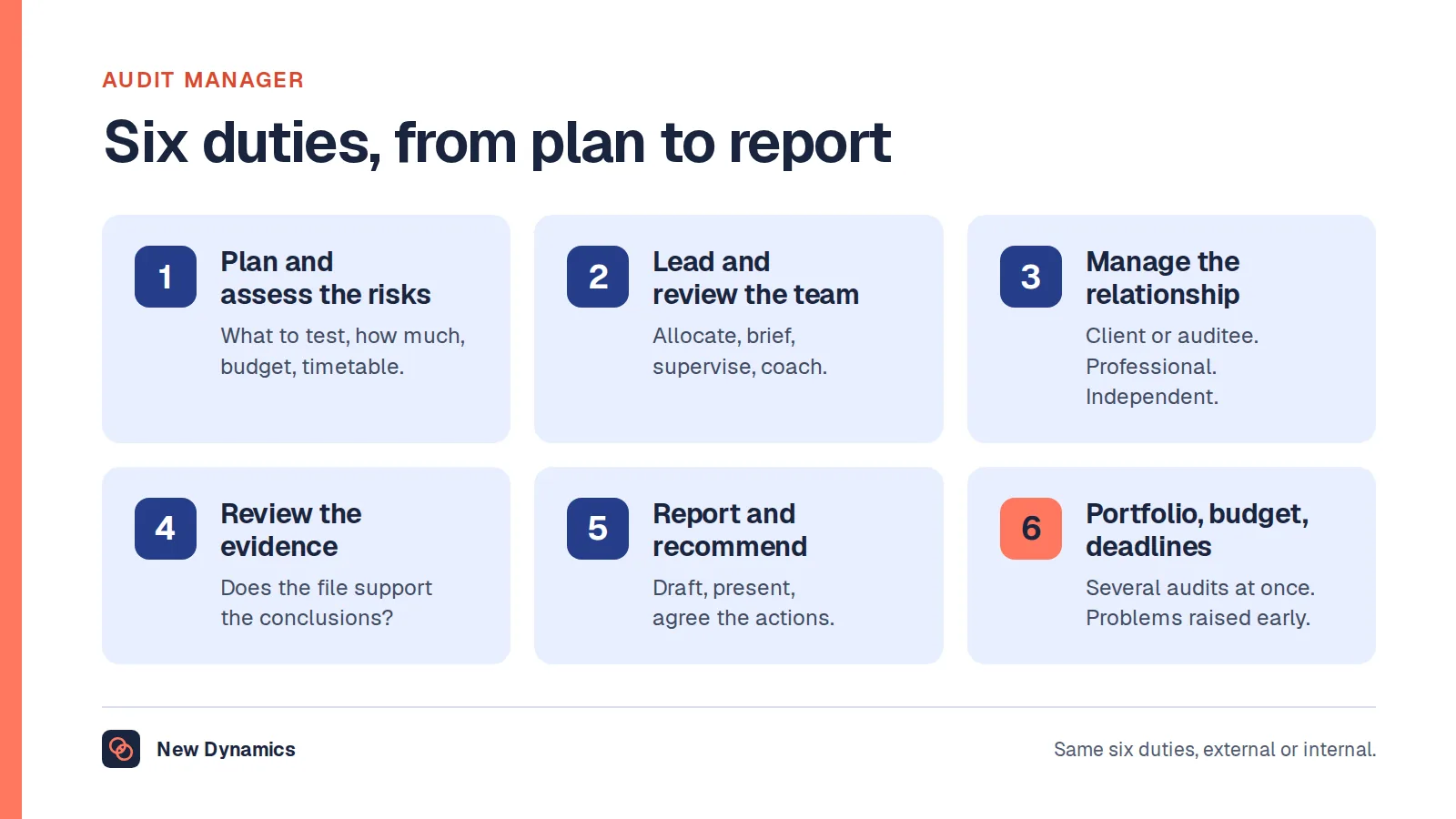
At manager level, Prospects adds managing the quality control team and liaising with staff across the organisation.

The three levels
| Level | Typical titles | What the job mostly is |
|---|---|---|
| Technician | QC technician, QA technician, QA lab tech, inspector | Testing, inspection, sampling, records; O*NET's quality control analyst |
| Specialist or engineer | QA specialist, QA engineer, quality engineer, QA auditor | Procedures, audits, investigations, supplier quality, corrective action |
| Manager | Quality manager, QA manager, head of quality | The quality management system, the team, certification, the board |
O*NET describes quality control analysts as people who “conduct tests to determine quality of raw materials, bulk intermediate and finished products”, with tasks from routine and non-routine analyses to calibrating equipment and troubleshooting, and places the occupation in Job Zone Three, where vocational training, an associate's degree or related experience is typical. Prospects describes the manager level as needing a relevant degree and experience, often via the technician route.

How the job changes by sector
- Manufacturing and engineering. Process control, measurement, supplier quality, non-conformance and corrective action; ISO 9001 and sector standards. Prospects notes early starts, late finishes and shift work in manufacturing.
- Food and drink. Food safety systems, hygiene, allergen control, traceability and audits by customers and regulators; the QA role often holds the site's food safety plan.
- Pharmaceuticals and medical devices. Good manufacturing and laboratory practice, validation, deviation reports and batch release; the most documented version of the job, and the one O*NET's task list most closely describes.
- Software. QA means testing software before release: test plans, automated and manual testing, defect tracking and release sign-off. The principles are the same, the tools and vocabulary different; say which you mean, because a software QA engineer and a food QA technician will not apply for each other's jobs.
- Services. Call quality monitoring, process audits, complaint analysis and compliance in banking, healthcare, education and the public sector, which Prospects lists among quality managers' employers.
Skills, qualifications and routes in
Skills. Prospects lists communication and interpersonal skills, analytical problem-solving, project management, persistence, team leadership, strategic thinking, the ability to facilitate change, numerical and statistical analysis, attention to detail and an understanding of the relevant engineering or science. O*NET's essential skills for analysts are monitoring, reading comprehension, active listening, critical thinking, writing, active learning, speaking and mathematics.
Qualifications. Prospects says degrees in business management, engineering, food science or the physical and mathematical sciences are preferred for manager roles, and that starting as a quality control technician and progressing is a viable route. The Chartered Quality Institute offers training and membership at introductory, practitioner and professional levels; Prospects notes that practitioner membership requires two years' experience and quality-related training. Sector standards bring their own certificates: internal auditor training, food safety qualifications, GMP training.
Progression. Prospects describes progression within the quality function to board level, or sideways into customer relations, health and safety, production and technical sales.
Quality assurance job description template
Job title: Quality Assurance Specialist (or QA Technician, QA Engineer, Quality Assurance Manager), with the sector named
Reports to: Quality Manager, Head of Quality or Operations Director
Scope: State the site or products, the standards and regulations that apply, the systems used, and whether the role is assurance, control or both.
Purpose: Make sure the organisation's products or services are fit for purpose, compliant and meet customer expectations, by maintaining the procedures, records, audits and improvements that prevent defects.
Responsibilities:
- Write, maintain and control quality procedures and standards.
- Ensure customer, legal and standards requirements are understood and met.
- Set and monitor supplier quality standards; manage non-conforming supplies.
- Carry out process monitoring, inspections and internal audits; support external audits.
- Maintain the records that support testing and release; write deviation reports and investigations.
- Compile and analyse quality data; report trends, complaints and defect rates.
- Lead corrective and preventive actions and improvement projects; reduce waste.
- Train colleagues in procedures; at manager level, lead the quality team.
Skills and experience:
- Experience in a quality role in the sector, or a relevant science, engineering or business qualification.
- Knowledge of the applicable standards; internal auditor training desirable.
- Analytical and statistical skills; attention to detail; clear technical writing.
- Communication and persistence with colleagues and suppliers.
- CQI membership or willingness to work towards it.
Working pattern: State the hours, any shifts and travel to suppliers or sites.
Targets: Defect and complaint rates, audit findings and their closure, right-first-time, corrective actions closed on time, and certification maintained.
Frequently asked questions
What does a quality assurance role do?
Maintains the procedures, standards, audits, records and improvements that prevent defects, so that products or services are fit for purpose, compliant and meet customer expectations, in Prospects' description of the aim. At technician level the work is mostly testing and inspection; at specialist level, procedures, audits and investigations; at manager level, the quality management system and the team.
What is the difference between quality assurance and quality control?
Quality assurance asks whether the process will produce a good result and designs the procedures, audits and improvements to make sure it does. Quality control asks whether a particular result is good and tests or inspects it. Most quality jobs do some of both; the job description should say how much.
What are the responsibilities of a quality assurance specialist?
Seven groups: procedures and standards, customer and regulatory requirements, supplier quality, monitoring and audit, documentation and records, data and reporting, and improvement through corrective and preventive action.
What qualifications do you need for quality assurance?
Prospects says degrees in engineering, science or business are preferred for manager roles, and that progression from quality control technician is a viable route; the US occupational database places quality control analysts in Job Zone Three, where vocational training or an associate's degree is typical. The Chartered Quality Institute offers qualifications and membership at several levels, and sector standards bring their own certificates.
Is software QA the same as quality assurance in manufacturing?
The principles are the same, preventing defects through procedures, testing and improvement, but the work and vocabulary differ: software QA means test plans, automated and manual testing, defect tracking and release sign-off. Job descriptions should say which sector they mean.
Your next step: say the level, the sector and the split
- Name the level: technician, specialist or manager.
- Name the sector and the standards and regulations that apply.
- State the split between assurance and control.
- Set targets that show what did not go wrong: defects, complaints, audit findings, actions closed.
For a way to write those targets so they can be measured, read and download our SMART goals guide. The guide is free to read, and the PDF uses our short download form.
Want quality targets, audit actions and the team's reviews in one place, with the same discipline you apply to the process? Book a New Dynamics demo and bring your current job descriptions. You can also email contact@new-dynamics.com.