TL;DR
- An audit manager plans, runs and reviews audits and leads the people who carry them out. In an audit firm the audit manager runs a portfolio of external audits of clients' financial statements. In an organisation, the internal audit manager runs the programme that checks the organisation's own risk management, governance and controls.
- The job has six duties: plan the audit and assess the risks, lead and review the audit team, manage the client or auditee relationship, review the work and the evidence, report the findings and recommendations, and manage the portfolio, budget and deadlines. Both kinds of audit manager are usually qualified accountants or internal auditors with several years' experience.
- In the UK, external audits of financial statements are conducted under the International Standards on Auditing (UK) issued by the Financial Reporting Council, and internal audit has its own professional standards and apprenticeship routes at levels 4 and 7.
Every set of company accounts that carries an auditor's opinion has been through a manager's hands. So has every internal audit report that told a board something it did not want to hear. The audit manager is the person between the partner or the head of audit and the team doing the testing: the one who plans the work, keeps it on track and decides what the evidence supports.
This article explains what an audit manager is, separates the external audit manager in a firm from the internal audit manager in an organisation, sets out six duties, summarises the UK standards the work follows, lists the skills and qualifications employers ask for and gives a job description template.
Audit work runs on plans, reviews and sign-offs, and they should be visible to the whole team. See how New Dynamics workflows let you shape forms, stages and approvals around the way you work.
What is an audit manager?
The Cambridge Dictionary defines an audit as “an official examination of the accounts of a business”, and to audit as “to make an official examination of the accounts of a business and produce a report”. An audit manager is the person who manages that examination: plans it, leads the people doing it, reviews their work and drafts the report.
The title covers two different jobs.
The external audit manager works in an accountancy or audit firm and runs a portfolio of audits of clients' financial statements. Prospects, the UK graduate careers service, lists audits among the core work of a chartered accountant, describing them as “independent checks of an organisation's financial position”. Audit manager is the grade below senior manager and director in most firms, reached after qualifying and a few years as a senior.
The internal audit manager works inside an organisation and runs its internal audit programme. Prospects describes the internal auditor's purpose as providing “an independent and objective service on monitoring business operations, ensuring an organisation's risk management, governance, and control processes are operating effectively”, and notes that internal audit looks at more than financial risk: “They also consider factors such as reputation, growth, environmental impact, treatment of employees, and ethics.”
The two jobs share the six duties below and differ in whose interests they serve. The external auditor reports to the shareholders on whether the accounts are true and fair. The internal auditor reports to the board, usually through an audit committee, on whether the organisation's controls work.

Audit manager duties: six responsibilities
- Plan the audit and assess the risks. Understand the client or the area, identify the risks of material error or control failure, decide what to test and how much, set the budget and the timetable and agree the plan with the partner or the head of audit.
- Lead and review the team. Allocate the work to seniors and juniors, brief them, supervise the fieldwork, coach them and review their working papers.
- Manage the client or auditee relationship. Be the day-to-day contact, chase information, resolve queries, handle the difficult conversations about adjustments and findings, and keep the relationship professional and independent.
- Review the work and the evidence. Check that the testing was done to the standard, that the evidence supports the conclusions and that the judgements are documented, and clear the review points before the file goes up.
- Report the findings and recommendations. Draft the audit report, the management letter or the internal audit report, present the findings to management, the audit committee or the partner, and agree the actions. Prospects lists preparing reports to highlight problems and agreeing recommendations with relevant staff among the internal auditor's tasks.
- Manage the portfolio, budget and deadlines. Run several audits at once, keep each within its budget and its statutory or committee deadline, and report progress and problems upwards early.

The standards the work follows
In the UK, audits of financial statements are conducted under the International Standards on Auditing (UK). The Financial Reporting Council's page on auditing standards explains that these standards “include objectives for the auditor, together with requirements and related application and other explanatory material”, and that the ISAs (UK) are based on the international standards issued by the International Auditing and Assurance Standards Board. An external audit manager is expected to know them and to make sure the file shows they were followed.
Internal audit follows its own professional standards, set by the profession's institutes, and in England the internal audit practitioner apprenticeship at level 4 and the internal audit professional apprenticeship at level 7, both listed by Skills England, describe the occupation, from checking an organisation's records and procedures to make sure they are accurate and reliable at level 4, to providing independent, objective assurance and consulting activity that adds value and improves the organisation's operations at level 7. This is general information about the UK, not legal or professional advice; other countries have their own auditing standards and regulators.
Skills employers ask for
- Technical knowledge. Accounting standards and auditing standards for the external manager; risk, control and governance frameworks for the internal manager.
- Judgement. Deciding what is material, what the evidence supports and what to escalate.
- Independence and honesty. Reporting what was found, to people who may not want to hear it, without softening it.
- Planning and project management. Several audits, teams, budgets and deadlines at once.
- Review and coaching. Improving the team's work without redoing it.
- Communication. Reports that a board can act on and conversations that keep a client cooperative while staying independent.
- Analysis and data. Prospects lists analytical skills and technical expertise in audit testing, and data tools are now part of both kinds of audit.
Qualifications
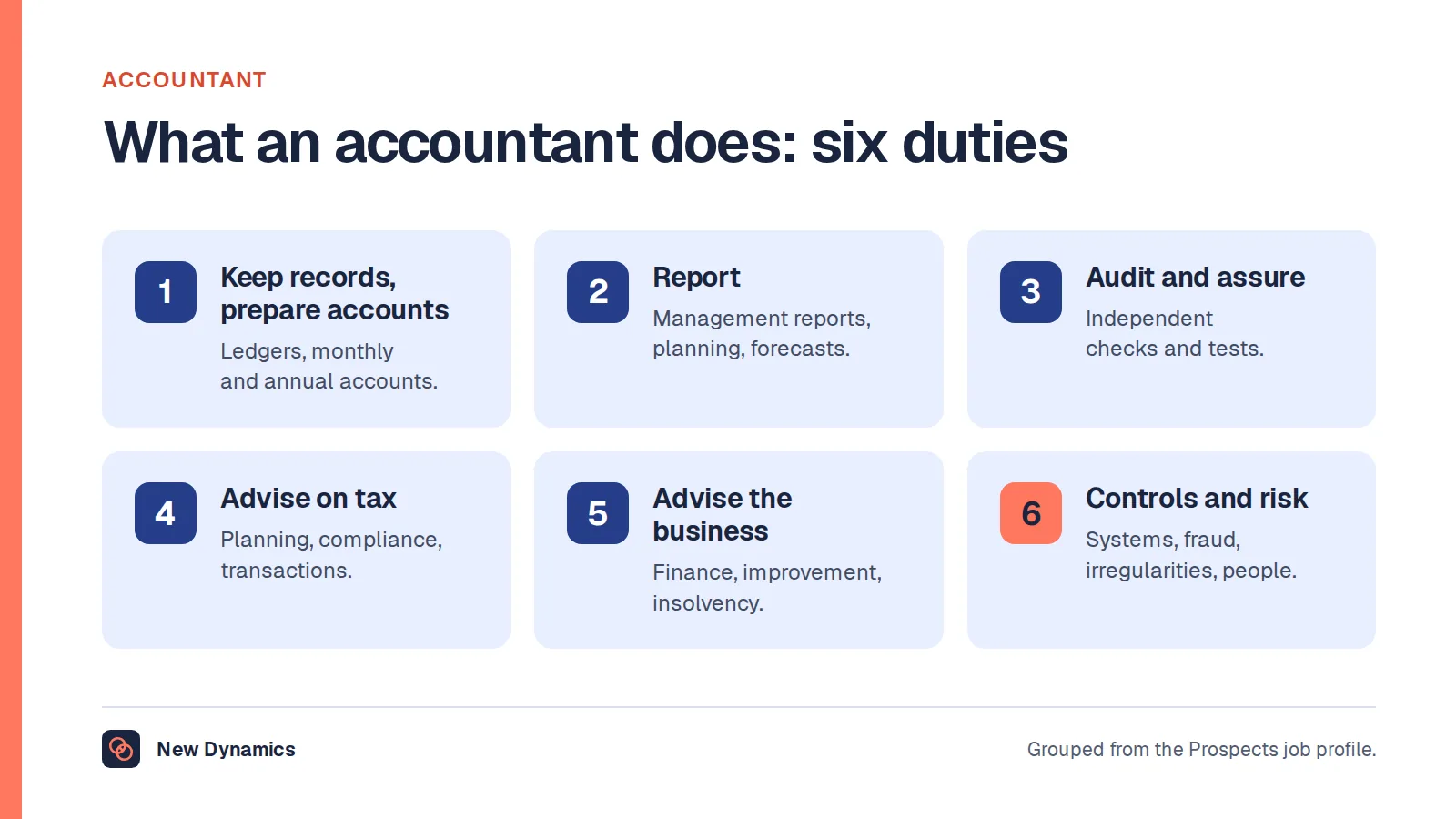
External audit managers are almost always qualified accountants, having trained in a firm and passed the professional examinations before promotion to manager. Internal audit managers are usually qualified accountants or qualified internal auditors, and in England the level 4 and level 7 internal audit apprenticeships provide a work-based route. Our accountant job description describes the professional routes in more detail.
Audit manager job description template
Adapt the version to the kind of audit and the size of the portfolio.
Job title: Audit manager (external) / Internal audit manager
Reports to: Audit partner or director / Head of internal audit
Direct reports: [Audit seniors and associates] / [Internal auditors]
Purpose of the role: To plan, manage and review [a portfolio of statutory audits] / [the annual internal audit plan], leading the audit team, managing the [client] / [auditee] relationships and delivering reports that are accurate, evidenced and on time.
Main responsibilities:
- Plan each audit, assess the risks, set the approach, budget and timetable and agree them with the [partner] / [head of audit]
- Lead, brief, supervise and coach the audit team and review their work
- Manage the [client] / [auditee] relationship, resolve queries and handle findings professionally and independently
- Review the evidence and the judgements so that every file meets [the ISAs (UK) and the firm's methodology] / [the internal audit standards]
- Draft and present the [audit report and management letter] / [internal audit reports] and agree actions
- Manage the portfolio's budgets, deadlines and progress reporting
Skills and experience:
- Qualified accountant [or qualified internal auditor] with [number] years' post-qualification audit experience
- Experience of supervising and reviewing audit teams
- Strong technical knowledge of [accounting and auditing standards] / [risk, control and governance frameworks]
- Sound judgement, independence and clear written and spoken communication
- Organised across several concurrent audits
Measures of success: Audits delivered to deadline and budget, file review outcomes, client or audit committee feedback, and the development of the team.
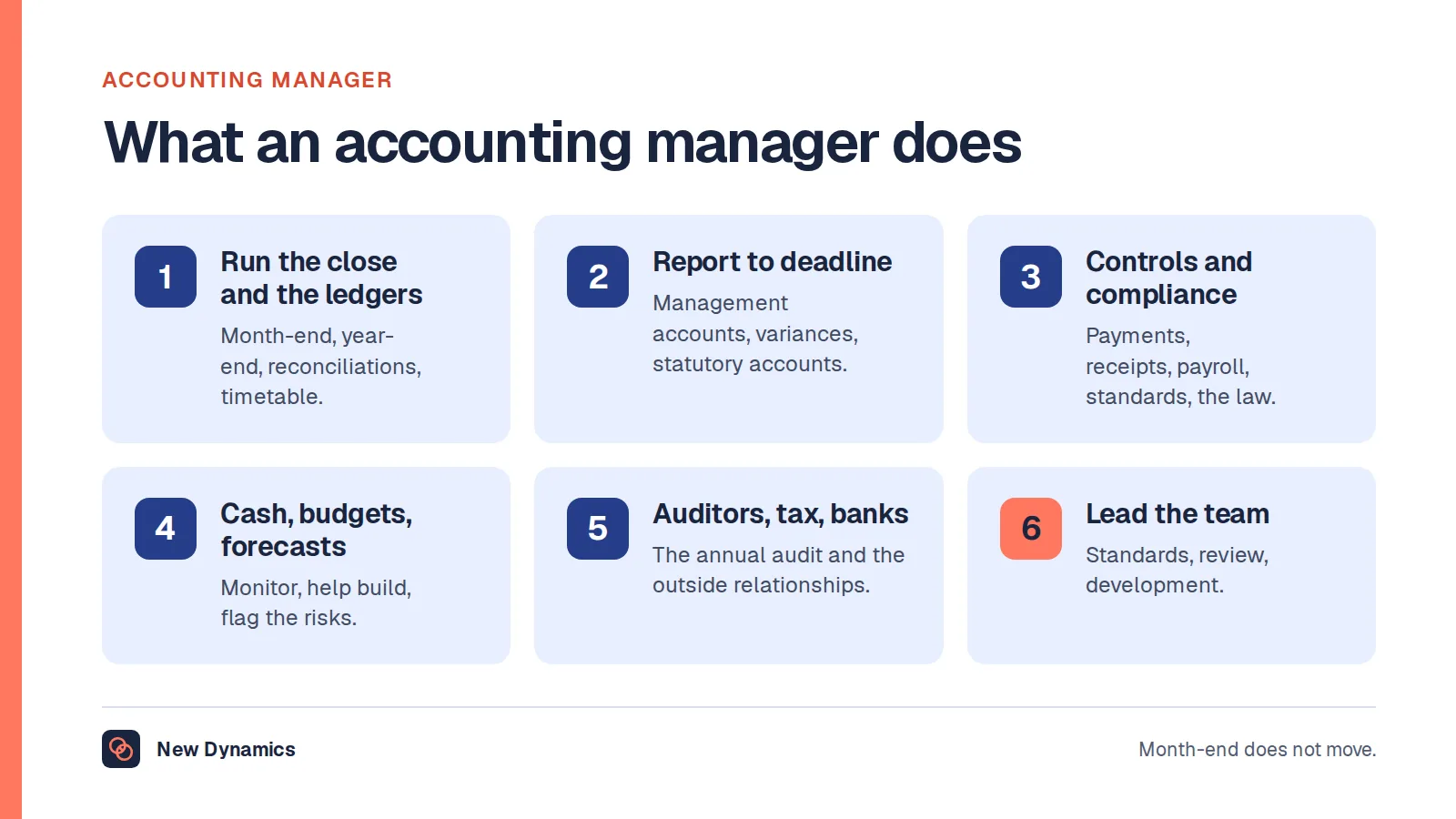
For the layout of the whole document, use our job description template. For the finance role on the other side of the audit, see our accounting manager job description.
Common mistakes in audit manager adverts
External and internal confused. They are different professions with different standards, clients and career paths. Say which.
Portfolio unstated. How many audits, of what size, in which sectors. Candidates need to know.
Technical skills only. The job leads people and delivers hard messages. Ask for both.
Independence unmentioned. The advert should say the firm or the function expects findings to be reported as found.

Frequently asked questions
What is an audit manager?
An audit manager plans, runs and reviews audits and leads the team that carries them out. In an audit firm the external audit manager runs a portfolio of audits of clients' financial statements. In an organisation, the internal audit manager runs the programme that checks the organisation's own risk management, governance and controls.
What does an audit manager do?
Plans each audit and assesses the risks, leads and reviews the audit team, manages the client or auditee relationship, reviews the evidence and judgements, drafts and presents the report and recommendations, and manages the portfolio's budgets and deadlines.
What is the difference between an external and an internal audit manager?
The external audit manager works in a firm and reports to the shareholders, through the partner, on whether a client's accounts are true and fair, under the auditing standards. The internal audit manager works inside an organisation and reports to the board, usually through an audit committee, on whether its controls, governance and risk management work, across financial and non-financial risks.
What qualifications does an audit manager need?
External audit managers are almost always qualified accountants who trained in a firm. Internal audit managers are usually qualified accountants or qualified internal auditors. In England the level 4 internal audit practitioner and level 7 internal audit professional apprenticeships offer a work-based route.
What skills does an audit manager need?
Technical knowledge of the relevant standards, judgement about materiality and evidence, independence and honesty in reporting, planning and project management across several audits, review and coaching of the team, clear communication with boards and clients, and analytical and data skills.
What should an audit manager job description include?
Whether the role is external or internal, the portfolio or plan it covers, the reporting line and team, six duties from planning to reporting, the standards the work follows, the qualification and experience required, and the measures of success.
Your next step: say which audit, and what it covers
- State whether the role is external or internal, and the standards it works to.
- Describe the portfolio or the annual plan: how many audits, what size, which sectors.
- Ask for evidence of leading a team and delivering difficult findings.
- Name the deadlines and the budget the manager will own.
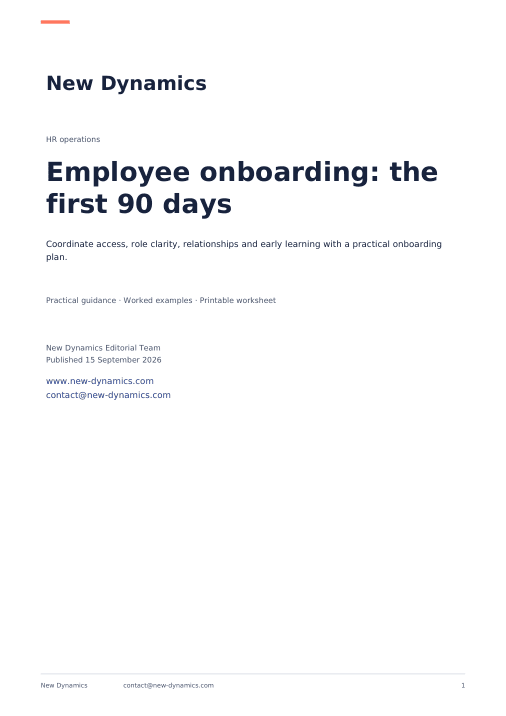
A new audit manager's first quarter should cover the methodology, the portfolio and the team. Read and download our employee onboarding guide. The guide is free to read, and the PDF uses our short download form.
Want audit plans, review stages and sign-offs to run through one workflow with the team's goals alongside? Book a New Dynamics demo and bring your current process. You can also email contact@new-dynamics.com.