TL;DR
- There is no statutory severance pay in the UK. There is statutory redundancy pay, which has a published formula, and everything above it is contractual.
- The formula is half a week's pay for each full year worked under 22, one week from 22 to 40 and one and a half weeks from 41, with service capped at 20 years and the weekly figure capped by law.
- Two details change the total and are routinely missed: payment in lieu of notice can push the relevant date into another year of service, and pay on family-related leave is calculated on normal contractual pay.
"How much is my severance?" has a precise answer in the UK, and it is usually lower than people expect and occasionally higher than their employer first calculated.
This article sets out who qualifies, the formula, what counts as a week's pay, the caps, the two details that change the total, and what sits on top of the statutory minimum.
Restructures move people between roles as well as out of them, and the picture has to stay accurate throughout. See how New Dynamics org charts keep that current.
There is no statutory severance pay
Severance is a commercial word rather than a legal one. What UK law provides is statutory redundancy pay, and the figure is calculated by a formula that anyone can apply. Anything above that comes from a contract, a policy or a negotiated settlement.
That distinction matters when comparing offers. A "severance package" may be the statutory minimum with a different name on it, or it may be several times that. You cannot tell without doing the sum.
Who qualifies
Acas sets out the three conditions on its guidance on redundancy pay. You have the right to statutory redundancy pay if you are "selected for redundancy", have "continuously worked for your employer for 2 years or more" and have "the legal status of employee".
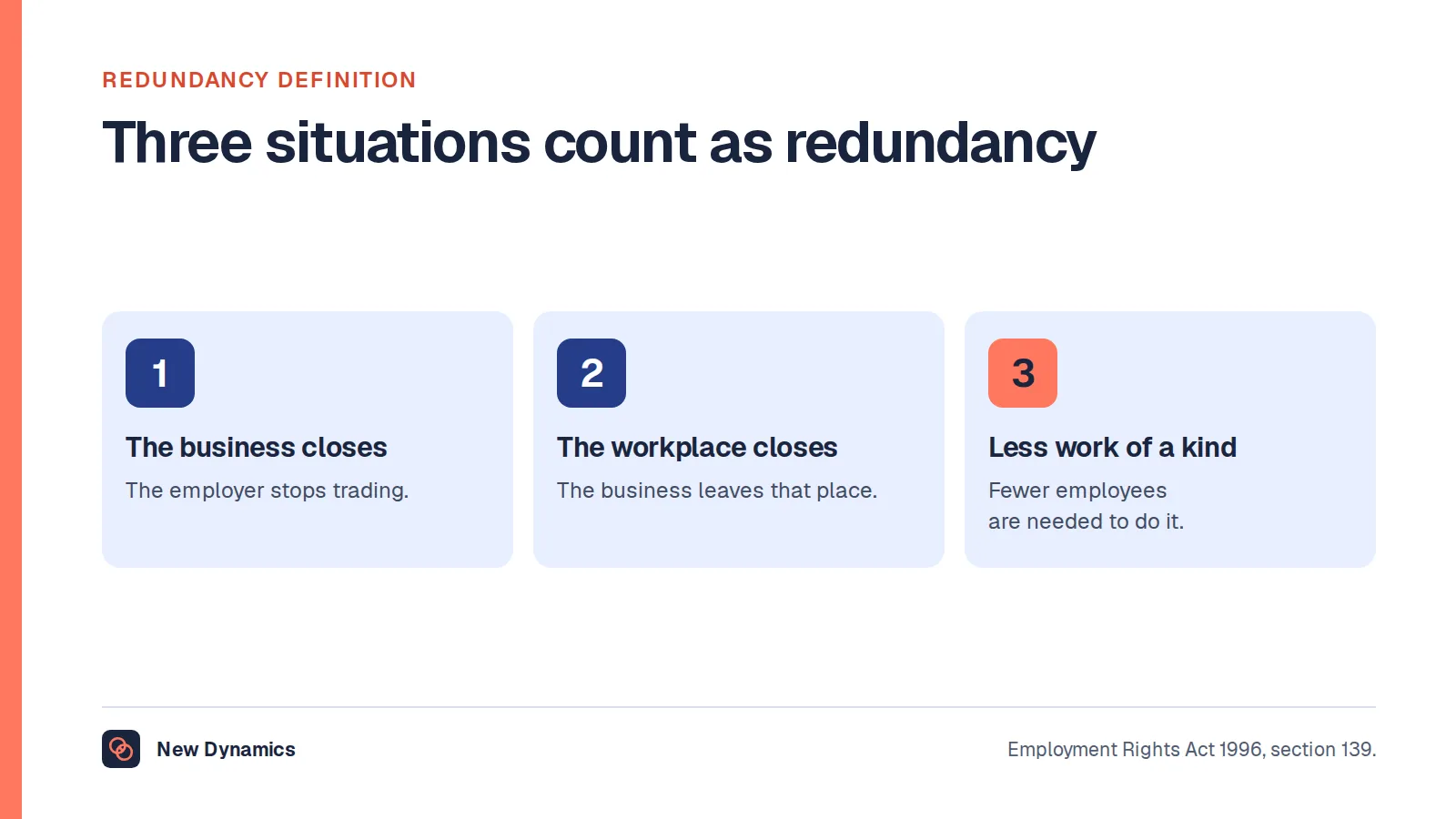
That last condition excludes more people than expected. Acas notes you are "not likely to be an employee" if you are "an agency worker" or "a casual worker on a zero-hours contract". Our post on the redundancy definition covers what counts as a redundancy in the first place.
There are also excluded categories, including the armed forces, crown servants, the police, and domestic service where the worker is a member of the employer's immediate family.
The formula

GOV.UK's guidance on redundancy pay gives three bands, applied to each full year of service at the age you were during that year:
- Half a week's pay for each full year you were under 22.
- One week's pay for each full year you were 22 or older, but under 41.
- One and a half weeks' pay for each full year you were 41 or older.
Service is capped at 20 years, counted backwards from the end. Somebody with 30 years' service is paid for the most recent 20.
The bands apply year by year, not to your age at the end. Someone made redundant at 45 after 10 years is paid one and a half weeks for the years from 41 and one week for the years before.
What counts as a week's pay

Weekly pay is "the average you earned per week over the 12 weeks before the day you got your redundancy notice". Where hours and pay are regular, it is normal weekly pay; where they vary, Acas says it is based on "your average hourly rate over a 12-week period".
Acas adds two inclusions people forget. Weekly pay "should also include" guaranteed overtime ("overtime your employer must offer and you must work") and "any contractual bonuses or commission you're entitled to". Discretionary bonuses are a different matter.
Two caps then apply. For redundancies on or after 6 April 2026, GOV.UK states that "your weekly pay is capped at £751 and the maximum statutory redundancy pay you can get is £22,530", with lower figures before that date. Both caps change each April, so check the current ones before relying on a number.
The cap is why the statutory sum rarely feels generous to a well-paid employee: the calculation ignores everything above the weekly ceiling.
The two details people miss
Payment in lieu of notice. Where you stop work immediately but are paid for the notice period, Acas says the relevant date for the calculation "is the date your employment would have ended if you had worked all of the statutory notice period". That "might mean you have worked for your employer for another year for redundancy pay calculations", which can cross a service anniversary or an age band and change the total.
Family-related leave. If you are made redundant while on leave, the calculation uses "your normal contractual weekly pay before tax", not the pay you were receiving while on leave. Acas lists maternity, paternity, adoption, ordinary parental, shared parental, parental bereavement, dependants, carer's and neonatal care leave.
Your employer "must tell you in writing how your redundancy pay has been worked out". Ask for that, and check the dates and the age bands against the two points above.
What sits on top
- Enhanced or contractual redundancy pay. Acas notes an employer "might top up the 'statutory' minimum amount". If a policy or contract promises this, it is enforceable like any other contractual term.
- Notice pay. Separate from redundancy pay. You are paid for your notice period whether you work it or not.
- Accrued holiday. Untaken holiday is paid on termination.
- A settlement agreement. A negotiated sum, usually in exchange for giving up the right to bring claims, and requiring independent legal advice to be binding.
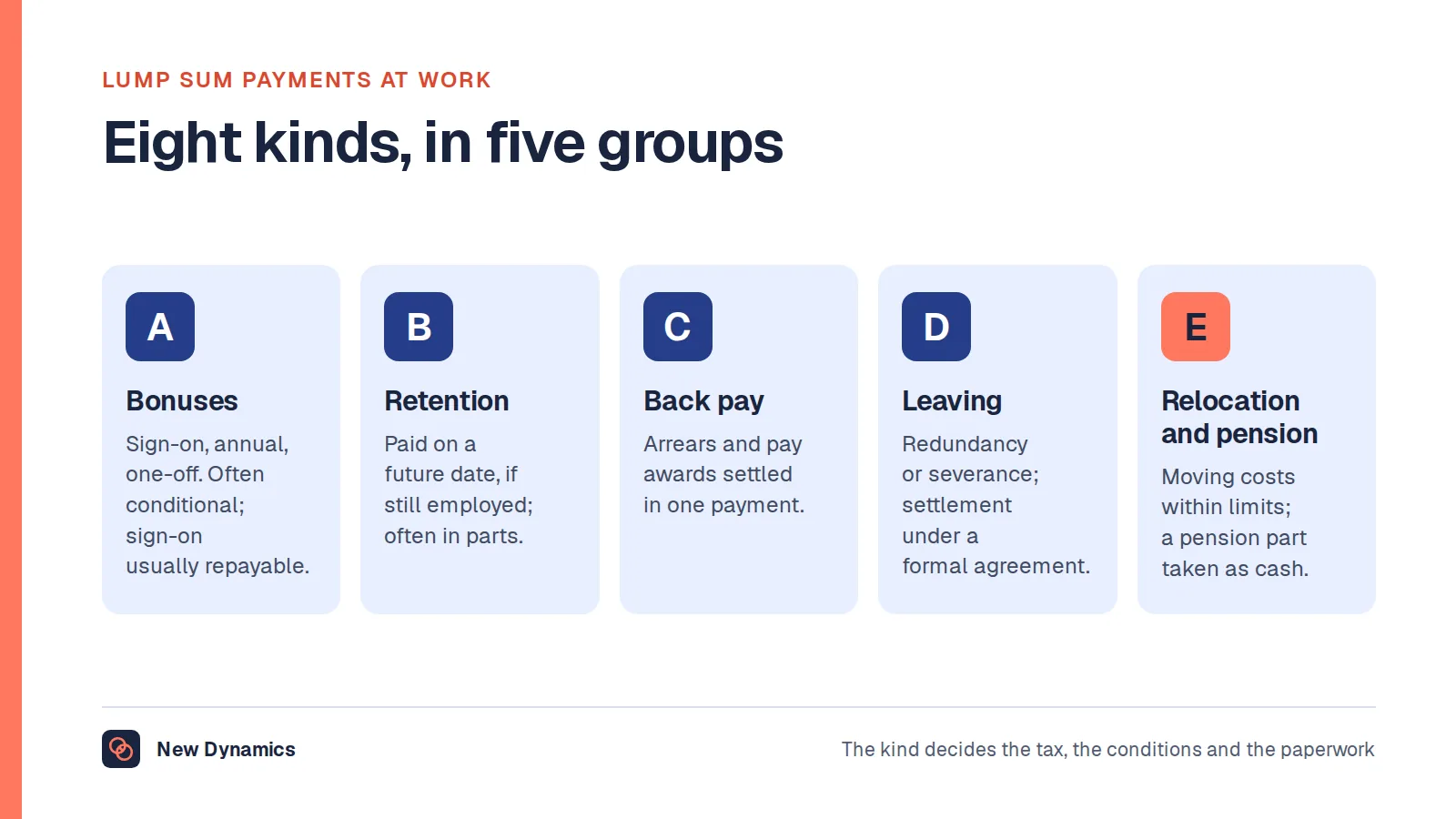
Our post on the lump sum payment covers how these one-off amounts differ in tax and conditions.
Tax
GOV.UK's guidance on tax and National Insurance explains that a termination payment "could include" statutory redundancy pay, holiday pay, unpaid wages and company benefits, and that "statutory redundancy pay under £30,000 is not taxable".
The rest of the package is not automatically covered. Holiday pay and unpaid wages are earnings and taxed as such, and what happens to a notice payment depends on how it is structured. This is general information rather than tax or legal advice.
When there is no entitlement
There is no statutory redundancy pay where your employer "offers to keep you on", or where they offer "suitable alternative work which you refuse without good reason". Dismissal for misconduct "does not count as redundancy", so nothing is due on that basis.
There is also a deadline: "you have 6 months from the date your job ends to apply for statutory redundancy pay".
Checking an offer

- Calculate the statutory figure first, using GOV.UK's redundancy pay calculator, so you know the floor.
- Check the relevant date, especially if you are being paid in lieu of notice.
- Separate the elements: redundancy pay, notice pay, holiday and anything extra. A single headline number hides which parts you were owed anyway.
- Ask for the written calculation, which your employer has to provide.
For running a restructure so that the process stands up as well as the arithmetic, read and download our redundancy and workforce change guide. The guide is free to read, and the PDF uses our short download form.
Frequently asked questions
How much is severance pay?
In the UK there is no statutory severance pay, only statutory redundancy pay. That is half a week's pay for each full year worked under 22, one week for each year from 22 to 40 and one and a half weeks for each year from 41, with service capped at 20 years and the weekly figure capped by law.
How is severance pay calculated?
Work out each full year of service and the age you were during it, apply the relevant band, then cap service at 20 years and the weekly figure at the statutory maximum. Weekly pay is the average over the 12 weeks before notice, including guaranteed overtime and contractual bonuses or commission.
Do you need two years' service to get redundancy pay?
Yes for the statutory payment. Acas requires continuous employment of two years or more, plus the legal status of employee, which agency workers and casual workers on zero-hours contracts are unlikely to have. A contractual scheme may set different conditions.
Is severance pay taxed?
Statutory redundancy pay under £30,000 is not taxable. Other parts of a termination payment, such as holiday pay and unpaid wages, are earnings and taxed accordingly, and the treatment of notice payments depends on how they are structured.
Does payment in lieu of notice affect redundancy pay?
It can increase it. Where notice is paid rather than worked, the relevant date is when employment would have ended had the statutory notice period been worked, which can add another year of service to the calculation.
What is the maximum statutory redundancy payment?
For redundancies on or after 6 April 2026, GOV.UK puts the weekly cap at £751 and the maximum total at £22,530. Both figures change each April, so check the current ones.
Can an employer pay more than the statutory minimum?
Yes. Enhanced or contractual redundancy pay is a top-up an employer may offer through a policy, a contract or a settlement agreement. Where it is contractual it is enforceable like any other term.
Your next step: do the sum before you respond
- Count full years of service, and note your age during each.
- Work out average weekly pay over the 12 weeks before notice, including guaranteed overtime.
- Apply the caps, then compare the result with what you have been offered.
- Ask for the written calculation and check the relevant date.
Want restructures where the structure, the roles and the record stay in step? Book a New Dynamics demo and bring your current org chart. You can also email contact@new-dynamics.com.