TL;DR
- A difficult conversation is one you would prefer not to have: about performance, behaviour, pay, a refusal or bad news. Delay almost always makes it harder.
- Use six steps: prepare the facts and your aim, open plainly in the first minute, describe what you have seen and its effect, listen, agree what happens next and follow up in writing.
- The 12 examples give opening lines for managers, colleagues and employees. None of them begins with small talk, and all of them end with a question or a next step.
Everyone has a conversation they are putting off. The colleague whose work keeps arriving late. The team member whose tone upsets people. The pay rise you cannot give. The boss who keeps moving your deadlines. Each week of delay makes the conversation bigger, and it rarely makes the problem smaller.
This article gives 12 difficult conversations examples from working life, each with an opening line you can adapt. It sets out a six-step structure, offers phrases for when things get heated and lists the mistakes that make matters worse.
Hard conversations are easier when feedback is a normal part of work and not a rare event. See how New Dynamics continuous feedback makes that routine.
About these examples: all of them were written by the New Dynamics editorial team. The people and details are illustrative.
Why we avoid them, and why that costs more
We avoid difficult conversations because we fear the reaction, doubt our own case or hope that the problem will sort itself out. Meanwhile the behaviour continues, other people notice that nothing is done, and resentment grows on both sides.
Acas makes the case for acting early and informally. Its guidance for employers on dealing with a problem raised by a worker says that “many problems at work can be resolved informally, for example through an informal chat”, and that a problem raised informally should still be taken seriously. Its advice to employees on how to raise a problem at work is that “it's usually best to try raising it informally first”, which can resolve the matter more quickly and “help maintain positive relationships at work”.
An honest conversation held early is the informal route. It is nearly always cheaper than what follows if you wait.
A six-step structure for any difficult conversation
- Prepare. Write down the facts, with dates. Decide what you want to be different afterwards. Check your own part in the problem. Choose a private place and a time when neither of you is rushed.
- Open plainly. Say what the conversation is about within the first minute. Small talk raises anxiety, because the other person can tell that something is coming.
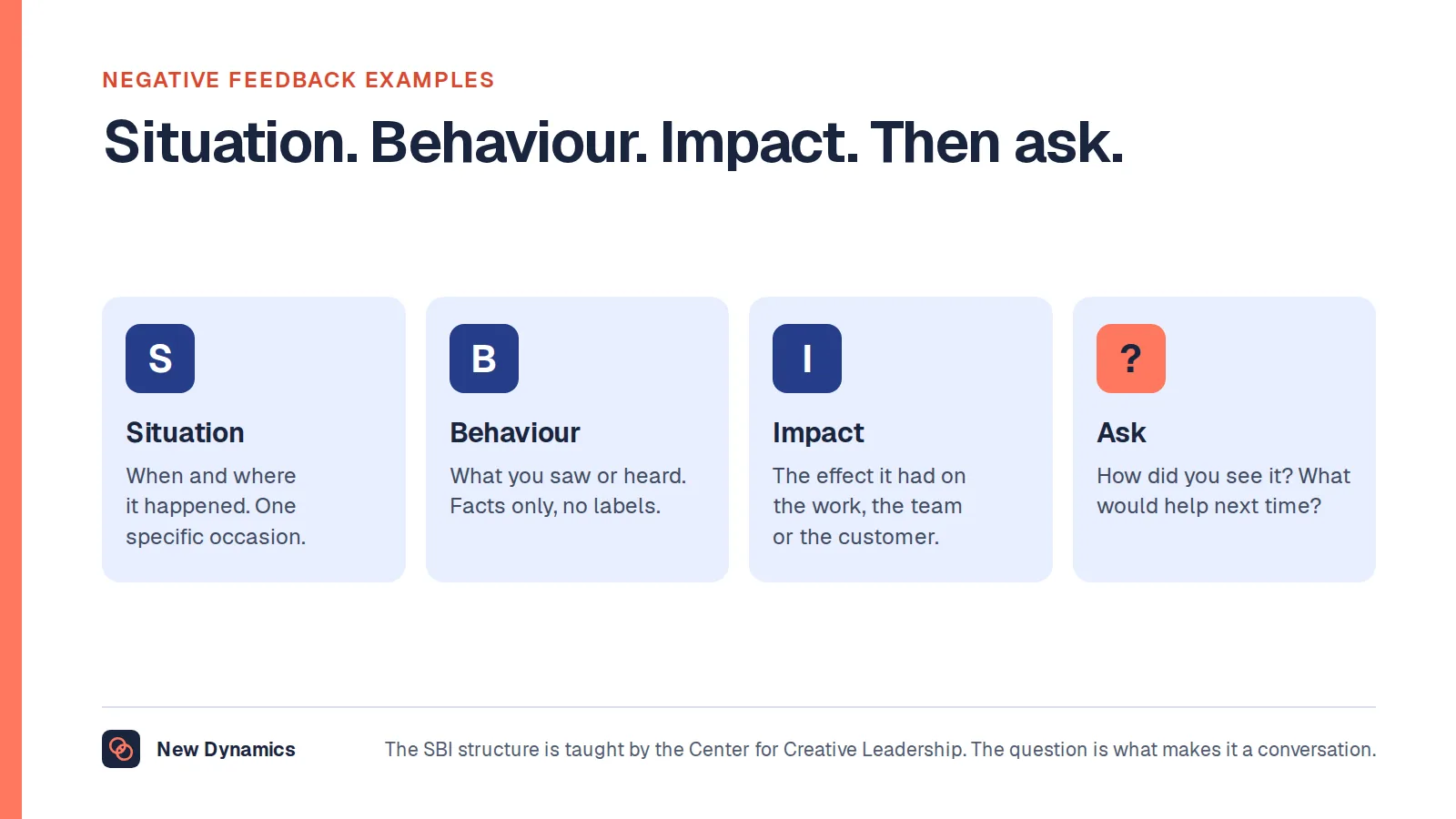
- Describe what you have seen, and its effect. Use the Situation-Behavior-Impact model taught by the Center for Creative Leadership: the situation, the behaviour you observed and the impact it had. Leave out labels and guesses about motive.
- Ask, and listen. “What is your view?” Then stop talking. You may learn something that changes the picture.
- Agree what happens next. One or two specific actions, who will do them and when you will review.
- Follow up. Send a short, neutral note of what was agreed, and keep the review date.

12 difficult conversations examples
For managers
1. Performance that has slipped
“Thanks for making the time. I want to talk about the last three client reports. Each one went out after the agreed date, and the March one had errors in the totals that the client spotted. That is not the standard I am used to from you, and I am concerned. What is going on from your side?”
Then listen. There may be a cause that you can fix. Agree what will change, the support you will give and when you will look at it again. See our guide to job performance for what to check first.
2. Behaviour that upsets colleagues
“I need to raise something that is uncomfortable. In Tuesday's meeting you cut across Priya three times, and when she made her proposal you said it was ‘pointless’. She stopped contributing, and two other people have mentioned it to me. I do not think that is how you want to come across. How did you see that meeting?”
Describe the behaviour, never the character. “You were rude” invites a denial. What was said and done cannot be argued with.
3. Turning down a pay rise or a promotion
“I know that you were hoping for the senior role, so I will tell you straight away: you have not got it this time. I would like to explain why, and then talk about what would make you the strongest candidate next time.”
Give the decision first. Do not make someone sit through three minutes of praise wondering where it is heading.
4. Repeated lateness or absence
“I have noticed that you have arrived after ten on six days this month. I wanted to ask about it before making any assumptions. Is there something going on that I should know about?”
Lateness often has a cause: caring, health or transport. Ask first. Acas notes that something that looks like a conduct issue may be linked to a health condition.
5. Personal hygiene or another sensitive personal matter
“This is an awkward thing to raise, and I am raising it because I would want someone to tell me. I have noticed a strong body odour on several days recently. I do not know whether you are aware of it. Is there anything going on, or anything I can do to help?”
Hold it in private, be brief and kind, and do not mention that others have complained unless you must. Be aware that there may be a medical or cultural reason.
6. Telling the team bad news
“I have some difficult news, and I would rather you heard it from me. The project has been cancelled. I will explain what I know about why, what it means for each of you and what I do not yet know. Then I will take your questions.”
Say it early, say what you know and do not know, and stay for the questions.
For colleagues
7. A colleague who takes credit for your work
“Can I raise something about yesterday's presentation? The analysis on slides four to eight was mine, and it was presented without my name. I may be misreading it, but it left me feeling overlooked. Can we agree how we credit each other's work in future?”
8. A colleague whose work is affecting yours
“I want to sort something out between us before it becomes a bigger issue. I need your figures by Wednesday to finish the Friday report, and for the last three weeks they have arrived on Thursday evening. I end up working late or sending it incomplete. What would help you to get them to me on Wednesday?”
9. An offensive remark
“I want to mention something from lunch. The joke about Sam's accent made me uncomfortable, and I noticed that he went quiet. I do not think you meant harm, but I would ask you not to do that again.”
If it is serious or repeated, take it to your manager or HR. See our guide to the definition of discrimination at work.
For employees speaking to a manager
10. An unmanageable workload
“I would like your help with my workload. I currently have the audit, the system migration and the monthly close, and they all fall in the same fortnight. I can do two of them well or three of them badly. Which should come first, and can anything move or be shared?”
Bring facts and options. Do not bring only the complaint.
11. Disagreeing with a decision
“I would like to raise a concern about the new rota before it is final. I understand the reason for it. My worry is that it leaves Thursday evenings with one person, and we had three incidents on Thursday evenings last quarter. Could we look at that together?”
12. Asking for a pay rise
“I would like to talk about my pay. In the past year I have taken on the supplier contracts and trained two new starters, and my responsibilities now match the senior analyst role. I would like my salary to reflect that. What would the process be?”
Our manager feedback examples give more wording for speaking upwards.
What these openings have in common
- The subject is named in the first sentence or two.
- Facts come before feelings, with dates and specifics.
- “I” statements describe the effect: “I am concerned”, “I end up working late”.
- No labels. Nobody is called lazy, rude or difficult.
- An opening for the other side: “How did you see it?”, “What is going on from your side?”
- A forward look: what would help, and what happens next.

Phrases for when it gets heated
| When | Try |
|---|---|
| They become angry | “I can see that this is upsetting. Let's take a minute.” |
| They deny it | “I understand that you see it differently. Here is what I observed on the 14th.” |
| They change the subject | “That matters too, and I will come back to it. For now, I want to stay with this.” |
| They blame others | “I will look into that separately. What I would like to talk about is your part.” |
| They go silent | “I have said a lot. I would like to hear what you are thinking.” |
| They cry | “Take your time. Would you like a short break?” Then carry on. Do not abandon the message. |
| You feel yourself getting angry | “I want to get this right, and I need a moment. Can we pick this up at two o'clock?” |
| You realise that you were wrong | “I did not know that. It changes how I see this. Thank you for telling me.” |
Lower your voice as the other person raises theirs. Slow down. It is always acceptable to pause and continue later.
After the conversation
- Write it down the same day: what was discussed, what was agreed and the review date. Send a short, neutral summary.
- Do what you said you would do.
- Notice improvement, and say so. People need to know that change was seen. Our positive feedback examples can help.
- Keep the review date. If nothing changes, the next conversation is more formal, and you will be glad of your notes. Our performance improvement guide explains the next stage.
- Treat the person normally. The conversation is over. Do not carry it into every interaction.
Common mistakes
Waiting. A problem raised after six months arrives with six months of resentment attached.
Ambushing. Raising it in front of others, or at the end of a meeting about something else.
The sandwich. Praise, criticism, praise. The message gets lost, and the praise is devalued.
Softening until it disappears. If the person leaves unsure whether there was a problem, there was no conversation.
Generalising. “You always” and “you never” start an argument about the word “always”.
Doing it by message. Email and chat strip out tone. Use them to arrange the conversation and to confirm it afterwards.
Going in to win. The aim is a better working situation. It is not to prove that you were right.
Skipping the formal route when it is needed. Bullying, harassment, discrimination and safety issues need more than a chat. Follow your procedure and take advice. This is general information, not legal advice.

Frequently asked questions
How do you start a difficult conversation at work?
Name the subject within the first minute, and give the facts: “I want to talk about the last three client reports. Each went out after the agreed date.” Then ask for the other person's view. Avoid small talk, which raises anxiety.
What is an example of a difficult conversation with an employee?
“In Tuesday's meeting you cut across Priya three times, and when she made her proposal you said it was pointless. She stopped contributing. I do not think that is how you want to come across. How did you see that meeting?”
How do you prepare for a difficult conversation?
Write down the facts with dates, decide what you want to be different afterwards, consider your own part in the problem, plan your first two sentences and choose a private place and an unhurried time.
What should you not say in a difficult conversation?
Avoid labels such as “lazy” or “rude”, the words “always” and “never”, guesses about motives, comparisons with colleagues and threats. Describe what you saw and its effect, and ask for the other person's view.
How do you have a difficult conversation with your boss?
Ask for a private time, state the issue with facts, explain the effect on your work and bring options. For example: “I can do two of these three projects well in this fortnight. Which should come first, and can anything move?”
What if the conversation goes badly?
Stay calm, lower your voice and offer a pause. It is fine to stop and resume later. Afterwards, write down what happened, send a neutral summary and keep the review date. If behaviour is serious, use your formal procedure.
Your next step: have the one you are avoiding
- Name the conversation that you have been putting off.
- Write down the facts, your aim and your first two sentences.
- Ask for twenty minutes in private this week.
- Afterwards, send a short note of what you agreed.
For prompts and an agenda that make honest conversations routine, read and download our one-to-one meeting guide. The guide is free to read, and the PDF uses our short download form.
Want feedback to be frequent enough that hard conversations become rare? Book a New Dynamics demo and bring your current approach. You can also email contact@new-dynamics.com.