TL;DR
- Most culture words are unfalsifiable. “Collaborative” only becomes a fact about your organisation when you can name the practice that would stop being true if you removed it.
- Group the words by what they claim (about workload, autonomy, support, behaviour, clarity and change) and each one acquires a test. HSE's Management Standards describe those conditions in checkable language.
- Some advert words carry legal risk. Acas names “recent graduate”, “highly experienced”, “barmaid” and “handyman” as wording that can discriminate, and says to describe the job rather than the applicant.
Ask six people at the same employer to describe the culture in three words and you will get eighteen adjectives, most of them complimentary, and no two descriptions of the same place.
This article gives words to describe work culture grouped by what each one actually claims, the condition that would make the claim true, the neutral words for when praise would be dishonest, and the advert wording that carries legal risk.
A culture description is only as good as the evidence underneath it. See how New Dynamics feedback builds that record continuously rather than once a year.
Why the words matter
They end up in job adverts, careers pages, induction decks and exit interviews. A candidate reads "fast-paced" and pictures something; six weeks in they discover it meant chronic understaffing. The word was not a lie, exactly. It was just untestable.
The fix is not a better thesaurus. It is to treat each word as a claim and ask what would have to be true.
Words grouped by what they claim

HSE's Management Standards are the most useful frame here, because they describe workplace conditions in language you can check rather than admire.
About workload and pace, fast-paced, demanding, steady, seasonal, deadline-driven, calm, relentless.
The Demands standard says an organisation should provide "adequate and achievable demands in relation to the agreed hours of work", that "people's skills and abilities are matched to the job demands", and that "jobs are designed to be within the capabilities of employees". If "fast-paced" coexists with work that does not fit the agreed hours, the honest word is overloaded.
About autonomy, autonomous, self-directed, trusting, empowering, micromanaged, prescriptive.
The Control standard is unusually concrete: employees "have control over their pace of work", are "encouraged to use their skills and initiative to do their work", "have a say over when breaks can be taken", and "are consulted over their work patterns". Four questions, four yes-or-no answers. Very few organisations calling themselves autonomous get four out of four.
About how people treat each other, collaborative, supportive, blunt, political, respectful, cliquey.
The Relationships standard expects that the organisation "promotes positive behaviours at work to avoid conflict and ensure fairness", that "employees share information relevant to their work", that there are "agreed policies and procedures to prevent or resolve unacceptable behaviour", and that systems exist "to enable and encourage employees to report unacceptable behaviour". Collaborative claims the second of those. Safe claims the fourth.
About clarity, structured, ambiguous, process-driven, matrixed, chaotic, well-defined.
The Role standard asks whether "the organisation provides information to enable employees to understand their role and responsibilities" and whether "the different requirements it places upon employees are compatible". An organisation that describes itself as dynamic while people hold conflicting objectives is describing incompatibility as energy.
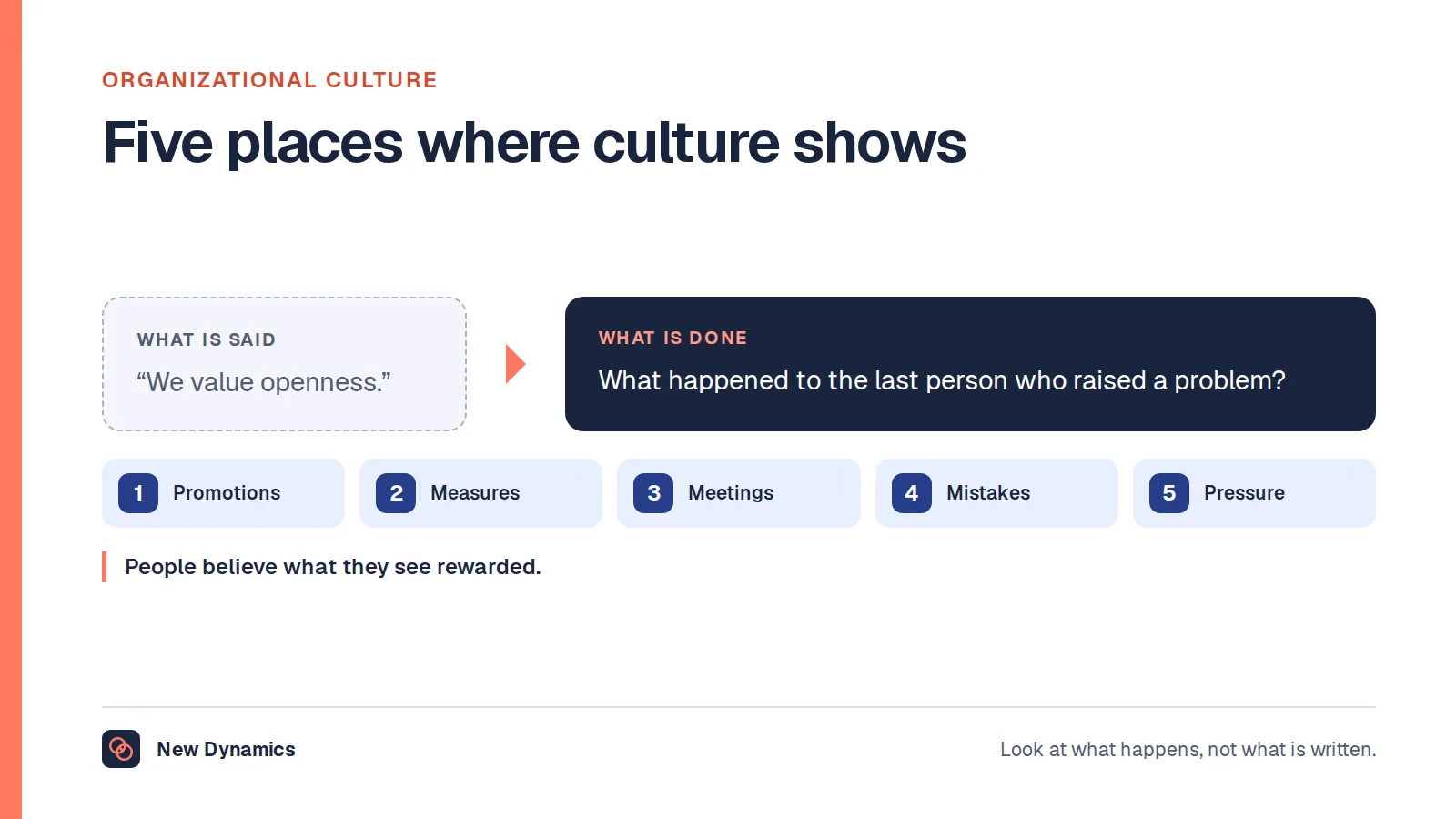
Our organizational culture post covers where culture shows up beyond the vocabulary.
Neutral words

Sometimes you need to describe a culture without praising or damning it, in a careers page that will be read by people who would hate the place, or in a handover note. Neutral words describe the shape of the work rather than its virtue:
- Structure: hierarchical, flat, matrixed, devolved, centralised, federated.
- Pace and rhythm: seasonal, cyclical, deadline-driven, steady, project-based, shift-based.
- Location: office-based, distributed, hybrid, field-based, site-based.
- Formality: formal, informal, process-driven, documented, verbal.
- Environment: regulated, safety-critical, client-facing, unionised, public sector.
These are the most useful words in a job advert, because a candidate can act on them. "Regulated and process-driven" tells someone more than "exciting" ever will, and it attracts the person who wants that.
Unflattering words are sometimes the accurate ones
A culture description that contains no cost is marketing. If your organisation is genuinely demanding, political, siloed, risk-averse or under-resourced, the choice is whether to say so internally, not whether it is true.
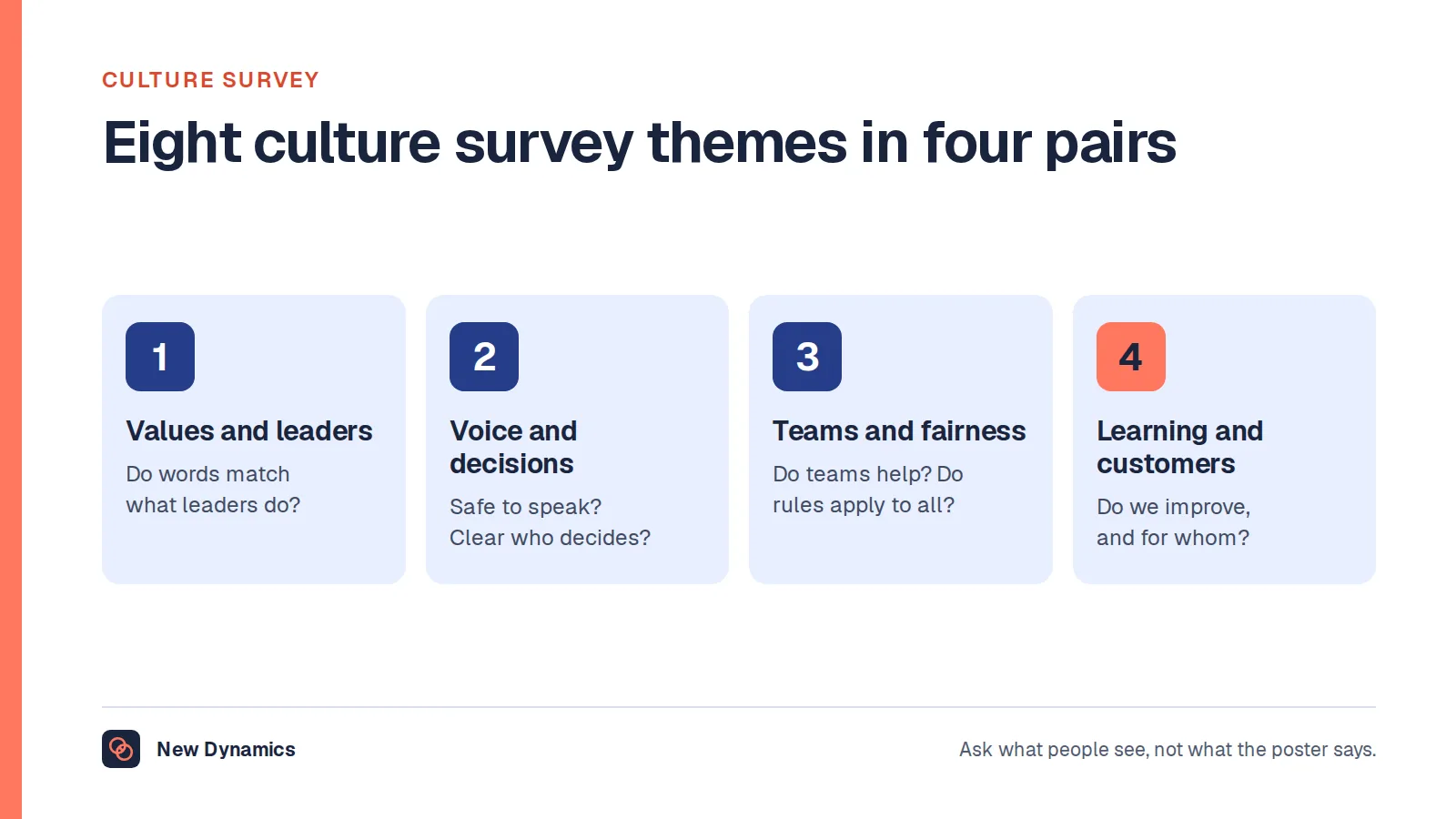
Saying it has two practical benefits. Candidates who would leave within a year select themselves out. And naming a problem in ordinary language is the first step anyone takes before fixing it. Our post on culture survey questions covers asking employees rather than guessing.
Words that carry legal risk in an advert
Culture words end up in job adverts, which is where an honest description becomes a regulated one. Acas's guidance on advertising a job is direct: "when advertising a job, you must not ask for or exclude anyone with a certain protected characteristic."
Its examples are worth quoting exactly:
- "Recent graduate" or "highly experienced", these "can discriminate against age and you must be able to prove you have a good reason for any job requirement in your advert".
- "Barmaid" or "handyman", "because they imply you want to recruit a man or a woman". The instruction is to "use inclusive language that defines the job not the applicant".
- "German sales rep", specifying a nationality rather than the language needed "could discriminate against race, so 'German-speaking sales rep' would be more appropriate".
Culture adjectives can drift the same way. Young, energetic and digital native describe an age group rather than a job. Work hard, play hard describes a social life some people cannot join. This is general information rather than legal advice.
Answering "three words to describe your culture"
If you are the candidate, answer about the culture you saw rather than the one you want. Name a thing you observed, not an adjective: "decisions seem to get made in the room" is a better answer than "empowering", and it shows you were paying attention during the interview.
If you are the employer, pick one word about the work, one about how people treat each other, and one honest cost. Three flattering words sound like a careers page. Two flattering and one honest sounds like a place that exists.
The evidence test

For each word you want to use, run four steps.
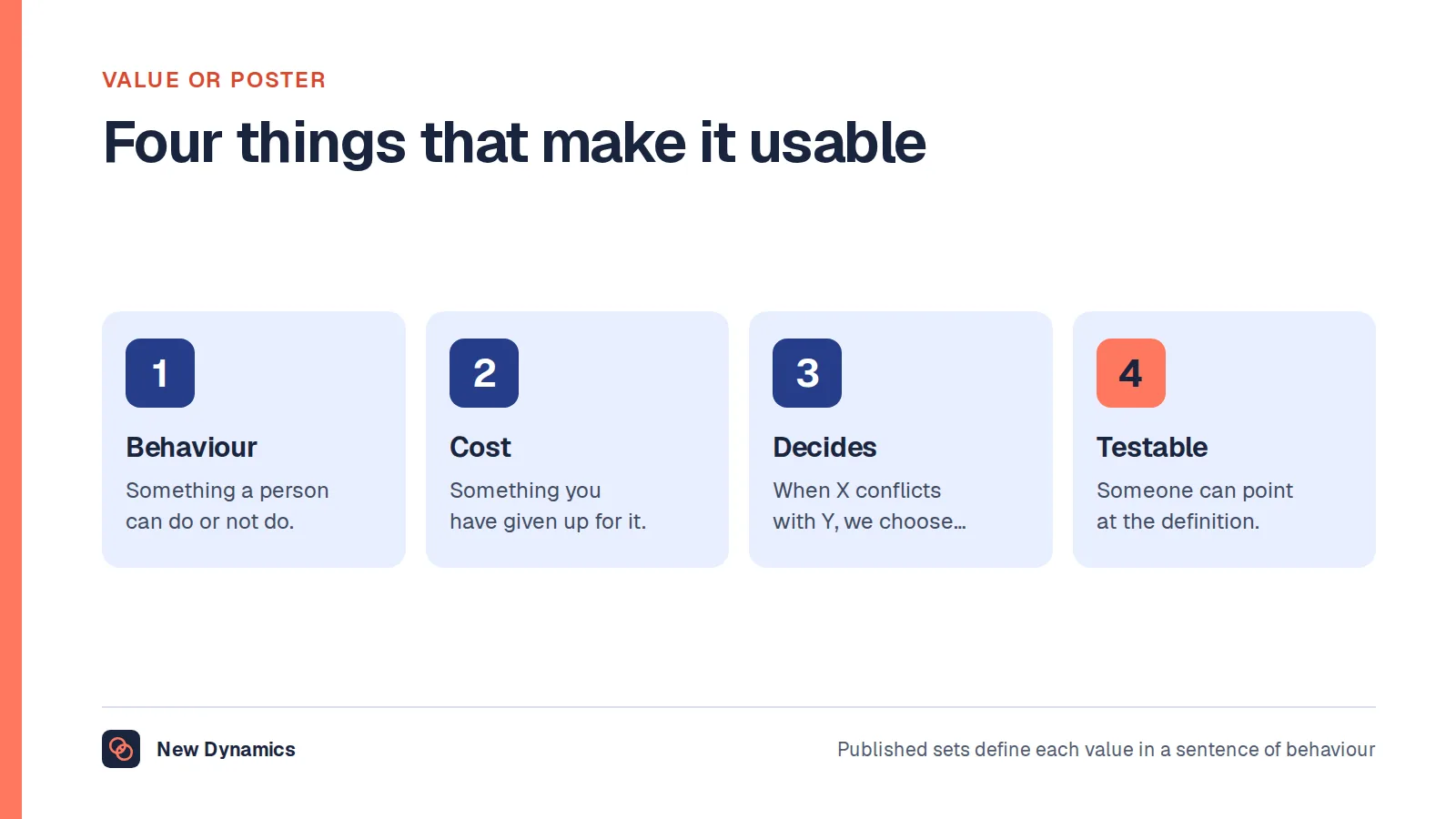
- State the claim in a sentence. "Collaborative" becomes "people share information across teams without being asked."
- Name the practice that makes it true. If removing the practice would not change anything, the word was decoration.
- Find one piece of evidence from the last quarter: a decision, a document, a case that was handled.
- Ask whether a new starter would say the same after six weeks. If not, you have an aspiration, which is a different thing and should be labelled as one.
Acas's guidance on changing your culture shows what step two looks like in practice for flexible working: "include any flexible working options in job adverts", "design performance measures based on output and achievements rather than hours worked", "raise awareness – for example by sharing success stories or role modelling flexible working", and "set clear expectations and boundaries – for example, how to keep in touch, defining work hours". Four practices. Remove them and the word goes with them.
Words worth retiring
- Family. Families do not make people redundant, and the word is most often used just before somebody is asked to do something unreasonable.
- Fast-paced. Say what it means: short deadlines, frequent changes of priority, or too few people.
- Passionate. Usually a request for unpaid hours dressed as a personality trait.
- Rockstar, ninja, guru. These describe the applicant, not the job, which is the thing Acas asks you to avoid.
Replace each with the plain fact underneath, and your description gets shorter and more accurate at the same time.
Frequently asked questions
What are good words to describe work culture?
The useful ones are specific and checkable: structured, autonomous, deadline-driven, regulated, distributed, collaborative, formal, informal. Group them by what they claim (about workload, autonomy, behaviour, and clarity of role) and pair each with the practice that makes it true.
What are neutral words to describe company culture?
Words that describe shape rather than virtue: hierarchical, flat, matrixed, centralised, seasonal, project-based, shift-based, office-based, hybrid, formal, process-driven, regulated, unionised. These help candidates decide whether a place suits them, which flattering adjectives cannot do.
How do you answer "three words to describe your culture"?
Choose one word about how the work runs, one about how people treat each other, and one honest cost. As a candidate, describe what you observed rather than what you hope for, and name a specific thing instead of an adjective.
What words should not be used in a job advert?
Acas warns that "recent graduate" and "highly experienced" can discriminate on age, that "barmaid" and "handyman" imply a gender, and that "German sales rep" should be "German-speaking sales rep". Its rule is to use language that defines the job rather than the applicant.
How do you describe a bad work culture honestly?
Use ordinary descriptive words (siloed, political, under-resourced, risk-averse, hierarchical) and attach each to an observable practice. Naming a condition plainly is how it gets discussed, and vague criticism is easier to dismiss than a specific one.
What is the difference between culture and values?
Values are what an organisation says it intends. Culture is what people actually do, including when the two conflict. A word only belongs in both lists when a practice connects them.
Your next step: test three words
- Write the three words your organisation currently uses about itself.
- Turn each into a sentence describing observable behaviour.
- Name one practice per word, and one piece of evidence from the last quarter.
- Delete any word that survives none of that, and replace it with a neutral one that is true.
For asking employees what the words should be rather than deciding for them, read and download our employee engagement guide. The guide is free to read, and the PDF uses our short download form.
Want the evidence behind the adjectives in one place? Book a New Dynamics demo and bring the three words from your careers page. You can also email contact@new-dynamics.com.