TL;DR
- Corporate values are meant to guide decisions when the answer is not obvious. The published sets that work define each value as behaviour: the Civil Service Code says “'honesty' is being truthful and open” and “'objectivity' is basing your advice and decisions on rigorous analysis of the evidence”.
- The NHS Constitution does the same at length, explaining respect and dignity as “we take what others have to say seriously” and working together for patients as including “we speak up when things go wrong”.
- This is governance rather than marketing. The UK Corporate Governance Code's five sections begin with “Board Leadership and Company Purpose”, and it operates on a “comply or explain” basis.
Every organisation that has ever run a values exercise has produced the same four words, and most of them are still on a wall somewhere being ignored.
This article gives real corporate values examples (published sets you can read in full rather than invented ones) explains what makes a value usable, and covers writing, testing and living a set of values.
Values become visible when people are thanked for acting on them. See how New Dynamics recognition makes that visible rather than private.
Values are not the same as direction: our post on the vision statement covers that half, with real published examples.
What values are for
Not inspiration. A set of values earns its place by settling arguments: when two reasonable courses of action conflict, which one does this organisation take? If a value cannot decide anything, it is decoration.
This is also a governance matter rather than a marketing one. The Financial Reporting Council notes that the UK Corporate Governance Code "is separated into five sections", beginning with "Board Leadership and Company Purpose", and that it operates "on a 'comply or explain' basis". Purpose and culture sit at board level in the same document as audit and remuneration.
Example one: the Civil Service Code
The Civil Service Code is a published values statement with legal underpinning, and it is short. Civil servants are "expected to carry out your role with dedication and a commitment to the Civil Service and its core values: integrity, honesty, objectivity and impartiality".
What makes it usable is that each value is defined:
- Integrity is "putting the obligations of public service above your own personal interests".
- Honesty is "being truthful and open".
- Objectivity is "basing your advice and decisions on rigorous analysis of the evidence".
- Impartiality is "acting solely according to the merits of the case and serving equally well governments of different political persuasions".
The code then "sets out the standards of behaviour expected of you and other civil servants", based on those values, and notes that "individual departments may also have their own separate mission and values statements based on the core values". Four words, four definitions, and behaviour attached to each.
Example two: the NHS Constitution
The NHS Constitution for England publishes six values, developed with "patients, public and staff", which "should underpin everything it does". It adds that "individual organisations will develop and build upon these values, tailoring them to their local needs", which is a sensible model for any group with divisions or sites.
The six are working together for patients, respect and dignity, commitment to quality of care, compassion, improving lives, and everyone counts. Again, the value is the explanation rather than the word:
- Working together for patients includes "we speak up when things go wrong".
- Respect and dignity includes "we take what others have to say seriously" and being "honest and open about our point of view and what we can and cannot do".
- Commitment to quality of care includes "we encourage and welcome feedback from patients, families, carers, staff and the public".
- Compassion includes finding "time for patients, their families and carers, as well as those we work alongside".
- Everyone counts includes making "sure nobody is excluded, discriminated against or left behind".
Notice that several of those sentences describe things that are uncomfortable to do. That is the point.
What makes a value usable

- It is a behaviour, not an adjective. "Excellence" tells nobody what to do on Thursday; "we say when something is not good enough" does.
- It costs something. A value you have never given anything up for is a preference.
- It settles a decision. You can complete the sentence: "when X conflicts with Y, we choose…".
- It can be tested. Someone could say "that was not respectful" and point at the definition rather than at their feelings.
Writing a set, in five steps

- Start from decisions already made, not from a workshop. What did this organisation choose when it was expensive to choose it?
- Write four or five, and define each in a sentence of behaviour.
- Test them against real cases. Take three difficult decisions from the past year and check whether the values would have decided them.
- Cut anything universal. If no serious organisation would claim the opposite, the word is not doing work: integrity is a floor, not a differentiator, unless you define it as sharply as the Civil Service Code does.
- Agree consequences. What happens when someone senior breaches one is the only question that matters, and it must be answered before publication.
The tests that separate values from wallpaper

- The opposite test. Could a reasonable organisation hold the opposite value? If not, it is a platitude.
- The cost test. Name the hire you did not make, the customer you resigned, the deadline you missed rather than breach it.
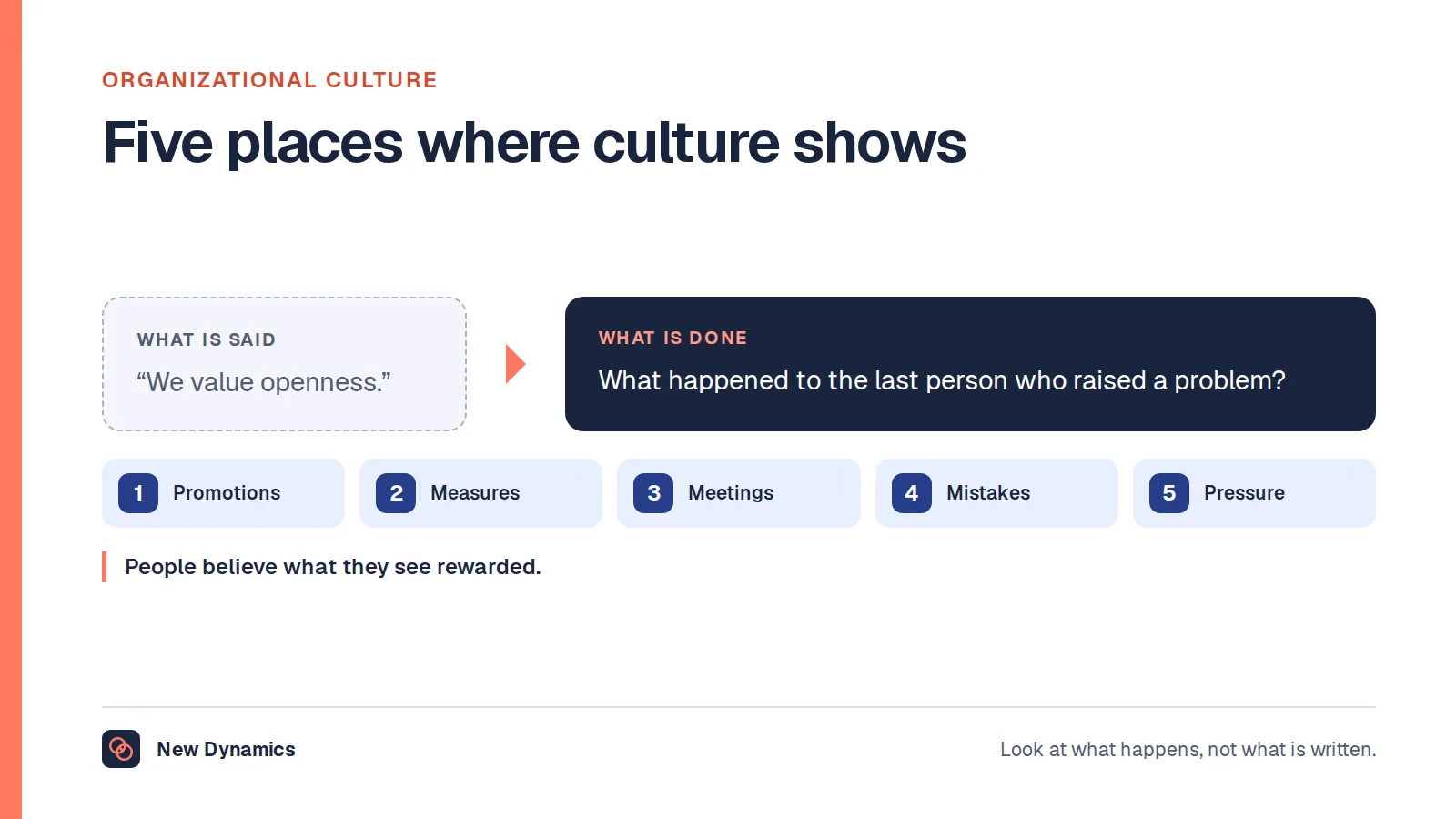
- The senior test. When the most senior person breached a value, what happened? Everyone already knows the answer, and it is the real values statement.
- The recruitment test. Are the values in the interview criteria, and has anyone been declined on them?
- The exit test. Do leavers describe the same values as the website?
Where values actually show up
- Hiring. Values as assessable criteria with defined behaviours, not a vague "culture fit" judgement that quietly filters for similarity.
- Induction. What the value means in this role, with examples specific to the job.
- Review conversations. Behaviour assessed alongside results, with the definitions in front of both people.
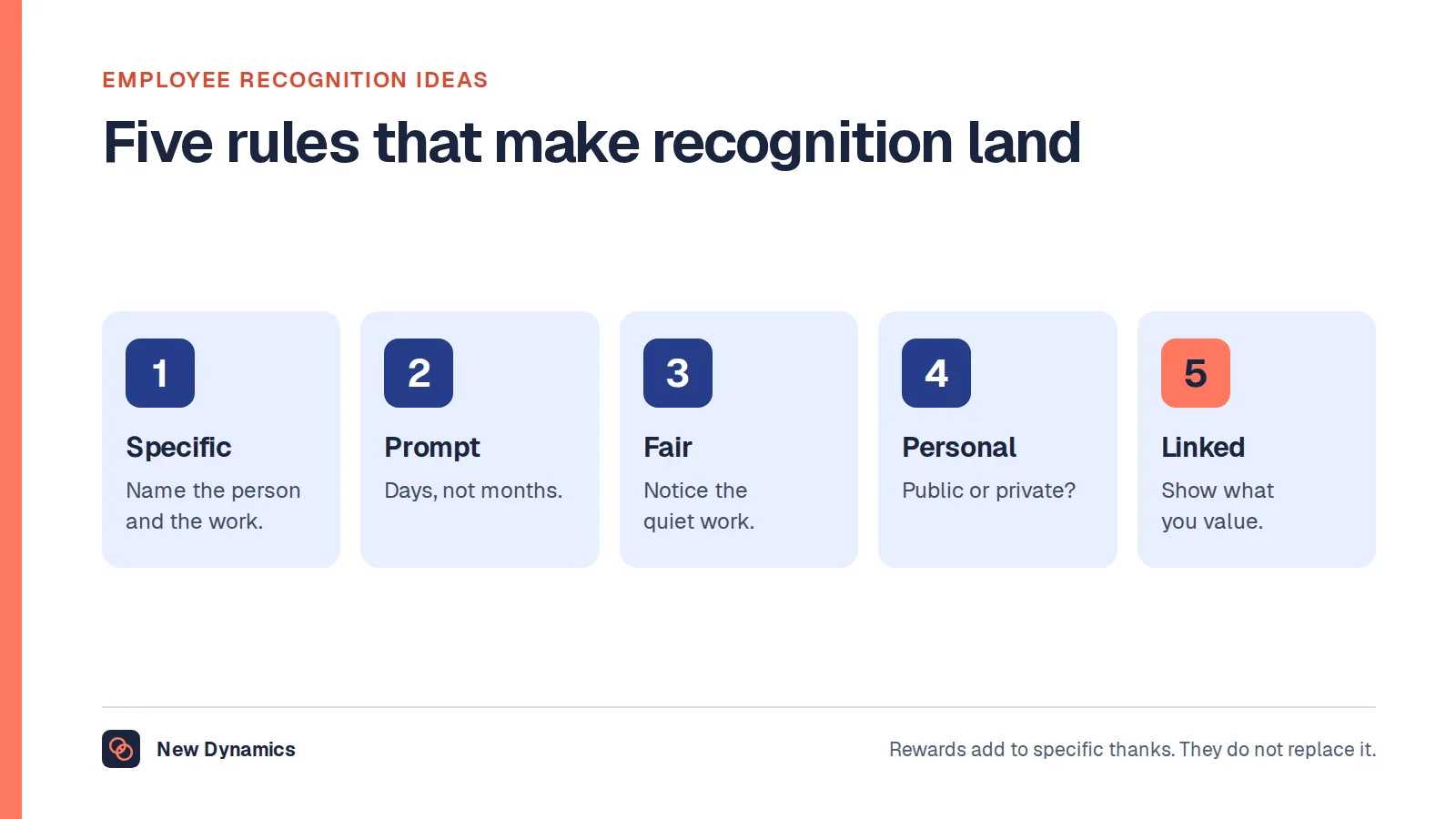
- Recognition. Thanks that names the value and the action; this is the cheapest and most effective reinforcement available.
- Difficult decisions. The value cited in the minutes when it was used, so people can see it working.
Our organisational culture post covers the wider system these sit in, and our code of conduct guide covers turning values into the standards people can be held to.
What goes wrong
- Too many. Nobody remembers seven.
- Aspirational rather than actual. Publishing the organisation you would like to be tells everyone that the published values are fiction.
- Values as an HR project. If the executive team does not use them in decisions, nobody else will.
- No teeth. A breach with no consequence removes the value more thoroughly than never publishing it.
- Never revisited. Organisations change; a values set written for a twelve-person startup does not survive to three hundred people unexamined.
Frequently asked questions
What are corporate values?
The principles an organisation says it uses to decide how it behaves, particularly when two reasonable options conflict. Useful sets define each value as behaviour rather than leaving it as an adjective, so people can tell whether they are acting on it.
What are some real examples of corporate values?
Two published sets are worth reading in full. The Civil Service Code lists integrity, honesty, objectivity and impartiality, and defines each one. The NHS Constitution lists working together for patients, respect and dignity, commitment to quality of care, compassion, improving lives, and everyone counts, each with explanations of the behaviour expected.
How many values should a company have?
Four or five that people can remember and use. Longer lists dilute each other and tend to include universal claims nobody could disagree with, which do no work in a decision.
How do you write company values?
Start from decisions the organisation has actually made when they were costly, write four or five values with a sentence of behaviour each, test them against real cases from the past year, cut anything no serious organisation would deny, and agree in advance what happens when someone breaches one.
How do you know if values are real?
Ask what they have cost. A real value shows up in a hire that was declined, a customer relationship that ended, or a decision that was reversed. Ask also what happened the last time a senior person breached one; everybody in the organisation already knows.
Should values be part of performance reviews?
Yes, if they are defined as behaviour and assessed alongside results rather than instead of them. Vague values in a review become a way of penalising people who are different rather than people who behave badly.
Your next step: define the behaviour
- Write your four or five values, each with one sentence of behaviour.
- Test them against three real decisions from the past year.
- Decide, in writing, what happens when a senior person breaches one.
- Put them into interviews, induction, reviews and recognition, or leave them off the wall.
For turning values into standards people can be held to, read and download our code of conduct guide. The guide is free to read, and the PDF uses our short download form.
Want recognition that names the value and the action rather than saying "great work"? Book a New Dynamics demo and bring your current values statement. You can also email contact@new-dynamics.com.