TL;DR
- A caterer is a person or company that makes or serves food, usually for an event or for an organisation such as a school, hospital or office. Catering may be in-house, contracted or private.
- A catering manager plans, organises and develops the food and drink service: leading the team, planning menus, keeping standards and hygiene, controlling budgets and stock, and looking after clients.
- In England, Wales and Northern Ireland, a food business must register with its local authority at least 28 days before trading, and must make sure that staff are trained on allergens.
Somebody fed four hundred people at the conference, hot, on time, with a separate plate for the delegate who cannot eat gluten. Nobody saw the kitchen, which was twelve miles away. That is catering: restaurant-quality food without the restaurant.
This article explains what a caterer is, describes the three kinds of catering, sets out what a catering manager does, lists the skills and qualifications, summarises the UK food rules that every caterer must meet and gives five questions to ask before you book a caterer for a work event.
Food brings a team together, but thanks should not wait for the party. See how New Dynamics employee recognition makes thanks specific and visible across the whole organisation.
What is a caterer?
The Cambridge Dictionary defines a caterer as “a person or company that makes or serves food”. The word covers a sole trader who cooks for weddings, a company that runs every canteen for a bank, and the kitchen team of a hospital.
What separates catering from a restaurant is that the food goes to the customer. It is produced for a particular group, at a particular time and place, often away from where it was cooked. That adds planning, transport, temporary kitchens and a great deal of timing to the ordinary work of cooking.
Three kinds of catering
Prospects, the UK graduate careers service, describes the settings in its catering manager job profile.
- In-house catering. The caterer works for one organisation and feeds its people. Prospects lists schools, colleges and universities, hospitals and care homes, and corporate offices that run their own canteens.
- Contract catering. A catering company provides the service to a range of clients under contract. Prospects says that these clients are more likely to be in hotels, events and sports venues, in factories and manufacturing plants, in the public sector, such as prisons and government buildings, and in retail and leisure.
- Private or event catering. Prospects describes the private caterer as “usually working on a smaller scale for customers celebrating special events, such as birthdays or anniversaries, either at home or in a hired venue”. Weddings, parties and many corporate events belong here.
The lines blur. Prospects gives the example of a university that uses an in-house team for everyday catering but brings in a contract caterer for large events.

What does a catering manager do?
Prospects sums up the job in a sentence: “Catering managers plan, organise and develop the food and beverage services of organisations and businesses”. It adds that in hotels the same job is often advertised as food and beverage manager.
The scale varies. In a small operation the manager cooks, serves and orders. In a large one, assistant managers and supervisors run the separate outlets. Either way, the responsibilities that Prospects lists fall into six duties.
- Lead the team. Organise, lead and motivate the catering team, plan shifts and rotas, and recruit, train and manage permanent and casual staff.
- Plan the menus. Prospects puts it precisely: “plan menus taking into account special diets and allergies, cultural and nutritional requirements”.
- Keep the standard. Monitor the quality of the food and the service, and deal with customers where the job is front of house.
- Keep it safe and legal. Ensure that food hygiene and health and safety regulations are met, together with fire, licensing and employment rules.
- Control the money and the stock. Manage budgets and financial targets, keep records, monitor spending, maintain stock levels and order supplies.
- Look after clients and suppliers. In contract catering, negotiate and manage contracts, assess what clients need and make sure that they are satisfied. Find new clients.
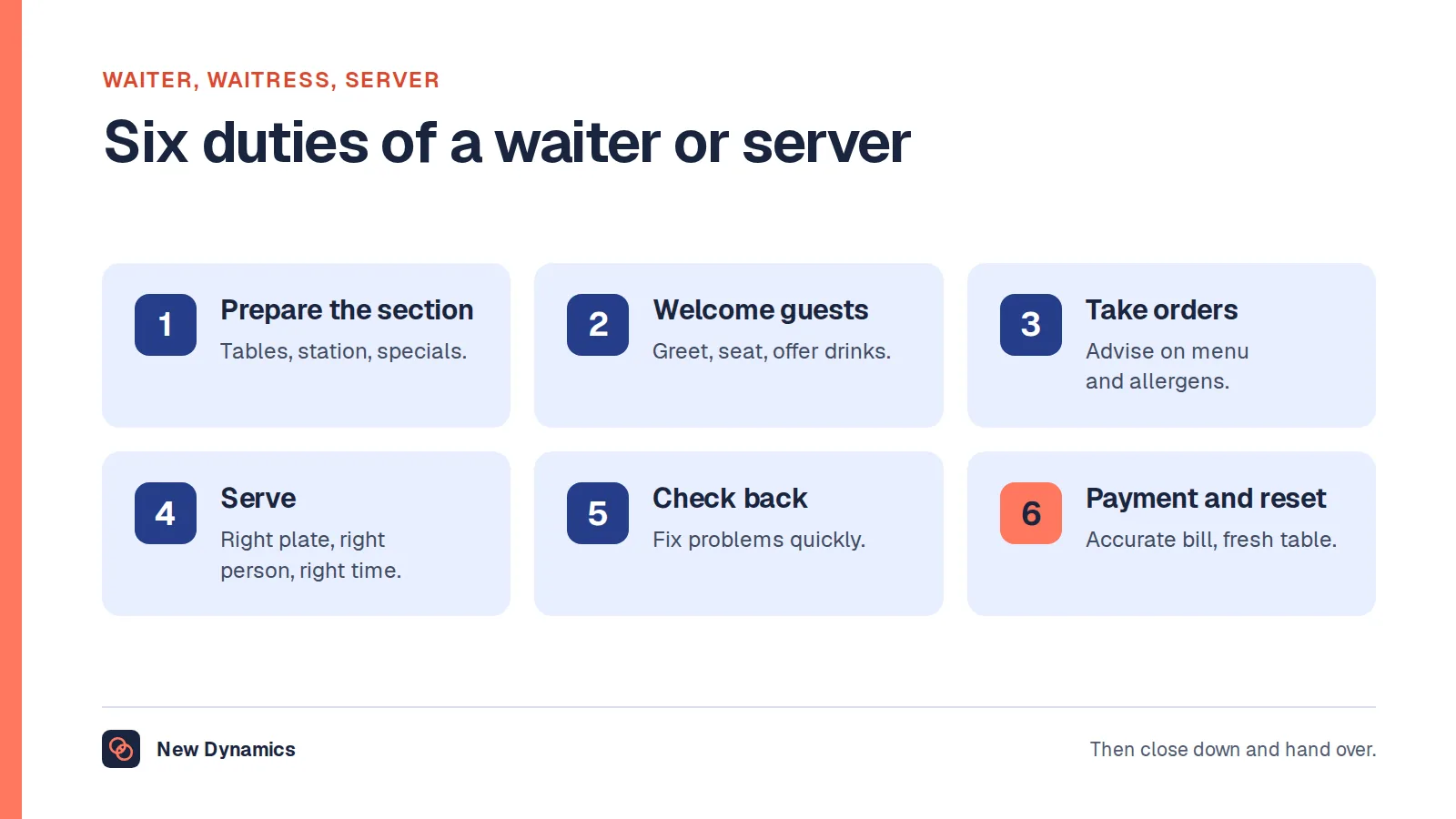
A catering assistant or event server works under that manager. Our waiter and server job description covers the front-of-house role, including banquet service.

Skills and qualifications
Prospects lists the skills that a catering manager needs. The ones that matter most are:
- culinary knowledge and experience of menu planning;
- the ability to lead and motivate a team;
- excellent customer service, with tact and diplomacy;
- commercial sense, numeracy and the ability to manage a budget;
- organisation, time management and the ability to solve problems under pressure;
- knowledge of food safety and compliance regulations;
- event management skills, resilience and stamina.
On qualifications, Prospects is encouraging: “You don't need a degree, HND or foundation degree to become a catering manager, as relevant experience, skills and personal qualities are often more important than formal qualifications.” It notes that it is possible to start as a catering assistant and work up, and that some large contract caterers and hotel chains run graduate schemes.
Hours follow the customers. Evenings, weekends and early starts are normal, and event work is seasonal. Say so in a job description.
Food rules that every UK caterer must meet
Registration
The Food Standards Agency's guidance on food business registration begins: “You must register with your local authority to run a food business.” It applies to anyone who sells, cooks, stores, handles, prepares or distributes food, including businesses trading from home, from a mobile unit or online. For England, Wales and Northern Ireland the guidance states: “You are required to register at least 28 days before trading.” A caterer with more than one site registers each one.
Allergens
The Food Standards Agency's allergen guidance for food businesses says that food businesses need to tell customers if any food that they provide contains any of 14 listed allergens as an ingredient. It is direct about people: “Food businesses must make sure that staff receive training on allergens.”
For an event, that means collecting dietary needs in advance, labelling dishes, keeping allergen information to hand and briefing every server, including casual staff hired for the day.
This is a summary of official guidance. It is general information, not legal advice. Scotland and other countries have their own arrangements.
Five questions to ask before you book a caterer for a work event
Office managers and HR teams book caterers more often than most people. Ask five questions.
- Are you registered, and what is your food hygiene rating, where a rating scheme applies? A registered business will answer at once.
- How do you handle allergens and special diets? Expect written allergen information and a clear process, not reassurance.
- Have you catered an event of this size and kind? Ask for a recent example, and for a reference that you can call.
- What exactly is included? Staff, equipment, crockery, delivery, set-up, clearing and waste. Get the price and the inclusions in writing.
- Who is in charge on the day, and what is the plan if something goes wrong? A named person, a timetable and a contingency for late deliveries or extra guests.
Then collect your own guests' dietary needs early, and pass them on in writing. Include everyone: a team event at which one person cannot eat anything sends its own message.

Writing a catering manager job description
If you are hiring, a short description built on the six duties works well.
Purpose of the job: To run a safe, high-quality and financially sound catering service for [site or clients].
Main duties: Lead and roster a team of [number]. Plan menus for [customers], including special diets and allergen controls. Maintain food safety and hygiene systems and records. Manage a budget of [amount], stock and suppliers. Meet client and customer standards, and handle feedback. Recruit and train permanent and casual staff.
Essential: Experience of running a kitchen or catering operation of similar scale. A food safety qualification at the level that your operation requires. Evidence of managing budgets and leading a team.
State plainly: the hours, including evenings and weekends, the sites covered and whether a driving licence is needed.
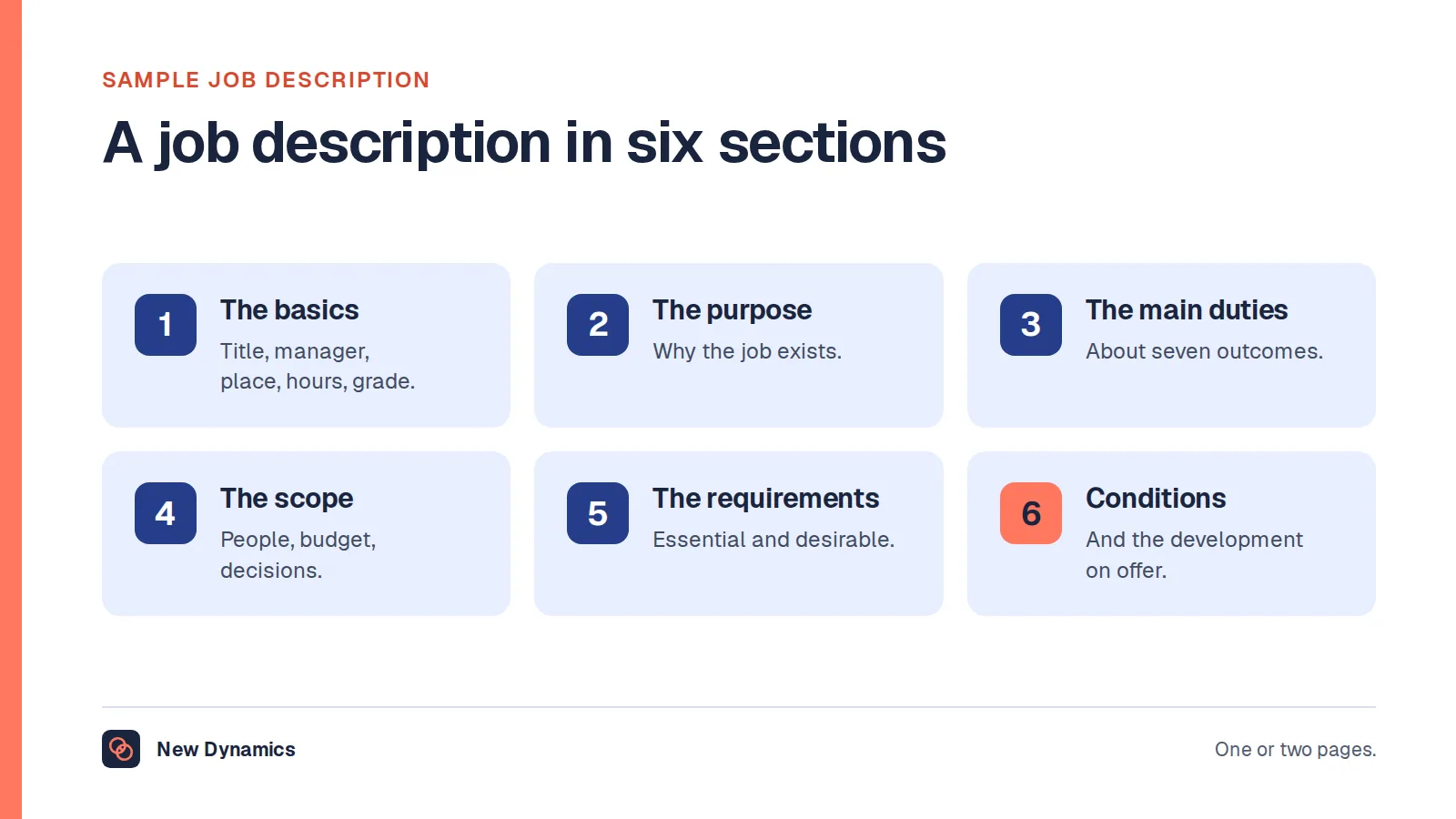
For the general format, see our sample job description.
Common mistakes
Treating catering as cooking only. Most failures at events are failures of logistics: timing, transport and numbers.
Asking about allergens on the day. By then it is too late to change the menu.
Hiring casual staff without a briefing. Every server needs to know what is in the food and whom to ask.
Choosing on price per head alone. Check what the price includes.
Forgetting the contract caterer's staff. People who work in your building every day for another employer are part of your workplace. Include them in safety briefings and common courtesy.
A job advert that hides the hours. Candidates find out soon enough.
Frequently asked questions
What is a caterer?
A caterer is a person or company that makes or serves food, usually for a particular event or for an organisation such as a school, hospital, office or venue. The food is often prepared in one place and served in another.
What are the types of catering?
There are three main kinds. In-house catering serves one organisation. Contract catering is provided by a catering company to several clients. Private or event catering serves special occasions such as weddings, parties and corporate events.
What does a catering manager do?
A catering manager plans, organises and develops a food and drink service. The job covers leading the team, planning menus, keeping quality and hygiene standards, managing budgets, stock and suppliers, and looking after clients and customers.
Do you need qualifications to be a caterer or catering manager?
Prospects says that you do not need a degree to become a catering manager, because relevant experience, skills and personal qualities are often more important. Food safety training is expected, and a qualification in hospitality or culinary arts can help.
Does a caterer need to register in the UK?
Yes. The Food Standards Agency says that you must register with your local authority to run a food business, including one run from home or a mobile unit. In England, Wales and Northern Ireland, registration is required at least 28 days before trading.
What is the difference between a caterer and a chef?
A chef cooks, and usually leads a kitchen. A caterer runs the whole service: the menu, the cooking, the transport, the staff, the equipment, the timing and the client. Many caterers are chefs, and a catering business employs chefs.
Your next step
If you are booking a caterer, send the five questions today and ask for answers in writing. If you are hiring a catering manager, build the job description on the six duties, and state the hours honestly.
For the whole hiring process, from the job description to the offer, read and download our recruitment and selection guide. The guide is free to read, and the PDF uses our short download form.
Want recognition to be part of everyday work, and not only of the annual party? Book a New Dynamics demo and bring your current approach. You can also email contact@new-dynamics.com.