TL;DR
- A construction company's roles fall into four groups: office and commercial, including estimating, buying, quantity surveying and planning; site management, from site manager or superintendent down to supervisor and foreman; engineering and technical, including setting out, design coordination and quality; and trades and operatives, who do the work. An advert that does not say which group a post sits in, and who it reports to on site, is describing a project rather than a job.
- Superintendent is largely the American name for what the UK calls a site manager: O*NET lists “Construction Superintendent”, “General Superintendent”, “Job Superintendent”, “Construction Foreman” and “Site Manager” together among the reported titles of construction managers. The National Careers Service describes the UK site supervisor's day as planning inspections with subcontractors, examining building plans against standards, managing orders and deliveries, organising work schedules, inspecting work and safety procedures, monitoring progress and quality, auditing inspection processes and completing site reports for construction managers.
- The construction operative, or labourer, is the role O*NET describes as performing tasks involving physical labour at construction sites: reading plans to determine work activities, setting out and marking distances, preparing sites to eliminate hazards, digging and backfilling to grade, moving and distributing materials to plan, positioning and sealing structural components, signalling plant operators and controlling traffic around work zones. Every construction advert then needs six things an office advert does not: the site and its duration, the duties under the construction safety regime, the cards and tickets required, the equipment provided, the hours and travel, and the employment status.
A housebuilder advertises for "a construction professional". A groundworks subcontractor advertises for "an operative". Neither advert says which site, who the person reports to, what card they need or whether the work lasts eight weeks or two years, and both firms then wonder why the response is poor. Construction company job descriptions fail in a way that office ones do not, because the job is defined as much by the site and the contract as by the duties.
This article maps the roles in a construction company into four groups, gives full descriptions of the two roles most often searched for, the construction superintendent and the construction operative, and sets out the six things every construction advert needs. It uses the US O*NET occupational database and the UK National Careers Service, and links to the detailed posts we have already written for the individual trades and professions.
New starters on site learn from induction, supervision and the first weeks of feedback, which on a short programme is most of the training they will get. See how New Dynamics onboarding brings tasks, early goals and manager conversations into a clear path for a new starter.
The four groups of roles
- Office and commercial. Estimators, buyers, quantity surveyors, planners, contracts managers, bid teams, plant managers and the finance, HR and health and safety functions behind them. They decide what the job costs and what it is committed to.
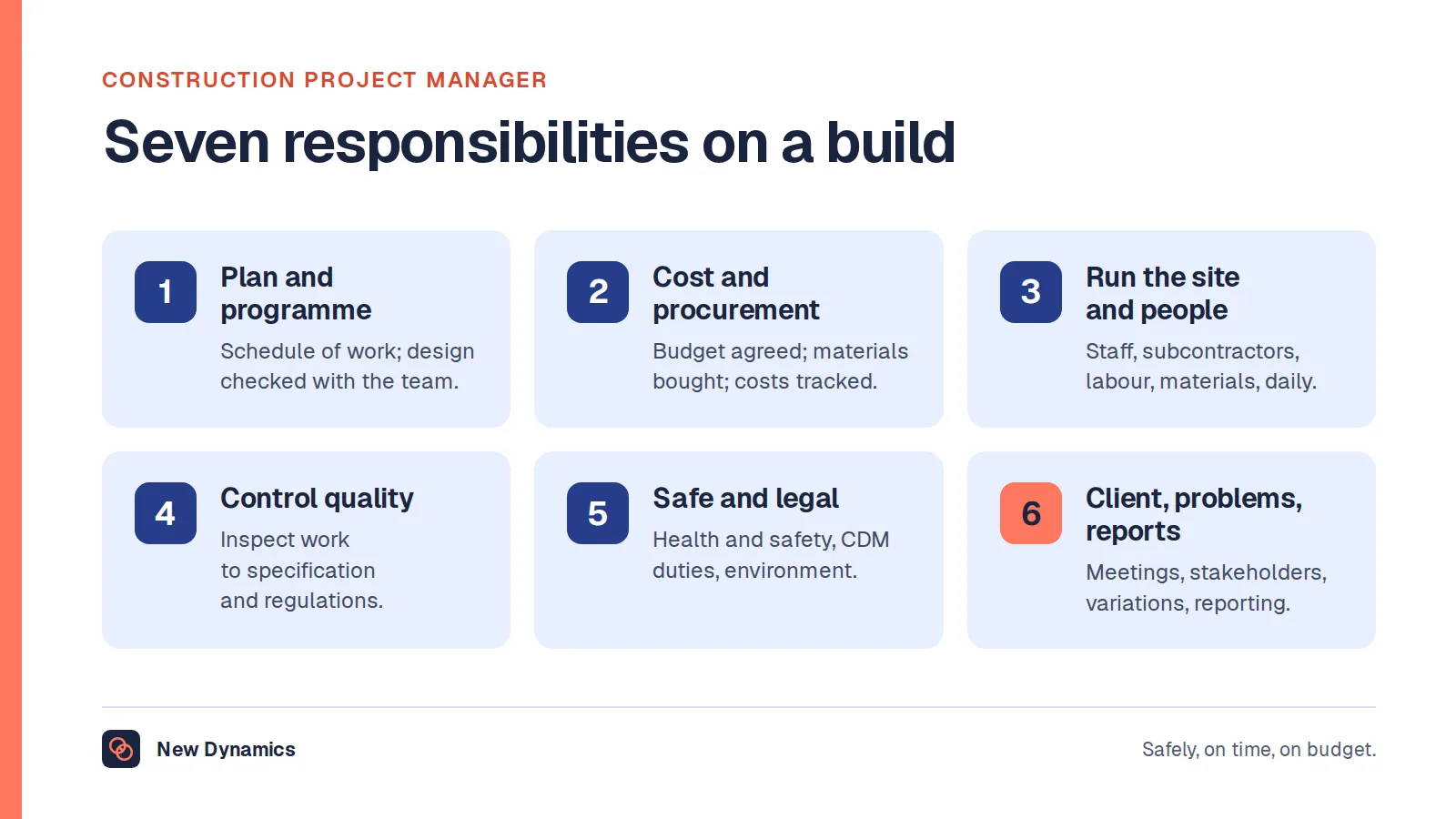
- Site management. Project manager, site manager or superintendent, site supervisor, foreman or ganger. They run the site day to day: sequence, labour, subcontractors, safety and progress. Our construction project manager job description covers the role above.
- Engineering and technical. Site and project engineers, setting-out engineers, design coordinators, temporary works and quality staff. Our project engineer job description and civil engineer job description cover these.
- Trades and operatives. Bricklayers, carpenters, electricians, plumbers, welders, plant operators, groundworkers and general construction workers. They do the work everyone else has been planning.
Write every advert with its group, its site and its reporting line in the first three lines.

The construction superintendent
What the title means
In the United States the superintendent runs the site. O*NET lists “Construction Superintendent”, “General Superintendent” and “Job Superintendent” among the reported job titles of construction managers, alongside “Construction Foreman”, “Construction Area Manager” and “Site Manager”, which tells you the important thing: superintendent and site manager are broadly the same job under different national conventions. O*NET places the occupation in Job Zone four, usually a bachelor's degree, though experience routes are common in both countries.
What the job involves
The National Careers Service describes the UK equivalent's day: plan site inspections with subcontractors; examine building plans to make sure they meet set standards; manage orders and deliveries of construction materials; organise staff work schedules; visit sites to inspect ongoing work and check safety procedures; monitor progress and check the quality of materials and building work; audit inspection processes to make sure they are effective; and complete site reports for construction managers. It notes that the work may be outdoors in all weathers, that the postholder needs to be able to cope with working at height, and that a full driving licence is required.
Grouped as duties for an advert:
- The programme on the ground. Sequence the work, organise labour and subcontractors, and keep the site to the construction programme.
- Materials and plant. Manage orders, deliveries and storage so that the right materials are there when the trade is.
- Quality and standards. Check work and materials against the drawings and specification; raise and close non-conformances.
- Safety. Inspect the site, check safe systems of work, run briefings, and stop work that is unsafe.
- Subcontractors and people. Brief, coordinate and hold subcontractors to their programme and standards; supervise the direct team.
- Records and reporting. Site diary, inspection records, progress reports to the construction manager, and the photographs that settle an argument later.
Progression. The National Careers Service lists health and safety, contract management, estimating, building surveying and control, and construction management as the routes on.

Superintendent job description template
Job title: Construction Superintendent (UK: Site Manager or Site Supervisor)
Reports to: Project Manager or Contracts Manager
Scope: State the project type and value band, the stage of the programme, the number of direct staff and subcontractors, the site location and the expected duration.
Purpose: Deliver the works on site safely, to the programme, to the specification and within the site budget, coordinating the trades and keeping the project team informed.
Responsibilities: as the six duties above, plus inductions for new starters and visitors, coordination with the client and designers where the role requires it, and handover and snagging at completion.
Requirements: experience managing comparable projects; the site management safety qualification and card the company requires; first aid and fire marshal training as applicable; ability to work at height; full driving licence; competence with the programme and reporting tools in use.
The construction operative
What the job involves
O*NET describes construction labourers as performing “tasks involving physical labor at construction sites”, operating hand and power tools of all types, and cleaning and preparing sites, digging trenches, setting braces and erecting scaffolding. Its tasks include: “read plans, instructions, or specifications to determine work activities”; “measure, mark, or record openings or distances to layout areas where construction work will be performed”; “clean or prepare construction sites to eliminate possible hazards”; “dig ditches or trenches, backfill excavations, or compact and level earth to grade specifications”; “load, unload, or identify building materials, machinery, or tools, distributing them to the appropriate locations, according to project plans or specifications”; “position, join, align, or seal structural components, such as concrete wall sections or pipes”; “signal equipment operators to facilitate alignment, movement, or adjustment of machinery”; “control traffic passing near, in, or around work zones”; and site activities required of green certified construction practices, such as waste management, identifying materials for reuse and installing erosion or sedimentation control.
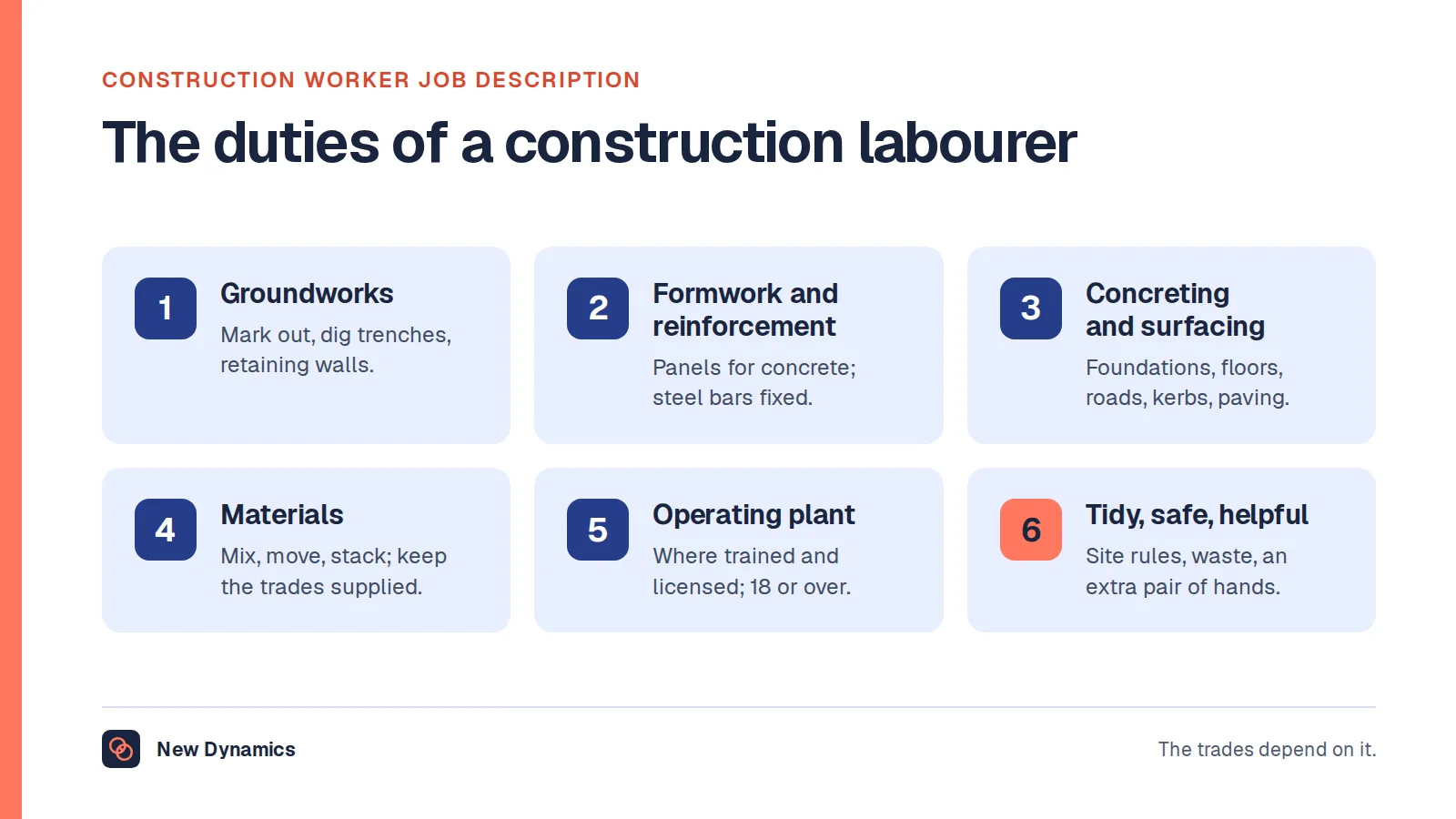
The National Careers Service's construction labourer profile gives the UK version: marking out and digging trenches for foundations and drains; putting up formwork panels to hold setting concrete; fixing steel bars to reinforce concrete; building retaining walls and steel piling to allow excavation; laying concrete for foundations, floors and beams; building or resurfacing roads and laying kerbs and paving; using machinery to lift and move materials; and keeping tradespeople supplied with bricks, mortar and timber. It notes that operating plant such as excavators or dumper trucks requires being 18 or over with a driving licence.
Operative job description template
Job title: Construction Operative (or Labourer, Groundworker, Plant Operative)
Reports to: Foreman, Ganger or Site Supervisor
Purpose: Prepare and support the works on site safely, keep the trades supplied and productive, and carry out the groundwork and general construction tasks the programme requires.
Responsibilities: site preparation and housekeeping to remove hazards; setting out and marking to instruction; excavation, backfilling and compaction to grade; moving, distributing and storing materials; assisting the trades; banksman duties and signalling plant; traffic management within the work zone; operating small plant and tools within competence; complying with method statements and risk assessments.
Requirements: the site card the company requires; any tickets for the plant or activities involved, such as plant operation or abrasive wheels; physical fitness; willingness to work outdoors and at height where applicable; for plant work, minimum age and licence.
Progression. The National Careers Service gives training on the job towards a qualified trade or plant operation, work in demolition or road resurfacing, and with experience team leader or site supervisor. Say so in the advert: operatives rarely hear that the route exists. Our construction worker job description covers the role in more detail.
Six things every construction job description must carry
Office job descriptions do not need these, and construction ones fail without them.
- The site and the duration. Where the work is, when it starts, how long the programme runs, and what happens at the end of it.
- The safety duties. The company's duties under the construction safety regime and what this role contributes: inductions, method statements, inspections, stopping unsafe work. Name the framework; do not paraphrase the regulations.
- Cards and tickets. The site card required, plant tickets, supervisory safety qualifications, first aid, and whether the company funds them.
- Equipment and PPE. What is provided, what the worker supplies, and the standards expected.
- Hours and travel. Start times, shift patterns, weekend working, travel between sites, and any lodging arrangement.
- Employment status. Employed, agency or subcontracted, and how pay and hours work in each case. This is the question candidates in construction ask first and adverts answer last.

Frequently asked questions
What job descriptions does a construction company need?
Four groups: office and commercial roles such as estimators, buyers, quantity surveyors and planners; site management roles from project manager and site manager or superintendent to supervisor and foreman; engineering and technical roles such as site and project engineers and setting-out staff; and trades and operatives. Each advert should state its group, the site, the reporting line and the duration.
What does a construction superintendent do?
Runs the site: sequencing the work and organising labour and subcontractors, managing materials and deliveries, checking quality against the drawings and specification, inspecting for safety and stopping unsafe work, supervising the team and reporting progress to the construction manager. The US occupational database lists construction superintendent among the titles of construction managers, alongside site manager, which is the UK name for broadly the same job.
What is the difference between a construction superintendent and a project manager?
The superintendent or site manager runs the works on the ground; the project manager owns the contract, the budget, the client relationship and the wider programme. On small projects one person does both, and the advert should say which it means.
What does a construction operative do?
Prepares sites to remove hazards, reads plans to determine work activities, sets out and marks distances, digs and backfills to grade, moves and distributes materials according to the plan, positions and seals structural components, signals plant operators, controls traffic around the work zone and keeps the trades supplied. The UK profile adds formwork, steel fixing, concreting, kerbing and paving.
What should a construction job advert include that others do not?
The site and how long the work lasts, the safety duties attached to the role, the cards and tickets required and who pays for them, the equipment and PPE provided, the hours, shifts and travel, and the employment status, whether employed, agency or subcontracted.
Your next step: write the advert from the site outwards
- Name the group, the site, the reporting line and the duration in the first three lines.
- Use the duty list for the role, not a generic one copied from another company.
- State the cards, tickets and PPE, and who funds them.
- Say plainly whether the post is employed, agency or subcontracted, and what the hours are.
For an induction that gets a new starter productive and safe in their first week on site, read and download our employee onboarding guide. The guide is free to read, and the PDF uses our short download form.
Want site inductions, early objectives and check-ins recorded in one place across multiple sites? Book a New Dynamics demo and bring your current site induction. You can also email contact@new-dynamics.com.