TL;DR
- A construction worker, called a construction labourer, construction operative or groundworker in the UK and a laborer in the United States, supports tradespeople on building sites: digging and forming, concreting, moving materials, operating small plant and keeping the site running.
- The job has seven duties: groundworks, formwork and reinforcement, concreting and surfacing, moving and supplying materials, operating plant, keeping the site tidy and safe, and helping the trades. In Great Britain, workers also hold legal safety responsibilities of their own under CDM 2015.
- No qualifications are needed to start. Most UK sites require a CSCS card, plant operation needs training and a licence, and level 2 apprenticeships exist for groundworkers and plant operatives. A good advert states the site, the hours, the training and the route to a trade.
Every trade on a building site works on ground somebody dug, concrete somebody poured and materials somebody carried. The person who did those things is the construction worker, and a construction worker job description that reads "general labouring duties" undersells a job with real skill, real risk and real legal responsibility.
This article sets out what a construction labourer does, seven duties, the safety responsibilities that workers themselves hold on a British site, the skills employers look for, the routes into the role including the CSCS card, a template and wording for a CV. It uses UK sources; other countries organise site work and its regulation differently.
New starters on site learn from induction, supervision and feedback in the first weeks. See how New Dynamics onboarding brings tasks, early goals and manager conversations into a clear path for a new starter.
What is a construction worker?
The UK National Careers Service profiles the role as construction labourer, with construction operative and groundworker as alternative titles: “Construction labourers support tradespeople on building sites by digging trenches, mixing mortar and concrete, and operating machinery.” Typical hours are 40 to 44 a week, with evenings, weekends and time away from home on some projects, at height and outdoors in all weathers.
Titles vary. Labourer and general operative are the common UK terms; laborer, construction laborer and construction worker the American ones. Groundworker describes the labourer who specialises in foundations, drainage and external works. The Health and Safety Executive's guidance on construction workers' roles and responsibilities under the Construction (Design and Management) Regulations 2015 defines a worker as “anyone working for or under the control of a contractor on a construction site”, and lists labourers alongside plumbers, electricians, scaffolders, painters, decorators and steel erectors.
Construction worker duties: seven responsibilities
The NCS lists the day-to-day tasks. Grouped into seven:
- Groundworks. Mark out and dig trenches for foundations and drains, and build retaining walls with panels to allow excavations.
- Formwork and reinforcement. Put up formwork panels to hold setting concrete in place and fix steel bars to reinforce concrete structures.
- Concreting and surfacing. Lay concrete for foundations, floors and beams; build or resurface roads and lay kerbs and paving.
- Moving and supplying materials. Keep tradespeople supplied with bricks, mortar and timber, and mix mortar and concrete.
- Operating plant. Use machinery to lift and move building materials around a site, where trained and licensed.
- Keeping the site tidy and safe. Clearing waste, keeping walkways and storage in order and following site rules, which the HSE guidance treats as part of every worker's duties.
- Helping the trades. Working alongside bricklayers, carpenters, steel fixers and others as the extra pair of hands their work needs.
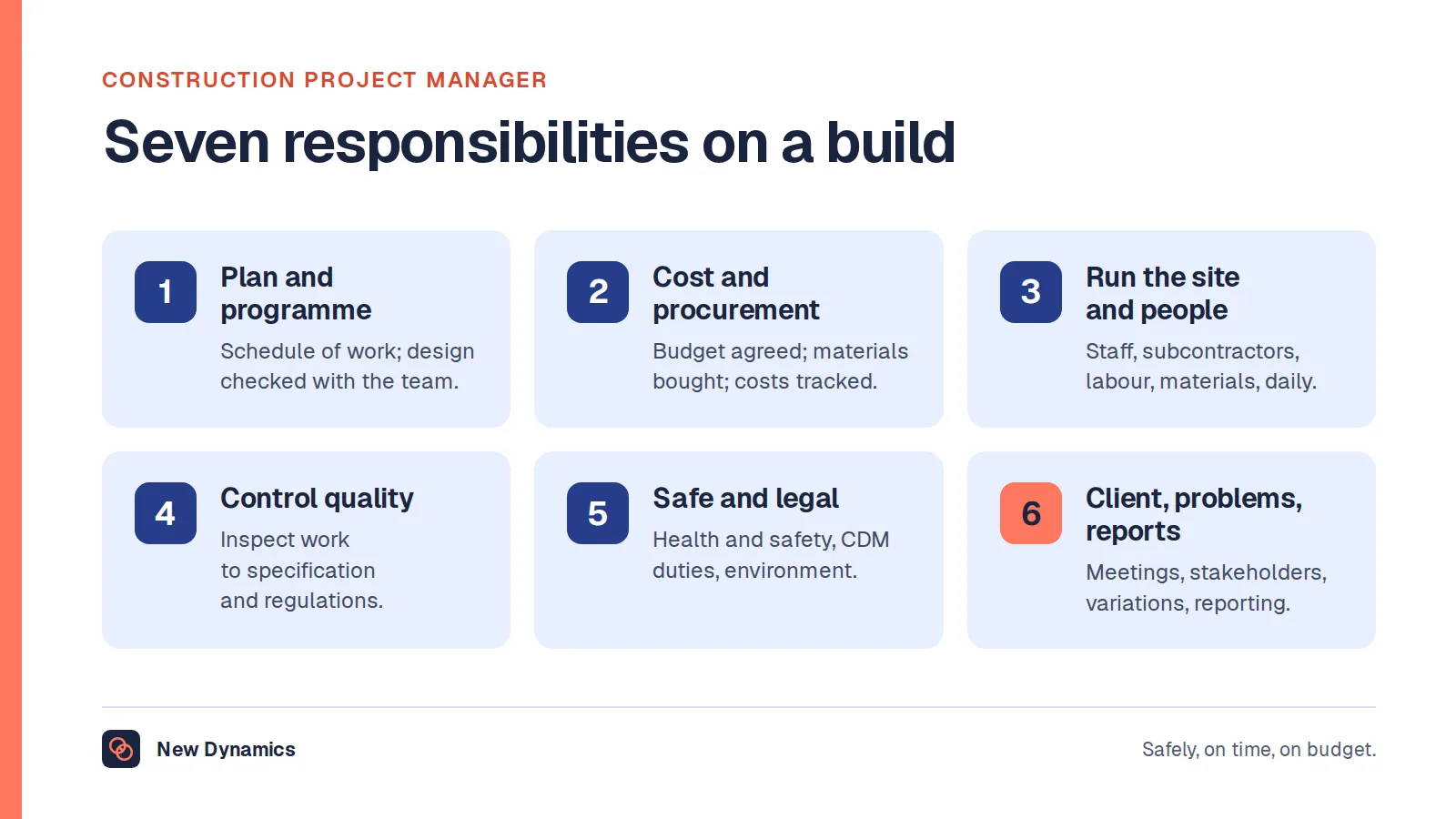
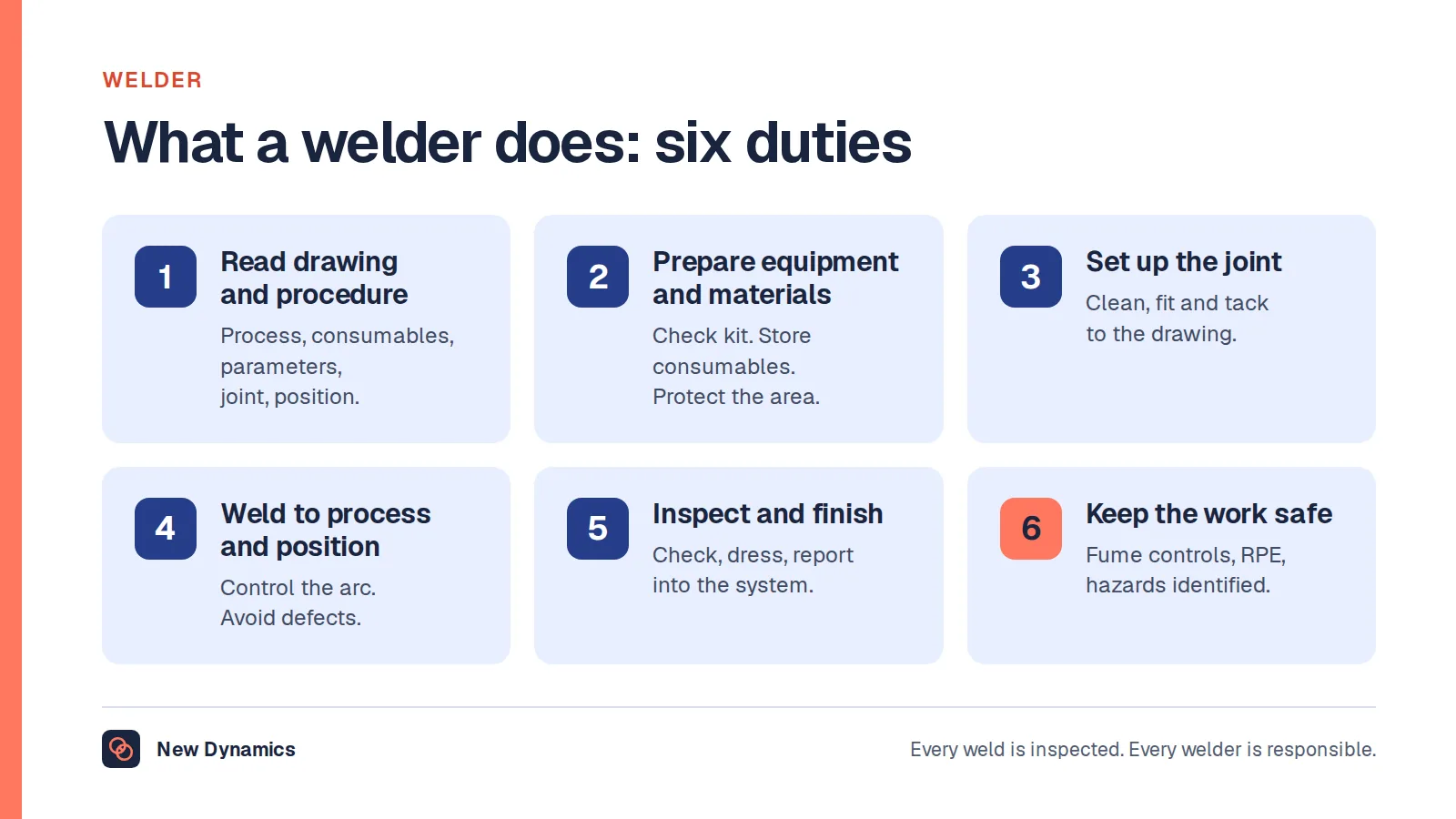
Our construction project manager job description describes the role that plans and directs this work, and our welder job description one of the trades it supports.

Safety responsibilities of a construction worker
On a British site, workers are not only protected by health and safety law; they hold duties under it. HSE's guidance on workers under CDM 2015 says workers “have an important role and should take an active part in helping to manage health and safety risks”, and lists what they must do: only carry out construction work if they have the relevant skills, knowledge, training and experience, or are provided with the training and supervision to do it safely; make themselves aware of the health and safety risks on every site and how they are managed; always follow site rules and procedures; cooperate with other dutyholders such as the contractor in control of their work and the principal contractor; and report any risks they find to whoever controls the work on site, whether the risks affect their own health and safety or anyone else's, including the public.
HSE also says employers “must consult their workers (or their representatives) on any health and safety matters that affect them”. A job description should include the worker's duties in that list, and the training, induction and equipment the employer provides to make them possible. HSE's construction safety topics cover the hazards a labourer meets most: working at height, excavations, mobile plant and vehicles, manual handling, slips and trips and structural stability.
This is general information about regulations as HSE describes them, not legal advice, and rules differ elsewhere.

Skills employers look for
The NCS lists knowledge of building and construction, the ability to work well with your hands, teamwork, knowledge of public safety and security, thoroughness and attention to detail, the ability to operate and control equipment, the ability to accept criticism and work under pressure, physical fitness and endurance, and basic computer or hand-held device skills. It notes that some jobs involve operating plant such as excavators or dumper trucks, for which you need to be 18 or over and hold a driving licence.
For an advert, six things: fitness and stamina, safety habits, practical skill with tools and materials, reliability for early starts, teamwork with the trades and a willingness to learn towards a trade or plant ticket.
Routes in, the CSCS card and progression
No set requirements. The NCS says you can apply directly, and it may help to have construction site experience, knowledge of building materials or experience in a builder's merchants or yard. You may need your own safety boots, hard hat and hi-vis, though some employers supply them.
CSCS card. The NCS lists registration with the Construction Skills Certification Scheme as a requirement; most UK sites will not admit workers without a card, which involves a health, safety and environment test.
College and apprenticeships. College courses in construction skills or construction operations, and level 2 apprenticeships including groundworker, construction plant operative, piling attendant and road surfacing operative.
Progression. The NCS says a labourer could train on the job to be a qualified tradesperson or plant operator, work in demolition or road resurfacing, or with experience become a team leader or construction site supervisor. Our foreman job description describes that supervisor role.
Requirements differ in other countries. Check the rules where you work.

Construction worker job description template
Adapt the template to your site. Keep every line true.
Job title: Construction labourer (general operative) [or: Groundworker]
Reports to: Site supervisor or ganger
Location and hours: [Project site]; [42] hours a week, [7am to 5pm], with [Saturday] working at busy stages; [travel or lodging as required]
Purpose of the role: To carry out groundworks, concreting and general site work and to keep the trades supplied, safely and to the site's standards, so that the programme keeps moving.
Main duties:
- Dig and prepare trenches and excavations; install formwork and reinforcement
- Lay concrete, kerbs and paving; assist with road and surface works
- Move, stack and supply materials to trades by hand and with plant where trained
- Operate [dumper / telehandler / excavator] where licensed
- Keep the site tidy and safe; segregate waste; follow site rules and the traffic plan
- Take part in inductions, toolbox talks and briefings; report hazards and near misses
- Support [bricklayers, carpenters, steel fixers] as required
Requirements:
- Valid CSCS card [or willingness to obtain before starting]
- Physically fit for manual work outdoors in all weathers
- [Plant tickets for named machines, desirable]
- Over 18 with a driving licence for plant operation
- Reliable and punctual for early starts
We provide: Site induction and safety training, PPE, [plant training towards tickets], and a route to a trade apprenticeship, plant operator or supervisor.
State the project, the hours and any travel or lodging, and what training you fund. Our job description template explains the overall structure.
How to describe construction work on a CV
Write what you did and the scale. The lines below are our own examples.
- “Groundworker on a [200]-plot housing site: foundations, drainage and external works over [18] months.”
- “CSCS card holder; [dumper and telehandler] tickets; trained in confined spaces.”
- “Fixed reinforcement and formwork for [n] pours; assisted the concrete gang on slab and beam work.”
- “Kept a [six]-trade site supplied and tidy; [zero] reportable incidents in my gang.”
- “Started a level 2 groundworker apprenticeship in [year].”
Common mistakes in construction worker adverts
"General labouring duties" and nothing else. Say what the site does and what the work is.
Hours and travel hidden. Early starts, Saturdays and lodging away are the job. Say so.
Safety as a footnote. Workers hold duties; list them and the training you provide.
CSCS and tickets unstated. Say what is required on day one and what you will fund.
No route onward. Trade apprenticeships, plant tickets and supervision come from this job. Name them.
Frequently asked questions
What does a construction worker do?
A construction worker or labourer supports the trades on a building site: digging and forming groundworks, fixing formwork and reinforcement, laying concrete and surfaces, moving and supplying materials, operating plant where trained, keeping the site tidy and safe and helping tradespeople. The National Careers Service profiles the role as construction labourer.
What are the duties of a construction labourer?
Seven core duties: groundworks, formwork and reinforcement, concreting and surfacing, moving and supplying materials, operating plant, keeping the site tidy and safe, and helping the trades. Workers on British sites also hold legal safety duties under CDM 2015.
What safety responsibilities does a construction worker have?
Under CDM 2015, HSE says workers must only do work they are trained and competent for, make themselves aware of the risks on every site, follow site rules, cooperate with the contractor and principal contractor, and report any risks they find. Employers must consult workers on health and safety matters.
Do you need qualifications to be a construction worker?
No set qualifications. Most UK sites require a CSCS card, plant operation needs training, a licence and a minimum age of 18, and level 2 apprenticeships exist for groundworkers, plant operatives, piling attendants and road surfacing operatives.
What is the difference between a labourer and a groundworker?
A groundworker is a labourer who specialises in foundations, drainage, excavations and external works. The National Careers Service lists groundworker as an alternative title for construction labourer and as a level 2 apprenticeship.
What is the career path for a construction worker?
Training on the job towards a trade or plant operation, demolition or road surfacing, and with experience team leader or site supervisor, according to the National Careers Service.
Your next step
- Describe the site and the work in the first two lines.
- State the hours, travel and lodging honestly.
- Put the worker's safety duties and your training and PPE into the job description.
- Plan the first week: CSCS check, induction, buddy and a review at the end.
For the first weeks on site, read and download our employee onboarding guide. The guide is free to read, and the PDF uses our short download form.
Want inductions, training records and check-ins tracked for every worker on every site? Book a New Dynamics demo and bring your current job description. You can also email contact@new-dynamics.com.