TL;DR
- UK data protection law sets no single retention period for employee records. The ICO is explicit that “data protection law does not set specific time limits for how long you can keep your workers’ personal information”. Your duty is to decide, document and justify your own periods, and then to actually delete.
- A handful of periods are fixed by statute: three years from the end of the tax year for PAYE and statutory maternity and paternity pay, two years after employment ends for right to work evidence, six years for minimum wage records, and two years for working time records.
- Everything else is reasoning, not a rule. Most employers set periods from the window in which a claim could still arrive, write the reason next to the number, and give deletion a date and an owner so the schedule is a process rather than a document.
Almost every page written about this question implies there is a single answer, a number you can write into a policy and stop thinking about. There is not one. UK data protection law sets no universal retention period for employee records. It requires something harder: that you decide your own periods, document them, be able to justify them, and then actually delete the records when the period ends.
That last clause is where most organisations quietly fail. A retention schedule that nobody runs is not a schedule. It is a document about a policy you do not have.
This article covers what is genuinely fixed by law and where each period comes from, which categories are a judgement call and how to reason about them, how to write a schedule, and how to make deletion happen. It describes the position in the United Kingdom and is general information rather than legal advice.
Retention fails at handovers and leavers, not at decisions. See how New Dynamics workflows give every step an owner and a due date, including the deletion step nobody currently owns.
Why there is no single number
The relevant principle is storage limitation. The ICO quotes the law as requiring that personal data be "kept in a form which permits identification of data subjects for no longer than is necessary for the purposes for which the personal data are processed", and then says plainly: "The UK GDPR does not set specific time limits for different types of data. This is up to you, and will depend on how long you need the data for your specified purposes."
The ICO repeats the point in its employment guidance, this time about workers specifically: "data protection law does not set specific time limits for how long you can keep your workers' personal information. This is up to you, and will depend on how long you need the information for your particular purposes."
So the duty is procedural rather than numerical. You "should set up a retention policy or schedule that lists: the types of record or information you hold; what you use it for; and how long you intend to keep it", you must "be able to justify why you need to keep personal data in a form that permits identification of individuals", and you are warned not to take a "one-size-fits-all" approach to retaining workers' personal information. When the period ends, "you should erase it or, if possible, anonymise it", for example "after the employment relationship and all your legal obligations to retain the information have ended".
No official body publishes a universal employee retention table, which is why the tables circulating online rarely cite anything. The useful move is to separate the periods that come from a statute from the ones that come from someone's judgement, and to be honest with yourself about which is which.
What is actually fixed by law

Payroll and PAYE records: three years from the end of the tax year
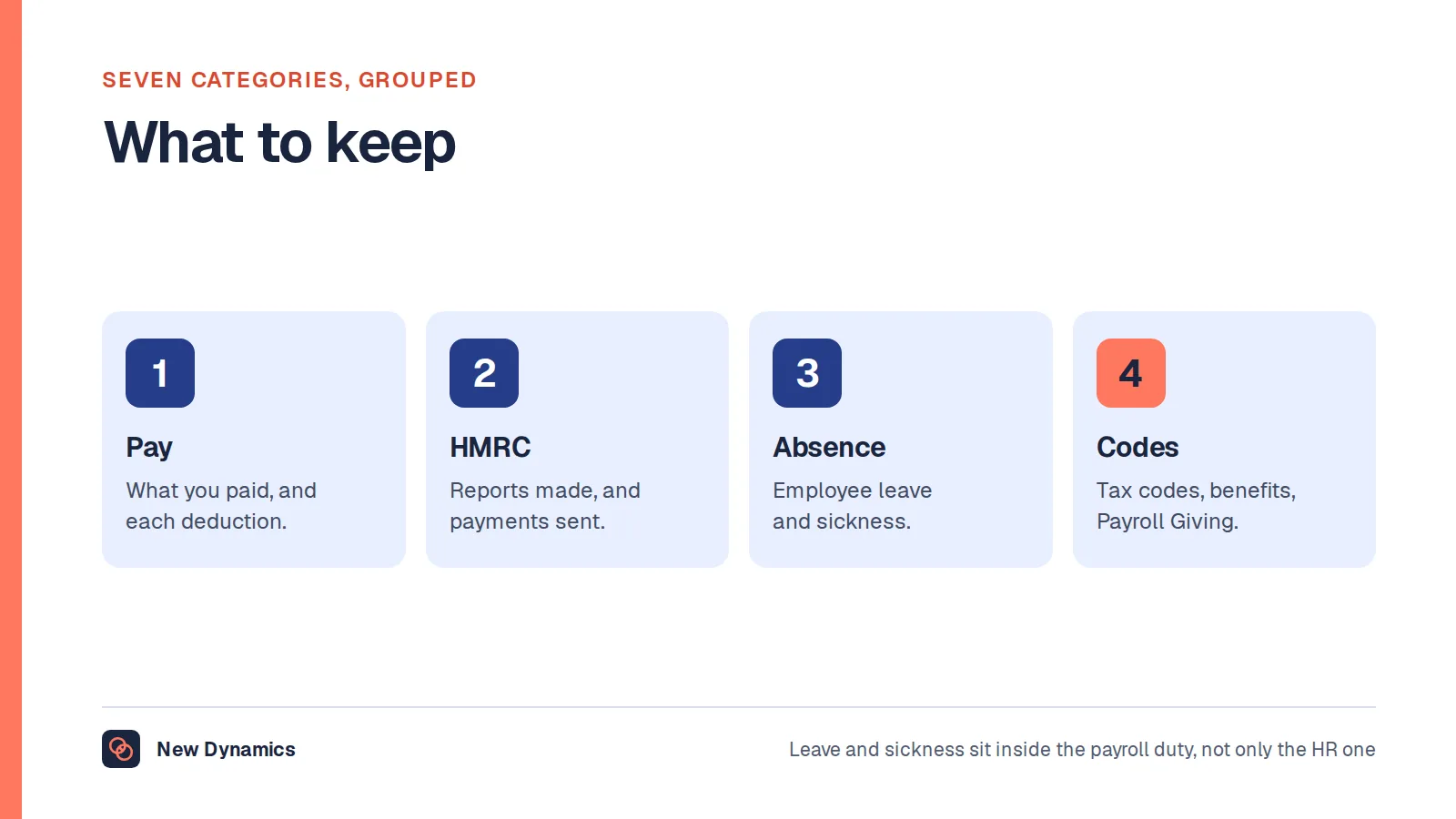
GOV.UK's guidance on keeping PAYE records lists what you must hold, including what you pay employees and the deductions you make, reports and payments to HMRC, employee leave and sickness absences, tax code notices, and taxable expenses or benefits. You must "keep them for 3 years from the end of the tax year they relate to".
The consequence of a gap is specific: "If you do not keep full records, HMRC may estimate what you have to pay and charge you a penalty of up to £3,000." Our payroll records post goes through the seven categories and the year-end calendar in detail.
Right to work evidence: all of employment, plus two years
This is the period most often got wrong, because it is measured from the wrong end. GOV.UK's guidance on checking a job applicant's right to work says to keep copies "during the applicant's employment and for 2 years after they stop working for you".
Two years after the leaving date, not two years after the check. A leaver purge that strips the whole file on the last day of employment destroys the one document that establishes a statutory excuse against a civil penalty.
National Minimum Wage records: six years
HMRC's internal National Minimum Wage manual sets the current period. Records "from 1 April 2021 must be retained by the employer for a minimum of 6 years beginning with the day the pay reference period following the one that the records cover ends". The older rule was three years, and the manual confirms that "for pay reference periods ending before 1 April 2018 employers are required to keep records for no less than 3 years".
Two things follow. The clock starts at the end of the pay reference period after the one covered, not at the payment date. And a retention rule that says "payroll: three years" and stops is wrong for minimum wage purposes by three years, which matters because these are exactly the records a wage dispute turns on.
Working time records: two years
Regulation 9 of the Working Time Regulations 1998 requires an employer to keep records "which are adequate to show whether the employer has complied" with the weekly working limits, and to "retain such records for two years from the date on which they were made". The regulation is permissive about format: records may be "created, maintained and kept in such manner and format as the employer reasonably thinks fit".
Note that this period runs from when the record was made, not from the end of employment or the end of a tax year. Three statutory periods, three different start points, which is the real reason a single retention number cannot work.
Statutory maternity and paternity pay: three years from the end of the tax year
For maternity pay you must keep proof of pregnancy, the date statutory maternity pay began, the payments made and their dates, the amount reclaimed, and "any weeks you did not pay and why". The period: "You must keep records for 3 years from the end of the tax year they relate to."
Paternity pay mirrors it, covering the start date, the payments made, the amounts reclaimed, unpaid weeks and the reason, plus a letter from the adoption agency or a matching certificate where adoption applies. Same period: "3 years from the end of the tax year they relate to."
Statutory sick pay: the rule that was withdrawn
Worth knowing because so much published advice still asserts a sick pay retention period. HMRC's statutory payments manual records that "with effect from 6 April 2014 regulation 13 was revoked and employers are no longer required to keep records of sickness absence". The manual adds that "regulation 13A is still in force and an employer may be required to produce records to show SSP has been paid to their employees".
So there is no prescribed sick pay record period, but there is still a duty to be able to show payment, which the PAYE records cover anyway. Where the absence record names a condition, data protection pulls in the opposite direction, as below.
The categories that are a judgement call

For these there is no statute to point at. What follows is reasoning you can write down, not numbers to copy.
Recruitment records for unsuccessful candidates. The ICO is unusually direct here. Its guidance on keeping recruitment records says that "under data protection law, you must not keep information for longer than you need to", and that unless there is a clear business reason, an employer "should not keep recruitment records for unsuccessful candidates beyond the statutory period in which an applicant can bring a claim arising from the recruitment process". More generally: "in general, you should not keep information beyond the statutory period in which a legal claim can potentially be brought". A talent pool is a clear business reason only if you told candidates about it and they can opt out of it.
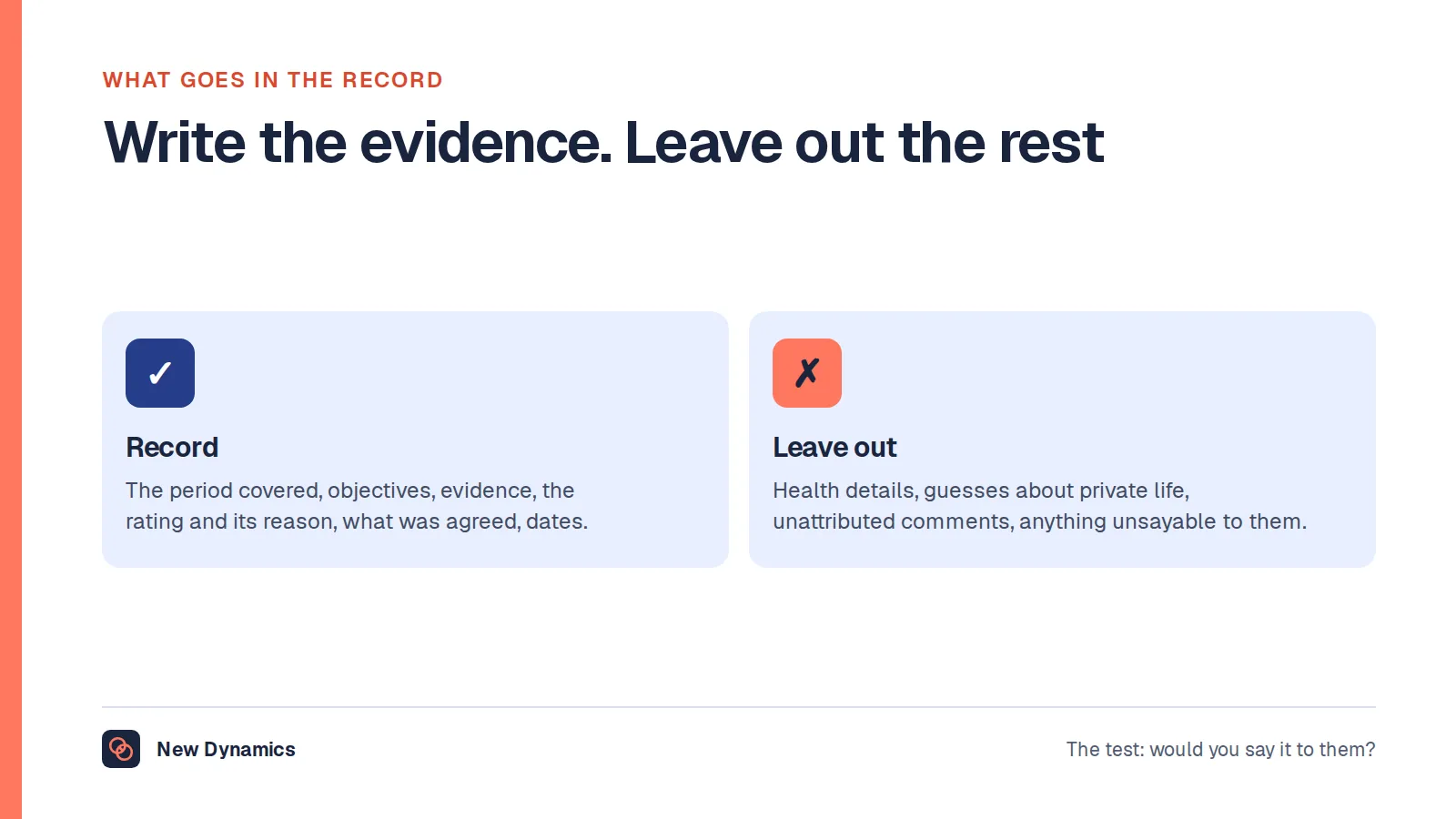
Disciplinary and grievance files. The record's useful life is usually tied to the sanction rather than the file. A warning that has expired has no decision-making purpose, so the live record should come off the file and the archived copy should be kept only to evidence that a fair process happened. Keeping an expired warning where a manager can read it is a fairness problem before it is a retention problem.
Performance records. No statutory period exists. The period usually runs through employment, because pay and progression decisions refer back to the history, plus a defined tail afterwards for references and disputes. We have written separately on performance review record keeping, including who should be able to read what.
Occupational health and sickness records. These need their own, shorter treatment because they are special category data. The ICO states that "sickness and injury records include information about workers' physical or mental health" and that "holding sickness or injury records therefore involves processing special category data". It distinguishes a sickness record, which "contains details of the illness or condition responsible for a worker's absence", from an absence record, which "may give the reason for absence as 'sickness' or 'accident' but does not include any reference to specific medical conditions". You "must ensure you take appropriate measures to keep sickness and injury records secure, especially given the sensitive nature of the information", and "should not make the sickness, injury or absence records of individual workers available to others, unless it is necessary for them to do their jobs". In practice: keep the absence record for as long as you need absence data, and keep the diagnosis for as long as you need the adjustment, which is usually much shorter.
CCTV and other monitoring data. The ICO's monitoring guidance says you "must not keep personal information obtained from monitoring workers for any longer than is necessary for your particular purpose or purposes", that you "should base any retention period you set on business need", and that you "should not retain information just in case you find a purpose for it in the future". It then closes the loop: "you must ensure you have a retention schedule and delete any information you collect from monitoring workers in line with your schedule". Footage retained because the system's default was ninety days is retention by accident, which is not a justification.
The limitation period logic, and what it really is
Here is the reasoning almost every employer actually uses, stated honestly as reasoning rather than as a rule.
Records exist partly to defend decisions. So the question becomes: for how long could a claim about this decision still arrive? GOV.UK's guidance on making an employment tribunal claim now states: "You usually have to make a claim to the tribunal within 6 months of the problem happening. If the problem happened before 1 October 2026, you may need to make a claim within 3 months." For a claim in contract rather than at the tribunal, section 5 of the Limitation Act 1980 provides that "an action founded on simple contract shall not be brought after the expiration of six years from the date on which the cause of action accrued".
That is where the familiar six-year convention comes from, and it is also why the shorter periods people quote for personnel files often leave a gap. A claim notified at the edge of a window can take considerably longer to conclude, so a period that expires the day the window closes still leaves you defending a decision with no record of it. Add a margin and write the margin down.
But be clear what this is. The limitation period tells you when a claim becomes impossible, not how long the record is necessary. The ICO's framing for monitoring applies everywhere: you "should be able to justify any retention periods that you set, and be able to link these to the reasons why you have obtained the information". A limitation period is a good reason. It is not a legal requirement to keep anything.
Writing a schedule that works

- List what you actually hold, not what the policy says you hold. Include the shared drive, the recruitment inbox, the exported spreadsheets, the previous system nobody switched off, and the manager notebooks. Anything that identifies someone is in scope.
- Name the purpose of each category in one line. This step does most of the work. A category with no statable purpose has already answered its own retention question.
- Check the statute first. PAYE, right to work, minimum wage, working time and statutory payments have periods set for you. Write those in before you start reasoning.
- Set the remaining periods from the purpose, with the reason recorded next to the number. The ICO asks you to "establish and document standard retention periods for the different categories of information you hold" where that is possible.
- Give deletion a date, an owner and evidence. A log showing the September batch was deleted on the second of October by a named person is worth more in an audit than a beautifully formatted policy.
Making deletion actually happen
A schedule fails for predictable reasons, and all of them are operational rather than legal.
The leaver process is the single biggest gap. When someone leaves, different parts of their file acquire different clocks on the same day: right to work evidence runs for two years from that date, payroll records run to the end of the tax year plus three, minimum wage records may run for six, and the diagnosis in the occupational health file may have no remaining purpose at all. Treat a leaver as a trigger that starts several timers, not as a single delete date.
Copies defeat schedules. The record you delete from the system still exists in the attachment, the export, the backup and the manager's downloads folder. The only durable fix is to reduce the number of places a record can live, which is the honest argument for employee records management software over a folder structure: one record per person, with access by role, and a deletion date that applies to the thing itself rather than to one of its copies.
Nobody owns it. Retention is everyone's responsibility, which means it is nobody's. Name a person, put a recurring date in their calendar, and make the task small enough that it actually happens.
And deleting feels risky, so people keep everything. This is the most common failure of all, and it is worth saying out loud that it is a choice with its own cost. Holding more than you need increases what a breach exposes, increases the work in every subject access request, and makes the information less accurate over time. "Forever, just in case" is not a cautious position. It is an undocumented decision to take on more risk than the statute asks of you.
The subject access request angle
Retention and access are the same problem seen from two ends. The ICO's employer guidance confirms that "a worker can make a SAR verbally or in writing, including by social media", and that "you must respond to a SAR from a worker without delay and within one month of receipt of the request".
One month is not long to search a decade of a shared drive. Every category you have genuinely deleted is a category you do not have to search, redact or explain, which is the practical argument for a schedule that people often find more persuasive than the legal one.
Two cautions. A request is not a reason to start deleting: routine, scheduled deletion that was already due is one thing, and deletion prompted by a request is another entirely. And a person asking for their file is often also asking why you still have it, so be ready to answer with a period and a reason rather than a shrug.
Frequently asked questions
How long do you keep employee records?
There is no single answer in UK law. Data protection law sets no specific time limits for workers' personal information, so you set, document and justify your own periods. A few are fixed for you: three years from the end of the tax year for PAYE and statutory maternity and paternity pay, two years after employment ends for right to work evidence, six years for minimum wage records and two years for working time records.
How long do former employers keep records of an employee?
For as long as they have a stated purpose, which in practice means years rather than months. Right to work evidence must be held for two years after the leaving date, payroll records for three years from the end of the relevant tax year, and minimum wage records for six years. Beyond those, many employers keep a core personnel record for several years after someone leaves so that they can answer reference requests and respond to any claim that arrives later.
Is there a legal retention period for employee files?
Not for the file as a whole. Statutory periods attach to particular records inside it, such as payroll, right to work, minimum wage and working time, and the rest is a judgement you must be able to justify. That is why a single retention period written across a whole personnel file is usually both too long for some records and too short for others.
How long should you keep records for unsuccessful candidates?
The ICO's position is that, unless there is a clear business reason, you should not keep recruitment records for unsuccessful candidates beyond the statutory period in which a claim arising from the recruitment process could be brought. If you want to retain applications for a future vacancy, tell candidates at the point of application, say how long you will keep them, and let them decline.
Do you have to delete employee records when the retention period ends?
Yes. Storage limitation is not satisfied by having a schedule; it is satisfied by acting on it. The ICO expects that once you no longer need the information you erase it or, where possible, anonymise it. Aggregate reporting data can usually be anonymised and kept, while the identifiable record behind it goes.
Can we keep everything in case we need it later?
That is the most common approach and the hardest to defend. You must be able to justify keeping personal data in a form that identifies people, and "we might need it" is not a purpose. Holding records with no purpose increases the exposure from any breach, lengthens every subject access request and leaves you relying on information that has gone stale.
Your next step: pick one leaver and follow the record
- Choose someone who left eighteen months ago and list every place their information still exists, including exports, inboxes and the old system.
- Mark each item with the statutory period that applies, or write "judgement" next to it.
- For every judgement item, write one line of purpose. Delete what has no purpose today.
- Set the deletion dates for the rest, give them an owner, and record that the deletion happened.
For the policy this schedule sits inside, read and download our employee data protection guide. The guide is free to read, and the PDF uses our short download form. Our HR compliance post covers the wider duties around it.
Want one record per person, with access by role and a deletion date that actually fires? Book a New Dynamics demo and bring your current retention schedule, if one exists. You can also email contact@new-dynamics.com.