TL;DR
- A foreman is a skilled person with experience who is in charge of and watches over a group of workers. On a construction site the role is usually titled site supervisor, and Skills England's level 4 standard sums it up as supervising specialist contractors and workers on construction projects.
- The foreman duties and responsibilities fall into six groups: plan and organise the day's work, supervise the gang and subcontractors, control quality against the drawings, run safety on the ground, manage materials and deliveries, and report progress to the site manager. The National Careers Service's site supervisor tasks cover all six.
- Write the description around the trades supervised, the size of the gang, the reporting line to the site manager and the cards and certificates needed. Ask for leadership and the ability to motivate and manage staff as much as trade knowledge.
Between the site manager's programme and the bricklayer's trowel there is a person who decides what happens on this scaffold this morning. Traditionally that person is the foreman; on most UK sites the job title now is site supervisor, and on the largest it is a ganger, a working foreman or a trade supervisor under a section manager. Whatever the title, the job is the same: turn the plan into the day's work, and see that it is done safely and properly.
This article gives a foreman job description for construction: what the role is, the foreman duties and responsibilities, the skills, the route in and the cards needed in the UK, how it differs from the site manager and the construction worker, and a template to adapt. The routes are for England; the duties are the same on any site.
Foremen run the daily conversation with the people doing the work. See how New Dynamics continuous feedback supports check-ins between managers and their teams.
What is a foreman?
The Cambridge Dictionary defines a foreman as “a skilled person with experience who is in charge of and watches over a group of workers”. The word is used in factories, warehouses and workshops as well as on sites; this article is about the construction foreman.
In the UK the formal title is usually site supervisor. The National Careers Service says construction site supervisors “inspect the work of contractors on building sites and make sure it meets quality and safety standards”, and lists building site manager, site inspector and clerk of works among alternative titles. Skills England's construction site supervisor apprenticeship, a level 4 standard of 36 months, summarises the occupation as “Supervising specialist contractors and workers on construction projects.”
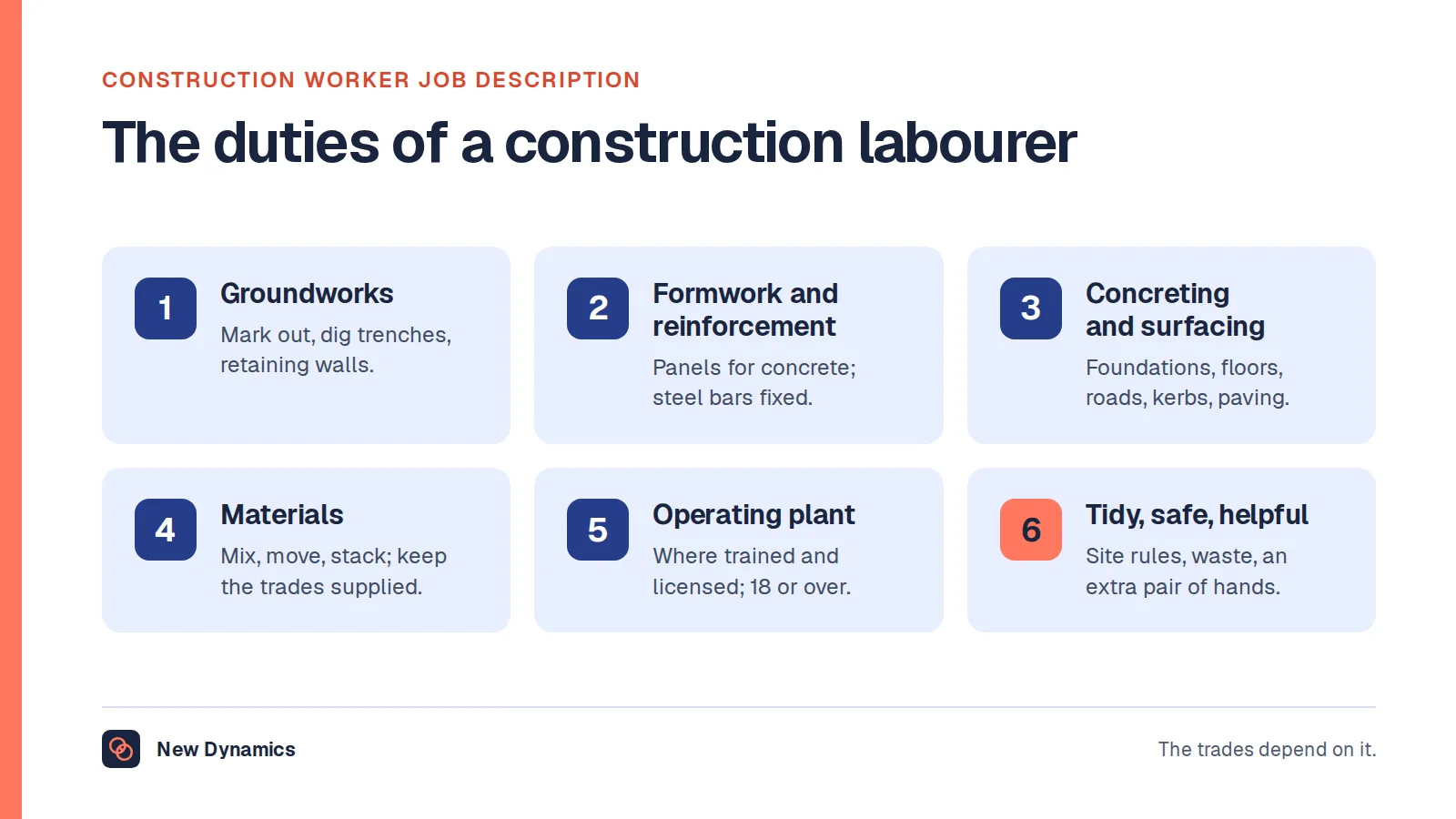
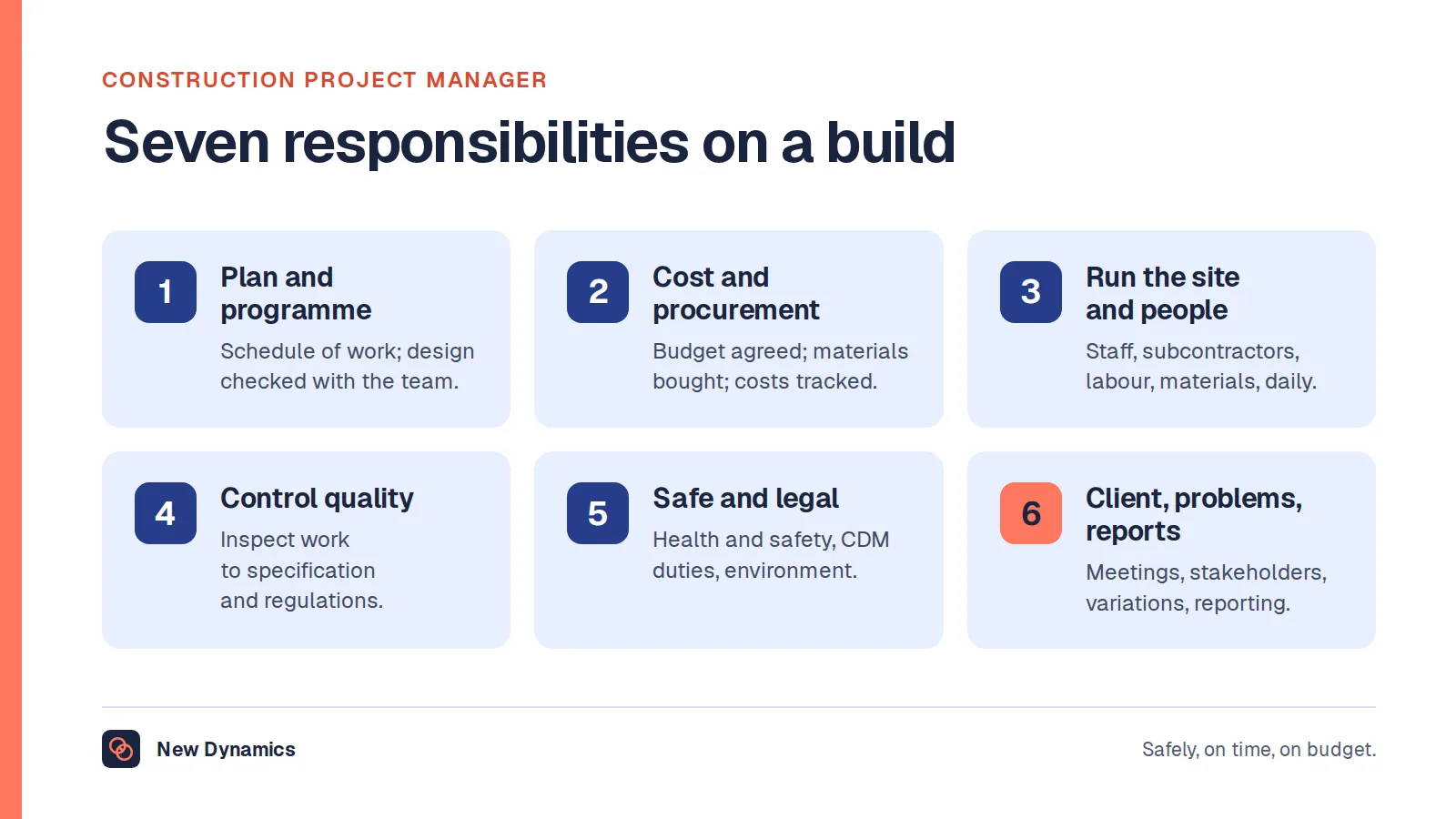
The foreman sits between two roles this site covers already. Above is the site manager or construction manager, accountable for the whole site; our construction project manager job description describes that job. Below are the operatives and trades; our construction worker job description describes theirs, and the National Careers Service names site supervisor as one of the roles a labourer can progress to.
Foreman duties and responsibilities
The National Careers Service lists the site supervisor's day-to-day tasks. In our words, a supervisor could plan site inspections with subcontractors; examine building plans to make sure they meet set standards; manage orders and deliveries of construction materials; organise staff work schedules; visit sites to inspect ongoing work and check safety procedures; monitor progress and check the quality of materials and building work; audit inspection processes; and complete site reports for construction managers.
Grouped for a job description, the construction foreman duties and responsibilities are six.
- Plan and organise the day's work. Break the programme into tasks for the gang and each subcontractor, sequence them, and make sure the materials, plant and access are there when the work starts.
- Supervise the gang and subcontractors. Allocate people, set the standard, watch the work, solve problems on the spot and deal with performance and conduct.
- Control quality. Check work against the drawings and specification, inspect at the hold points, and stop and correct what is wrong before it is covered up.
- Run safety on the ground. Toolbox talks, method statements and risk assessments explained and followed, permits in place, PPE worn, hazards reported, and the authority to stop unsafe work.
- Manage materials and deliveries. Order and call off materials, receive and check deliveries, control waste and keep the site tidy.
- Report progress. Daily records, site diaries, progress against programme and any problems, reported to the site manager.

Foreman, site supervisor, site manager
| Role | Accountable for | Typical scope |
|---|---|---|
| Foreman or site supervisor | The day's work, the gang, quality and safety on the ground | One trade, section or small site |
| Site manager | The site: programme, cost, safety, client and subcontractors | A whole site or a large section |
| Construction or project manager | The project from planning to handover | One or more sites; the client relationship |
On a small job the foreman is the site manager. On a large one there may be several foremen or trade supervisors reporting to section managers. The description should say which.
Skills to ask for
The National Careers Service lists knowledge of building and construction, thoroughness and attention to detail, leadership skills, working well with others, flexibility, the ability to organise time and workload, maths knowledge, and the ability to motivate and manage staff. Two of those deserve emphasis in a foreman description.
- Leadership on the ground. Foremen are promoted for being good at the trade and succeed for being good with the gang: clear instructions, fair allocation, and the ability to have the difficult conversation about late starts, poor work or unsafe behaviour.
- Reading drawings and specifications. Quality control depends on knowing what the drawing says and what the tolerance is.
Add safety leadership, planning, record-keeping and the communication skills to deal with subcontractors, delivery drivers, inspectors and the site manager in one morning.

Routes in, cards and qualifications
The National Careers Service says you can become a site supervisor through a university course, a college course, an apprenticeship, working towards the role or applying directly. The apprenticeships it names are the construction site supervisor and civil engineering senior technician at level 4 and construction site management at level 6, each taking around three years. The route most foremen take is the one it calls work: a site tradesperson or technician becomes a supervisor through on-the-job training. For direct application, it says you will need several years' experience and qualifications in construction, and that awards in building health and safety would be useful.
Two requirements matter for the description. The National Careers Service says you will need a Construction Skills Certification Scheme card or equivalent to train and work on a construction site; a supervisor-level card and a recognised supervisor safety qualification are the norm. And first aid, plant tickets or specialist trade cards may be needed depending on the site.
Working conditions to state
The National Careers Service describes a working environment on site, at a client's business or in an office, outdoors in all weathers, with protective clothing, and typical hours of 40 to 45 a week with evenings and weekends and time away from home possible. Say in the description: the site and its duration, the start time, the working week and overtime, whether the role is working or non-working (does the foreman pick up tools), travel and lodging, and the tickets required on day one.
A foreman job description template
Job title: Foreman / Site Supervisor (state trade or section)
Reports to: Site Manager
Direct reports: Operatives, tradespeople and, on site, the subcontractors' gangs
Purpose: Turn the site programme into safe, well-organised daily work, and make sure the work of the gang and the subcontractors meets the drawings, the specification and the safety standards.
Responsibilities:
- Plan and allocate the day's work to the gang and subcontractors; arrange materials, plant and access.
- Supervise the work, set the standard and deal with performance and conduct on the spot.
- Inspect work against drawings and specification at hold points; stop and correct defects.
- Deliver toolbox talks; ensure method statements, risk assessments, permits and PPE are followed; stop unsafe work.
- Order and call off materials; receive and check deliveries; control waste and site tidiness.
- Keep the site diary and daily records; report progress and problems to the site manager.
- Liaise with subcontractors, suppliers, inspectors and the client's representatives as directed.
- Induct new operatives and support apprentices.
Skills and experience:
- Several years' site experience in the trade or discipline supervised.
- Leadership and the ability to motivate and manage staff.
- Ability to read drawings and specifications; attention to detail.
- Planning, record-keeping and clear communication.
- CSCS card at supervisor level, a recognised supervisor safety qualification and first aid: state which are required on day one and which you will fund.
Working pattern: Site, hours, overtime, working or non-working role, travel and lodging.
Our job description template explains each section.

Frequently asked questions
What does a foreman do?
A foreman, or site supervisor, runs the day's work on a construction site: planning and allocating tasks to the gang and subcontractors, supervising the work, checking quality against the drawings, running safety on the ground, managing materials and deliveries, and reporting progress to the site manager.
What are the duties and responsibilities of a construction foreman?
Six groups: plan and organise the day's work, supervise the gang and subcontractors, control quality, run safety on the ground, manage materials and deliveries, and report progress. The National Careers Service's site supervisor tasks, from planning inspections to completing site reports for construction managers, cover all six.
What is the difference between a foreman and a site manager?
The foreman is accountable for the day's work and the gang on one trade, section or small site. The site manager is accountable for the whole site: programme, cost, safety, client and subcontractors. On a small job one person does both; on a large one several foremen report to section or site managers.
What is a site supervisor?
The usual UK title for a construction foreman. The National Careers Service says site supervisors inspect the work of contractors on building sites and make sure it meets quality and safety standards, and Skills England's level 4 standard describes the occupation as supervising specialist contractors and workers on construction projects.
What qualifications does a foreman need?
Usually several years' experience in the trade, a CSCS card at supervisor level, a recognised supervisor safety qualification and often first aid. In England the construction site supervisor apprenticeship at level 4 is a formal route; many foremen are promoted from the tools with on-the-job training.
What skills does a foreman need?
The National Careers Service lists knowledge of building and construction, attention to detail, leadership, teamwork, flexibility, organising time and workload, maths and the ability to motivate and manage staff. Reading drawings, safety leadership and the confidence to have difficult conversations matter most in practice.
Your next step: describe the section
- Name the trade or section supervised, the size of the gang and the reporting line.
- State whether the role is working or non-working, and the hours and travel.
- List the cards and certificates required on day one and those you will fund.
- Plan the first weeks: the site, the programme, the subcontractors and a named site manager to learn from.
For the regular conversations a foreman has with the gang and the site manager, read and download our one-to-one meeting guide. The guide is free to read, and the PDF uses our short download form.
Want site supervisors' check-ins, goals and records in one place? Book a New Dynamics demo and bring your current job descriptions. You can also email contact@new-dynamics.com.