TL;DR
- There is no general legal right to a cost-of-living rise in the UK. Acas lists three exceptions: a minimum wage increase, moving into the next minimum wage age bracket, and a contract that says so.
- The percentage is not a formula but three choices: which inflation index, over which period, and applied to what base. Changing any one of them changes the answer.
- A cost-of-living adjustment and a merit increase do different jobs. Announcing them as one number is how employers end up rewarding nobody and reassuring nobody.
"Are we getting a cost-of-living rise?" is really three questions: is one owed, how would the number be worked out, and is it the same as a pay rise for doing the job well.
This article answers all three. It covers what a cost of living adjustment is, whether UK law requires one, the choices hidden inside the percentage, and why it should be announced separately from merit pay.
Pay conversations go better when the evidence is already in one place. See how New Dynamics performance reviews bring goals, feedback and development into one fair discussion.
What it is
A cost-of-living adjustment is an increase to pay intended to keep its purchasing power roughly level as prices rise. It is not a reward for performance, and it is not a promotion.
The abbreviation COLA is more formal in the United States, where some pension and benefit payments are adjusted by a published mechanism. In the UK it is an ordinary commercial decision by an employer, with one narrow statutory exception.
Is one required by law?

Mostly no. Acas's guidance on pay rises is direct: "there is no legal requirement for an employer to give a pay rise to an employee unless: they earn the minimum wage and it increases; they earn the minimum wage and move into the next age bracket; their contract states they are entitled to one".
Two of those three are the National Minimum Wage, whose rates change each April. Everyone paid above it has no statutory claim to an annual uplift.
Four ways an obligation can still arise:
- Contractual. Acas says "the employer must pay a contractual pay rise if certain agreed criteria are met", and the entitlement "should be recorded in their written statement of employment particulars".
- Discretionary, but exercised unfairly. Discretionary rises "are not guaranteed each year", but where a contract makes a rise discretionary "the employer should still act fairly when deciding whether to pay it". If some employees will not receive it, "there should be clear reasons for this", and an employer who "does not act in a fair and reasonable way" may face a claim.
- Custom and practice. Where an employer "might have regularly paid their employees a pay rise without a written agreement", employees "might be entitled to a pay rise through 'custom and practice'". Acas advises taking legal advice where this is unclear.
- Collective agreement. Where a trade union is recognised, the employer "must carry out 'collective bargaining'", which "usually includes negotiations about pay". A resulting increase "can cover employees who are not a member of the trade union".
This is general information rather than legal advice.
How to calculate one

There is no formula, only three choices. Make them explicitly, because each one moves the answer.
1. Which index. The ONS publishes several measures of inflation, defined as "the change in prices for goods and services over time". The two most used are CPIH, the Consumer Prices Index including owner occupiers' housing costs, and CPI. They differ: at the August release, CPIH "rose by 3.3% in the 12 months to August 2026" while CPI "rose by 3.1%". Same month, different number, because housing costs are in one and not the other.
2. Which period. A twelve-month rate to a chosen month, an average over a year, or a forecast. Picking the month with the most helpful figure is a real temptation and a visible one.
3. Applied to what base. A percentage of salary, or a flat cash amount for everyone, or a percentage that tapers as salary rises.
Figures change every month, so whichever you choose, name the release you used and the date it covers.
A flat percentage is not neutral
This is the part most pay policies skip. Applying the same percentage to everybody preserves existing differences exactly, in cash terms it widens them, and it does not track the experience of inflation, which falls harder on people whose spending is concentrated in essentials.
The alternatives each have a cost:
- A flat cash amount helps lower-paid staff most and compresses differentials, which can create problems at the boundaries between levels.
- A tapered percentage is fairer to explain but harder to administer, and it moves the shape of your pay structure each time you use it.
- A flat percentage is simplest and preserves your structure, but do not describe it as protecting everyone equally.
Whichever you use, say which one you used and why. Our HR salary post covers reading pay data by percentile rather than by average.
It is not merit pay
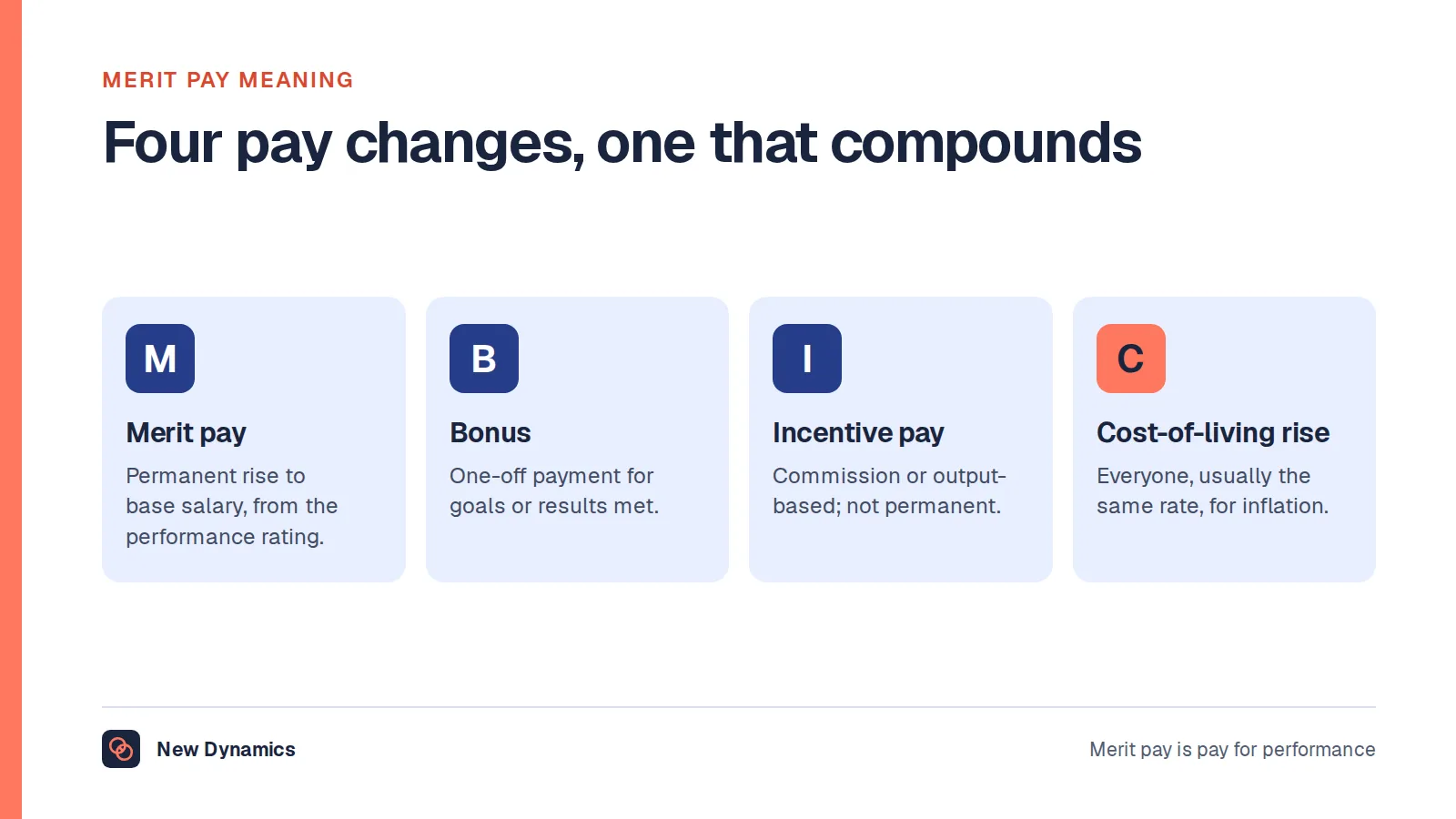
A cost-of-living adjustment answers "has your pay kept up with prices". A merit increase answers "has your contribution changed". They are different questions with different evidence, and combining them into one number means neither gets answered.
The practical failure is familiar: an organisation awards 3% "including performance", the strong performer hears that excellence is worth nothing beyond inflation, and the weak performer hears that it did not matter. Our merit pay post covers the other half properly.
Where budget allows both, announce them as two lines. Where it does not, say which one you are doing and why, rather than blurring them.
What to tell people

- The decision, and the number, at the top rather than after three paragraphs of context.
- The basis: which index, which period, and whether it is a percentage or a flat amount.
- Who is included and who is not, with the reason. Acas expects clear reasons where some employees are excluded.
- What it is not. State plainly whether merit or promotion decisions are separate, and when those happen.
The announcement that causes least damage is the honest one, including in a year when the answer is no increase.
Frequently asked questions
What is a cost of living adjustment?
An increase to pay intended to keep its purchasing power roughly level as prices rise. It is distinct from a merit increase, which reflects performance or a change in the job, and from a promotion.
Are cost of living raises required by law?
Not generally in the UK. Acas states there is no legal requirement to give a pay rise unless someone earns the minimum wage and it increases, they move into the next minimum wage age bracket, or their contract entitles them to one. Custom and practice and collective agreements can also create obligations.
How do you calculate a cost of living increase?
Choose an inflation index, a period and a base. The ONS publishes CPIH and CPI as twelve-month rates each month, and the two differ because CPIH includes owner occupiers' housing costs. Then decide whether to apply a percentage of salary or a flat cash amount.
What percentage is a cost of living increase?
There is no standard figure. It is whatever the employer decides, usually with reference to a published inflation rate for a stated period. Because those rates change every month, any policy should name the release and date it used rather than a fixed number.
Is a cost of living increase the same as a pay rise?
It is one kind of pay rise. Acas describes a pay rise as an increase in the amount of money an employee gets for doing their job, and distinguishes discretionary from contractual rises. A cost-of-living adjustment is usually discretionary unless a contract says otherwise.
Can an employer refuse a cost of living increase?
Yes, unless a contract, custom and practice or a collective agreement creates an entitlement, or the person is at the minimum wage when it rises. Where a rise is discretionary, Acas still expects the employer to act fairly and to give clear reasons where people are excluded.
Should cost of living and merit increases be announced together?
Better separately. They answer different questions (whether pay has kept up with prices, and whether contribution has changed) and merging them into a single percentage tends to satisfy neither the strong performer nor anyone worried about their bills.
Your next step: write down the basis before the number
- Choose the index and the period, and record which release you used.
- Decide percentage or flat amount, and be able to say why.
- List who is excluded and the reason for each.
- Separate the merit decision, with its own timing and evidence.
For setting pay in a way you could explain to the people you set it for, read and download our compensation policy guide. The guide is free to read, and the PDF uses our short download form.
Want pay decisions that rest on a record rather than a recollection? Book a New Dynamics demo and bring your current pay review process. You can also email contact@new-dynamics.com.